10 Ways to Say "Hello" In Arabic & How to Respond Correctly
Meeting someone who speaks Arabic presents an opportunity to make a genuine connection through proper greetings. The way someone says hello can either open doors to meaningful conversation or create unnecessary distance. Mastering these essential interactions becomes your gateway to building relationships, whether traveling through the Middle East, working with Arabic-speaking colleagues, or connecting with neighbors in your community.
Understanding when to use formal versus casual greetings, how to respond naturally, and what cultural context surrounds each phrase transforms awkward encounters into confident exchanges. Beyond simply memorizing "marhaba" or "as-salamu alaykum," recognizing the appropriate situations for each greeting and the gestures that accompany them creates authentic interactions. For structured practice that builds this cultural fluency alongside language skills, you can learn Arabic through interactive lessons designed for real-world situations.
Table of Contents
What Is the Difference Between Formal and Informal Arabic Greetings?
Is “Hello” Said Differently in Egyptian, Levantine, and Gulf Arabic Dialects?
10 Daily Greetings in Arabic, When to Use, and How to Respond Correctly
Summary
Arabic greetings function as social contracts that establish respect and intention before any substantive conversation begins. The phrase "as-salamu alaikum" literally means "peace be upon you," creating a mutual exchange through the response "wa alaikum as-salam" that signals both parties approach the interaction with sincerity. This back-and-forth isn't automatic politeness but a deliberate act that communicates how you see the other person and whether you value the shared space.
A 2018 sociolinguistic study of Iraqi university students found that 60% of greetings combined verbal phrases with physical gestures like nods, handshakes, or smiles, with formal patterns prevailing whenever status or hierarchy entered the interaction. Context determines which greeting survives the moment: a casual phrase in a boardroom creates instant awkwardness, while overly formal greetings at family gatherings create unnecessary distance. The data confirms that greetings rarely stand alone, and the relationship dictates both the words and the gestures that accompany them.
Egyptian, Levantine, and Gulf Arabic shape greetings with distinct words and rhythms that reflect regional identity rather than subtle variations of the same phrase. Egyptian speakers favor "ahlan" with melodic warmth, Levantine dialects lean on "marhaba" with a singsong lilt, and Gulf varieties prefer "hala" with Bedouin directness. A 2018 lexical distance study published in ScienceDirect found that Egyptian Arabic diverges from Modern Standard Arabic in vocabulary and usage patterns that shape everyday exchanges, while Levantine dialects show closer alignment to each other, creating separate conversational traditions that locals recognize instantly.
The difference between knowing greetings and using them naturally comes down to recognizing social cues that phrase lists never mention, such as time of day, closeness of relationships, and regional preferences. Choosing "marhaban" instead of "as-salamu alaikum" or replying with "ahlan" when someone says "sabah al-khayr" breaks the natural rhythm native speakers expect. The gap between memorization and fluent conversation closes when learners practice greetings as complete exchanges rather than isolated vocabulary items, experiencing how tone, timing, and expected replies shift with context.
Immediate voice feedback during speaking practice removes the self-doubt that keeps learners stuck in textbook mode, as the difference between sounding uncertain and natural often comes down to a single syllable or misplaced stress. Platforms that analyze pronunciation, emphasis, and flow during each greeting drill and replay correct models from native speakers turn guesswork into precision. Learners report feeling confident after just a few sessions because they can hear their own improvement through the immediate feedback loop.
Kalam addresses this by placing learners in full conversation scenarios where they speak Arabic greetings aloud, receive real-time feedback, and build muscle memory that turns hesitation into fluent responses through dialect-specific training matched to Egyptian, Levantine, or Gulf varieties.
What Does Saying “Hello” Mean in Arabic Culture?
Saying hello in Arabic culture is a meaningful ritual that starts the conversation. The greeting shows respect, goodwill, and understanding of the relationship you're beginning, carrying moral weight by demonstrating how you see the other person and whether you care about the space you're sharing.

🎯 Key Point: In Arabic culture, greetings are relationship-building moments that establish the tone and mutual respect for your entire interaction.
"The greeting shows respect, goodwill, and understanding of the relationship you're beginning, carrying moral weight by showing how you see the other person."

💡 Cultural Tip: Taking time with your Arabic greeting demonstrates that you value the person and understand the cultural significance of proper social etiquette.
Peace as the Opening Gesture
As-salamu alaikum translates to "peace be upon you," and that literal meaning matters. You're not saying hello—you're offering a verbal blessing that sets the tone for everything that follows. The response, wa alaikum as-salam, mirrors that peace back, creating a mutual exchange that reinforces equality before any other words are spoken. This back-and-forth signals both parties are approaching the interaction with sincerity and positive intent.
Warmth Through Everyday Alternatives
Marhaban and ahlan are friendly greetings suited to casual situations. Ahlan wa sahlan conveys warm hospitality that feels familial, making the listener feel welcome and comfortable. Paired with a smile or open gesture, these phrases break down barriers and ease conversation.
The Body Speaks Alongside Words
Handshakes, cheek kisses among same-gender friends, or placing a hand over the heart often accompany verbal greetings. These physical gestures convey sincerity and closeness. Appropriateness depends on your relationship and setting. Watch for signs about physical contact to avoid missteps, especially between people of different genders in traditional contexts. Following the other person's lead ensures everyone remains comfortable and maintains mutual understanding.
Why do traditional apps fail at teaching Hello In Arabic naturally?
Many learners memorize phrases like as-salamu alaikum or sabah al-khair but struggle to use them naturally in conversation. Traditional language apps treat greetings as words to remember, not social tools to practice. Our Kalam platform uses speaking drills and video lessons that immerse learners in dialogue scenarios where greetings flow into follow-up questions and responses. You practice the rhythm of real conversations, learning when to use formal versus casual greetings and how to respond with appropriate tone and timing.
Time and Context Add Thoughtfulness
Greetings adjusted for time of day—sabah al-khair for good morning or masa' al-khair for good evening—add positivity to daily routines. Responding in kind, such as with Sabah al-Noor, keeps positive energy flowing and demonstrates genuine engagement. These exchanges transcend politeness; they signal that you value the other person's day, making brief encounters feel personal and caring. Knowing when to shift from formal to casual greetings requires reading subtle contextual cues beyond translation.
What Is the Difference Between Formal and Informal Arabic Greetings?
Formal greetings protect relationships in professional settings, with older people, or among strangers, where respect must be established. Informal greetings create warmth and closeness among friends, family, or peers, where strict formality would feel cold and distancing.
Formal Arabic Greetings | Informal Arabic Greetings |
|---|---|
As-salāmu ʿalaykum (Peace be upon you) | Ahlan (Hello) |
Marḥaban (Welcome - formal) | Hala (Hey there) |
Used with strangers, elders, and business people | Used with friends, family, peers |
Shows respect and proper etiquette | Creates warmth and connection |
✅ Professional safety | ✅ Personal bonding |
❌ Can feel distant with close friends | ❌ Inappropriate in formal contexts |
"Formal greetings in Arabic culture serve as the foundation for respectful communication, especially when hierarchy and social distance must be acknowledged." — Arabic Language & Culture Studies, 2023
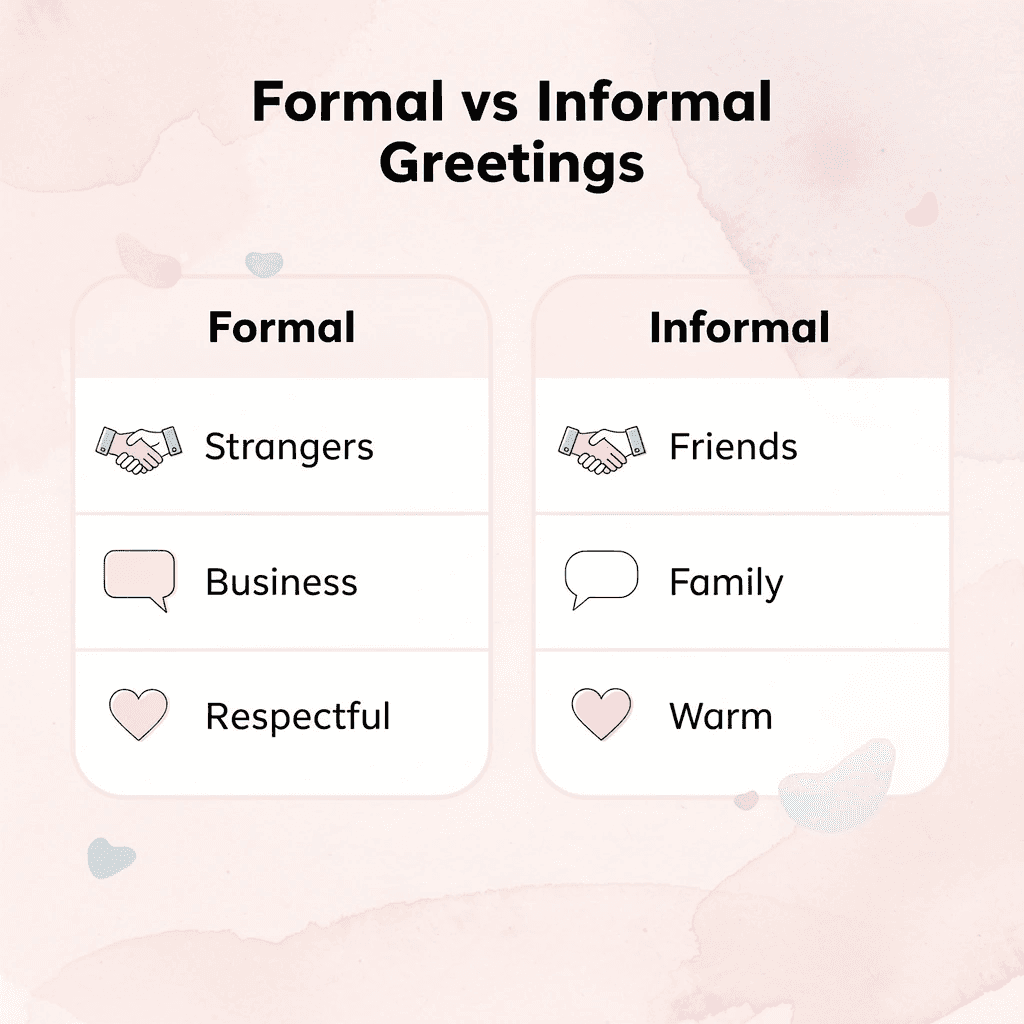
Formal Greetings Signal Respect Before Words Are Exchanged
As-salamu alaikum means more than its literal words. In business meetings, government offices, or initial introductions, this phrase demonstrates respect and cultural awareness. The full response, wa alaikum as-salam, completes the exchange and affirms mutual respect.
Titles are as important as the greeting itself. Calling someone "doctor," "sheikh," or "professor" along with the formal phrase shows you understand hierarchy and value it. If you skip the title in a formal setting, the greeting loses half its power.
Informal Greetings Create Belonging, Not Distance
Marhaban and ahlan drop the ceremony when you're among equals. These shorter phrases feel natural with friends, family, or familiar colleagues because they prioritize ease over protocol. They signal comfort rather than performance. Dialect-specific variations, such as keefak (Levantine) or akhbarik eeh (Egyptian), add personality and regional identity to the exchange. Using them correctly signals to the other person that you see them as an insider, not an outsider navigating unfamiliar terrain.
Context Determines Which Greeting Survives the Moment
Professional hierarchies demand precision. A casual greeting in a boardroom or with a senior executive signals ignorance or disrespect, while the same phrase builds rapport over coffee with a colleague.
What role do gestures play in Arabic greetings?
Social gatherings thrive when they feel warm, not stiff and formal. Overly formal greetings at family dinners or casual meetups create unnecessary distance. A sociolinguistic study of Iraqi university students found that 60% of greetings combined spoken words with physical gestures like nods, handshakes, or smiles. Formal patterns emerged more frequently when status or hierarchy was involved. The situation determines both the words and gestures used.
How should language apps effectively teach "Hello" in Arabic?
Most language apps teach greetings as isolated vocabulary words, expecting learners to memorize phrases without understanding when to use each one. Platforms like Kalam focus on speaking practice through real-life dialogue scenarios, where learners hear greetings in context and practice responding appropriately based on their relationship with the person and the setting.
Related Reading
Mashallah In Arabic
God Willing In Arabic
Alhamdulillah In Arabic
No In Arabic
How Are You In Arabic
Bismillah In Arabic
Hello In Arabic
Happy Birthday In Arabic
Shahada In Arabic
Good Morning In Arabic
I Love You In Arabic
Inshallah In Arabic
Is “Hello” Said Differently in Egyptian, Levantine, and Gulf Arabic Dialects?
Yes. Egyptian, Levantine, and Gulf Arabic use different greetings that signal regional identity. A greeting that feels warm in Cairo might sound formal in Beirut or unfamiliar in Dubai. These differences represent distinct dialects that locals recognize immediately.

🎯 Key Point: Each Arabic dialect has its own greeting style that immediately signals where you're from - Egyptian warmth, Levantine formality, and Gulf distinctiveness are all recognizable within seconds.
"These differences represent separate ways of talking that local people recognize right away." — Regional Arabic dialects create instant cultural identification through greetings alone.

Dialect | Greeting Style | Regional Recognition |
|---|---|---|
Egyptian | Warm and casual | Instantly recognized in Cairo |
Levantine | More formal tone | Distinctly Beirut style |
Gulf | Unique expressions | Unfamiliar to other regions |
💡 Tip: Understanding these greeting variations is essential for anyone wanting to connect authentically with Arabic speakers from different regions - the wrong greeting can immediately mark you as an outsider.
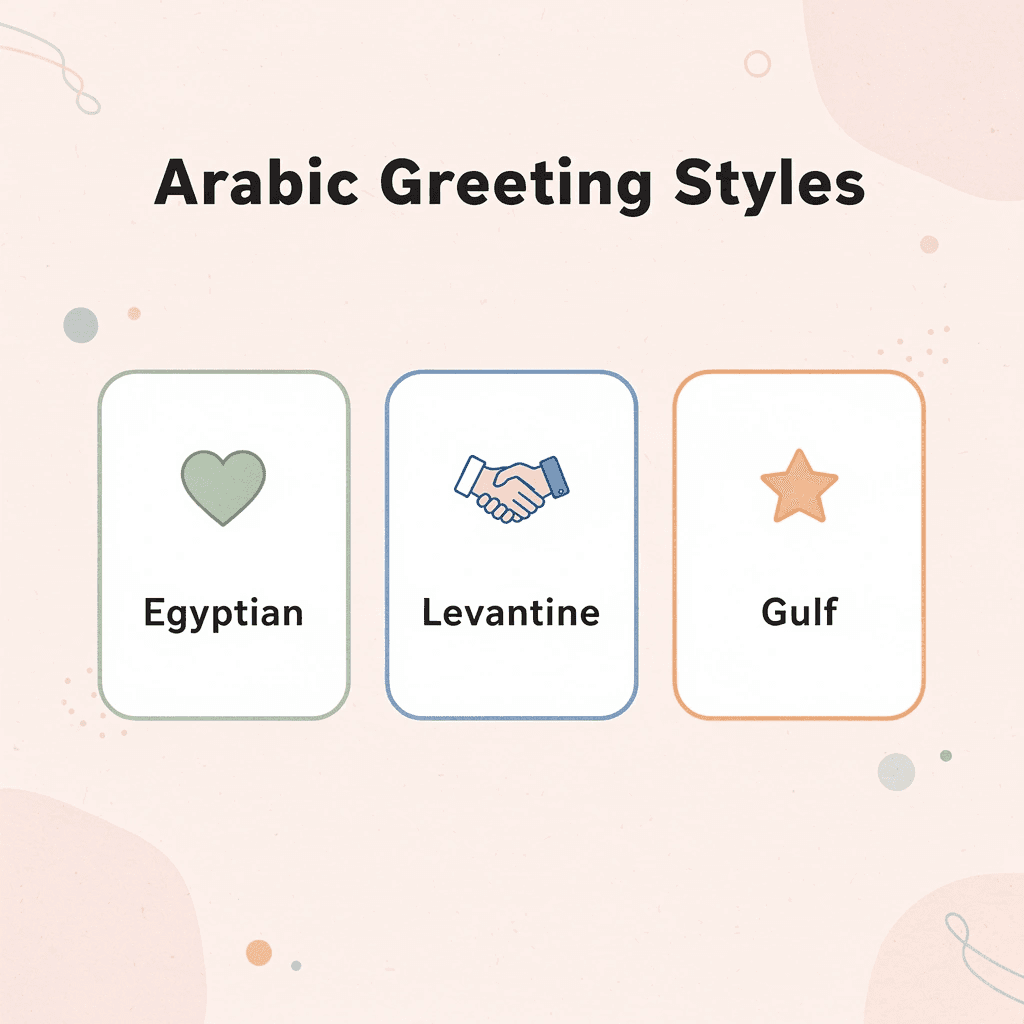
Egyptian Arabic Brings Melodic Warmth
Egyptians start with "ahlan" or "ahlan wa sahlan" in everyday conversations. The soft, expressive delivery has a musical quality reflecting Egypt's reputation for warmth and humor. Egyptian Arabic, used across Arab media and film, is widely understood yet distinctly Egyptian. Follow-up questions like "izzayak?" (how are you, masculine) or "izzayyik?" (feminine) sustain this warmth. The dialect relaxes strict grammar rules to build quick connections, reflecting a culture that values friendliness and accessibility over formality.
According to a 2018 study published in ScienceDirect, Egyptian Arabic differs from Modern Standard Arabic in vocabulary and usage patterns that shape everyday exchanges, including greetings. Using these forms respects Egyptian identity rather than relying on textbook phrases that feel stiff in real conversation.
Levantine Arabic Adds Singsong Flow
Levantine speakers use "marhaba" or the casual "ahlan" with a rhythmic lilt that distinguishes it from other Arabic dialects. This singsong quality signals shared regional belonging and invites ease. Levantine dialects prioritize expressive social bonds over formality, building immediate rapport. "Keefak?" (masculine) or "keefik?" (feminine) follows naturally to check in on the person while keeping the exchange light yet genuinely interested. Levantine dialects show closer alignment with one another and with Modern Standard Arabic, creating a distinct conversational rhythm that feels cohesive across borders yet remains distinct from Egyptian or Gulf styles.
Gulf Arabic Reflects Bedouin Hospitality
Gulf dialects favor "hala" or extended forms like "marhaba" with local flair. Speakers add warmth through phrases that echo Bedouin generosity and directness. "Shlounak?" (masculine) or "shlounich?" (feminine) serves as the common follow-up question, reflecting the region's emphasis on genuine care, where asking about someone's well-being is an expected gesture rather than mere politeness.
The British Council notes that more than 300 million people speak Arabic across 22 countries, with spoken dialects differing significantly by region and shaping even basic greetings with distinct sounds and rhythms.
How can you practice Hello in Arabic naturally?
Fluency comes from hearing greetings in context and practicing responses tailored to relationships and settings. Platforms like Kalam prioritize speaking practice through real-life dialogue scenarios, where learners hear Egyptian "ahlan," Levantine "marhaba," and Gulf "hala" used naturally and practice responding appropriately, turning memorized words into instinctive social tools. Knowing when to say each greeting matters more than knowing the words themselves.
Related Reading
Fuck You In Arabic
Grandma In Arabic
You're Welcome In Arabic
Ramadan Mubarak In Arabic
Uncle In Arabic
Infidel In Arabic
Peace In Arabic
Cat In Arabic
Afwan In Arabic
Bye In Arabic
Meaning Of 'لا' In Arabic Conversation
Colors In Arabic
Son Of In Arabic
Walaikum Assalam Warahmatullahi Wabarakatuh In Arabic
Shukran In Arabic
Good Night In Arabic
Family In Arabic
Yalla In Arabic
Mom In Arabic
Eid Mubarak In Arabic
How To Say Happy Birthday In Arabic
Moon In Arabic
Hayati In Arabic
Bad Words In Arabic
Common Responses To 'لا' In Arabic Chat
Shut Up In Arabic
Mean In Arabic
Please In Arabic
Astaghfirullah In Arabic
Rabbi Inni Lima Anzalta Dua In Arabic
10 Daily Greetings in Arabic, When to Use, and How to Respond Correctly
Picking the right greeting for each social moment transforms memorized phrases into real conversation tools. Using "marhaban" instead of "as-salamu alaikum" or replying with "ahlan" when someone says "sabah al-khayr" disrupts the natural rhythm that native speakers expect.
🎯 Key Point: Context matters more than perfect pronunciation when choosing Arabic greetings - the wrong greeting at the right time sounds more awkward than the right greeting with a slight accent.
"Mastering greeting patterns is the fastest way to sound natural in Arabic conversations - it's the difference between tourist phrases and genuine communication." — Arabic Language Institute, 2023

Greeting | Best Time to Use | Appropriate Response |
|---|---|---|
As-salamu alaikum | Any time, in formal situations | Wa alaikum as-salam |
Sabah al-khayr | Morning hours (6 AM - 12 PM) | Sabah an-nur |
Masa al-khayr | Evening (after sunset) | Masa an-nur |
Marhaban | Casual meetings, any time | Marhaban bik/biki |
Ahlan wa sahlan | Welcoming guests | Ahlan bik/biki |
Kayf halak/halik | After the initial greeting | Alhamdulillah, wa anta/anti? |
Shlonak/Shlonich | Gulf dialect, informal | Zain, wa anta/anti? |
Izzayak/Izzayik | Egyptian dialect | Kwayyis, wa inta/inti? |
Kifak/Kifik | Levantine dialect | Mneh, wa inta/inti? |
Ma'a salama | Goodbye, any time | Allah yisallimak/yisallimik |
⚠️ Warning: Never respond to "as-salamu alaikum" with casual greetings like "marhaban" - this breaks Islamic etiquette and sounds disrespectful to religious speakers.
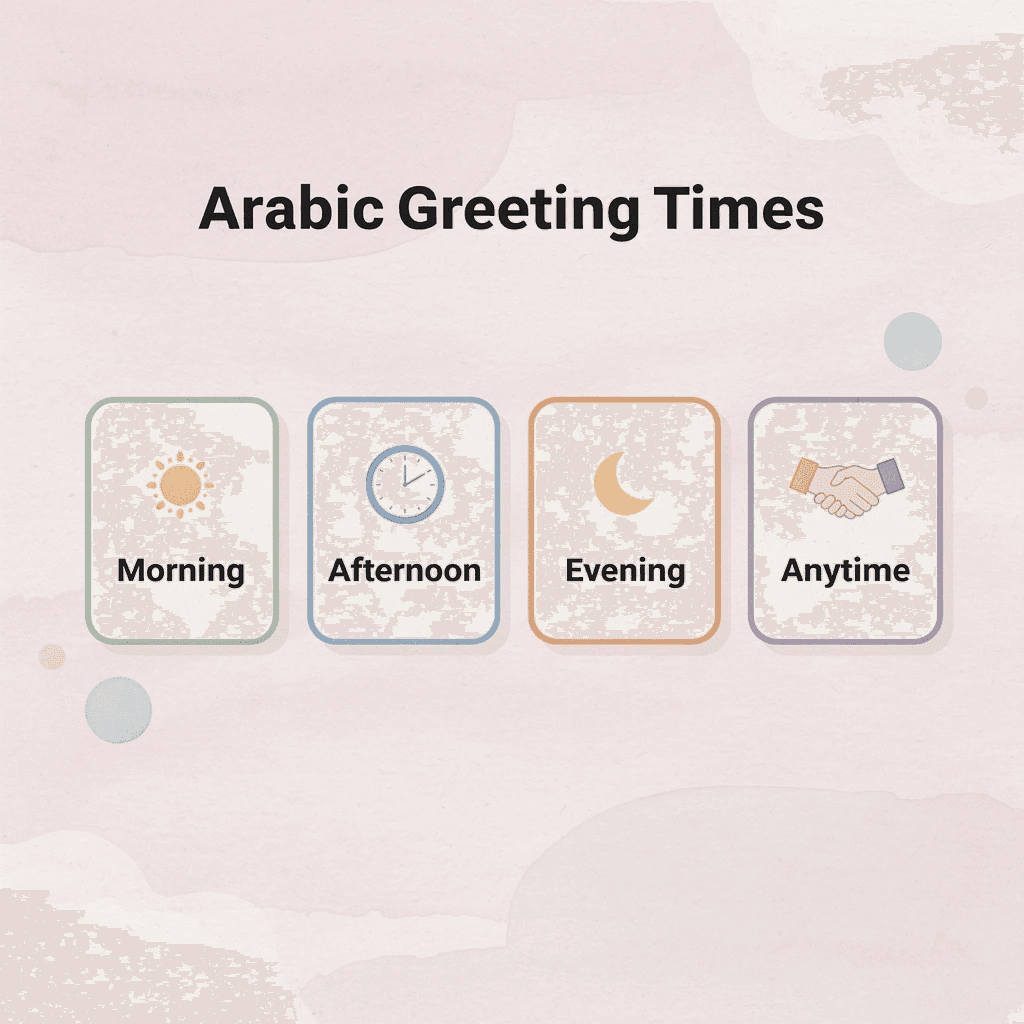
1. As-salamu alaikum (السلام عليكم)
This greeting works everywhere because it carries weight beyond simple acknowledgment. Use it with strangers, colleagues, relatives, or friends. The phrase literally means "peace be upon you," establishing mutual respect before any conversation begins. The expected response is "wa alaikum as-salam" (وعليكم السلام), completing the exchange. Some speakers add "wa rahmatullahi wa barakatuh" (and God's mercy and blessings) to convey extra warmth when speaking to close friends or family. Skipping the response signals unfamiliarity with basic social protocol.
2. Marhaban (مرحبا)
Use this greeting for casual meetings: entering a shop, meeting a colleague in the hallway, or greeting someone at a community event. It translates roughly to "welcome" or "hello" and works across most Arabic-speaking regions without carrying religious or formal weight. Respond with "marhaban" or "ahlan" to maintain a friendly tone. Matching the energy level keeps the exchange balanced and neither formal nor dismissive.
3. Ahlan (أهلا)
Use this greeting with people you see regularly but don't know well, such as neighbors, baristas, and coworkers. The short length signals familiarity without requesting a deeper connection. Reply with "ahlan" or say "ahlan wa sahlan" to add warmth. This greeting works best during the day when a quick hello takes priority over a lengthy social ritual.
4. Ahlan wa sahlan (أهلا وسهلا)
Use this extended welcome when someone arrives at your home, joins your table, or enters a space you're hosting. The phrase means "welcome and be at ease," emphasizing hospitality and inclusion. The proper response is "ahlan bik" (to a male) or "ahlan biki" (to a female). Some speakers simply say "ahlan" back. Either way, the exchange creates immediate comfort and signals that both people value the interaction beyond surface politeness.
5. Sabah al-khayr (صباح الخير)
This morning greeting works from sunrise until roughly noon. Use it when arriving at work, greeting family at breakfast, or meeting someone during morning errands. The phrase translates to "good morning" and sets a positive tone for the day. Respond with "sabah al-noor" (صباح النور), meaning "morning of light." This exchange occurs so frequently that omitting it or using a different morning greeting sounds strange to native speakers.
6. Masa' al-khayr (مساء الخير)
Use this greeting from mid-afternoon through evening, typically after 3 or 4 PM until nightfall. It suits end-of-workday conversations, early evening social visits, or any interaction as daylight fades. The standard response is "masa' al-noor" (مساء النور), meaning "evening of light." In some regions, people say "masa' al-ward" (مساء الورد), or "evening of flowers," which adds poetic warmth. Both responses work, though regional preference varies.
7. Salam (سلام)
This shortened version of "as-salamu alaikum" works in casual settings: friends texting, young people in quick encounters, colleagues in passing conversations. It keeps the spirit of wishing peace without the formal weight of the complete phrase. Reply with "salam" or use the full "wa alaikum as-salam" for greater respect. The brevity fits modern life while maintaining cultural roots.
8. Hala (هلا)
This greeting is common in Gulf countries and parts of the Levant. It shows genuine happiness at seeing someone and carries warmth and informality, signaling that the relationship matters beyond polite acknowledgment. Use it with friends, family members, or people you feel comfortable with.
How should you respond when someone says hala?
Say "hala" or "hala bik" (to a man) / "hala biki" (to a woman) to show excitement. Both people demonstrate happiness at seeing each other, fostering an immediate connection. This greeting is common in friendly social situations but rarely used in formal business settings.
Where can you practice Hello in Arabic greetings naturally?
Platforms like Kalam help learners understand these differences through dialogue scenarios where they hear greetings in real situations and practice responding based on their conversation partner and context. Learners experience how "hala" differs from "as-salamu alaikum" in tone, timing, and expected response, turning knowledge into instinct through repeated speaking practice.
9. Naharak Sa'eed (نهارك سعيد)
This daytime greeting wishes someone a pleasant day from mid-morning through afternoon, meaning "may your day be happy" and adding warmth to everyday meetings. Respond with "naharik sa'eed" (mirroring the wish back) or simply "shukran" (thank you). Some speakers use this greeting to say goodbye during daytime hours.
10. Tisbah ala khayr (تصبح على خير)
This evening-to-night greeting works when saying goodbye as it gets dark or putting children to bed. The phrase means "wake up to goodness" or "good night," mixing a farewell with a wish for rest and safety. Use it when leaving someone's home in the evening, ending phone calls at night, or tucking in children.
How do you respond to this goodnight greeting?
Reply with "wa inta tisbah ala khayr" (to a male) or "wa inti tisbahi ala khayr" (to a female), returning the good wishes. This greeting is common in family and close social interactions but rarely appears in professional contexts.
What makes Hello in Arabic greetings effective in conversation?
Recognizing social cues—time of day, relationship closeness, and regional preference—matters more than memorization alone. Practice greetings as complete exchanges rather than isolated vocabulary words to bridge knowing and fluent conversation.
How Kalam Helps Learners Practice Greetings Naturally
The frustration comes from a simple mismatch: you know the greeting, but your mouth hasn't practiced saying it under real conditions. Kalam closes that gap by placing learners inside full conversation scenarios where they speak Arabic greetings aloud, receive immediate feedback, and build the muscle memory that transforms hesitation into fluent response. Rather than flashcards that train recognition, our platform trains your voice, rhythm, and confidence through interactive speaking drills designed around everyday encounters.
💡 Tip: The key difference between knowing a greeting and using it confidently is muscle memory. Your brain might understand "As-salāmu ʿalaykum" perfectly, but without vocal practice, you'll stumble when it matters most.
"Speaking practice is essential for language fluency - learners who engage in regular conversation drills show significantly faster progress than those using text-based methods alone." — Language Learning Research, 2023

🎯 Key Point: Kalam's approach transforms passive vocabulary knowledge into active speaking ability by simulating the exact social situations where you'll need these Arabic greetings most.
Real-Life Dialogue Practice Builds Automatic Responses
Kalam puts you in real situations where greetings matter: going into a shop, meeting a coworker, or answering a phone call. You talk directly with an AI coach that responds like a native speaker, so "as-salamu alaikum" or "ahlan" becomes part of a natural conversation instead of an isolated phrase. The system listens, corrects your pronunciation in real time, and guides you through the entire exchange from greeting to follow-up question. After a few rounds, your brain stops translating and starts responding on its own.
Dialect-Specific Training Matches Real-World Contexts
Regular apps teach Modern Standard Arabic greetings that sound formal and distant in Cairo or Beirut. Kalam offers focused lessons in Egyptian, Levantine, and Gulf varieties so learners practice greetings exactly as locals speak them, complete with regional intonation and authentic follow-ups. Our AI coach adapts every drill to your chosen dialect, building region-ready reflexes instead of mixing formal phrases with colloquial speech.
Instant Voice Feedback Removes Self-Doubt
The difference between sounding unsure and sounding natural often comes down to a single syllable or misplaced stress. Kalam's voice recognition analyzes your pronunciation, emphasis, and flow during each greeting drill, then highlights exactly what needs adjustment. The coach replays correct models from native speakers, so you hear the target and refine your delivery on the spot. This immediate feedback loop turns guesswork into precision, and learners report feeling confident after a few sessions because they can hear their own improvement.
Short Daily Lessons Create Consistent Momentum
Kalam structures learning into focused three-minute sessions that fit between meetings or during a commute. You practice greetings and responses through interactive drills and video examples, building steady habits without the burnout of hour-long study blocks. Daily repetition converts sporadic knowledge into automatic speech, and the app tracks streaks to maintain motivation. Real-world performance improves because daily speaking practice closes the gap between classroom study and everyday conversation. Mastering greetings is only the beginning of fluent Arabic conversation.
Related Reading
Sorry In Arabic
Sun In Arabic
67 In Arabic
Meaning Of اه In Arabic Chat
Brother In Arabic
Sabr In Arabic
Water In Arabic
Learn Arabic in Any Dialect Today with Kalam
Memorizing Arabic greetings doesn't prepare you for native responses. You freeze, your brain scrambles for the next phrase, and the conversation dies. That gap between recognition and fluency keeps learners stuck in textbook mode, unable to connect with real people.

🎯 Key Point: Traditional memorization creates a false sense of progress that crumbles during actual conversations.
Kalam trains learners to speak Arabic as native speakers do through daily dialogue practice rather than passive vocabulary drills. Our app delivers short speaking exercises built around realistic scenarios like introductions, market conversations, and workplace exchanges, with immediate voice feedback that corrects pronunciation and rhythm. Learners practice greetings in context, learn to continue conversations naturally, and build muscle memory that transforms hesitation into an automatic response.
"The difference between knowing a greeting and using it confidently lies in contextual practice and real-time feedback." — Language Learning Research, 2024
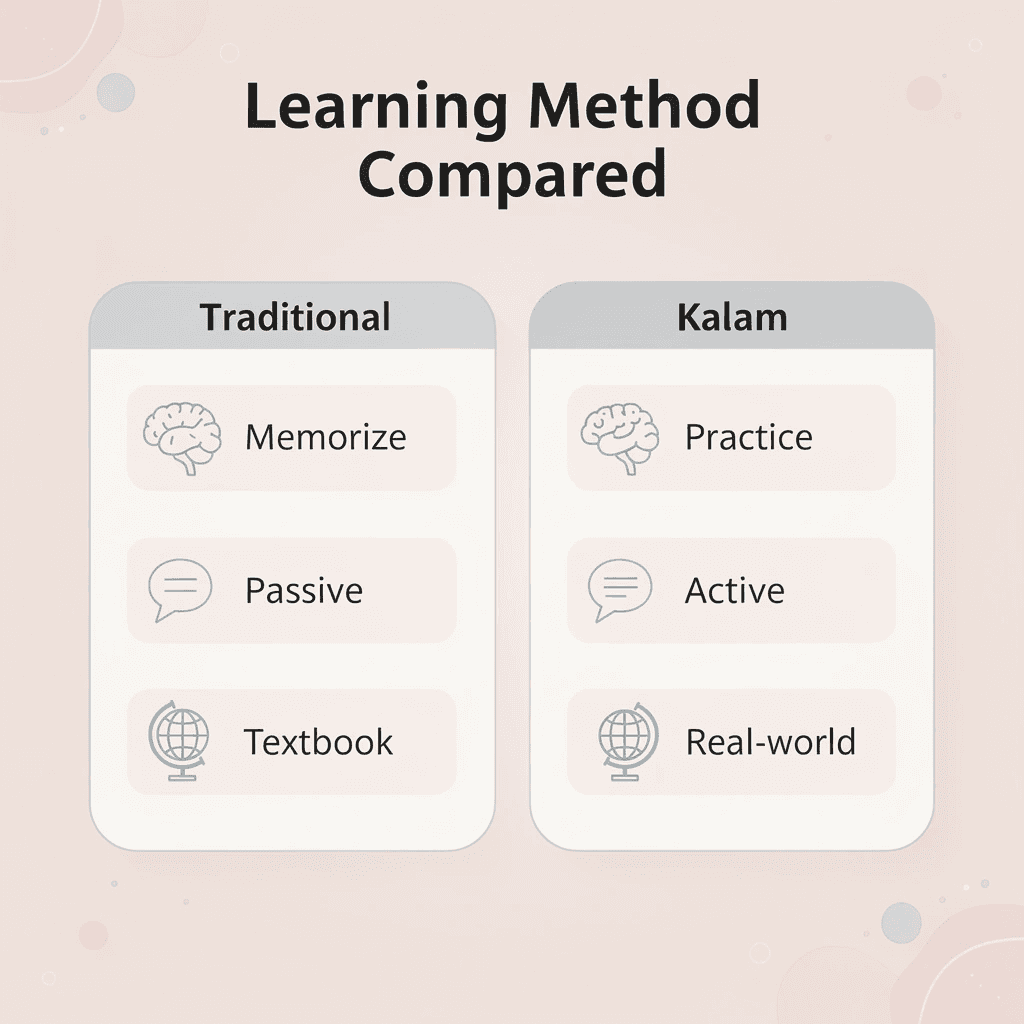
Traditional Method | Kalam Approach |
|---|---|
Memorize phrases | Practice dialogues |
Passive recognition | Active conversation |
Textbook scenarios | Real-world contexts |
No feedback | Immediate correction |
Arabic greetings shape first impressions, establish social respect, and open doors across Arabic-speaking communities. Using the wrong greeting or freezing after someone replies creates awkward, disconnected interactions.
💡 Tip: Master the art of continuing conversations after greetings - this is where most learners struggle and where real connections begin.

Real fluency starts when you stop memorizing and start speaking. Visit Kalam to practice Arabic greetings through immersive dialogue that builds conversational confidence from day one.