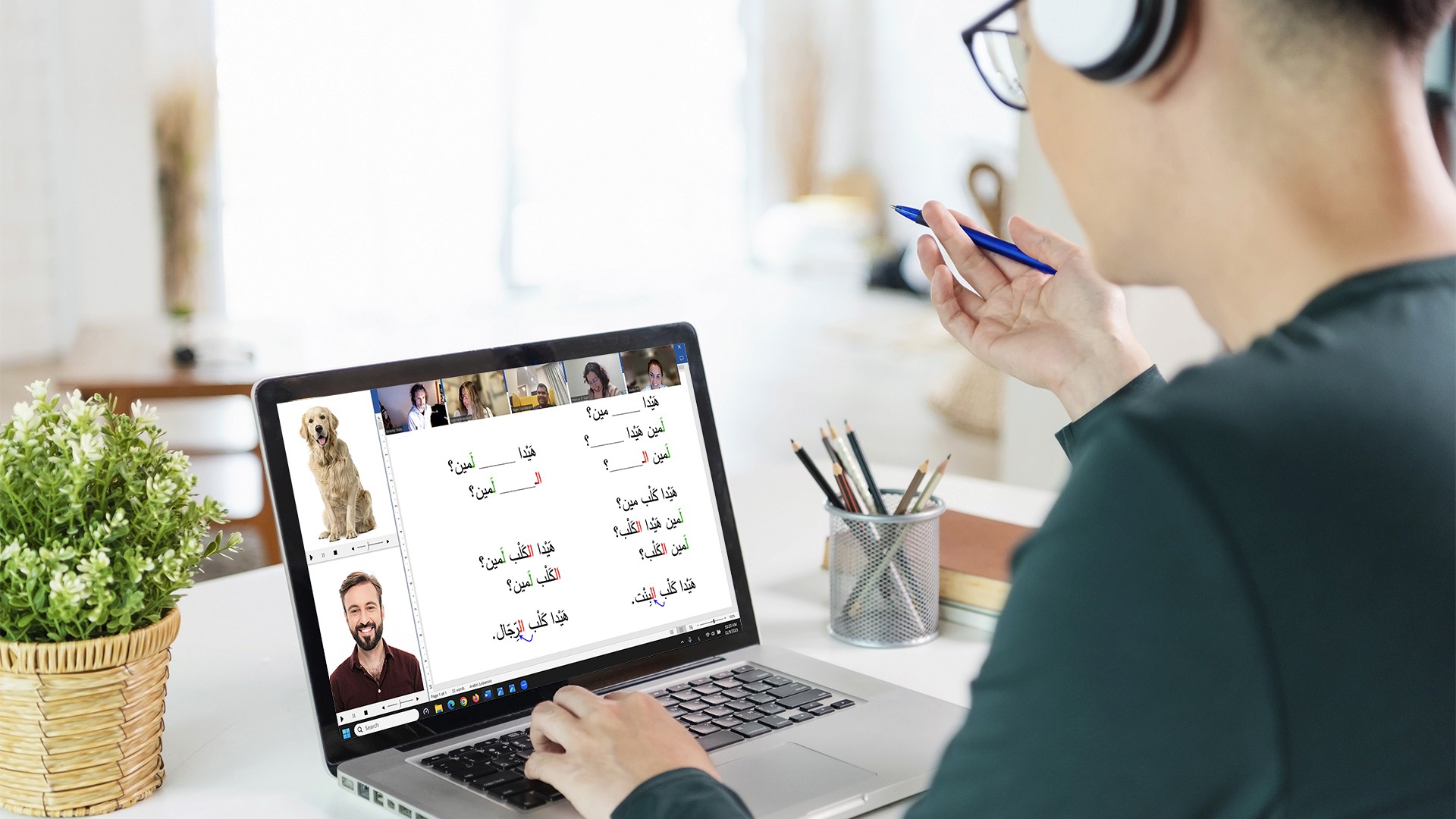
How to Speak Arabic Fluently: A Step-by-Step Guide
Most Arabic courses teach Modern Standard Arabic, but this formal version won't prepare learners for everyday conversations in Cairo, Beirut, or Riyadh. Arabic dialects vary so dramatically that speakers from Morocco and Iraq often struggle to understand each other's casual speech. Building genuine speaking skills requires choosing a dialect that matches specific goals and mastering pronunciation patterns that distinguish fluent speakers from beginners.
Real fluency develops through structured practice with native speakers rather than memorizing grammar rules in isolation. Learners need listening skills and confidence in speaking for real interactions, whether preparing for travel, connecting with family, or advancing careers in Arabic-speaking regions. Kalam provides the conversation practice necessary to learn Arabic through real interactions that adapt to individual skill levels.
Table of Contents
Summary
Arabic belongs to the Semitic branch of the Afro-Asiatic language family, placing it alongside Hebrew and Aramaic as descendants of a common ancestral tongue. The language uses a three-consonant root system, with most words built from a core set of letters that carry a base meaning, with vowel patterns and affixes creating variations. This pattern repeats across thousands of roots, creating a web of related vocabulary that rewards learners who grasp the underlying logic rather than memorizing words in isolation.
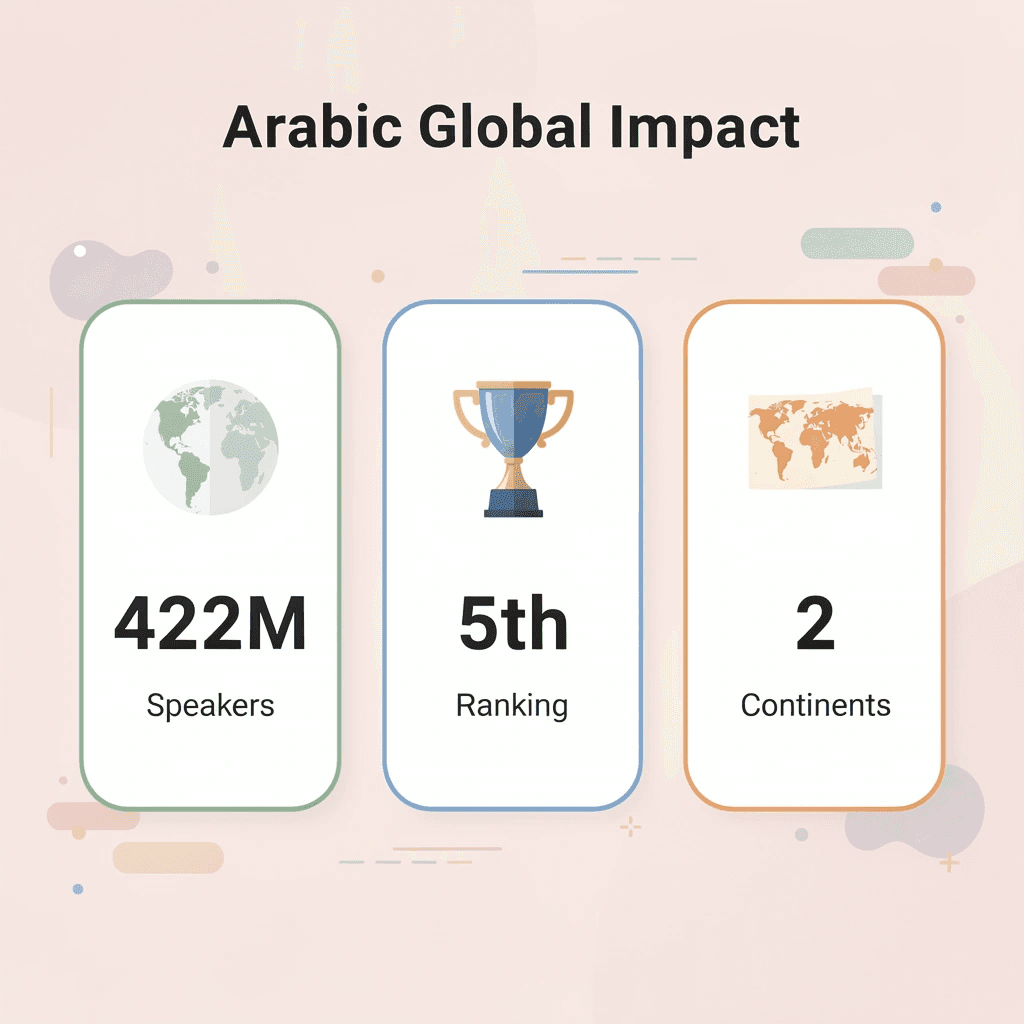
Speaking Arabic connects you to over 420 million native speakers across 26 countries and serves as the 5th most spoken language globally. Western job markets treat Arabic proficiency as a rare asset, often rewarding candidates with faster promotions, higher salaries, and access to niche positions that competitors can't fill. The language shortage creates opportunity in sectors where cultural fluency matters as much as technical skill.
Maghrebi Arabic, spoken across Morocco, Algeria, and Tunisia, consistently ranks as the most challenging dialect for learners because of rapid phonetic shifts, heavy borrowing from Berber, French, and Spanish, and pronunciation patterns that diverge sharply from both Modern Standard Arabic and Eastern dialects. Native speakers from Syria, Jordan, or Iraq often report needing weeks of exposure before they can comfortably follow Maghrebi conversations, while North Africans understand Eastern dialects more easily thanks to widespread Egyptian media.
Egyptian Arabic dominates Arab media thanks to Cairo's film and television industry, which spent decades exporting dramas, comedies, and music across the region. Over 420 million speakers recognize Egyptian phrases even if they use different dialects at home, making it the closest thing to a pan-Arab colloquial standard. That widespread familiarity means Egyptian speakers get understood from Morocco to Iraq, while learners gain access to decades of movies, YouTube channels, podcasts, and social media content that make daily practice effortless.
Most learners delay speaking until vocabulary feels sufficient, but that hesitation creates a silent gap that slows progress. Those who push through by speaking early report that fluency transforms the language from an obligation into something deeply desired and emotionally fulfilling. Research consistently links the constant mental juggling between formal Modern Standard Arabic and regional dialects to delayed cognitive decline and enhanced executive function, making Arabic a workout for long-term mental health.
Kalam addresses this by making speaking practice the foundation rather than an afterthought, using interactive drills and video lessons focused on real-life conversations that help users practice pronunciation with clear audio models and repeat patterns until responses feel automatic.
What is Arabic, and What Language Family Does It Belong To?
Arabic is used by hundreds of millions of people for everyday communication and holds deep religious and cultural importance across the Middle East and North Africa. It features a standardized literary form for formal settings and many spoken dialects for daily life. The language belongs to an ancient linguistic family known for its unique sound system and word-building methods.

🎯 Key Point: Arabic serves dual purposes as both a living spoken language with regional variations and a unifying literary standard that connects diverse Arabic-speaking communities across continents.
"Arabic is spoken by over 422 million people worldwide, making it the 5th most spoken language globally and a crucial bridge between ancient traditions and modern communication." — Ethnologue, 2023
💡 Language Family Insight: Arabic belongs to the Semitic language family, which also includes Hebrew, Aramaic, and Amharic - languages that share distinctive features like root-based word formation and consonantal writing systems.
Defining Arabic and Its Common Names
Arabic, known to its speakers as al-Arabiyyah, is a collection of related varieties rather than a single uniform language. Regional spoken forms vary widely by country or city, but all derive from the same core system used for centuries in poetry and religious texts.
How does Modern Standard Arabic differ from spoken dialects?
The formal version, called Modern Standard Arabic or Fusha in its classical roots, is used for writing and serves as the official standard taught in schools and used in media, government, and literature. This literary form remains closely connected to ancient texts, enabling mutual understanding across regions even when spoken dialects differ enough to impede mutual comprehension.
Arabic's Position in the Language Family
Arabic belongs to the Afro-Asiatic language family's Semitic branch, alongside Hebrew and Aramaic. These languages share ancient roots from a common ancestral source spoken thousands of years ago. Arabic retains older grammatical patterns that were lost in related languages.
Arabic belongs to the Central Semitic subgroup, distinguished by specific verb structures and sound features. Linguists recognize its close connections to ancient Northwest Semitic languages, making it a key example of how these languages evolved while preserving core elements, such as root-based word formation, that define the entire family.
Historical Development of Arabic
Arabic's roots predate Islam on the Arabian Peninsula, with early dialects appearing in writings from the first few centuries of the common era. These ancient forms supported a rich oral tradition of poetry among nomadic tribes before any standardized writing system was established.
How did Islam shape how to speak Arabic today?
Following Islam's rise in the seventh century, Classical Arabic became important through the Quran, which established grammatical and vocabulary standards as the language spread across large regions. Modern Standard Arabic emerged in the 1800s and 1900s to serve educational and media needs, while spoken varieties developed independently under local influences.
Geographic Reach and Speaker Numbers
Arabic varieties are spoken by millions of native speakers across North Africa, the Arabian Peninsula, and the Middle East, with additional millions using it as a second language in formal or religious contexts. It is an official language in more than twenty countries and several international organizations.
Modern Standard Arabic has around 335 million users worldwide, though few speak it natively since dialects dominate everyday life. The language thrives in diaspora communities globally, maintaining its role as a unifying force despite regional differences that create a dialect continuum reflecting centuries of cultural mixing.
Script, Grammar, and Distinctive Features
Arabic uses an abjad writing system of twenty-eight letters, written right-to-left, derived from the Nabataean script and designed to capture unique guttural and emphatic sounds. Short vowels appear as optional marks above or below consonants, allowing flexibility in formal texts while dialects rely on context for pronunciation.
How does Arabic grammar structure help when learning how to speak Arabic?
Grammar uses a root-and-pattern system in which most words are built from three-consonant roots combined with vowel patterns and affixes to create related meanings—for example, turning a base for "write" into nouns like "book" or "writer". The language includes three grammatical cases, dual number forms in classical styles, and verb conjugations that express tense through prefixes and suffixes, creating a rhythmic quality suited to poetry, legal writing, and scientific expression.
Cultural and Literary Significance
Arabic shaped global thought as the language of the Quran, serving as the religious language for over two billion Muslims and preserving classical poetry, philosophy, and scientific works from the medieval golden age. Its influence extended beyond its speakers, introducing key terms into European languages during periods of translation and exchange, thereby advancing mathematics and medicine.
How does learning How To Speak Arabic connect modern communities?
Today, the language brings communities together through literature, news broadcasts, and digital media. It absorbs new words while preserving its beautiful traditions. This lasting presence strengthens cultural identity across nations and inspires efforts to promote literacy and creative expression in both standard and everyday forms.
Related Reading
Why Learn How to Speak Arabic?
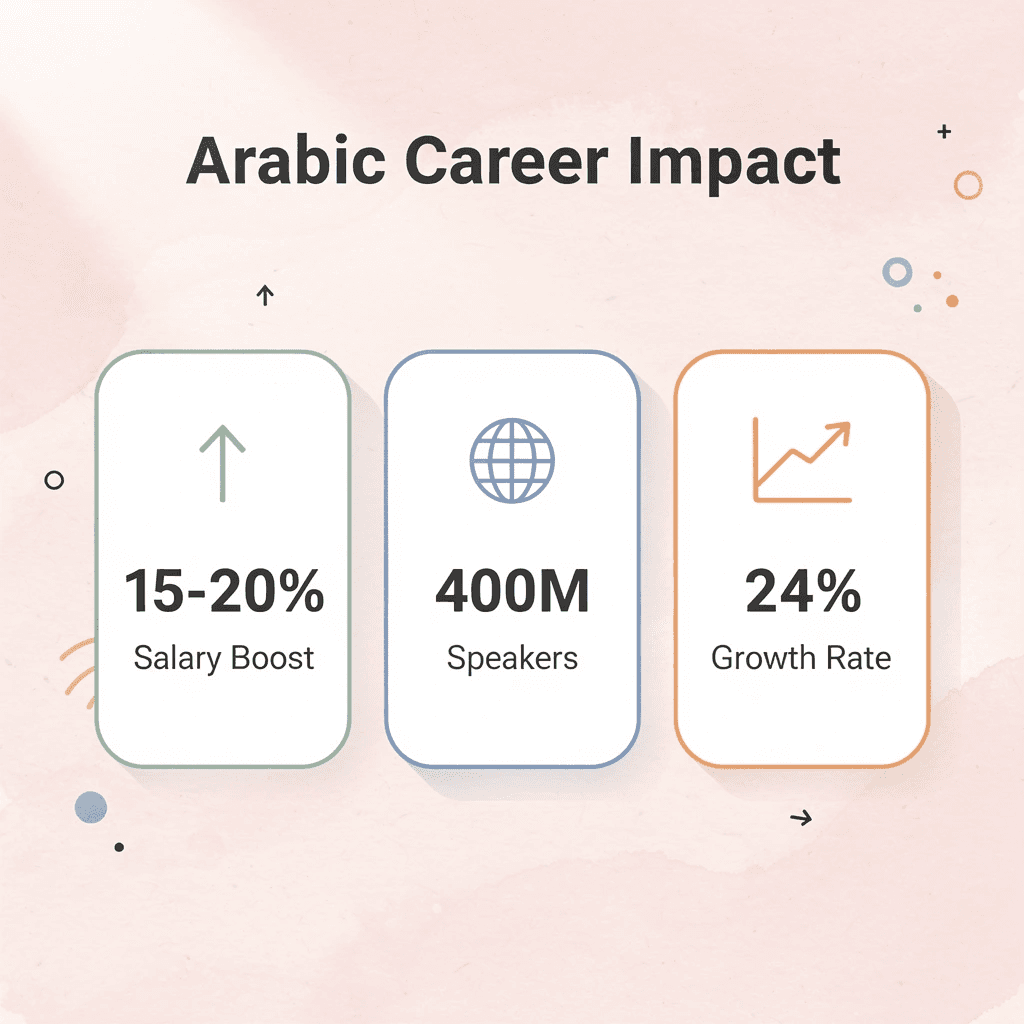
Arabic opens doors to unique experiences that few other languages offer, whether for work goals, cultural learning, or personal interest. As the 5th most spoken language globally with over 400 million speakers, Arabic connects you to a vast network spanning 22 countries across the Middle East and North Africa. Learning Arabic unlocks career opportunities in international business, diplomacy, and translation, while offering cultural insights into one of the world's most influential civilizations.

🎯 Key Point: Arabic proficiency can increase your earning potential by 15-20% in international business roles, particularly in energy, finance, and consulting sectors.
"Arabic speakers are among the most in-demand language professionals, with translation and interpretation services growing by 24% annually in global markets." — Bureau of Labor Statistics, 2023
Benefit Category | Specific Advantages | Impact Level |
|---|---|---|
Career Growth | Access to Middle East markets, government positions | High |
Cultural Understanding | Direct access to Islamic texts, literature, and history | Very High |
Travel & Living | Enhanced experiences in 22 Arabic-speaking countries | Medium |
Cognitive Benefits | Improved problem-solving, right-to-left reading skills | High |
💡 Tip: Start with Modern Standard Arabic (MSA) first—it's understood across all Arabic-speaking countries and serves as the foundation for learning regional dialects later.

Global Importance
Millions of people speak Arabic as their first language, making it one of the top five most widely used native languages globally. It is the official language in 22 countries across the Middle East and North Africa and serves as one of the six official languages of the United Nations.
Arabic connects people in global business, religious dialogue, and diplomatic efforts. Millions use it daily through media, trade agreements, and faith-based activities, making it an important connector where Middle Eastern and North African perspectives shape major economic and political outcomes.
Career Edge
Being able to speak Arabic gives professionals a clear advantage in diplomacy, international trade, energy resources, and higher education. Governments and organizations actively seek candidates who can navigate complex relationships in the region, which holds strategic importance in global security and business.
In Western job markets, Arabic remains uncommon, making speakers more employable and often leading to specialized roles in intelligence, journalism, finance, or multinational corporations. Many employers offer bonuses or faster advancement to Arabic speakers, making language skills a tangible asset for long-term career growth.
Mental Workout
Learning Arabic challenges your brain by requiring you to master a new script, distinct sounds, and complicated grammar patterns: right-to-left writing, a consonant-based root system, and differences between formal standard Arabic and regional dialects.
This constant mental switching strengthens memory retention, sharpens focus, and improves cognitive flexibility. Studies on language learning show that tackling such complexities enhances problem-solving abilities and may delay age-related mental decline, offering lifelong cognitive benefits.
Cultural Treasures
Learning Arabic gives you direct access to the original Qur'an, classical poetry, and historical writings, revealing nuances and literary beauty that translations cannot fully capture. It unlocks modern literature, films, and works from the Golden Age of science and philosophy, when Arab scholars made significant advances in mathematics and medicine. Engaging with these materials firsthand deepens appreciation for a civilization that continues to influence global art, thought, and innovation.
Travel with Ease
From the markets of Morocco to the landscapes of Oman, Arabic enables travelers to connect directly with local people across diverse regions. Simple phrases unlock genuine hospitality, improved navigation, and insider knowledge beyond standard tourist experiences. This ability transforms trips into cultural exchanges—whether bargaining in a souk, exploring historical sites, or joining community events. Genuine connections reduce misunderstandings and create lasting memories.
Community and Family
Arabic connects learners to a worldwide network of speakers across continents, including diaspora communities in Europe and the Americas. For those with family roots in Arabic-speaking regions, it strengthens personal bonds and preserves shared heritage through everyday conversation and traditions. It builds bridges in multicultural settings through religious study groups, professional networks, and social gatherings, fostering empathy, lifelong friendships, and a broader worldview that enriches both individual lives and global understanding. But choosing to learn Arabic raises an immediate question: which version do you need?
Which Arabic Dialect is the Hardest to Learn?
Many learners think that learning Modern Standard Arabic makes spoken dialects feel like a natural next step. Yet one variety often fails to meet that expectation, standing out as uniquely hard even to those who already know the basics.
🎯 Key Point: Even MSA proficiency doesn't guarantee an easy transition to all dialects - some present unexpected challenges.

Maghrebi Arabic, spoken across Morocco, Algeria, and Tunisia, is frequently regarded as the hardest Arabic dialect to learn. This overview examines why, drawing on native-speaker experiences and linguistic insights, and shows how understanding these differences transforms the challenge into an exciting opportunity.
"Maghrebi Arabic is often considered the most challenging dialect for learners, even those with MSA background, due to its unique linguistic features." — Arabic Language Studies, 2023
💡 Tip: Understanding the specific linguistic barriers of Maghrebi Arabic helps learners develop targeted strategies rather than feeling overwhelmed by the complexity.
Pronunciation Creates the Steepest Learning Curve
People who speak Maghrebi Arabic compress vowels, drop syllables, and speak at speeds that blur words into continuous sound streams. Consonant clusters borrowed from Berber introduce sound combinations absent from other Arabic varieties and English. Moroccan Darija prioritizes efficiency over clarity, collapsing sounds in ways that textbook Arabic never prepares you for. The initial shock of hearing how much the dialect diverges from what you studied can feel overwhelming, though focused listening practice helps.
Vocabulary Pulls from Multiple Language Families
In everyday Maghrebi conversation, people mix French nouns for technology, Spanish verbs for household tasks, and Berber terms for food or family relationships. These borrowed words often replace Arabic equivalents, requiring learners to build vocabulary from scratch even if they speak another dialect fluently.
Spoken Arabic is used by over 400 million speakers globally, yet its word choices remain among the least mutually intelligible with Eastern Arabic. A fluent Egyptian speaker might pause mid-conversation in Casablanca, mentally translating words that sound unrelated to anything they recognize, proof of how deeply foreign influences have shaped the dialect over centuries.
Mutual Intelligibility Drops Sharply
Native speakers from Syria, Jordan, or Iraq need weeks of exposure to comfortably follow Maghrebi conversations, whereas North Africans understand Eastern dialects more easily thanks to widespread Egyptian media. This one-way intelligibility creates a unique barrier: mastering Levantine or Gulf Arabic leaves you lost in Tunis, whereas Moroccans who grew up watching Egyptian films adapt quickly to Cairo street talk. This asymmetry reflects Maghrebi's isolation—shaped by geography and history—from the broader Arabic-speaking world until modern transportation and media began bridging the gap.
How do scarce resources affect learning paths when you want to speak Arabic?
Egyptian Arabic benefits from decades of cinema, music, and language apps, but Maghrebi learners face a resource shortage. Fewer textbooks, limited online courses, and sparse immersive materials mean learners often rely on native speaker exchanges, local media, or travel to gain fluency.
Platforms like Kalam address this gap by prioritizing speaking practice over vocabulary drills, letting learners engage with real conversational patterns from day one. This approach pushes you toward authentic interaction more quickly, which many find more effective than passive study, though it demands patience when progress feels slower than in better-resourced dialects.
Which dialect should you actually start with?
Yet knowing Maghrebi is the hardest doesn't answer the real question: which dialect should you start with?
5 Key Arabic Dialects Learners Can Choose From
Choosing a dialect depends on where you plan to use it: business in Dubai, street conversations in Beirut, or film dialogue in Cairo. Each variety serves different regions, carries distinct cultural weight, and offers varying levels of learning support through apps, media, and native speaker communities. The five most practical options balance geographic reach, resource availability, and real-world utility.

Dialect | Primary Regions | Best For | Learning Resources |
|---|---|---|---|
Egyptian Arabic | Egypt, widely understood across the Arab world | Media consumption, the entertainment industry | Abundant - films, TV shows, apps |
Levantine Arabic | Syria, Lebanon, Jordan, Palestine | Daily conversation, cultural immersion | Good - music, social media content |
Gulf Arabic | UAE, Saudi Arabia, Kuwait, Qatar | Business, oil industry, modern commerce | Moderate - news channels, business content |
Moroccan Arabic | Morocco, parts of North Africa | Travel, a unique cultural experience | Limited - fewer mainstream resources |
Iraqi Arabic | Iraq, some neighboring areas | Regional specialization, cultural studies | Limited - mainly news and cultural content |
🎯 Key Point: Egyptian Arabic offers the widest recognition across the Arab world due to Egypt's dominant film industry and media presence, making it the most versatile choice for beginners.
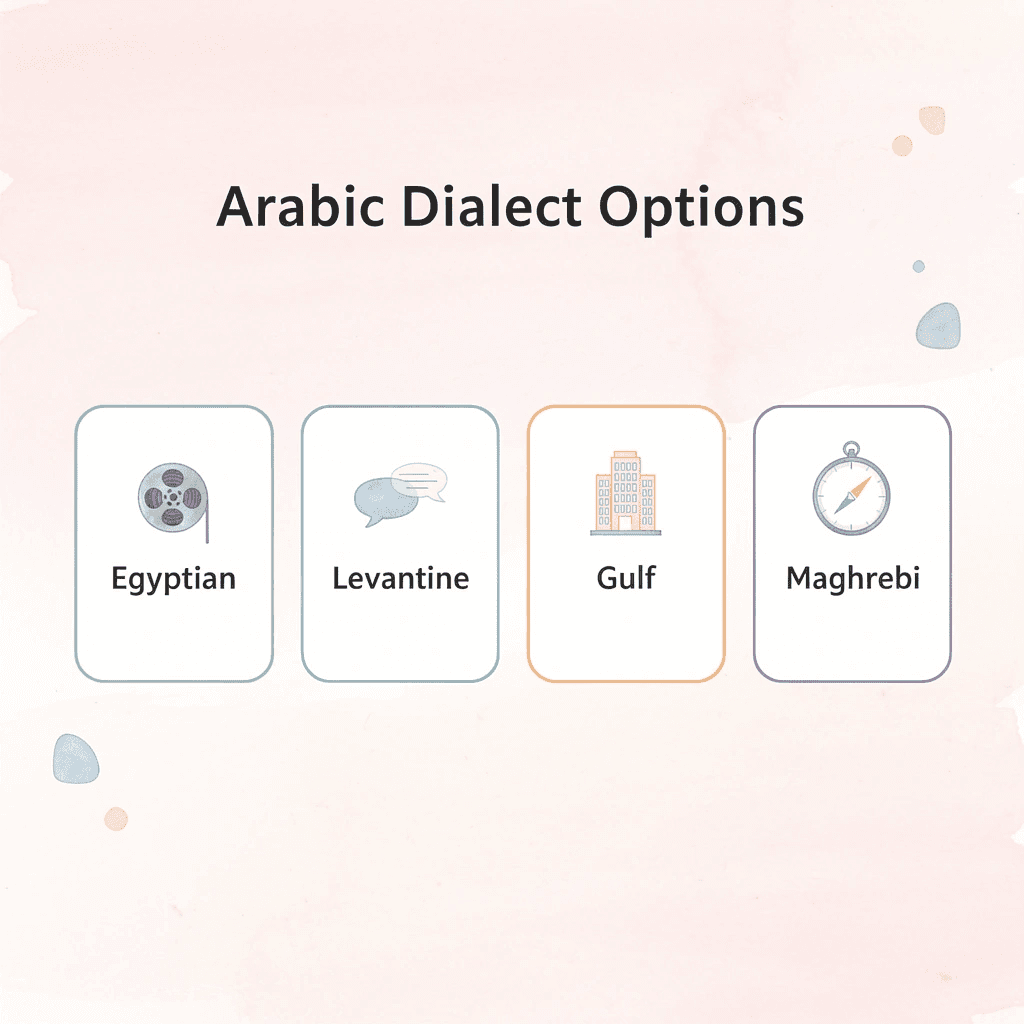
💡 Tip: Consider your long-term goals - if you're planning to work in the Gulf states, prioritize Gulf Arabic over more widely spoken dialects for maximum professional relevance.
"Egyptian Arabic is understood by approximately 300 million Arabic speakers across the Middle East and North Africa, making it the most widely comprehensible dialect." — Arabic Language Institute, 2023

1. Modern Standard Arabic (MSA / Fus'ha)
MSA serves as the formal backbone across all Arab countries, appearing in newspapers, official speeches, academic writing, and religious texts. It provides grammatical structure that helps you understand any dialect later, since spoken varieties simplify or change MSA patterns rather than create entirely new systems. Diplomats, journalists, scholars, and professionals working in formal Arab contexts need MSA to read contracts, follow policy debates, and participate in professional settings.
How does combining MSA with dialects help you speak Arabic better?
Pairing MSA with a spoken dialect creates the most flexible skill set, allowing you to switch between business presentations and casual conversation. MSA alone leaves you unable to follow everyday exchanges, which is why conversation-first platforms push learners toward spoken varieties that unlock immediate interaction.
2. Egyptian Arabic
Egyptian is the most common Arabic dialect in Arab media because Cairo has a major film and television industry that has distributed dramas, comedies, and music across the region for decades. With over 420 million speakers familiar with Egyptian phrases, it functions as the closest thing to a standard Arabic dialect understood throughout the Arab world. Egyptian speakers can be understood from Morocco to Iraq and have access to decades of movies, YouTube channels, podcasts, and social media content for daily practice.
How does Egyptian Arabic help beginners learn how to speak Arabic?
It has straightforward pronunciation and abundant learning resources—from dedicated apps to native-speaker tutors—making Egyptian the default choice for beginners seeking conversational fluency. For travel, entertainment, or building informal communication skills across the Arab world, Egypt offers the fastest return on invested effort.
3. Levantine Arabic
Levantine covers Syria, Lebanon, Jordan, and Palestine with closely related varieties that share smooth sound patterns and vocabulary closer to MSA than many other dialects. Its musical flow and clearer pronunciation make it easier to understand than faster North African speech.
How does Levantine Arabic help you learn how to speak Arabic through media?
The dialect's popularity in modern TV shows, music, and social media provides steady opportunities to learn it without travel.
Why is Levantine Arabic essential for professional and personal connections?
Humanitarian workers, students studying in the region, or anyone building personal relationships in the eastern Mediterranean find Levantine essential for genuine connection. Its geographic concentration means that mastering it unlocks access to multiple countries with minimal adjustment, while its cultural prestige in modern Arab arts gives learners access to creative voices shaping regional identity and political discourse.
4. Gulf Arabic
Gulf varieties serve the Arabian Peninsula's economic powerhouses: the UAE, Saudi Arabia, Qatar, and Kuwait, where oil wealth drives international business. Expatriates in finance, energy, construction, and hospitality need Gulf Arabic to navigate workplace hierarchies, negotiate contracts, and build trust with local partners who value linguistic effort as a sign of cultural respect. The dialect's clearer consonant articulation makes it more accessible for English speakers.
How does Gulf Arabic enhance career opportunities?
People who want to build careers in Gulf Cooperation Council countries gain an immediate advantage, as basic speaking ability sets them apart from other job candidates. Gulf Arabic appears increasingly in business podcasts, LinkedIn content, and professional networking events, providing learners with practice material that matches real workplace situations.
5. Maghrebi (North African) Arabic
Maghrebi covers Morocco, Algeria, Tunisia, and Libya. Each area has its own version shaped by centuries of Berber, French, and Spanish influence. It differs in its use of compressed vowels, a fast pace, and borrowed words that replace standard Arabic terms in daily use. Speakers of Eastern Arabic often need weeks of listening to follow Maghrebi conversations.
How does learning Maghrebi help you speak Arabic authentically?
Students interested in North Africa find that Maghrebi opens cultural understanding unavailable from other varieties. With fewer textbooks and apps, learners engage in authentic conversations sooner, aligning with speaking-first methods. Platforms like Kalam fill this resource gap by emphasizing pronunciation practice and real-life conversation patterns from the start, enabling learners to participate authentically rather than waiting until they've memorized enough words.
What cultural connections does Maghrebi Arabic provide?
The reward comes from experiencing vibrant traditions, food heritage, and social dynamics that differ markedly from Gulf formality or Levantine city life. If your plans involve living in the Maghreb or working with North African communities abroad, time spent learning this dialect creates connections that surface-level tourist Arabic cannot.
Related Reading
Memrise
Busuu
Madinah Arabic
Alifbee
Persian Vs Arabic
Modern Standard Arabic
Duolingo Arabic
Arabic For Beginners
Best Way To Learn Arabic
Pingo Ai
Is Arabic Hard To Learn
How to Speak Arabic Fluently: A Step-by-Step Guide
Building fluency in Arabic requires mastering foundational sounds and letters, learning high-frequency phrases in full sentences, understanding core grammar patterns that appear in daily speech, immersing yourself in native audio, and practicing conversation consistently until responses feel automatic. This approach prioritizes active speaking from day one rather than delaying conversation until grammar feels perfect.
🎯 Key Point: Start speaking Arabic immediately, even with imperfect grammar. Fluency comes from consistent practice, not from waiting until you've mastered every rule.
"The most effective language learners prioritize speaking practice and real conversation over perfect grammar from the beginning." — Language Learning Research, 2023
💡 Pro Tip: Focus on high-frequency vocabulary and common sentence patterns first. These deliver the greatest return on your time investment and enable you to communicate effectively in most everyday situations.

Start with the Alphabet and Pronunciation Drills
The Arabic script has 28 letters and their connected forms, which form the foundation for reading, writing, and recognizing word patterns. Spend focused time daily tracing letters and repeating sounds like the guttural "ayn" or emphatic "qaf" that don't exist in English. Correct pronunciation at this stage prevents mistakes from becoming permanent habits. Daily practice with audio models helps your vocal muscles adapt quickly, turning unfamiliar sounds into natural reflexes.
Learn High-Frequency Vocabulary in Context
Focus on the 500 most common words covering greetings, questions, directions, and everyday transactions. Learn them in full sentences rather than isolated lists. Flashcards or spaced repetition apps can accelerate your review, but learning words in context helps them stick because you understand how they work in real conversations. This approach builds practical speaking ability faster than memorizing abstract vocabulary and lets you form original sentences within weeks.
Grasp Essential Grammar Without Overloading
Arabic grammar centers on patterns such as noun-adjective agreement, verb changes for tense and person, and root-based word formation that generate related meanings from three-consonant roots. Master the structures that appear frequently in spoken dialects rather than every classical rule. Short, focused lessons tied to real-world examples help you create sentences without translating from English in your head.
Immerse Yourself in Native Audio Daily
Surround your ears with podcasts, music, TV shows, or YouTube channels in your chosen dialect, even if you only catch pieces at first. Change your phone settings to Arabic and watch familiar series with subtitles to absorb rhythm, intonation, and common expressions. This constant exposure trains your brain to process Arabic naturally, improving comprehension and pronunciation while making active speaking feel less strange and more natural.
Practice Speaking from Day One
Most learners wait to start speaking until they feel they know enough words, creating a silent gap that slows progress. Start talking immediately through self-talk, shadowing native speakers by copying their exact timing and tone, or repeating after audio clips to build muscle memory. People who speak early say that fluency transforms the language from an obligation into something they want to do, which feels emotionally fulfilling.
How can platforms help you speak Arabic daily?
Platforms like Kalam make speaking practice central to learning rather than an afterthought. Interactive drills and video lessons focus on real-life conversations. Users practice with short daily sessions, adjusting pronunciation against clear audio models and repeating patterns until responses become automatic. Knowing the steps matters only if you commit to using them every day.
Related Reading
Arabic Vs Hebrew
Arabic Basics
Best App To Learn Arabic
Urdu Vs Arabic
Arabic Vowels
Basic Arabic Phrases
Learn Arabic in Any Dialect Today with Kalam
Daily commitment becomes effortless when tools remove friction. You need an environment where opening the app feels easier than scrolling social media, where practice fits between meetings or during commutes, and where progress shows quickly enough to sustain motivation. The gap between knowing what works and doing it closes when the method itself becomes a habit.

🎯 Key Point: Kalam turns speaking practice into the default activity rather than an intimidating final step. Short interactive drills focus on real-life conversations in Egyptian, Levantine, or your target dialect, with clear audio models to guide pronunciation of sounds that trip up beginners. Meaning breakdowns and pattern repetition build muscle memory so responses surface naturally during actual exchanges. Interactive games keep sessions engaging, and a few minutes daily lead to tangible improvements in how confidently you respond when someone speaks to you.
"Daily practice turns fluency from an abstract goal into a skill you feel growing stronger each week." — Language Learning Research, 2024
⚠️ Warning: The difference shows fastest in unscripted moments: you stop translating mentally before answering, recognize phrases in songs or street conversations without pausing, and your accent shifts from hesitant approximation to something locals understand on the first try. These wins compound quickly with daily practice, turning fluency from an abstract goal into a skill you feel growing stronger each week.

Start by downloading the Kalam app and practicing with its conversation coach. Your first session takes less time than reading this guide, and the confidence you build carries forward into every interaction that follows.