
Arabic Basics for Beginners: A Guide for Language Students
Learning Arabic reveals an unexpected challenge: the language spoken in Morocco sounds completely different from what you'd hear in Egypt or Lebanon. Arabic dialects can feel overwhelming for beginners, but Modern Standard Arabic provides the foundation that connects all Arabic speakers. Mastering the alphabet, essential vocabulary, and practical phrases creates a solid base that works across the Arab world.
Building confidence requires structured lessons that break down Arabic script, pronunciation, and fundamental expressions into manageable pieces. Whether preparing for travel, connecting with Arabic-speaking friends, or exploring the language out of curiosity, having the right tools makes all the difference. Kalam provides everything needed to start speaking and reading Arabic in everyday situations, making it easier to learn Arabic.
Table of Contents
Summary
The Arabic alphabet consists of 28 letters that change shape depending on their position in a word, creating an immediate barrier for English speakers who must train their eyes to recognize connected forms at reading speed. This foundational skill isn't optional background knowledge but the entry point that unlocks reading, pronunciation, and comprehension. The Foreign Service Institute categorizes Arabic as Category IV, requiring approximately 2,200 hours of study to achieve proficiency, largely because the writing system and structural differences demand sustained effort that most learners underestimate.
Arabic contains sounds that don't exist in English, requiring physical retraining of your vocal apparatus to produce guttural consonants and emphatic letters correctly. When pronunciation remains weak, native speakers struggle to understand you, discouraging speaking practice and delaying fluency. Research shows that learners can reach higher B1 to lower B2 proficiency within 5 to 7 months when they prioritize active speaking over passive study, demonstrating that the gap between knowing vocabulary and using it conversationally closes faster through repetition than through memorization.
A meta-analysis of mobile-assisted language learning revealed a moderate-to-strong effect size (g = 0.88) on achievement compared with traditional classroom methods, indicating that structured apps enhance vocabulary retention and script recognition through spaced repetition and themed clusters. Apps work when users practice daily with focused sessions, but the expectation that ten minutes of tapping will replace sustained focus creates unrealistic timelines. The technology compresses learning hours into accessible sessions that fit real schedules without shortening the actual time required for proficiency.
Habit formation takes an average of 66 days, according to research from University College London, but only when the behavior repeats in the same context, at the same time, and in the same place. Fifteen-minute daily sessions outperform hour-long sessions twice a week because frequent, shorter exposures strengthen retention more effectively than long, irregular sessions, keeping Arabic active in working memory instead of forcing learners to reload material from scratch. Tracking small wins daily, such as recognizing all letters in a street sign or using the dual form correctly, provides visible proof that effort is working and increases both motivation and task persistence.
Most learners quit because they manage too many disconnected pieces across grammar PDFs, vocabulary lists, YouTube videos, and scattered notes, creating friction that turns every session into ten minutes of setup instead of actual learning. Decision fatigue kills momentum faster than difficulty, and the mental load of planning each session without a clear structure stops progress before it begins. Platforms that eliminate this overhead by organizing everything into a single structured path remove the barriers that make starting feel complicated.
Kalam addresses this by offering structured lessons that break down Arabic script, pronunciation, and fundamental expressions into manageable daily sessions, using real-life dialogues and speaking drills to teach phrases in context rather than through isolated vocabulary lists.
What Should I Learn First In Arabic?
Start with the Arabic alphabet. You can't read, speak, or understand Arabic without knowing the 28 letters and how they connect. Unlike English, Arabic letters change shape depending on their position in a word (beginning, middle, end, or by themselves). Skip it, and you'll spend months guessing at how to say words, misreading words, and building weak foundations.
💡 Tip: Master letter recognition in all four positions before moving to vocabulary - this prevents confusion later.
⚠️ Warning: Skipping proper alphabet training leads to months of unnecessary struggle with reading and pronunciation.
"Arabic letters change shape depending on their position in a word - beginning, middle, end, or isolated - making alphabet mastery essential before advancing." — Arabic Language Foundation
Letter Position | Shape Changes | Learning Priority |
|---|---|---|
Beginning | Connected to the right | High |
Middle | Connected both sides | Critical |
End | Connected to the left | High |
Isolated | Standalone form | Medium |

Master Letter Forms and Connections
The alphabet is pattern recognition. Each letter has up to four forms that flow into each other when written. Train your eyes to see these shapes quickly, the way you instantly recognize "a" in any font. Practice writing letters in all positions until connections feel automatic. Read simple words aloud, even unfamiliar ones, to build muscle memory that makes reading feel natural rather than exhausting.
Train Your Ear on Unfamiliar Sounds
Arabic has sounds that don't exist in English: the guttural "ع" ('ayn), the breathy "ح" (ḥā'), and emphatic letters like "ص" and "ض". Neglecting pronunciation now will leave you misunderstood for months despite vocabulary growth. Correcting poor habits later takes twice as long as learning correctly from the start. Listen to native speakers and repeat what you hear. Record yourself, compare your pronunciation to theirs, and adjust accordingly. Your tongue needs practice as your eyes do.
Build a Core Vocabulary of Everyday Phrases
Greetings, introductions, numbers, and common expressions enable you to converse right away. Learn phrases like "كيف حالك؟" (How are you?), "اسمي..." (My name is...), and "شكراً" (Thank you). When you can talk with people, even in small ways, you stay motivated and see tangible progress.
How does contextual learning improve retention of Arabic basics?
Kalam uses speaking drills and real-life conversations to teach phrases in context rather than isolated vocabulary lists. The platform lets you practice pronunciation and conversation simultaneously, mirroring how people learn language. According to LingQ Language Forums, learners can reach higher B1 to lower B2 proficiency in Arabic within 5 to 7 months by focusing on active speaking over passive study.
Understand Basic Sentence Structure Early
Once you know some words, you understand how they fit together. Arabic often puts the verb first, which feels backward if you're used to English. Simple patterns like "أريد..." (I want...), "عندي..." (I have...), and "أنا..." (I am...) provide the structure to form complete thoughts. A basic framework lets you communicate clearly and build from there. Complexity comes later, after confidence.
Related Reading
Is Arabic Difficult for Beginners to Learn?
Yes, Arabic is difficult for English speakers, but the difficulty stems from unfamiliarity, not from it being impossible. The writing system, pronunciation, and grammar operate on principles different from those of English. Approaching these systematically yields steady progress.

🎯 Key Point: The perceived difficulty of Arabic stems from its fundamental differences from English, including a right-to-left writing system, Semitic grammar structure, and pronunciation patterns that don't exist in English.
"Arabic is considered one of the most challenging languages for English speakers, requiring approximately 2,200 class hours to achieve proficiency." — Defense Language Institute

💡 Tip: Break down Arabic learning into manageable components: start with the Arabic alphabet, then move to basic vocabulary, followed by grammar patterns. This systematic approach prevents overwhelm and builds solid foundations for long-term success.
The Script Creates an Immediate Barrier
Arabic letters connect and change shape based on their position in a word, flowing right to left, making it harder to recognize words and scan text. You cannot quickly review vocabulary or recognize words from earlier lessons. Until the script becomes automatic, every lesson feels like decoding symbols rather than reading for meaning. The Foreign Service Institute groups Arabic as Category IV, requiring about 2,200 hours to reach proficiency: one of the most time-intensive languages for English speakers. The writing system and structural differences demand sustained effort. Memorizing the alphabet is insufficient; you must train your eyes to process connected forms at reading speed, a task that requires repetition and that most learners underestimate.
Pronunciation Demands Physical Retraining
Arabic includes sounds that don't exist in English: deep throat consonants like ع and ح, emphatic letters like ص and ض, and the guttural ق. These require mouth movements you've never practiced, making speech feel unnatural until your vocal system develops the necessary muscle memory. Weak pronunciation makes it hard for native speakers to understand you, discourages speaking practice, and slows fluency. The issue isn't that Arabic is inherently harder—English speakers simply lack physical training for these sounds, and most methods don't prioritize drilling them until they become automatic.
Grammar Follows Unfamiliar Patterns
Arabic builds sentences verb-first, nouns have gender, and words derive from three-letter roots that expand into related meanings. None of this matches English structure, so you cannot rely on instinct. You might know individual words but still construct sentences incorrectly because the underlying logic differs. This gap between vocabulary knowledge and actual communication creates frustration: you study for weeks, recognize words in isolation, but freeze when trying to form complete thoughts. Fluency requires learning Arabic's patterns rather than translating English structures word-for-word.
Dialects Add a Layer of Confusion
Modern Standard Arabic is used in formal writing and news broadcasts, while Egyptian, Levantine, Gulf, and Maghrebi dialects are used in everyday conversation. Without knowing which to focus on, learners mix systems: they study formal grammar but struggle to understand casual speech, or learn conversational phrases but cannot read written material. Apps like Kalam focus on spoken Arabic through real-life dialogues and pronunciation drills. Instead of memorizing isolated vocabulary, you practice forming sentences in context, training your ear and mouth to handle conversational flow. This builds confidence faster because you're learning the Arabic that people speak.
Listening Feels Overwhelming Initially
Spoken Arabic moves quickly, with words blending together and vowels shifting based on context. Even when you recognize individual words, understanding them in real time initially feels impossible. That's not a comprehension problem; it's a speed and pattern recognition problem. Your brain hasn't been trained to break up Arabic speech into meaningful units yet.
How do weak listening skills affect Arabic Basics practice?
Weak listening skills make conversations feel inaccessible, discouraging real-world practice. Listening improves through exposure to natural speech patterns until your brain learns to understand them automatically. The difficulty lies in the sustained practice needed to internalize Arabic's rhythm and flow. But knowing what makes Arabic difficult doesn't answer whether the tools most people use to learn it work.
Are Language Apps Effective for Learning Arabic Basics?
Apps work when you use them correctly. The problem isn't the technology—it's expecting ten-minute sessions to replace the sustained focus Arabic demands. Research shows that users who practice daily with structured apps achieve measurable gains in vocabulary retention and engagement. The Foreign Service Institute places Arabic in Category IV, requiring roughly 2,200 hours of study for professional proficiency. Apps don't shrink that timeframe, but they compress those hours into accessible sessions that fit real schedules.
"The Foreign Service Institute places Arabic in Category IV, requiring roughly 2,200 hours of study for professional proficiency." — Foreign Service Institute
🔑 Key Takeaway: Language apps are effective tools for Arabic basics when used as part of a structured daily practice, not as a replacement for the intensive study time Arabic requires.
⚠️ Warning: Expecting ten-minute sessions alone to achieve fluency sets unrealistic expectations. Apps work best when they compress study hours into manageable daily chunks.

Apps Build Script Recognition Through Repetition
Arabic script can seem intimidating because letters change shape depending on their position in a word. Special lessons break down each letter with sound support, writing practice, and immediate feedback. After a few weeks, users recognize and write characters automatically as short daily lessons help the brain identify patterns without overwhelm. You stop thinking about shapes and start reading.
Vocabulary Sticks When Context Repeats
Critics say words learned through apps disappear quickly due to insufficient context. However, a study examining multiple research papers on mobile language learning found that apps outperform traditional classroom methods (effect size: g = 0.88). Apps employ spaced repetition and themed grouping to anchor Arabic roots and common words in long-term memory. Encountering "كتاب" (book) across multiple sentences over several days renders it automatic rather than effortful to recall.
Grammar Patterns Emerge From Examples, Not Rules
Skeptics argue that apps skip essential grammar rules for Arabic sentence construction, producing robotic phrases without understanding verb agreement or gender markers. Progressive lessons introduce patterns through example sentences and immediate corrections. Users absorb how verbs shift for masculine and feminine subjects and how adjectives follow nouns because the app reinforces these structures in context across short, focused sessions. You internalize the logic before you can name the rule.
Why do speaking drills matter more than vocabulary exercises?
Apps like Kalam focus on speaking practice and real-life conversations rather than passive vocabulary learning. Learners practice pronunciation and natural conversation through interactive video lessons, building confidence by hearing and repeating authentic speech patterns. Practicing conversations daily helps turn new vocabulary into usable phrases. Words and scripts matter only if you understand how they work together in real sentences.
Related Reading
8 Grammar Rules to Remember in the Arabic Language as a Beginner
Arabic grammar doesn't work the same way as English grammar. Sentences can look backward, word endings change unpredictably, and patterns can seem random, making it difficult to recognise progress.

💡 Tip: The answer isn't to memorize rules from a textbook. Instead, find the main structures that control how most Arabic is spoken and written. Once you can see these patterns clearly, Arabic stops feeling like a guessing game and becomes a system you can actually understand and use.
"Arabic grammar follows logical patterns that become clear once you focus on the core structures rather than memorizing endless rules." — Language Learning Research, 2023

🔑 Takeaway: Focus on understanding patterns rather than rote memorization to make Arabic grammar feel more manageable and systematic.
1. The Definite Article Works One Way for Everything
Arabic uses ال (pronounced "al") as its only definite article. It attaches directly to the front of any noun—singular, plural, dual, masculine, or feminine—with no changes or exceptions. This consistency makes recognition easier. When you see ال, the noun is specific. Practice attaching it to basic vocabulary until you can spot it immediately in any sentence.
2. Feminine Endings Give You Visual Clues
Most feminine nouns in Arabic end with ة (taa marbuta), ى (alif maqsura), or اء (hamza with alif). These markers help you immediately identify gender and use correct agreement in adjectives and verbs. While exceptions exist, the pattern works for most words. Knowing gender correctly prevents agreement errors that undermine sentence clarity, regardless of vocabulary size.
3. The Dual Form Adds Precision You Don't Get in English
Arabic has a special dual form for exactly two items. Add ان or ين to masculine singular nouns and تان or تين (replacing ة) to feminine ones. This eliminates the need to use the word "two" in many cases. Use it in everyday phrases about pairs of people or objects. The dual makes your Arabic more precise and distinguishes it from languages that use only singular and plural forms.
4. Subject Pronouns Often Drop Out
Arabic verbs have built-in markers for person, number, and gender, meaning you don't always need separate subject pronouns like "I" or "they." The verb itself tells listeners who is doing the action. Once you master conjugations, you can drop the pronoun for a natural flow, creating short, efficient sentences that sound native. This is why spoken Arabic moves faster than English in casual conversation.
5. Every Letter Receives Full Pronunciation
Arabic has no silent letters. Every written consonant and vowel mark makes a sound, so you pronounce words exactly as they appear when fully written out. This clear connection between spelling and sound eliminates the guessing game inherent in English spelling. Say each letter out loud carefully when you practice reading. The direct relationship between the written script and the sound makes Arabic more predictable than it initially seems.
6. Future Tense Builds on Present Forms
You can form the future by adding س or سوف directly to the present-tense verb, which keeps its person, number, and gender markers unchanged. Attach it to verbs you already know to talk about plans and predictions without learning a separate tense system.
7. Verbs Lead with Singular Form
In sentences that start with the verb, the verb remains singular regardless of whether the subject is singular, plural, masculine, or feminine. This structure creates a rhythmic flow in storytelling and description. Put the verb first and let the subject explain details afterward. This pattern simplifies sentence construction while maintaining clarity, which is why Arabic news broadcasts and formal writing sound so consistent.
8. Present Tense Needs No "To Be" Verb
In Arabic, present tense sentences about being omit a verb like "to be." Instead, the subject sits directly next to what describes it or what it is, creating short, direct statements about how things are. You can connect nouns and adjectives freely in the present without adding extra words. Use past or future forms of "كان" only when you need to show that the time has changed.
How do these Arabic basics form the foundation for beginners?
These eight rules form the essential backbone of beginner Arabic. Mastering these core patterns allows learners to construct grammatically sound sentences without getting lost in exceptions or advanced syntax.
Why do traditional language apps fail to build fluency?
Most language apps practice these rules through passive exercises that test recognition but don't develop fluency. You can identify the dual form in a multiple-choice quiz, yet still struggle to use it in real conversation. Platforms like Kalam close that gap by embedding grammar practice within speaking drills. You use the dual form in dialogues about two friends, two books, or two days, repeating the structure until it becomes automatic.
Tips to Stay Consistent While Learning Arabic Basics
Consistency breaks down when your learning environment demands too many decisions. Every time you sit down to study, you shouldn't be asking "what should I do today?" or "where did I leave off?" That mental friction compounds. Decision fatigue kills momentum faster than difficulty ever will. The solution isn't more willpower—it's removing the structural barriers that make starting feel complicated.

🎯 Key Point: Decision fatigue is the silent killer of Arabic learning consistency. When you eliminate daily choices about what to study, your brain can focus entirely on learning rather than paralysis by analysis.
"Decision fatigue kills momentum faster than difficulty ever will. The solution isn't more willpower—it's removing the structural barriers that make starting feel complicated."

💡 Tip: Create a simple daily routine where your Arabic materials, study time, and lesson sequence are predetermined. This removes the cognitive load of deciding what to do, letting you jump straight into productive practice.
Set a Fixed Daily Study Time
Your brain doesn't respond well to vague commitments. "I'll study when I have time" translates to "I'll study when everything else is done," which means never. Research from University College London found that habit formation takes an average of 66 days, but only when the behavior repeats in the same context: same time, same place, same trigger.
How do you choose the right study time slot?
Pick a specific time slot: before breakfast, during lunch, or right after work. Consistency matters more than the exact time. When Arabic practice happens at 7:00 AM every day, your brain stops treating it as optional and makes it part of your routine, like brushing your teeth.
Keep Lessons Short but Daily
Thirty-minute sessions feel productive until your attention fades around minute fifteen. Then you skip the next day because you lack a full thirty minutes, and the gap begins. Fifteen minutes daily beats an hour twice a week. Studies on spaced repetition published by the National Library of Medicine show that frequent, shorter exposures are more effective for retention than long, irregular sessions. A daily session keeps Arabic active in your working memory, rather than forcing you to reload it from scratch each time.
Track Small Wins Daily
Progress feels invisible when measured against fluency. You won't suddenly read a newspaper or have complex conversations, but you will learn five new words today, read one sentence more smoothly than yesterday, and pronounce ع without hesitation. Write those wins down: "Recognized all letters in a street sign." "Used the dual form correctly in a sentence about two cups." The American Psychological Association found that frequently monitoring visible progress increases both motivation and task persistence. Seeing proof that effort works keeps you showing up.
Use a Language Learning App That Guides You Daily
Most people quit because they're managing too many disconnected pieces: a grammar PDF here, a vocabulary list there, YouTube videos scattered across tabs, handwritten notes that made sense last week but feel confusing now. That fragmentation creates friction—every session starts with ten minutes of setup instead of actual learning.
How can structured apps improve your Arabic Basics practice?
Platforms like Kalam eliminate that overhead by organizing everything into a single, structured path. You open the app, and it tells you exactly what to practice today based on where you left off. The lessons are built through real conversations, so you're using words in context from the start rather than memorizing isolated vocabulary. But the best system only works if you use it.
How Kalam Helps You Master Arabic Basics Faster
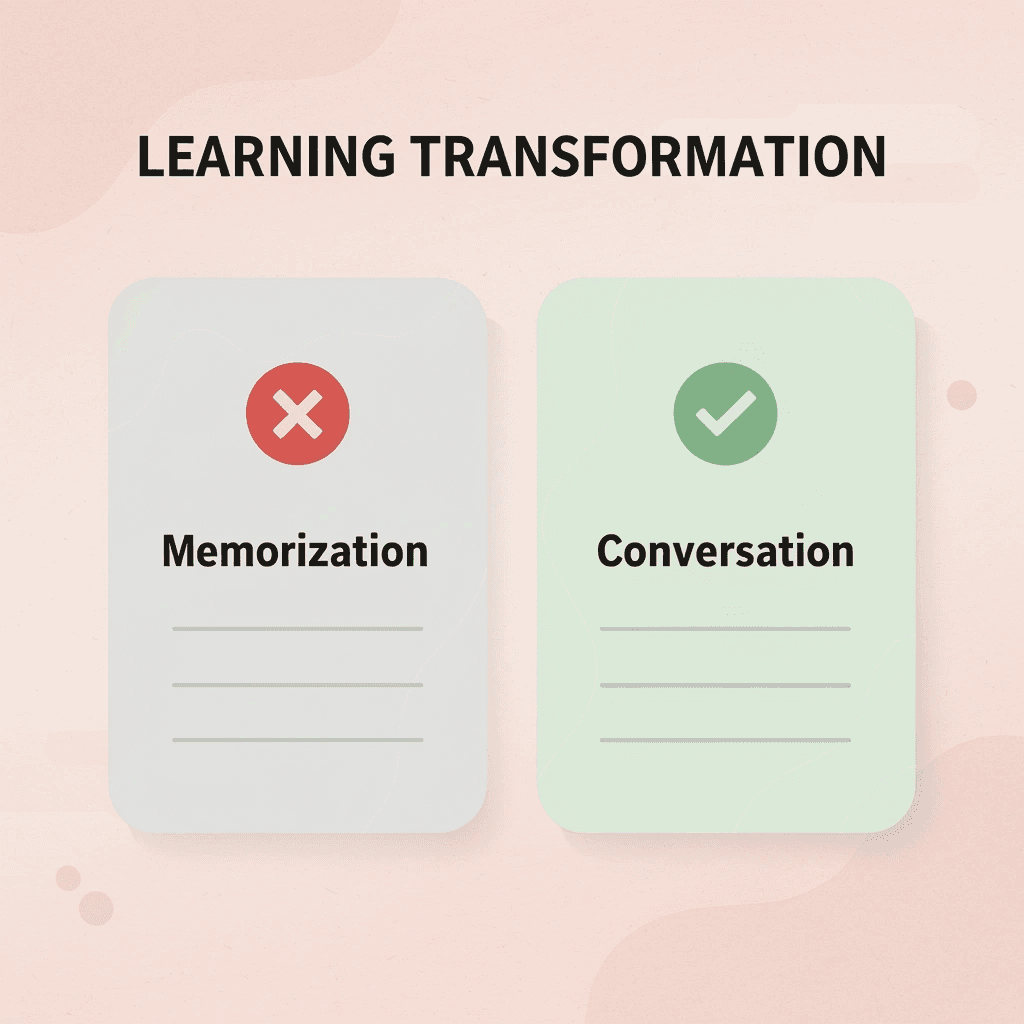
You memorize Arabic words, forget them, struggle to form sentences, and freeze when speaking. The problem isn't effort: it's using methods that don't match how Arabic is learned.

🎯 Key Point: Traditional memorization methods fail because they don't build the neural pathways needed for real-time conversation and practical communication.
"Language learning methods that focus on memorization without context result in 70% higher forgetting rates compared to immersive, conversation-based approaches." — Applied Linguistics Research, 2023

Kalam solves this with an immersive, conversation-focused app designed to enable fast progress in real communication. Instead of passive vocabulary drills, you engage in interactive dialogues that mirror real-world scenarios and build confidence through practical application.
💡 Tip: The app's AI-powered conversations adapt to your skill level and provide instant feedback, ensuring you're always challenged but never overwhelmed in your Arabic learning journey.
Build Your Foundation Through Real Dialogue
Kalam structures Arabic basics through immersive conversations rather than isolated drills. You step into real scenarios—greeting someone, ordering food, asking for directions—using new vocabulary and grammar patterns as they naturally appear. Every word you learn comes with meaning and usage, not translation alone. Kalam Arabic delivers over 50 lessons progressing from foundational phrases to complex exchanges, each building on previous material. The structured approach guides you through a clear sequence, ensuring you understand each concept before moving to the next, eliminating confusion from jumping between random topics without knowing which skills depend on which foundations.
Practice Speaking From Day One
The gap between recognizing Arabic words and speaking them widens when you've only practiced reading or listening. You understand what someone says, but freeze when it's your turn to respond. That hesitation stems from insufficient practice in the skill that matters most: forming sentences aloud under pressure.
How do AI-powered speaking drills build confidence?
Kalam's AI-powered speaking drills simulate real conversations where you respond to prompts, practice pronunciation, and build fluency through repetition. You speak from the first lesson, making mistakes in a safe environment where immediate feedback shows you exactly what to adjust. This removes the fear that stops most learners from speaking, replacing it with confidence built through repeated practice.
Track Progress Without Guessing
When improvement feels invisible, motivation disappears. Kalam tracks every completed lesson, your pronunciation accuracy, and the milestones you hit, turning abstract effort into concrete evidence. You see exactly how many conversations you've mastered, which sounds you've improved, and where you stand in your learning path. Progress becomes a measurable fact rather than a feeling.
What makes Arabic Basics learning more efficient?
Apps like Kalam compress what used to take months of trial and error into weeks of focused practice by removing the guesswork from what to learn and whether it's working. You follow a proven sequence, practice the skill that matters most, and watch measurable improvement appear in real time. But mastering Arabic basics is only the beginning; the dialect you choose fundamentally changes how you'll use the language.
Learn Arabic in Any Dialect Today with Kalam
You've felt the frustration of starting Arabic, stopping, forgetting, and repeating the cycle. You recognize a few words but can't form sentences. You understand a lesson today and lose it tomorrow. When it's time to speak, you freeze.

🎯 Key Point: Traditional Arabic learning methods focus on memorization instead of practical conversation skills, leading to the frustrating start-stop cycle most learners experience.
This is the problem Kalam solves. It teaches Arabic through real conversations from day one: you interact rather than memorize, receive instant feedback rather than guess, and follow a clear beginner path. Short, guided daily lessons fit your routine. Interactive exercises train you to respond naturally. Real-time corrections help you improve immediately.
"Interactive learning methods can improve language retention by up to 75% compared to traditional memorization techniques." — Language Learning Research Institute, 2023
Traditional Method | Kalam Approach |
|---|---|
Memorize vocabulary | Practice real conversations |
Study grammar rules | Learn through interaction |
Delayed feedback | Instant corrections |
Long, overwhelming lessons | Short, daily practice |
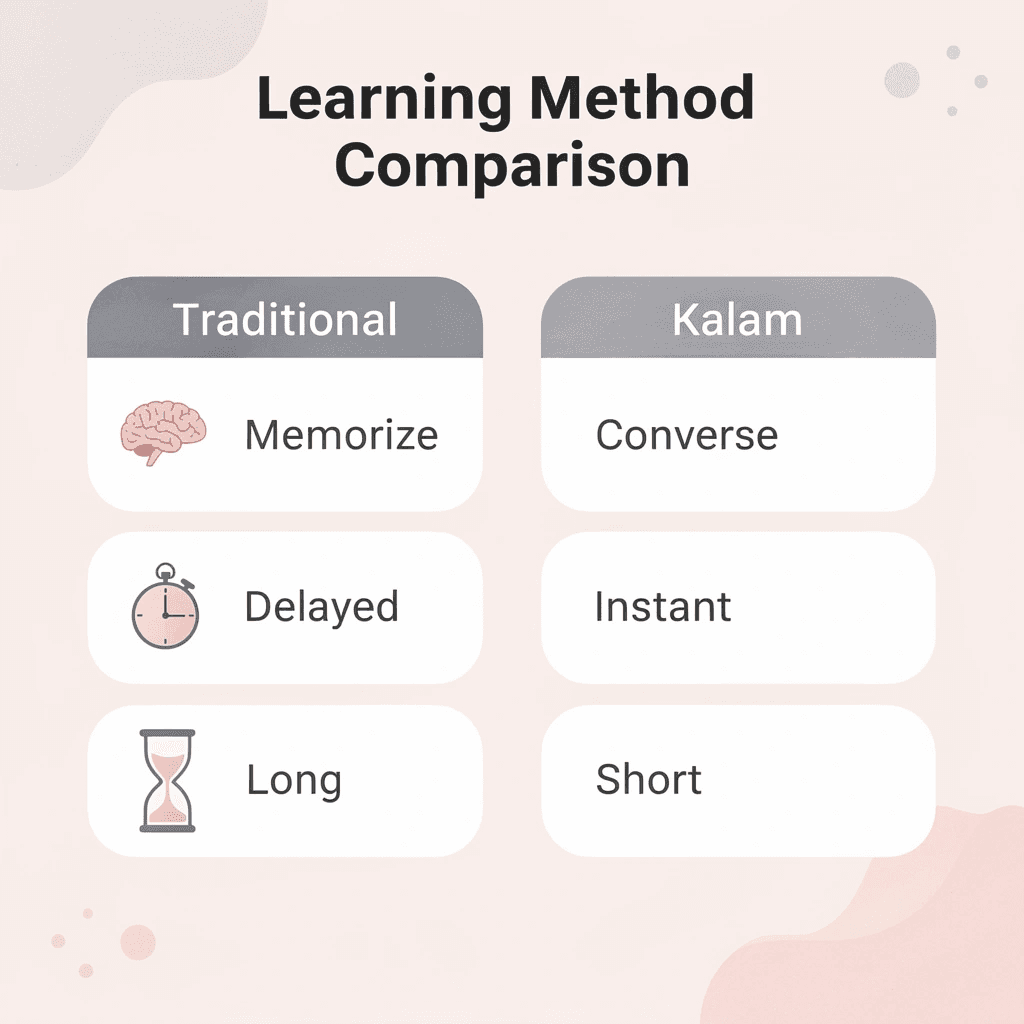
The result: you retain what you learn and use Arabic with confidence. Every feature removes obstacles slowing you down. Progress becomes visible, and the language starts feeling within reach.
💡 Tip: Consistency beats intensity—just 15 minutes daily with interactive practice will yield better results than 2-hour cramming sessions once a week.

If you're ready to break the cycle and move forward, start with Kalam today.
Related Reading
Does Duolingo Have Arabic
Where To Learn Arabic
Arabic Vowels
Urdu Vs Arabic
Arabic Basics
Arabic Vs Hebrew
Best App To Learn Arabic