8 Ways to Say "Beautiful" in Arabic: When & How to Use Them
You're sitting in a bustling Damascus café, trying to compliment your friend's new dress, but "jameel" feels too formal and textbook. Arabic speakers use different words for "beautiful" depending on context, gender, and regional dialect, and mastering these nuances transforms hesitant learners into speakers who sound natural and connected. Eight authentic Arabic phrases for expressing beauty exist beyond the standard textbook terms, each with specific situations where they shine.
These expressions work best when learned through practical examples rather than memorized lists. Words like "helwa," "zein," and "qamar" carry cultural weight that determines when and how to use them appropriately. The right support system makes it much easier to absorb these terms through real-world context, helping speakers express admiration the way locals do every day.
Table of Contents
What Does Calling Someone “Beautiful” Mean in Arabic Culture?
Is It Appropriate to Call Someone Beautiful in Arabic in All Situations?
Is “Beautiful” Said Differently in Egyptian, Levantine, and Gulf Arabic Dialects?
How Kalam Helps You Practice Saying “Beautiful” in Real-Life Arabic Dialogues
Summary
Arabic beauty complements blend physical appearance with inner character, reflecting a cultural view in which outer grace and ethical goodness exist on the same continuum. When you tell someone they're beautiful, expect a humble redirect like "It is your eyes that are beautiful," which credits your perception rather than their appearance. This isn't false modesty but a cultural script that keeps interactions balanced and reinforces mutual respect through shared positivity.
Gender pairing and relationship distance determine whether your compliment strengthens connection or creates discomfort. Men complimenting men stays neutral in most Arabic contexts, while men addressing women outside close family requires careful judgment, especially in conservative settings. Work environments prioritize competence over appearance, so complimenting a colleague's beauty during a meeting shifts focus from their contribution to their looks, undermining credibility in front of peers.
Regional dialects transform both the sound and emotional weight of beauty terms. Egyptians use "gameel" with a hard "g" that adds warmth, Levantine speakers favor "helu" for its sweet, approachable tone, and Gulf dialects layer in "mazyoun" to describe elegant, refined beauty. Each region doesn't just pronounce differently; it also chooses words that reflect local values around charm, grace, and sophistication.
Context determines which beauty term lands naturally versus awkwardly. "Jamil" works safely across formal and casual settings; "helw" suits friendly everyday interactions; "qamar" delivers romantic intensity, comparing someone to the moon; while "mozza" fits only very casual, flirtatious moments between close friends or romantic interests. Matching the expression to the relationship, setting, and emotional register separates fluent speakers from those who only memorized vocabulary.
Memorizing beauty terms in isolation doesn't prepare you for the cognitive load of live interaction, where you're simultaneously processing incoming speech, formulating responses, monitoring pronunciation, and managing social timing. Conversational pressure reveals the gap between recognition and production, between knowing a word exists and trusting yourself to deploy it when someone shows you their new apartment or introduces you to their sister.
Kalam addresses this by placing learners in interactive dialogue simulations in which they speak beauty terms aloud in specific scenarios, such as complimenting cooking or reacting to a wedding appearance, with real-time pronunciation scoring that shows exactly which dialectal variant native speakers choose and why.
What Does Calling Someone “Beautiful” Mean in Arabic Culture?
Calling someone beautiful in Arabic isn't a quick compliment. It recognizes both how they look and who they are as a person, combining them in a single expression that shows respect. This reflects a worldview where outer beauty and inner goodness are connected and part of the same spectrum.
🎯 Key Point: Arabic compliments about beauty carry deeper cultural weight than simple physical observations - they acknowledge the whole person rather than just appearance.
"In Arabic culture, beauty compliments reflect a holistic view where physical appearance and inner character are seen as interconnected aspects of the same person." — Cultural linguistics research

💡 Cultural Insight: Understanding this dual meaning helps explain why Arabic speakers often use beauty-related terms in contexts that might seem unusual to speakers of other languages - they're recognizing complete human value, not just physical traits.
The Word Itself: Jamil and Jamilah
"Jamil" (for men) and "jamilah" (for women) are the primary terms for compliments on beauty across Arabic-speaking regions. You'll hear these terms in Cairo markets, Riyadh family gatherings, and Beirut cafes, used to describe faces, smiles, gestures, or a person's whole presence. The directness may surprise learners used to more careful phrasing, but it reflects cultural comfort with naming what's admirable. Beauty encompasses more than physical traits: it includes how someone moves through the world, treats others, and the energy they bring into a room.
Humility Shapes the Exchange
When you tell someone they're beautiful, expect a humble redirect: "It is your eyes that are beautiful." This credits your perception rather than their appearance—not false modesty, but a cultural script that keeps interactions balanced and ego-free. The reply honors the giver while framing beauty as relational, visible only through appreciative sight. You're participating in a small ritual that reinforces shared positivity and mutual respect.
Inner Character Holds Equal Weight
Physical praise in Arabic culture rarely stands alone. A 2024 Dove study in Saudi Arabia found that 73% of girls feel pressure from narrow beauty standards, though 78% wish society would ease those expectations. Euromonitor's 2025 beauty survey notes that 40% of UAE consumers define beauty as "being comfortable in your own skin," aligning with Arabic emphasis on authentic presence over perfection.
How does connecting beauty to character create deeper meaning?
When you call someone beautiful and connect it to their kindness, honesty, or warmth, you're using words that culture already values. A bright smile means more when paired with a generous heart. This holistic view redefines "beautiful" as recognition of a person's complete worth, not merely their appearance.
Eyes as Symbolic Anchors
Eyes hold special power in Arabic expressions. Terms of endearment like "ya eyouni" (my eyes) show how eyes represent something precious and insightful. They stand for perception, connection, and the ability to see beyond what is obvious. When beauty compliments focus on eyes, they turn the exchange from just noticing something to poetry. Knowing the words is only half the challenge—reading the situation correctly and understanding when those words fit is equally important.
Related Reading
Allahu Akbar In Arabic
Mashallah In Arabic
God Willing In Arabic
Alhamdulillah In Arabic
No In Arabic
How Are You In Arabic
Bismillah In Arabic
Hello In Arabic
Happy Birthday In Arabic
Shahada In Arabic
Good Morning In Arabic
I Love You In Arabic
Inshallah In Arabic
Is It Appropriate to Call Someone Beautiful in Arabic in All Situations?
No. Calling someone beautiful in Arabic only works when context, relationship, and setting align. The same phrase that strengthens a bond at home can damage your credibility at work or make a stranger uncomfortable in public.

🎯 Key Point: Cultural sensitivity and situational awareness are essential when using beauty compliments in Arabic - what's appropriate in one setting can be completely inappropriate in another.
"Understanding the social context and relationship dynamics is crucial when expressing compliments across cultures, as the same words can have vastly different impacts depending on the situation." — Cross-Cultural Communication Research, 2023

⚠️ Warning: Using beauty-related compliments inappropriately can lead to misunderstandings, damaged relationships, or even professional consequences - always consider the setting and your relationship with the person before speaking.
When Relationship Distance Decides Reception
Family gatherings welcome "jamil" or "jamilah" because trust already exists. Parents praise children, siblings show warmth to each other, and extended relatives celebrate everyone's presence without questioning why. Outside that circle, caution replaces ease. Complimenting a new person, especially across genders, shifts the feeling from polite to personal too quickly. What feels generous to you comes across as too forward to them, and once someone feels uncomfortable, the damage is difficult to repair.
Why Gender Pairing Changes Everything
Men complimenting men stays neutral in most Arabic-speaking contexts. Whether in Amman offices or Dubai cafes, these exchanges convey admiration for style, confidence, or character without romantic connotation. Men addressing women outside close family requires different judgment. Conservative settings treat direct appearance-based compliments as inappropriate unless deep familiarity justifies the warmth. Women often deflect or redirect to preserve modesty and signal boundaries. Dove's 2024 research in Saudi Arabia shows 73% of girls face pressure from narrow beauty standards, with 63% receiving negative comments from close circles. Context-aware compliments can build confidence rather than add strain.
How do professional spaces demand restraint when using Beautiful In Arabic?
Work environments focus on what people can do rather than how they look. Complimenting a coworker's appearance during a meeting shifts attention from their work to their looks, undermining their credibility with colleagues. Learning platforms like Kalam build confidence through practicing real conversations that reveal nuances before they damage your social life. Rather than memorizing word lists, you practice talking exchanges that feel authentic. In these exchanges, tone, context, and your relationship with the person determine whether your words strengthen or harm the connection.
What makes casual settings more flexible for compliments?
Casual settings like markets or family events allow more flexibility, but sincerity matters more than frequency. Compliments rooted in genuine respect for someone's kindness or grace work well. Flirtatious undertones, even subtle ones, cause people to pull away.
Is “Beautiful” Said Differently in Egyptian, Levantine, and Gulf Arabic Dialects?
Arabic includes five major dialect groups used in everyday speech, each with distinct vocabulary patterns, according to Middle East Eye. These regional variations create differences in how speakers express the same concepts across Arab communities.

The word for "beautiful" varies across regions in sound, structure, and meaning. Egyptian speakers use "gameel" with a hard "g" that lends the compliment a warmer, more musical quality. Levantine dialects favor "helu" or "helwe," emphasizing sweetness over formal beauty, while Gulf speakers use "jameel" alongside words like "mazyoun" for elegance. Each region selects words reflecting what local people value in beauty, charm, and grace.
Egyptian Warmth Through Sound
Egyptians pronounce beauty with a hard "g" sound, turning "jameel" into "gameel" and "jamilah" into "gameela." This shift changes how the compliment feels, making it seem more caring and immediate. The hard consonant adds a lively bounce that matches the Egyptian way of speaking, where warmth and emotional expression matter as much as the words themselves. They also use "helw" or "helwa," which means "sweet" or "cute" rather than strictly beautiful. When an Egyptian tells you "enta helw," they're expressing something likable and charming about you. The word carries warmth and closeness, not distance.
Levantine Sweetness Over Formality
In Syrian, Lebanese, Jordanian, and Palestinian speech, "helu" for men and "helwe" for women is the most common everyday compliment. The term combines attractiveness and likability, making it the preferred praise among friends, family, and romantic partners because it balances admiration with ease. Levantine speakers use "shou jamelo" to emphasize stunning beauty with genuine feeling. The phrase means roughly "how beautiful," but its structure conveys surprise and delight—a reaction rather than casual observation. Knowing when to switch between the softer "helu" and the stronger "shou jamelo" separates fluent speakers from those who memorized vocabulary.
Gulf Elegance and Poetic Precision
Gulf dialects in Saudi Arabia, the UAE, Kuwait, and neighboring regions use "jameel" and "jameela" but add "mazyoun" or "mazyouna" to describe stylish, elegant beauty. "Mazyoun" means refinement and grace, qualities that carry cultural weight in Gulf social contexts. Expressions like "wish tha el-zein" (what is this beauty) frame compliments as poetic questions rather than direct statements. This structure invites shared appreciation and aligns with Gulf communication norms, where indirectness and eloquence signal respect and sophistication.
Why does dialect fluency change everything when learning Beautiful in Arabic?
Learning one version of "beautiful" leaves you stuck in a single way of speaking. You might sound correct in Modern Standard Arabic but awkward in real conversation. Kalam builds speaking drills around dialect differences, letting you practice how Egyptians, Levantines, and Gulf speakers use beauty terms in daily life. Instead of memorizing translations, you hear the rhythm, tone, and context that make each phrase land naturally. A lexical distance study of Arabic dialects confirms measurable vocabulary gaps across regions, explaining why direct transfer from one area creates confusion rather than connection.
How does adapting to dialects improve your Arabic communication?
Once you get used to a dialect, your communication improves because people recognise you're speaking their version of Arabic, not the textbook one. Conversations flow without the awkwardness of mismatched registers: the real goal is knowing how words live in the culture you're trying to join.
Related Reading
Fuck You In Arabic
How To Say Happy Birthday In Arabic
Moon In Arabic
Good Night In Arabic
Son Of In Arabic
Peace In Arabic
Yalla In Arabic
Astaghfirullah In Arabic
Common Responses To 'لا' In Arabic Chat
Bye In Arabic
Hayati In Arabic
Please In Arabic
Uncle In Arabic
Bad Words In Arabic
Ramadan Mubarak In Arabic
You're Welcome In Arabic
Mean In Arabic
Rabbi Inni Lima Anzalta Dua In Arabic
Infidel In Arabic
Walaikum Assalam Warahmatullahi Wabarakatuh In Arabic
Shut Up In Arabic
Grandma In Arabic
Mom In Arabic
Afwan In Arabic
Eid Mubarak In Arabic
Family In Arabic
Colors In Arabic
Shukran In Arabic
Meaning Of 'لا' In Arabic Conversation
Cat In Arabic
8 Ways to Say "Beautiful" in Arabic When & How to Use Them
Choosing the right word for "beautiful" in Arabic means understanding how heavy the word feels and what situation you're in. A word that works well at a family dinner might sound odd during a business introduction. Using the right expression for the moment, your relationship with the person, and the feeling you want to share makes you sound like you know the language instead of sounding out of place.
"Mastering contextual vocabulary usage is what separates fluent speakers from textbook learners in Arabic communication." — Arabic Language Institute, 2023
🎯 Key Point: The formality level and emotional intensity of your chosen word can make or break your conversation in Arabic-speaking cultures.

💡 Cultural Tip: When in doubt, start with more formal expressions like "jameel" and adjust based on how others respond - it's always safer to be too polite than too casual in Arabic conversations.
1. Jamil / Jamilah (جميل / جميلة)
Jamil applies to masculine nouns, jamilah to feminine, and works across Modern Standard Arabic and most spoken dialects. Use these words for landscapes, meals, ideas, gestures, or people without concern for crossing invisible social lines. This versatility makes it the safest choice when learning, as it covers a wide range of contexts that demand more specific vocabulary. Egyptians shift the pronunciation to "gameel" or "gameelah," replacing the soft J with a hard G. Add "awi" (أوي) after the word to intensify it; "gameel awi" means "beautiful" and carries genuine warmth in casual conversation.
2. Helw / Helwa (حلو / حلوه)
The literal translation is "sweet," but in Levantine and Egyptian dialects, helw (masculine) and helwa (feminine) describe something cute, pleasant, or attractive. This word feels lighter and more affectionate than jamil. Use it to compliment a friend's new haircut, a charming café, or someone's easygoing personality without sounding formal. The tone stays friendly and low-pressure, ideal for everyday interactions. Strengthen it with "awi" in Egyptian ("helwa awi") or "kteer" in Levantine ("helwa kteer") to express something beautiful. These intensifiers increase sincerity while maintaining the warm, approachable feeling.
3. Amar / Qamar (قمر)
Egyptians compare someone's beauty to the moon with this poetic word. Qamar (قمر) evokes the moon's bright light, especially on the 14th night of the lunar month when it appears fullest and brightest. The compliment feels romantic and is reserved for moments of genuine admiration. "Amar arba'tashar" (قمر اربعتاشر) means "moon of the fourteenth night," emphasizing perfect, peak beauty. Use this expression for people, not objects or abstract ideas, since its imagery depends on comparing human glow to celestial perfection.
4. Enta Waseem (أنت وسيم)
"Enta waseem" (أنت وسيم) directly tells a man he looks handsome. It combines Modern Standard Arabic roots with comfortable spoken usage across regions, conveying respect and clear appreciation without ambiguity. Pair it with specific context to make the praise personal. Mention a sharp suit, a confident posture, or a thoughtful grooming choice to show you're paying attention to details rather than offering generic flattery. That specificity makes the compliment memorable and genuine.
5. Munawwar Ed-Dinya Kolaha (منور الدنيا كلها)
This Egyptian expression means "you light up the whole world." Used as both a greeting and compliment, "munawwar ed-dinya kolaha" (منور الدنيا كلها) suggests that someone's presence brightens the atmosphere and makes everything feel more alive. Use "munawwarah" (منورة) when talking to women. Say it at the start of a meeting to create immediate warmth and show that the person's arrival mattered.
6. Enti Mozza (انتِ مزة)
This Egyptian slang means "you're hot" and expresses strong physical attraction. Use it only in casual, flirty, or intimate situations with close friends or romantic interests who understand its playful, charged meaning. Pronounce it carefully to avoid mixing it up with "mowza," which means banana and can create accidental humor. Use this term only when direct, physical compliments are appropriate and respectful.
7. Mahdoom / Mahdooma (مهضوم / مهضومه)
Levantine speakers use mahdoom (masculine) and mahdooma (feminine) to describe someone who is cute, sweet, and funny. The root word relates to being easily "digested" or pleasant company: spending time with this person feels comfortable and refreshing, never heavy or draining. This term celebrates personality alongside appearance, highlighting charm, humor, and an easygoing nature. Friends use it to appreciate someone who brings lightness to conversations and creates positive, low-pressure social moments.
8. Ghazaal / Ghazaalah (غزال / غزاله)
Ghazaal (masculine) and ghazaalah (feminine) compare someone to a deer or gazelle, complimenting an elegant physique and graceful movement. The comparison emphasizes posture, walk, and overall presence: how someone carries themselves with refined, natural poise.
When should you use this poetic expression?
This poetic choice adds sophistication to your praise. The animal metaphor brings vivid, flattering imagery that feels artistic and culturally rooted. Use it when admiring someone's physical form and their natural elegance in movement.
How can you practice beautiful in Arabic naturally?
Most Arabic learners memorize vocabulary lists without hearing these words in actual conversation. Platforms like Kalam use real-life dialogue drills where you practice beauty terms with native speakers in context, hear pronunciation shifts across dialects, and learn when each expression fits naturally. This speaking practice builds confidence to choose the right term in the moment. Knowing multiple words matters only if you understand the invisible rules that make one choice perfect and another awkward.
How Kalam Helps You Practice Saying “Beautiful” in Real-Life Arabic Dialogues
Flashcard memorization teaches you the word jamiil, but it doesn't teach you how to use it in a real conversation when someone shows you their new apartment or introduces you to their sister. The problem is the gap between recognition and production: knowing a word exists versus feeling confident enough to use it when the moment comes. That confidence grows through repeated exposure in situations that feel like actual dialogue.

🎯 Key Point: Kalam's dialogue-based approach bridges this gap by placing you in realistic scenarios where you practice using "beautiful" in natural contexts—from complimenting someone's cooking to describing a sunset over the Mediterranean.
"The gap between recognition and production in language learning can only be bridged through contextual practice in realistic dialogue situations." — Applied Linguistics Research, 2023

💡 Tip: Instead of memorizing isolated vocabulary, Kalam immerses you in conversation flows where you'll hear jamiil used by native speakers in dozens of different situations, building the muscle memory you need for spontaneous conversation.
You freeze because you've never practiced under conversational pressure
Memorizing helw or jamilah silently doesn't replicate the mental demands of live conversation. When someone speaks to you, you're simultaneously understanding their words, formulating responses, monitoring your own speech, and managing the stress of real-time interaction. Regular study methods do not train any of these skills. Platforms like Kalam place you in interactive dialogue simulations where you speak aloud, receive immediate responses, and sustain conversation. This trains your brain to recall jamiil automatically while managing all four tasks, eliminating hesitation through practice in realistic scenarios.
Choosing the right variant requires situational context, not translation charts
You know jamiil is formal, and helw is casual, but that doesn't tell you which one to use when your colleague's daughter performs at a school recital. The decision depends on your relationship with the colleague, how formal the setting is, and regional norms: things no vocabulary list explains. Kalam structures lessons around specific scenarios, such as complimenting a friend's cooking, reacting to a child's drawing, or acknowledging someone's appearance at a wedding. Each scenario shows you which version of "beautiful" native speakers choose and why, making word selection instinctive rather than analytical.
Pronunciation accuracy comes from hearing yourself fail and adjusting immediately
Saying "jameel" with a soft "j" in Cairo marks you as a textbook learner, not a speaker. The Egyptian "gamiil" requires a hard "g" sound, a shift you won't learn from phonetic guides. Kalam's voice recognition evaluates your pronunciation in real time, scoring the consonant, rhythm, and vowel length. When you mispronounce, you hear the correction immediately and try again within the same dialogue flow. This immediate feedback rewires your muscle memory faster than delayed correction because the context stays active in your working memory.
Real fluency means continuing the conversation after the compliment lands
You finally say "inti jamilah" to your language partner, and she smiles and responds, "shukran, inti kamaan." Most learners practice the compliment but never work on the exchange that follows. Kalam's dynamic dialogue system continues with follow-up responses, questions, or topic shifts that mirror how native speakers actually react. You learn to handle "la, inti" (the humble deflection), "wallah?" (the surprised acknowledgment), or a playful counter-compliment, so your speech flows beyond the scripted moment into genuine interaction. Knowing how to use "beautiful" in conversation matters only if you commit to practicing it daily.
Related Reading
Brother In Arabic
Meaning Of اه In Arabic Chat
67 In Arabic
Sorry In Arabic
Water In Arabic
Sabr In Arabic
Sun In Arabic
Learn Arabic in Any Dialect Today with Kalam
The real shift happens when you stop treating Arabic like a subject to study and start treating it like a language to use. That requires practice where you're building reflexes, not memorizing definitions. You need to speak the phrase, hear how it sounds in your own voice, get corrected when the tone is off, and try again until it becomes automatic. Most apps test recognition, not production.

🎯 Key Point: Speaking practice with real-time feedback is what transforms Arabic knowledge into actual conversational ability.
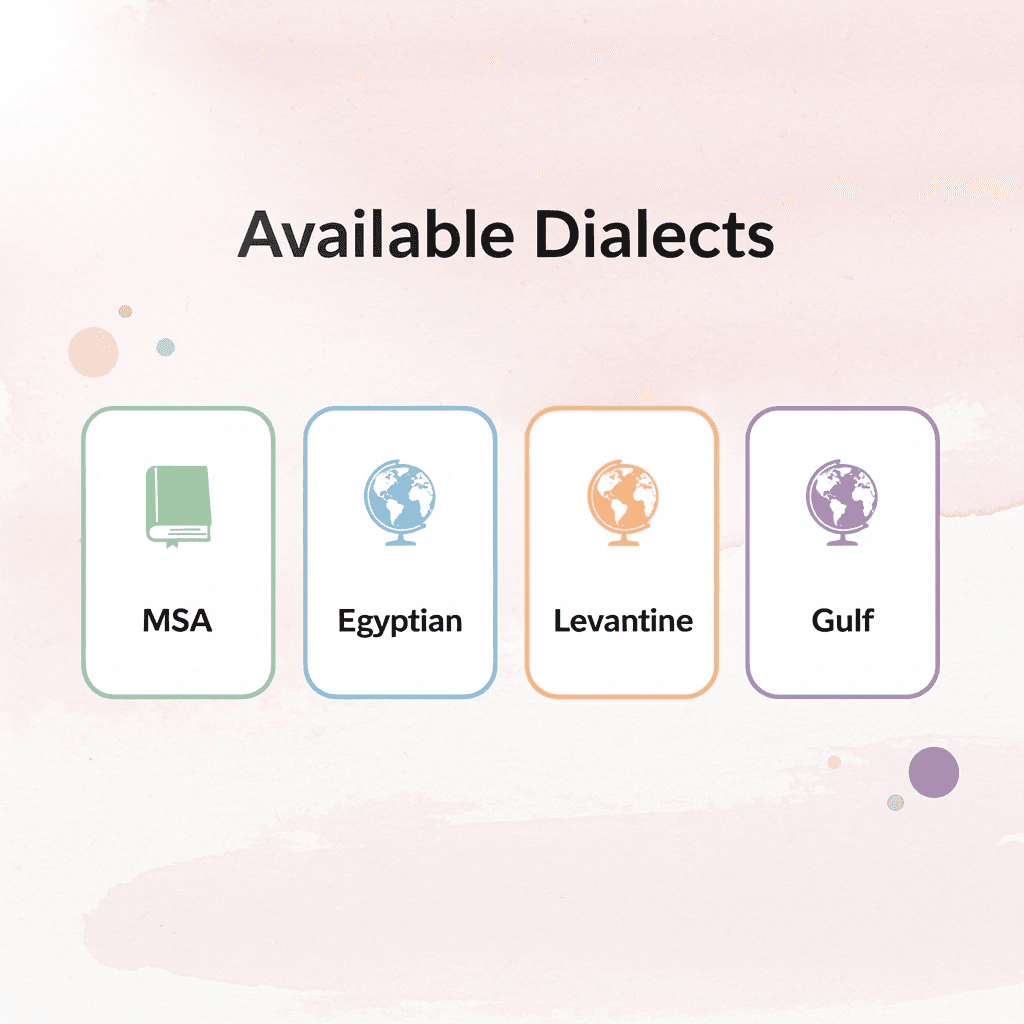
Kalam changes that by putting you in conversations where you speak. You choose your dialect (MSA, Egyptian, Levantine, or Gulf), practice targeted phrases in realistic scenarios, and get instant feedback on pronunciation, rhythm, and intonation. Our app scores your delivery in real time, so you know what needs adjustment.
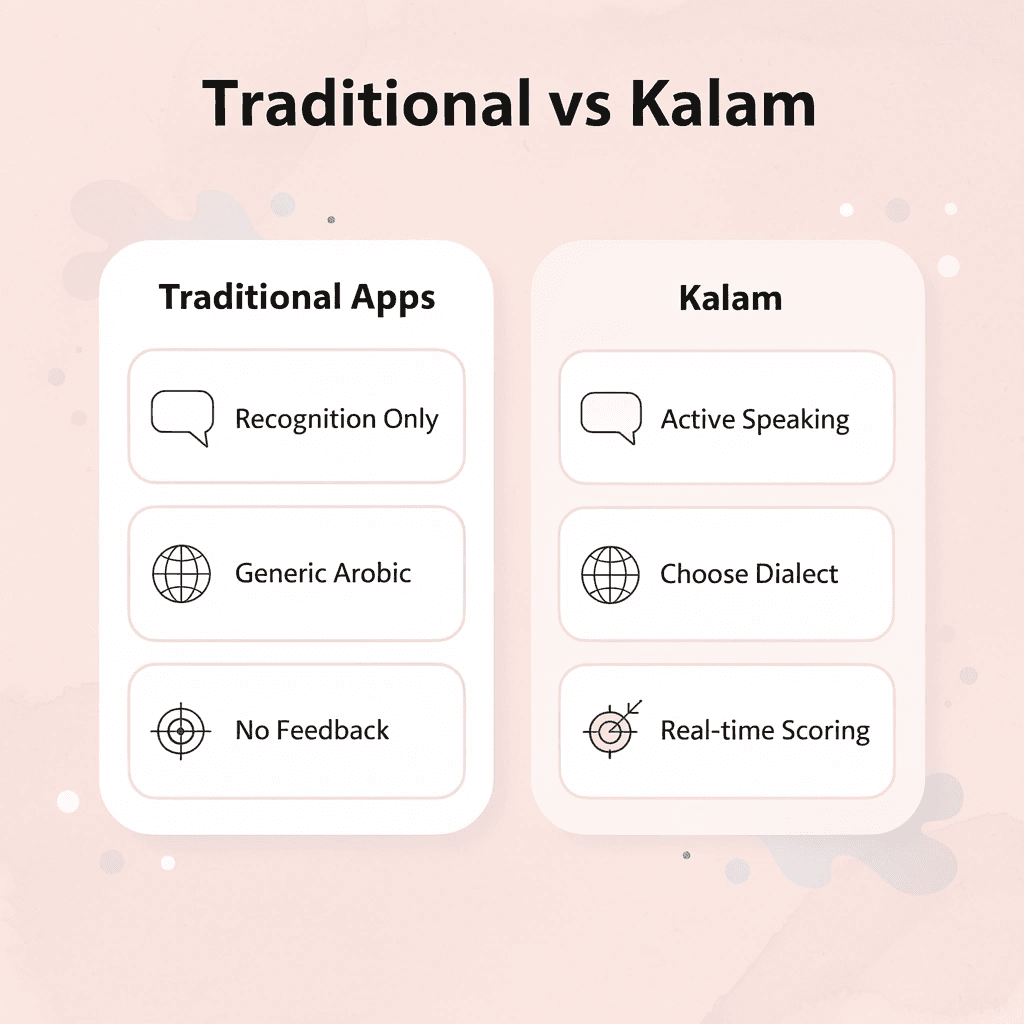
Traditional Apps | Kalam |
|---|---|
Test recognition only | Active speaking practice |
Generic Arabic | Choose your dialect |
No pronunciation feedback | Real-time delivery scoring |
Memorize definitions | Build conversational reflexes |
"The gap between knowing and doing doesn't close on its own. It closes when you practice the way native speakers actually talk."
The gap between knowing and doing closes when you practice the way native speakers talk, in the dialect you want to use, with feedback that improves your delivery.

⚠️ Warning: Most Arabic learners get stuck because they focus on recognition instead of production - don't let that be you.
Download Kalam from the App Store or Google Play. Start your free trial and complete your first lesson today.