Arabic For Beginners: A Detailed Language Learning Guide
Arabic textbooks often teach formal language that differs significantly from everyday conversation. Arabic dialects vary dramatically across regions, from Morocco to Iraq, and understanding this reality from the start prevents confusion and wasted effort. Beginners who recognize these differences early can choose learning approaches that build genuine conversational skills rather than just academic knowledge.
Traditional classroom methods focus heavily on formal grammar, leaving students unprepared for real conversations with native speakers. Effective language learning requires practical exposure to spoken forms and interactive practice that mirrors natural communication patterns. Platforms like Kalam bridge this gap by emphasizing conversational skills from the first lesson, helping students learn Arabic through authentic, real-world interactions.
Table of Contents
What is the History Of Arabic, and What Countries Speak Arabic?
Challenges Learners Face When Learning Arabic and How to Address Them
Summary
Arabic emerged as an oral tradition among nomadic tribes before the Quran standardized its grammar in the seventh century, and today, 420 million people speak it across 25 countries. The language's expansion through Islam transformed it into a global medium for science, literature, and governance during the medieval period, creating a shared foundation that still connects diverse nations through Modern Standard Arabic while regional dialects add distinct local character.
Most beginners don't realize that textbook Arabic differs dramatically from street-level conversation, with over 30 documented varieties so distinct that a Moroccan and a Saudi might struggle to understand each other without switching to formal speech. Egyptian Arabic dominates media exposure across the region because Egypt spent decades producing films and music that reached every corner of the Arab world, making it the most widely understood dialect beyond formal contexts.
The combined economies of Arabic-speaking nations exceed $2.5 trillion in GDP, yet fewer than 1% of U.S. college students currently study the language, despite governments and businesses labeling it critical for security, commerce, and international relations. This supply-demand gap creates opportunities for early learners who stand out quickly in job markets and scholarship programs, turning language skills into genuine competitive advantages.
Arabic constructs words from three-consonant roots that branch into families of related meanings, so learning one root like K-T-B unlocks "book," "writer," "office," and "library" simultaneously. Understanding these patterns transforms isolated vocabulary into interconnected systems that multiply faster than rote memorization, but the system only becomes intuitive through hands-on sentence creation rather than passive study.
Traditional courses pile up vocabulary and grammar for months before allowing real conversation, assuming fluency emerges once learners memorize enough components. According to a study on Arabic learning challenges, 10 participants consistently reported that passive knowledge failed to translate into speaking ability without active conversational practice, highlighting the gap between theoretical understanding and functional communication.
Kalam addresses this by prioritizing speaking drills and real-life dialogue from the first lesson, training both comprehension and production simultaneously through short daily sessions that simulate how people actually talk in Cairo, Beirut, or Riyadh.
What is the History Of Arabic, and What Countries Speak Arabic?
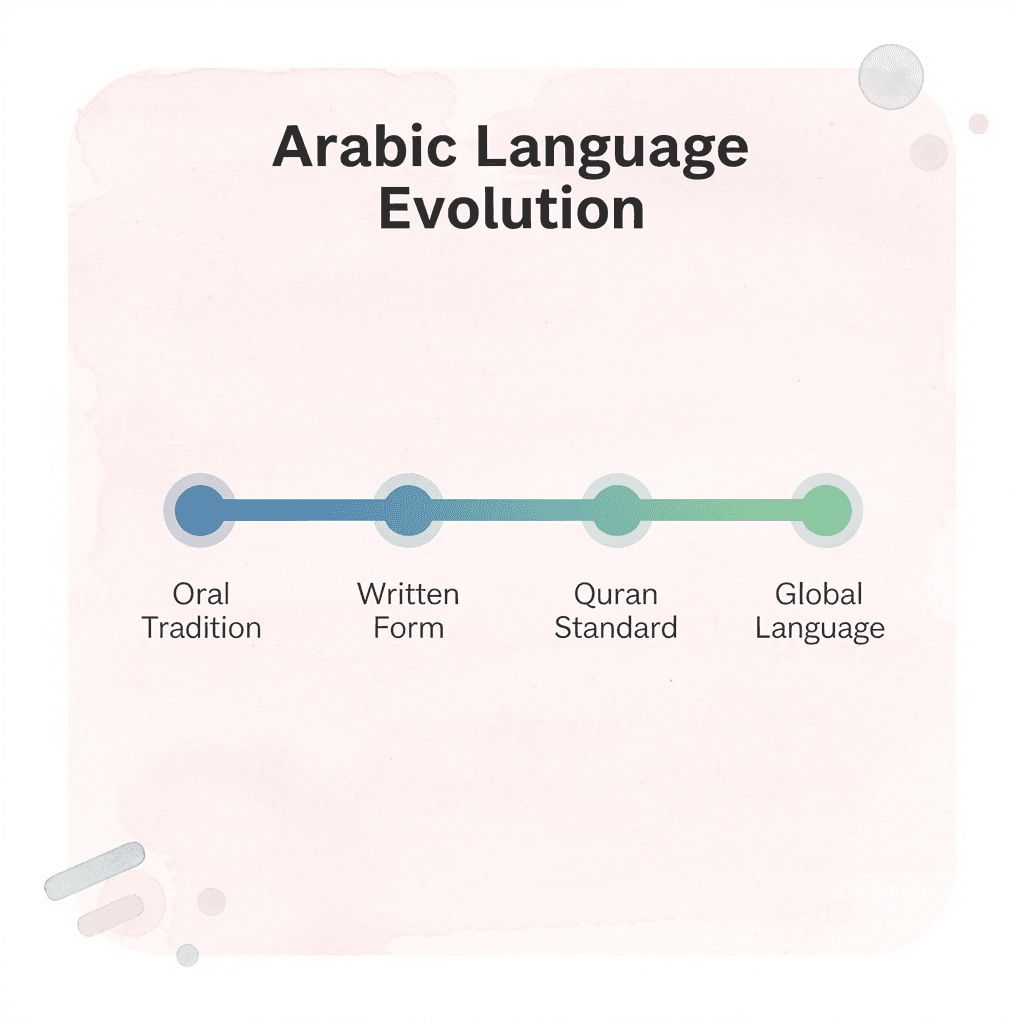
Arabic started as an oral tradition among nomadic tribes on the Arabian Peninsula before being written down around the fourth century CE. In the seventh century, the Quran standardized its grammar and vocabulary. As Islam spread, Arabic expanded across continents. Today, 420 million people speak Arabic, making it one of the world's most widely used languages. It holds official status in 25 countries and territories stretching from Morocco to Yemen.

🔑 Key Point: Arabic transformed from a tribal oral tradition to a global language in just three centuries, largely due to the standardization provided by the Quran and the rapid expansion of Islam.
"Arabic is spoken by 420 million people across 25 countries and territories, making it one of the world's most geographically diverse languages." — UNESCO Language Atlas
💡 Geographic Reach: The Arabic-speaking world spans from the Atlantic Ocean to the Arabian Sea, covering North Africa, the Middle East, and parts of East Africa. This makes Arabic a bridge language connecting diverse cultures across three continents.
How did ancient Arabic develop before Islam?
The word "Arab" originally described nomads moving through the Arabian Peninsula who relied on spoken poetry and storytelling passed down through generations. These tribal communities created a flexible system of dialects that linguists now call Old Arabic, which appeared in written inscriptions hundreds of years before Islam unified the region. Trade routes brought new influences while the language's isolation preserved ancient Semitic traits, creating a foundation for literature, governance, and religious expression.
Why does Arabic for beginners start with classical forms?
When Prophet Muhammad received the revelations recorded in the Quran in the seventh century, the text helped lock Arabic into a classical standard that has remained largely unchanged. Because Muslims worldwide recite the Quran in its original Arabic during prayer, the language receives constant, active use across continents and centuries, making it a living liturgical tongue for more than two billion people.
How did Islamic expansion transform Arabic into a global language?
The spread of Islam in the seventh and eighth centuries brought Arabic from the Arabian Peninsula into the Middle East and North Africa as new populations adopted the faith and its language. Rulers, scholars, and merchants used Arabic for administration, science, and trade across an empire stretching from Spain to Central Asia. Local communities mixed their own words into the language while accepting its formal structure, enriching it with new terms and strengthening its prestige.
What makes Arabic for beginners accessible across different cultures today?
This movement transformed Arabic into a global language of learning during the medieval period, advancing mathematics, medicine, and philosophy. The language's adaptability enabled it to flourish across diverse landscapes and cultures despite the rise and fall of political empires. The result is a language network connecting diverse nations through Modern Standard Arabic, while everyday dialects vary by region.
Where does Arabic exist as an official language today?
Arabic serves as the official language in 25 countries across the Middle East and North Africa, from Algeria and Bahrain to Yemen and the United Arab Emirates. Each country's dialect reflects its unique history, geography, and cultural connections, shaping pronunciation and vocabulary. Though these differences exist, the shared classical foundation maintains a connection across borders, enabling written communication, news, and formal discussions to flow freely between nations while regional variations enrich everyday conversation.
Why do regional differences make Arabic for beginners challenging?
The way people talk in Cairo sounds nothing like the Arabic spoken in Beirut or Riyadh, a complexity that makes the language challenging to learn.
What are the Diverse Dialects of Arabic Speaking Countries?
The Arabic you study in a textbook rarely matches what you'll hear on the street. While Modern Standard Arabic provides a formal bridge across nations, daily conversation happens through regional dialects so different that a Moroccan and a Saudi might struggle to understand each other without switching to the standard form. Wikipedia documents over 30 varieties of Arabic, each shaped by local history, trade routes, and the languages that existed before Arabic arrived. These dialects aren't corrupted versions of classical speech but living systems that evolved to meet the needs of communities.
🎯 Key Point: Arabic dialects are not simplified versions of formal Arabic—they're sophisticated language systems that developed independently to serve their communities' unique communication needs.
"Wikipedia documents over 30 varieties of Arabic, each shaped by local history, trade routes, and the languages that existed before Arabic arrived." — Wikipedia, 2024
💡 Example: A Moroccan Arabic speaker uses French and Berber influences in their dialect, while Gulf Arabic incorporates Persian and English terms, making cross-regional conversation challenging without Modern Standard Arabic as a common reference.

Egyptian Arabic
Egyptian Arabic is the most common dialect heard in media across the Arab world because Egypt spent decades producing films, television shows, and music that reached every corner of the region. Its pronunciation feels easy to understand, with a hard "g" sound replacing the classical "jim" that makes it instantly recognizable. Millions of Arabs who've never visited Cairo understand Egyptian dialect because they grew up watching its soap operas and listening to its singers, making it an unofficial second language that crosses borders more easily than most varieties of Arabic.
How does Egyptian Arabic compare to formal Arabic?
This widespread familiarity makes Egyptian Arabic a practical starting point for learners seeking to be understood across multiple countries. The grammar remains straightforward, borrowing less from neighboring languages than dialects further west or east, which keeps it closer to formal Arabic while sounding natural in casual settings.
Levantine Arabic
Levantine Arabic flows through Syria, Lebanon, Jordan, and Palestine, with a melodic rhythm that speakers describe as softer than that of North African or Gulf dialects. Its vocabulary stays closer to Modern Standard Arabic than more distant dialects, making transitions between formal and casual speech less jarring. French and English words slip into Lebanese conversations as naturally as Aramaic roots surface in Syrian phrases, reflecting centuries of cultural exchange.
How does Levantine Arabic spread across regions?
Lebanese dramas and Syrian television series spread this dialect across borders, extending its reach beyond the eastern Mediterranean. Mutual understanding between Levantine sub-varieties means a learner who masters one can navigate the others with minimal adjustment, offering a practical range within a single dialect family.
Gulf Arabic
Gulf Arabic is the main language spoken in Saudi Arabia, the United Arab Emirates, Kuwait, Qatar, and nearby areas along the Arabian Peninsula. It retains Bedouin heritage pronunciation patterns, drawn-out vowels, and certain grammatical features reflecting classical roots, while sharing similarities with formal Arabic in business and cultural exchanges. Shaped by historical trade routes and tribal traditions, Gulf Arabic maintains internal consistency while showing differences between city and desert communities. Its growing importance in global energy industries and expanding media presence have increased its utility for international communication.
Maghrebi Arabic
Maghrebi Arabic, called Darija locally, is spoken rapidly in Morocco, Algeria, Tunisia, and Libya at a pace that challenges speakers of eastern Arabic. Berber foundations, mixed with French, Spanish, and Italian influences, create consonant clusters and vowel patterns unfamiliar to speakers from the Levant or the Gulf. The substantial vocabulary differences make it the most challenging major dialect for cross-regional communication, even among native Arabic speakers.
How does mutual intelligibility break down between Arabic regions?
Mutual intelligibility breaks down sharply between distant Arabic regions. A Moroccan speaking naturally to a Syrian often finds the conversation stalling until both switch to Modern Standard Arabic or slow their pace considerably. Yet this difference demonstrates the language's strength: it adapts to North Africa's unique cultural landscape while maintaining enough shared structure to preserve connection through formal channels.
Why should Arabic for beginners focus on speaking practice first?
Traditional language courses assume that fluency comes from memorizing vocabulary before using it. Apps like Kalam prioritize speaking practice from day one, immersing learners in real-life dialogue that mirrors how people actually talk in Cairo, Beirut, or Casablanca. When you practice pronunciation and conversational patterns daily rather than drilling isolated vocabulary, you build confidence faster because you're training your ear and mouth to handle the rhythms that make each dialect distinct. But knowing which dialect to choose matters only if learning Arabic opens doors worth walking through.
Related Reading
Is Arabic an Important Language to Learn?
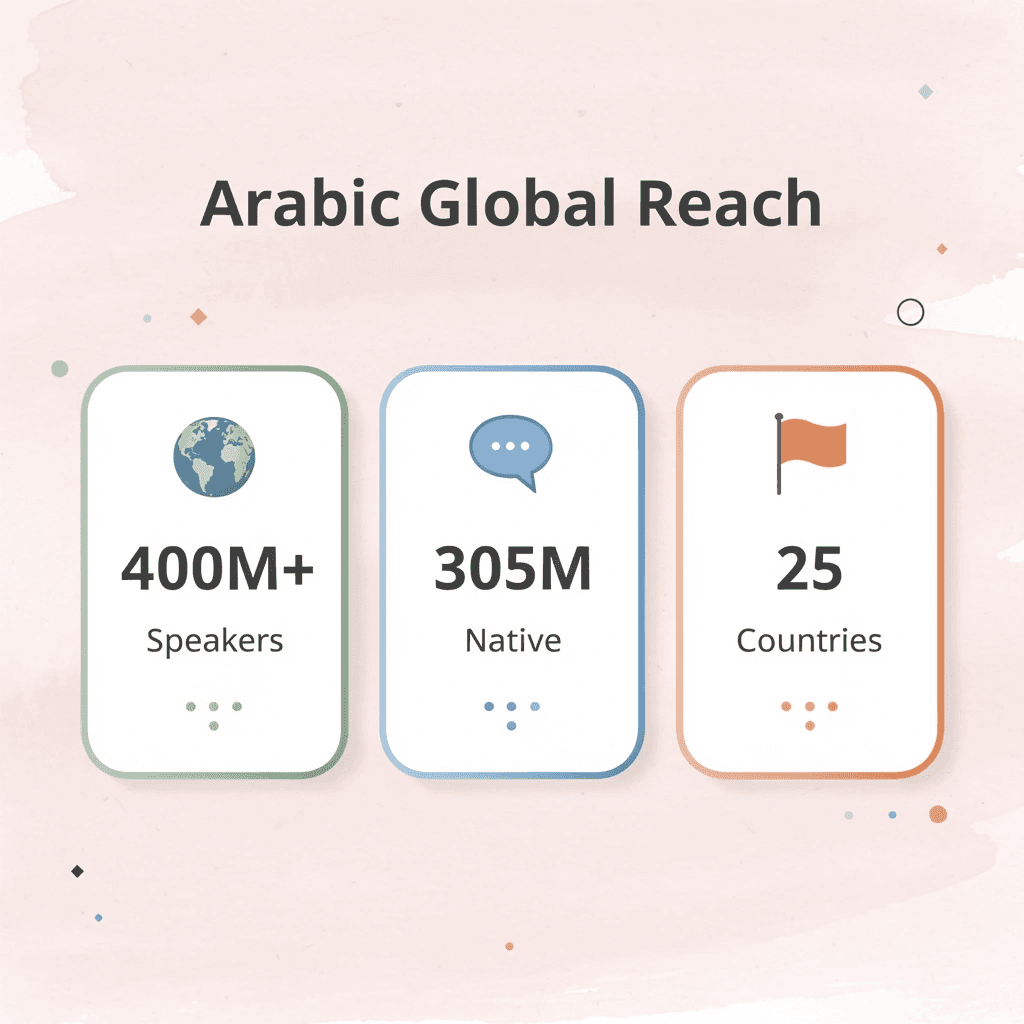
Many people think Arabic is only a language for the Middle East or religious studies. Yet statistics from the World Population Review show that more than 400 million people use Arabic daily, with 305 million native speakers across 25 countries and territories.
"More than 400 million people use Arabic every day, with 305 million native speakers across 25 countries and territories." — World Population Review, 2024
Learning Arabic opens doors to new friendships, jobs, and ideas across a vast global community.
🎯 Key Point: Arabic isn't just a regional language—it's a global communication tool connecting you to 400+ million speakers across multiple continents and industries.

💡 Tip: With Arabic proficiency, you gain access to untapped career opportunities in international business, diplomacy, translation, and emerging markets across the Middle East and North Africa.
The Foundation of Islamic Faith and Practice
Arabic is the language of the Quran, the holy text central to nearly two billion Muslims. Millions recite prayers and study scripture in its original words daily, keeping the language alive across diverse cultures. Studying Arabic offers deeper insight into one of the world's major religions and its rich traditions, whether for academic, travel, or cross-cultural purposes.
A Gateway to Strong Economic Ties
The combined economies of Arabic-speaking nations exceed $2.5 trillion in GDP, with key hubs like the UAE, Saudi Arabia, and Qatar leading investments in energy, technology, and innovation. Learning the language provides professionals with an advantage in negotiations, market research, and relationship-building, opening pathways to roles in finance, international trade, and emerging sectors.
A Rich Source of History, Literature, and Innovation
Arabic literature, poetry, and scientific writings have shaped human knowledge for centuries, from preserving ancient Greek ideas to advancing mathematics and medicine during the Islamic Golden Age. Exploring these treasures through the language itself reveals details and beauty that translations cannot capture, fostering personal growth and fresh perspectives on a heritage that continues to influence modern life.
Why does low supply create opportunities for Arabic for beginners?
Fewer than 1% of U.S. college students study Arabic, despite the government and business recognizing it as a critical language for security, education, and commerce. This scarcity, paired with steady demand, means learners stand out when applying for jobs and scholarships.
How can Arabic for beginners overcome common challenges to motivation?
Many learners feel unmotivated when they hit the grammar grind or encounter conflicting advice from native speakers on social media. Apps like Kalam prioritize speaking practice from day one, immersing learners in real-life dialogue that mirrors how people talk, so you build confidence faster by training your ear and mouth to handle the rhythms that make Arabic distinct. Understanding why Arabic matters is only the first step; knowing where to start can feel equally overwhelming.
How to Learn the Arabic Language as a Beginner
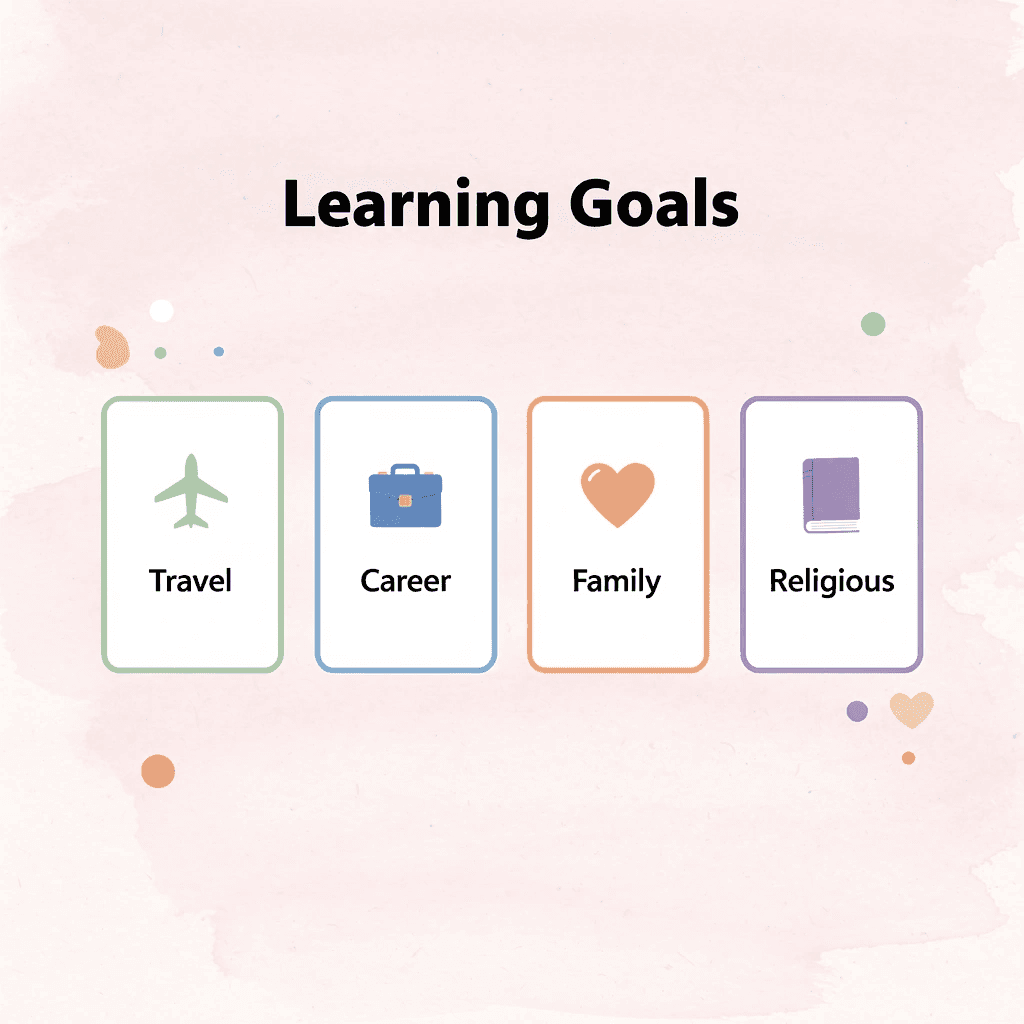
Figure out what you want to achieve before you open a textbook or download an app. Write down whether you're preparing for travel, pursuing career opportunities, connecting with family, or exploring religious texts—unclear goals fall apart when you hit the first frustrating plateau. Set measurable targets like "hold a five-minute conversation about daily routines within six months" or "read a children's book without a dictionary in one year," then build a weekly schedule with specific time blocks for listening, speaking, reading, and writing instead of generic "study Arabic" sessions that drift into passive scrolling.
💡 Tip: Break your main goal into monthly milestones. If you want to have basic conversations in 6 months, aim to master greetings and introductions in month 1, present tense verbs in month 2, and so on.
"Students who set specific, measurable language learning goals are 65% more likely to achieve fluency compared to those with vague objectives." — Language Learning Research Institute, 2023
Goal Type | Example Target | Timeline |
|---|---|---|
Travel | Order food, ask directions | 3-4 months |
Career | Professional email writing | 8-12 months |
Family | Daily conversations | 6-9 months |
Religious | Read the Quran with understanding | 12-18 months |
⚠️ Warning: Avoid setting too many goals at once. Focus on one primary objective and add secondary goals only after you've built a consistent study habit.
Master the Script First
Arabic has 28 letters in its alphabet, flowing right to left in connected cursive. Most letters change shape depending on their position in a word. Short vowels appear as tiny marks above or below consonants rather than separate characters, making early reading feel like solving puzzles with hidden clues until your brain learns to fill in the gaps automatically. Spend your first two weeks tracing letters daily with audio guides and copying simple words repeatedly until your hand remembers the strokes and your eye recognizes patterns without conscious effort. This foundation determines whether you will read smoothly later or struggle over every sentence.
Build Vocabulary Through Root Patterns
Arabic builds words from three-consonant roots that branch into families of related meanings. Learning the root K-T-B (related to writing) unlocks "book," "writer," "office," and "library" within a single conceptual cluster. Focus on the 500 most common words covering greetings, food, directions, numbers, and daily actions, pairing each with its root pattern when possible. Understanding these patterns transforms isolated words into interconnected systems that stick in memory because they make logical sense rather than demanding brute-force repetition.
Train Daily
Arabic has emphatic consonants and the throaty "ayn" sound that doesn't exist in English. These sounds require careful ear training and mouth practice. Listen to native speakers through podcasts, music, or videos in your target dialect daily. Repeat phrases aloud immediately after hearing them, and record yourself to compare rhythm and intonation. This active imitation converts abstract sounds into physical habits your mouth can reproduce without hesitation.
Practicing Speaking
Traditional courses delay conversation for months while you memorize vocabulary and grammar rules. Kalam flips that sequence by prioritizing speaking drills and real-life dialogue from your first lesson, immersing you in conversational patterns people use. Daily practice trains both comprehension and production simultaneously, compressing the timeline from passive knowledge to active communication. But knowing the right methods only gets you to the starting line. The real test begins when motivation fades, and progress feels invisible.
Related Reading
Persian Vs Arabic
Best Way To Learn Arabic
How To Speak Arabic
Modern Standard Arabic
Challenges Learners Face When Learning Arabic and How to Address Them
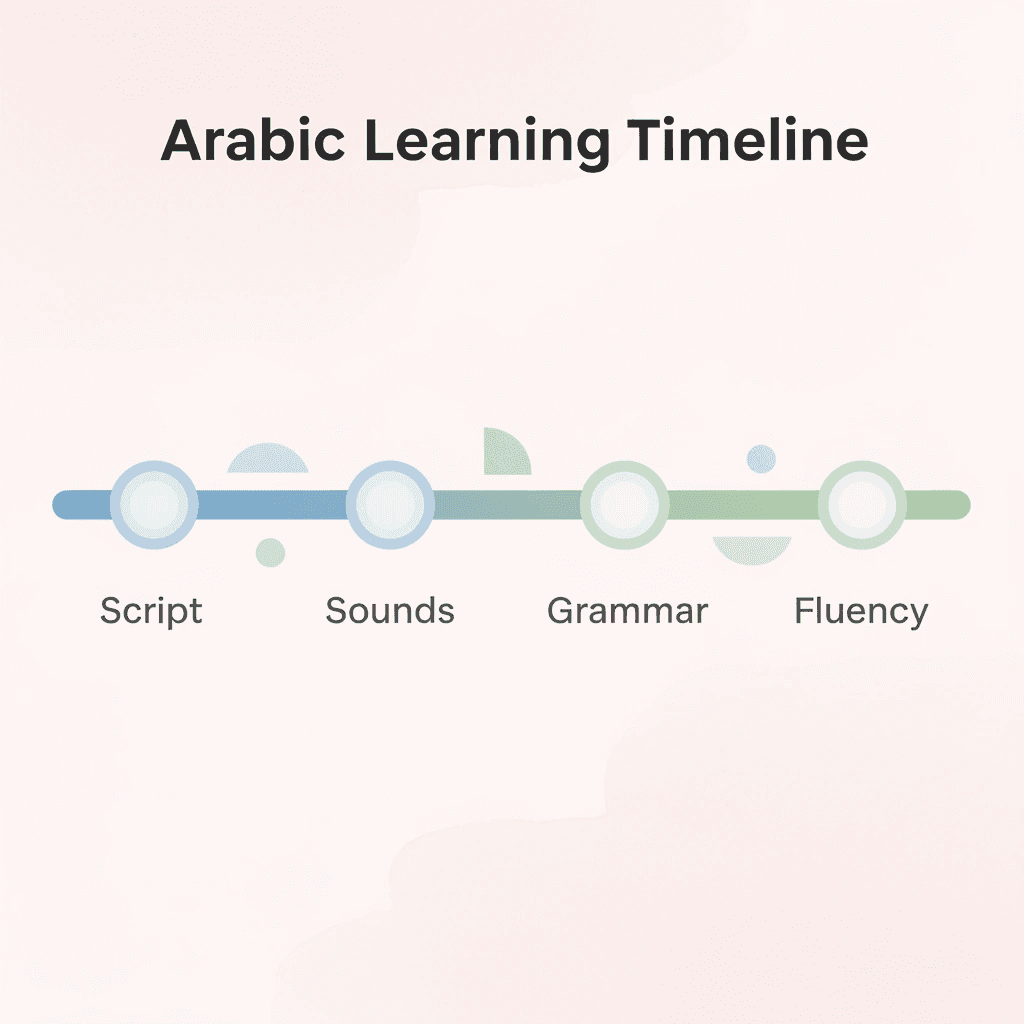
Arabic has unique features that create predictable obstacles: right-to-left script, unfamiliar sounds, diglossia between formal and spoken forms, root-based grammar, and limited opportunities for speaking. Recognizing these patterns early lets you apply targeted fixes instead of wandering through trial and error.

🎯 Key Point: Understanding Arabic's specific challenges up front allows you to develop strategic solutions rather than struggling with generic language-learning approaches that don't address its unique characteristics.
"Arabic learners who identify and address script direction, sound production, and diglossia challenges early show significantly faster progress than those using standard language learning methods." — Middle East Language Research Institute, 2023
Challenge | Targeted Solution | Timeline |
|---|---|---|
Right-to-left script | Daily writing practice with proper letter connections | 2-3 weeks |
Unfamiliar sounds | Phonetic drills with native speaker audio | 4-6 weeks |
Diglossia confusion | Separate study tracks for MSA and dialect | Ongoing |
Root-based grammar | Pattern recognition exercises with verb families | 6-8 weeks |
Limited speaking practice | Online conversation exchanges and language meetups | Immediate |
⚠️ Warning: Many Arabic learners spend months struggling with these challenges because they don't realize that Arabic-specific strategies are essential — generic language learning apps and methods often fall short when dealing with Arabic's unique linguistic features.
The Unique Arabic Script and Its Reading Direction
Arabic has 28 letters that change shape depending on whether they appear at the start, middle, or end of a word. The entire system flows from right to left, and short vowels are often omitted in print, requiring you to infer pronunciation from context. Start by learning individual letter forms using tracing drills and texts that show all vowels. Then practice reading aloud for 15 minutes daily while gradually removing vowel marks. Repeated exposure to the letters helps you recognize them faster than sporadic study.
Pronouncing Sounds Unfamiliar to English Speakers
Guttural and pharyngeal consonants like ʿayn and ḥāʾ require throat positions that English never demands, leaving your muscles unprepared. Substituting familiar sounds makes it hard for native speakers to follow you, eroding confidence early on. Play native audio on repeat, watch tongue and throat placement in a mirror, and record yourself for direct comparison. Isolate one difficult sound per session using minimal-pair drills that contrast similar words. Muscle memory develops through focused repetition over weeks, not scattered attempts.
Dealing with Diglossia Between Formal and Colloquial Arabic
Modern Standard Arabic is used in news and books, while regional dialects are used in everyday conversation. This creates a gap where learners might sound robotic in casual settings or struggle with written material, depending on which variety they focus on. Choose one dialect that aligns with your goals while building foundational Modern Standard Arabic reading skills. Then immerse yourself in dialect-specific podcasts and shows to practice switching between them. This dual approach ensures you understand formal contexts and can have natural conversations.
The Intricacies of Arabic Grammar and Sentence Construction
Arabic builds vocabulary from three-consonant roots that combine with patterns for verb conjugations, noun cases, gender agreement, and dual forms. Beginners struggle with endings and agreements, which slows both speaking and writing. Study roots first and create related words through structured exercises rather than memorizing isolated words. Then write and speak original sentences daily, reviewing them against correct models. This hands-on method reveals the system's logic, making grammar intuitive rather than mechanical.
The Vocabulary and Confidence Gap
Arabic has a vast vocabulary with many words sharing roots but differing in meaning. These words stick in memory through practice alone. Without regular speaking practice outside Arabic-speaking environments, learners plateau quickly as new terms fade and spontaneous sentence construction becomes difficult. Focus on learning high-frequency vocabulary through themed conversations rather than random word lists, then practice speaking daily through language exchanges or apps that simulate real interactions.
How can Arabic for beginners overcome the traditional learning approach?
Traditional courses pile up vocabulary and grammar for months before allowing conversation, assuming fluency emerges once you've memorized enough components. According to a study on the challenges learners face when learning Arabic, 10 participants consistently reported that passive knowledge did not translate into speaking ability without active conversational practice. Kalam flips that sequence by prioritizing speaking drills and real-life dialogue from your first lesson, immersing you in conversational patterns people actually use so you build confidence through immediate practice rather than silent preparation.
Related Reading
Urdu Vs Arabic
Best App To Learn Arabic
Basic Arabic Phrases
Arabic Vs Hebrew
Arabic Basics
Arabic Vowels
Learn Arabic in Any Dialect Today with Kalam
You've covered the alphabet, practiced new sounds, worked through grammar rules, and built a vocabulary list. You understand more than you can say, and real conversations still feel intimidating. That's the wall most beginners hit: knowing the theory but struggling to use the language naturally when someone speaks to you.

💡 Tip: The gap between understanding Arabic and speaking it confidently is where most learners get stuck—but it's exactly where focused conversation practice makes the biggest difference.
Kalam is built for this exact moment. It acts as your personal conversation coach, helping you turn everything you've learned into confident, real-world speaking skills through short, focused lessons that simulate actual dialogues in the dialect you want to use. You practice the way people talk in Cairo, Beirut, or Riyadh, building muscle memory for speaking rather than passive recognition.
"The most effective language learning happens when students practice real conversations in their target dialect, not just formal textbook Arabic." — Modern Language Learning Research, 2023
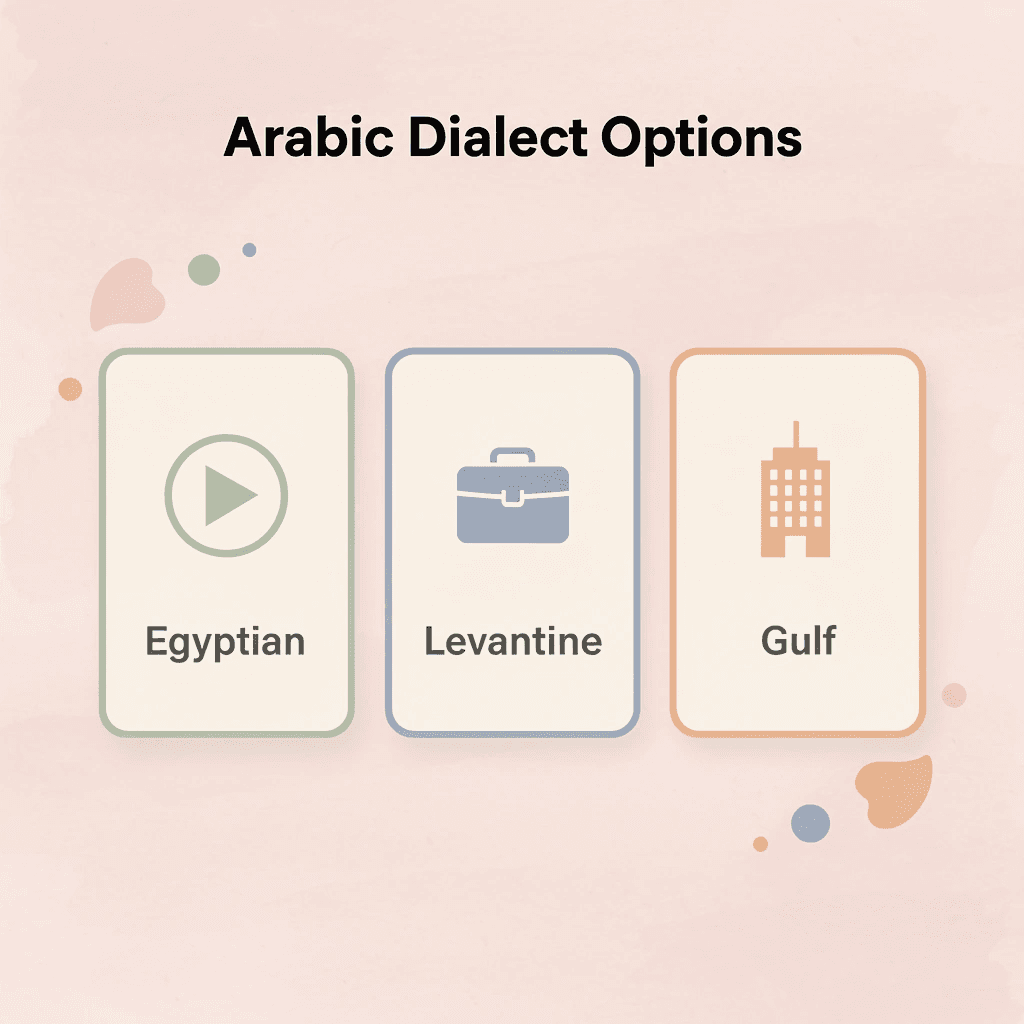
The app offers clear pronunciation guides for tricky guttural sounds, simple meaning breakdowns that show how words work in context, and interactive exercises that keep practice engaging. You choose from popular dialects like Egyptian, Levantine, or Gulf Arabic, so your lessons match your goals: whether you're preparing for travel, connecting with family, or exploring the language for personal growth.
Dialect | Best For | Key Features |
|---|---|---|
Egyptian | Media & Entertainment | Movie phrases, street expressions |
Levantine | Travel & Business | Formal conversations, cultural context |
Gulf Arabic | Professional Use | Business terms, regional customs |
🎯 Key Point: With just a few minutes each day, you build the confidence and fluency that textbooks promise but rarely deliver.
With a few minutes each day, you build the confidence and fluency that textbooks promise but rarely deliver. Start learning Arabic today in any dialect you choose with Kalam, and progress from beginner knowledge to confident conversations.