120+ Arabic Words to Help You Get Familiar With the Language
Arabic Dialects span from Morocco to the Gulf, each with a unique vocabulary that reflects local culture and daily life. While these regional varieties share common roots, the words you'll actually hear on the street can vary significantly from one country to another. Mastering essential vocabulary gives you the foundation to navigate real conversations, whether you're ordering food in a Lebanese restaurant or asking for directions in an Egyptian marketplace.
Learning core Arabic words opens doors to authentic interactions across the Middle East and North Africa. These building blocks help you handle practical situations like shopping, dining, and socializing while building confidence in your language skills. Ready to move beyond memorizing lists and start speaking with confidence? learn Arabic through words and phrases people actually use in daily conversations.
Summary
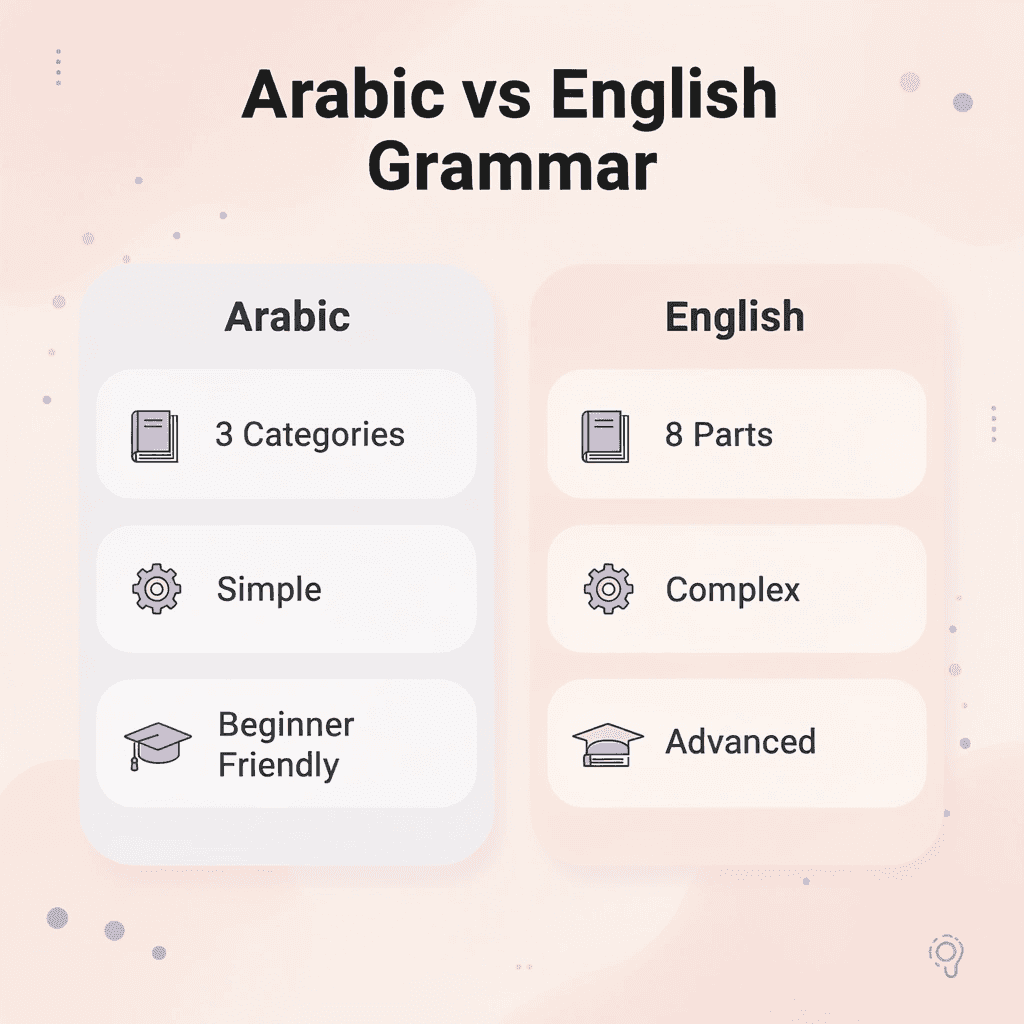
Arabic vocabulary is organized into just three fundamental categories: nouns, verbs, and particles. This tripartite system simplifies classification compared to English's eight parts of speech while maintaining grammatical precision. Understanding which category a word belongs to immediately reveals its grammatical function, making parsing and comprehension more efficient for the 400 million people who speak Arabic despite regional variations.
Spoken Arabic fragments into distinct regional varieties where the same concept gets expressed through completely different vocabulary. A simple greeting shifts from "izzayyak" in Cairo to "kifak" in Beirut to "labas" in Casablanca, each version feeling foreign to speakers from other regions. These aren't minor pronunciation tweaks but wholesale word replacements across thousands of everyday terms, turning mutual comprehension into active negotiation rather than automatic understanding.
The root-and-pattern system creates vocabulary connections that you have to earn through practice. Every Arabic word springs from a three-consonant root that carries a core idea, then morphs through patterns that shift meaning in predictable ways. The root k-t-b relates to writing, so "kataba" means "he wrote," "kitaab" means "book," "maktab" means "office," and "kaatib" means "writer," but beginners see no connection because English trains you to expect word families that share obvious letters.
Written Arabic drops the short vowel marks that tell you exactly how to pronounce a word, leaving only consonants and long vowels visible. The string "ktb" could be "kataba" (he wrote), "kutiba" (it was written), or "kutub" (books), depending on context, so you reconstruct pronunciation by combining root knowledge, grammatical awareness, and sentence meaning. This active problem-solving feels laborious until extensive listening exposure paired with reading practice builds automatic pattern recognition.
Learners can reach higher B1 to lower B2 proficiency in Arabic within 5 to 7 months when combining intensive listening with active speaking practice, according to data from the language learning community. The physical act of speaking embeds vocabulary deeper than silent review because your motor cortex participates in memory formation. Repetition builds automaticity through neural pathways that passive reading never creates, turning fragile recognition into confident production.
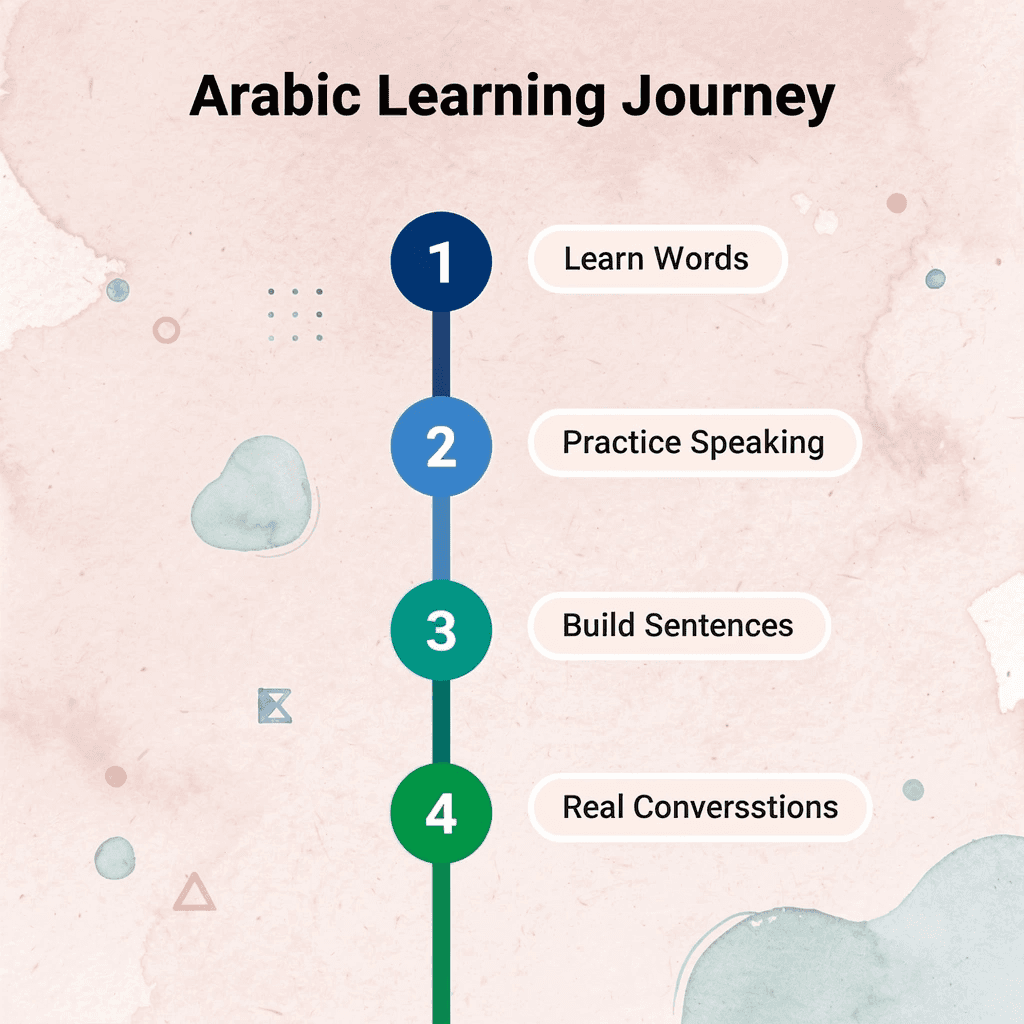
Kalam addresses this by structuring practice around producing full phrases aloud, embedding pronunciation and context simultaneously so your brain links sound, meaning, and usage in one motion rather than three separate steps.
Table of Contents
What are the Different Types of Arabic Words, And How Are They Classified?
120+ Arabic Words to Help You Get Familiar With the Language
What are the Different Types of Arabic Words, And How Are They Classified?
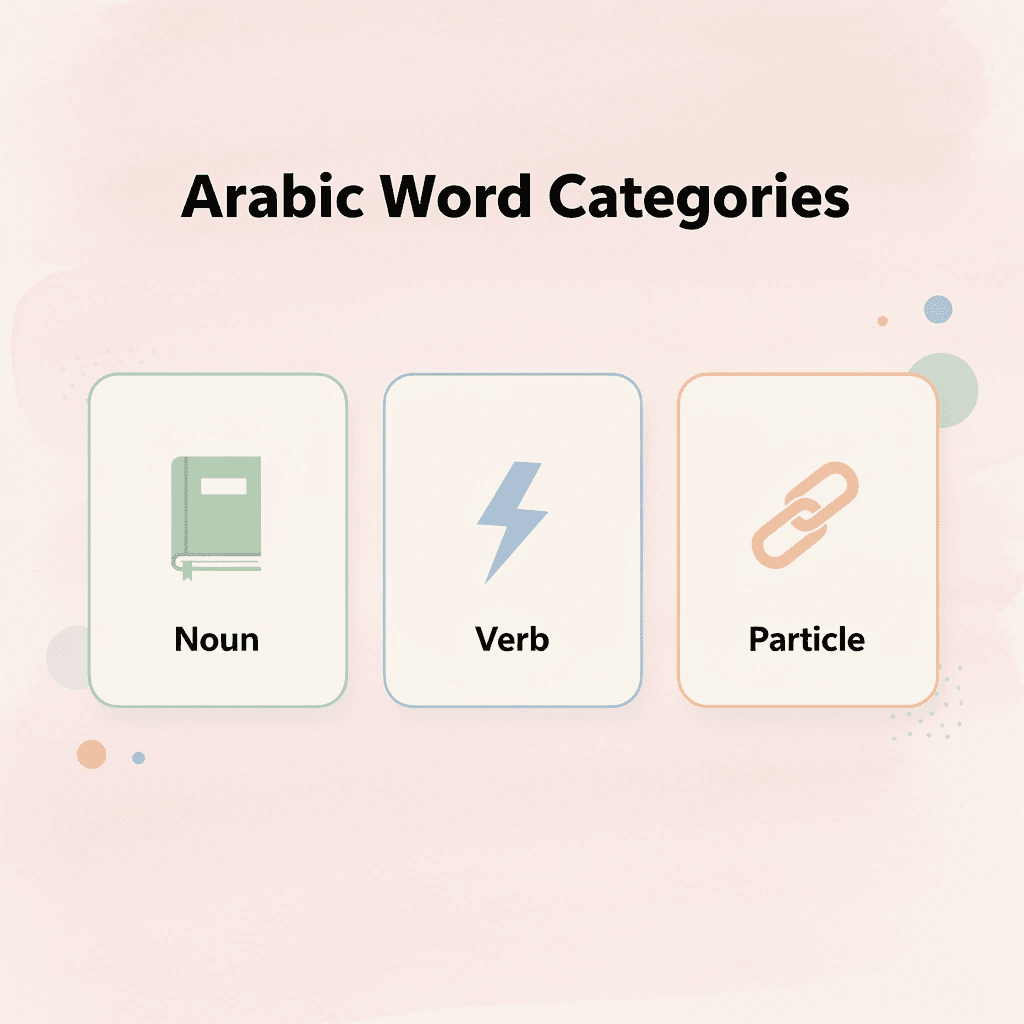
Arabic organizes every word into three basic categories: nouns (ism), verbs (fi'l), and particles (harf). Unlike English's eight parts of speech, this system simplifies classification while maintaining grammatical precision. According to IstiZada, nouns carry meaning independently of time, verbs express actions tied to their occurrence, and particles connect or modify the other two.

🎯 Key Point: Arabic's three-category system is significantly simpler than English grammar, making it easier for beginners to classify words and understand their grammatical functions.
"Arabic nouns have meaning on their own without reference to time, verbs show actions tied to when they happen, and particles connect or change the other two." — IstiZada, Arabic Language Statistics
Word Type | Arabic Name | Function |
|---|---|---|
Noun | Ism | Has meaning independent of time |
Verb | Fi'l | Shows actions tied to a specific time |
Particle | Harf | Connects or modifies other words |
💡 Example: In the phrase "the student writes," "student" is a noun (ism) with independent meaning, "writes" is a verb (fi'l) showing present action, and "the" would be a particle (harf) that modifies the noun.
Nouns (Ism)
Nouns represent people, places, objects, ideas, or qualities with complete, standalone meaning. They function as subjects, objects, or modifiers, undergoing changes for case, gender, and number to fit their grammatical roles. This category encompasses what English splits into nouns, pronouns, adjectives, and adverbs. A noun may appear as masculine or feminine, singular, dual, or plural, definite or indefinite, primitive or derived from a root, with each variation signaling precise grammatical relationships. Gender defaults to masculine unless marked by specific endings like a tied taa; number shifts through suffixes or broken plural patterns; definiteness emerges through the article al-, proper names, pronouns, or possessive structures.
Verbs (Fi'l)
Verbs show actions, states, or occurrences and are always connected to time. They change form to match the person, number, gender, voice, and mood, making them the moving part of Arabic sentences. Perfect forms show completed past actions, imperfect forms show present or future actions, and imperative forms give commands. Derived from triliteral or quadriliteral roots, verbs change through causative, reflexive, or intensive patterns while preserving their core meaning. The verb automatically agrees with the subject through conjugation, eliminating the need for helper words like English requires.
Particles (Harf)
Particles lack independent meaning; they connect, modify, or relate other words by functioning as prepositions, conjunctions, articles, and interrogatives. A particle like "min" governs the genitive case on following nouns, while "wa" links elements as a conjunction, and "hal" transforms statements into questions. Their fixed, non-inflecting nature contrasts with the variable forms of nouns and verbs. Many learners underestimate particles because of their size, yet they direct sentence flow and add nuance that makes meaning precise.
How does the three-part system create clarity in Arabic words?
The three-part system clarifies meaning efficiently. When you encounter an unfamiliar word, its category immediately reveals its grammatical function. A noun ending indicates case and number; a verb prefix indicates person and tense; a particle's position shows what it relates to. This structural efficiency serves more than 400 million Arabic speakers, providing a shared grammatical framework despite regional variation.
Why does understanding categories make memorizing Arabic words more effective?
Memorizing vocabulary becomes more effective when you understand how words function within these three categories. Kalam embeds grammatical patterns into speaking practice, so you learn noun-verb-particle relationships through repetition rather than abstract study. When you practice real dialogue, you encounter nouns in their natural case forms, verbs conjugated for actual contexts, and particles connecting ideas the way native speakers do. But knowing the three categories forms the foundation; the real complexity emerges when you realize these words shift dramatically depending on where Arabic is spoken.
Related Reading
How Do Arabic Words Differ Between Dialects?
Arabic dialects have their own words that developed over hundreds of years of regional growth and cultural exchange. Though all types of Arabic stem from classical Arabic and share a basic structure with Modern Standard Arabic (MSA), spoken forms often use different words instead of standard terms. This means everyday words for common ideas vary significantly by region.

🎯 Key Point: While MSA serves as the formal standard across the Arab world, regional dialects have developed their own vocabulary that can make cross-regional communication challenging for native speakers.
"Regional Arabic dialects can differ so significantly that speakers from distant areas may struggle to understand each other, despite sharing the same linguistic roots." — Arabic Language Studies, 2023

💡 Tip: When learning Arabic, focus on one specific dialect first rather than trying to master multiple regional variations simultaneously, as this approach leads to better fluency and less confusion.
Everyday Vocabulary Shifts Among Major Dialect Groups
Basic terms for common objects and actions vary noticeably across regions. The word for "bread" is "aish" in Egyptian Arabic but typically "khubz" or "khobz" in Gulf and Levantine varieties, reflecting how regional preferences shape vocabulary for daily essentials. These differences allow speakers to identify regional origins quickly, though communication between groups sometimes requires clarification. These variations occur because dialects focus on practical, frequently used words shaped by local environments and traditions. What feels natural in one area might sound strange elsewhere, yet mutual understanding often occurs through context or shared MSA knowledge.
Incorporation of Loanwords from Neighboring Languages
Dialects borrow terms from languages tied to historical trade, colonization, or migration. Maghrebi Arabic integrates French and Berber influences, such as adapting "fromage" into "formaj" for cheese, reflecting North Africa's cultural contacts. These additions enable speakers to express modern ideas while preserving Arabic grammar patterns. Egyptian Arabic draws heavily from Turkish, English, and Italian sources due to past interactions. Levantine varieties similarly incorporate Turkish and Aramaic elements in select terms. Loanwords reveal how external forces have shaped spoken Arabic while preserving its Semitic foundation, making each dialect a living record of its region's history.
Divergence in High-Frequency Words Compared to Modern Standard Arabic
High-use verbs and function words show the sharpest changes from MSA, since these terms appear frequently in casual speech and evolve rapidly. The concept of "want" shifts from MSA's "urīd" to forms like "ʿāyiz" in Egyptian, "biddi" in Levantine, or "bghīt" in Maghrebi speech. This pattern appears consistently in words for "go," "see," or "bring," which become "anzil," "shāf," or "jab" across many dialects.
Why do Arabic words simplify in everyday speech?
Everyday language favors simplicity and speed over formal precision, allowing dialects to streamline expressions for practical use. While MSA remains consistent for media, education, and official settings, these spoken adaptations create barriers for learners while fostering strong regional identities.
Differences in Interrogative Words and Basic Particles
Question words change significantly across dialects. "What?" becomes "eh?" in Egyptian Arabic, "shoo?" in Levantine Arabic, or "ash?" in Maghrebi Arabic, diverging from MSA's "madha?" to shorter local variants. Negation follows similar local rules: Egyptian uses "mesh" for adjectives and a "ma-...-sh" sandwich for verbs, while Moroccan uses "mashi" and a similar structure. Syrian varieties simplify this with "mu" or plain "ma." These words demonstrate how each dialect has evolved while preserving core Arabic principles.
How have historical events shaped Arabic words across regions?
Historical events—conquests, cultural exchanges, migrations—have driven vocabulary splits by blending Arabic with local or foreign elements. Gulf dialects stay closer to MSA roots due to fewer external disruptions, while Maghrebi forms absorbed Berber and European influences through prolonged contact, creating layered lexicons that mirror each area's unique path. Geographic isolation amplifies these distinctions, turning shared roots into specialized terms suited to local life. Despite differences, core similarities ensure cross-understanding, especially with exposure.
Why do Arabic words present deeper challenges than expected?
This diversity strengthens Arabic globally by demonstrating its effectiveness across different communities. Learning these differences means understanding why Arabic learners often underestimate the difficulty of the challenge.
What Makes Learning Arabic Words Challenging?
Many people think Arabic words are a confusing mix of unfamiliar letters and sounds. In reality, their elegant root-and-pattern design creates natural connections that make building vocabulary logical and fun once you understand the system.

🎯 Key Point: Arabic's root system isn't just about memorization—it's about recognizing intelligent patterns that connect hundreds of related words.
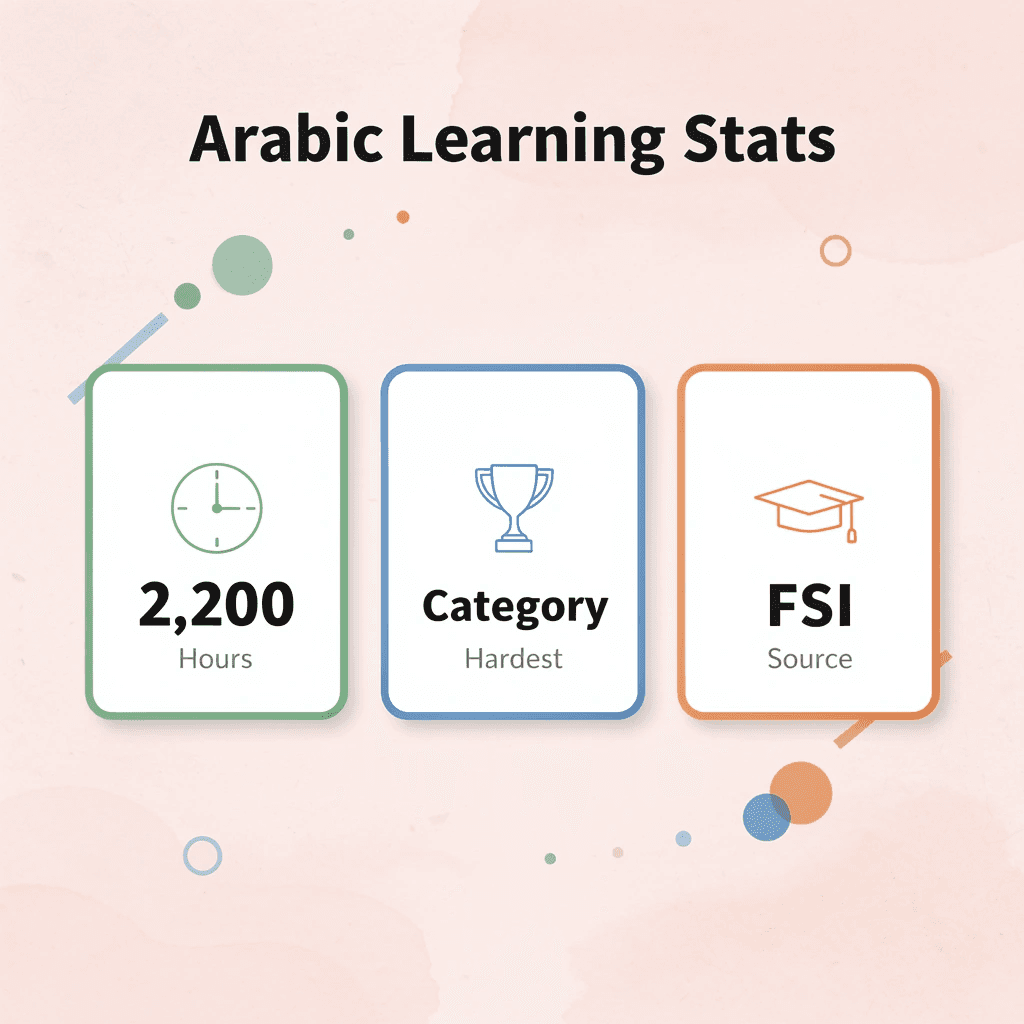
"English speakers typically need 2,200 hours of focused study to reach professional proficiency in Arabic." — U.S. Foreign Service Institute

The U.S. Foreign Service Institute reports that English speakers typically need about 2,200 hours of focused study to reach professional proficiency in Arabic, placing it among the toughest languages for native English speakers. Mastering the patterns that link every new word to others, however, boosts confidence and motivation.
⚠️ Warning: Don't let the 2,200-hour estimate discourage you—understanding root patterns can dramatically accelerate your vocabulary acquisition compared to rote memorization.
The Root-and-Pattern System Behind Most Words
Arabic builds thousands of words from just three consonants called a root, which hints at a core idea like "write" or "eat." Different patterns change that root to create nouns, verbs, or adjectives—sometimes dozens of related terms from one set of letters. Spotting the root within changing forms takes time and practice. Once you recognize these patterns, vocabulary no longer feels scattered. You begin predicting new words instead of memorizing them individually, which accelerates retention and reveals the language's hidden logic.
Short Vowels Often Left Out of Writing
Everyday Arabic text omits short vowel marks (harakat), so readers rely on context, roots, and experience to determine pronunciation and meaning. The same consonant group can represent multiple words until surrounding words clarify it, making reading initially slower than in scripts with complete vowel marks. When you practice regularly and listen frequently, your brain learns to fill in missing vowels automatically, as native speakers do. This skill accelerates your reading and improves word comprehension, enabling you to tackle real books, signs, and messages with greater ease.
Sounds Unique to Arabic That Changes Word Meanings
Arabic includes guttural and emphatic sounds (produced deep in the throat or with extra tension) that don't exist in English. A tiny difference in how you shape one sound can transform one word into a completely different one, so mispronouncing early on leads to confusion when trying to remember or use vocabulary correctly. Targeted listening and imitation drills train your ear and mouth to catch these differences. As the sounds become second nature, you gain sharper word recognition in conversations and media, making listening comprehension feel more natural.
A Few Shared Words with English
Unlike languages closer to English, Arabic offers almost no ready-made cognates or familiar-looking terms. Most vocabulary requires starting from scratch, without the memory shortcuts that help learners of Spanish or French quickly acquire dozens of words. Yet a handful of everyday English words trace back to Arabic roots: "coffee," "sugar," and "algebra." Noticing these bridges and grouping words by root provides helpful anchors and a growing sense of progress.
Words That Shift Meaning by Context or Have Close Synonyms
Arabic often uses a single word in several related but distinct ways, or offers multiple similar words where English uses one. Without sufficient context, it is easy to pick the wrong meaning or confuse similar-sounding options, which complicates both memorization and accurate use in speaking or writing. Putting yourself in short, real-life sentences and conversations helps you learn these small differences naturally. Over time, this richness lets you communicate more precisely and sound more natural.
Related Reading
Persian Vs Arabic
Best Way To Learn Arabic
How To Speak Arabic
Modern Standard Arabic
120+ Arabic Words to Help You Get Familiar With the Language
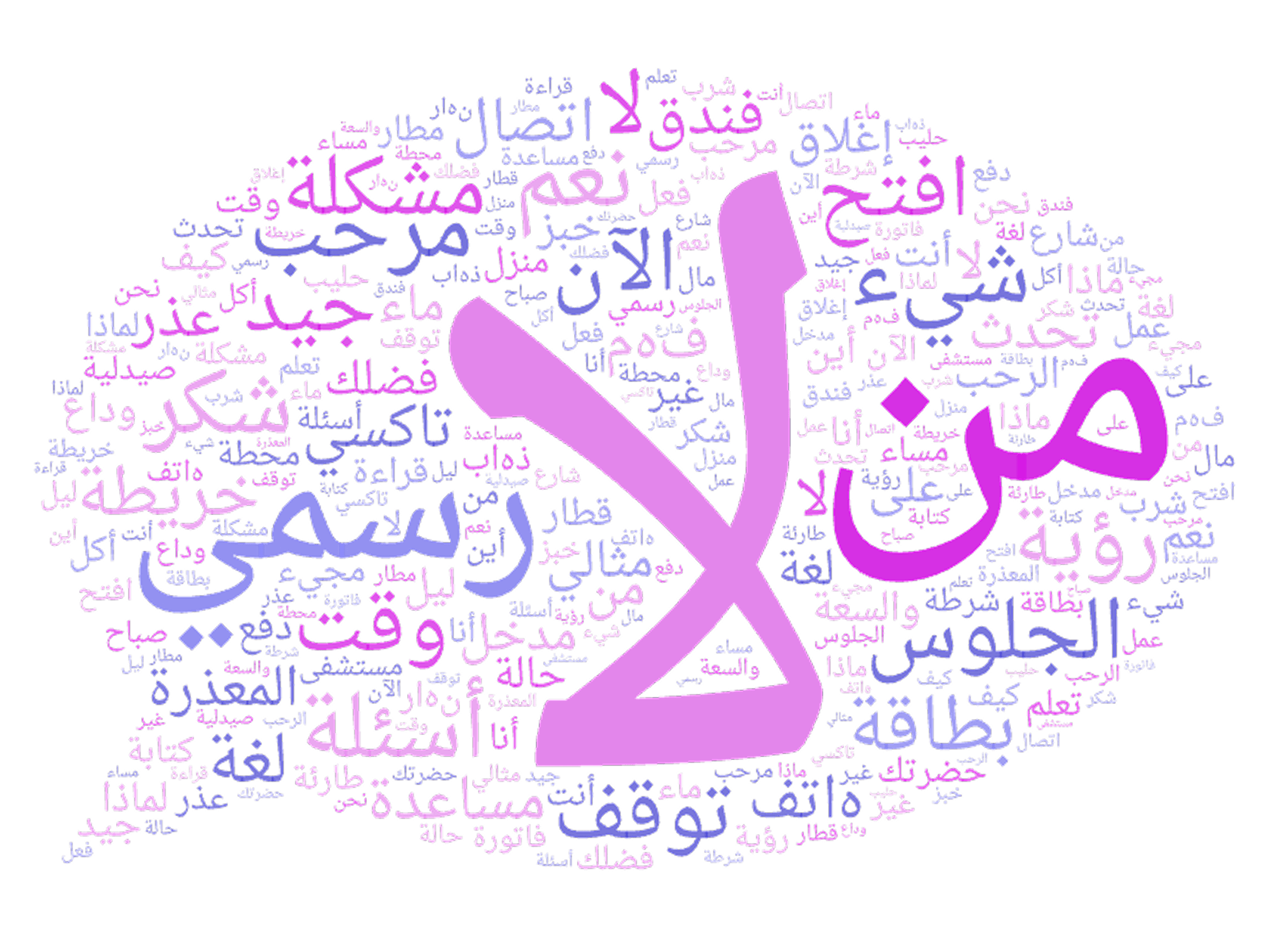
Arabic connects millions of people across the Middle East, North Africa, and beyond, offering a window into rich cultures, histories, and traditions. This guide presents around 120+ practical Arabic words and phrases for everyday use, organized into clear categories: greetings, pronouns, daily vocabulary, verbs, descriptors, connectors, and regional dialect.

🎯 Key Point: Learning these 120+ Arabic words will give you a solid foundation for basic conversations and help you navigate everyday situations in Arabic-speaking countries.
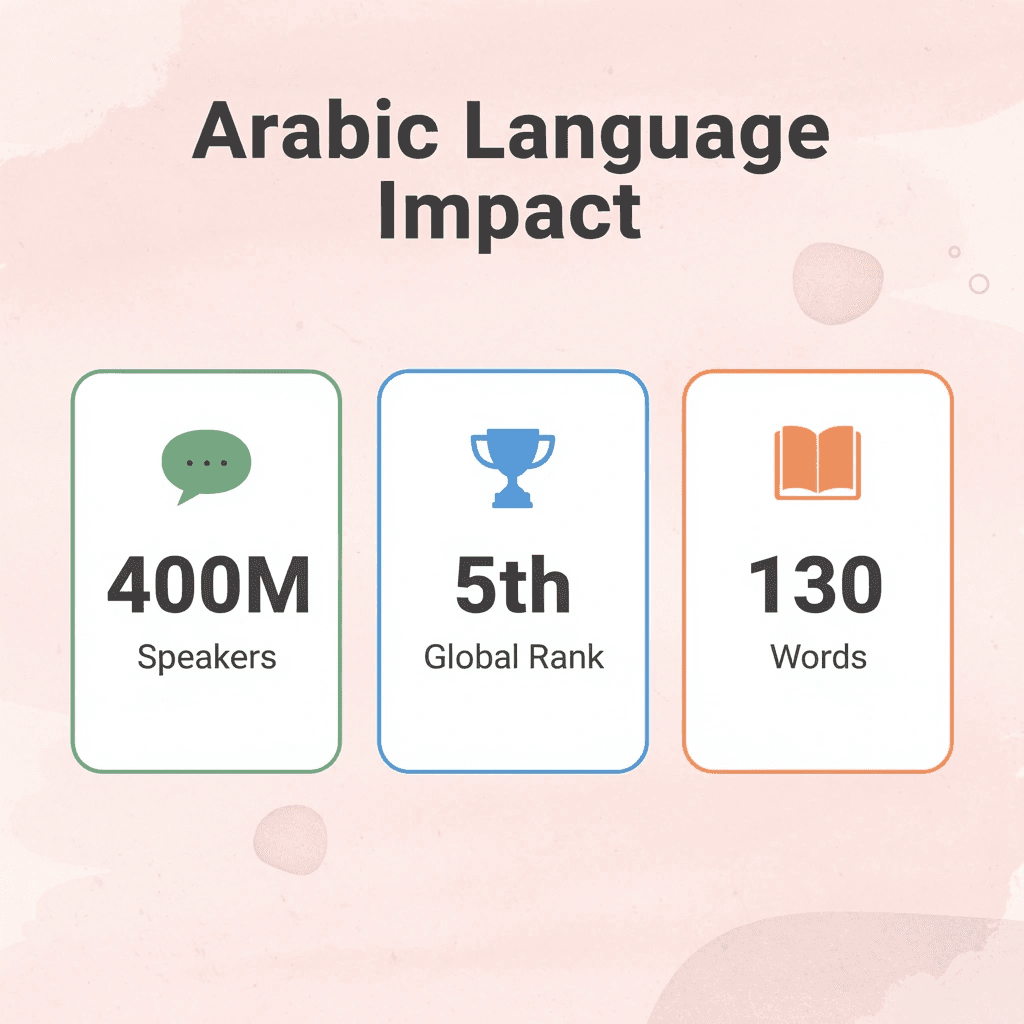
"Arabic is spoken by over 400 million people worldwide, making it the fifth most spoken language globally and an essential bridge to understanding Middle Eastern and North African cultures." — UNESCO Language Statistics, 2023
💡 Tip: Start with the greetings and pronouns sections first, as these form the backbone of daily interactions and will give you immediate confidence when speaking with native speakers.
Essential Greetings and Polite Expressions
Being polite at the start and end of conversations shows respect when speaking Arabic. These 11 basic phrases help you begin and finish talks smoothly while demonstrating cultural understanding.
What are the most important Arabic words for daily greetings?
Peace be upon you – السلام عليكم (as-salamu alaykum)
Good morning – صباح الخير (sabah al-khayr)
Hello – مرحبا (marhaba)
Goodbye – مع السلامة (ma'a as-salama) or إلى اللقاء (ila al-liqa')
Yes – نعم (na'am)
No – لا (la)
Okay – حسنا (hasanan)
Please – من فضلك (min fadlik)
Thank you – شكرا (shukran)
You're welcome – عفوا (afwan) or لا شكر على واجب (la shukr ala wajib)
I'm sorry – أنا آسف (ana asif)
I don't know – لا أعرف (la a'rif)
Arabic Personal Pronouns
Arabic pronouns show gender, number, and a special dual form for exactly two people. Since all nouns and pronouns have masculine or feminine traits, learning pronouns helps you avoid mistakes later.
Singular
I – أنا (ana)
You (feminine) – أنتِ (anti)
You (masculine) – أنتَ (anta)
He – هو (huwa)
She – هي (hiya)
Dual
We – نحن (nahnu)
You – أنتما (antuma)
They – هما (huma)
Plural
We – نحن (nahnu)
You (feminine) – أنتن (antunna)
You (masculine) – أنتم (antum)
They (feminine) – هن (hunna)
They (masculine) – هم (hum)
Everyday Vocabulary for Real-Life Situations
Words that frequently appear in discussions of time, places, things, and people are essential to everyday conversation. Learning these words enables you to describe your daily activities, navigate your surroundings, and discuss with others.
Words Related to Time
Day – يوم (yawm)
Week – أسبوع (usbu')
Month – شهر (shahr)
Year – سنة (sana)
Today – اليوم (al-yawm)
Yesterday – أمس (ams)
Tomorrow – غدا (ghadan)
Hour – ساعة (sa'a)
Minute – دقيقة (daqiqa)
Time – زمن (zaman)
Before – قبل (qabl)
After – بعد (ba'd)
Now – الآن (al-an)
Words for Places and Locations
Here – هنا (huna)
There – هناك (hunak)
Place – مكان (makan)
School – مدرسة (madrasa)
Shop – متجر (matjar)
Work – عمل ('amal)
Bathroom – حمام (hammam)
City – مدينة (madina)
Country – دولة (dawla)
Room – غرفة (ghurfa)
Mosque – مسجد (masjid)
Morocco – مغرب (maghrib)
Airport – مطار (matar)
Words for Objects and Things
Thing – شيء (shay')
Nothing – لا شيء (la shay')
House – منزل (manzil)
Car – سيارة (sayyara)
Words – كلمات (kalimat)
Language – لغة (lugha)
Water – ماء (ma')
Movie – فيلم (film)
Food – أكل (akl)
Tea – شاي (shay)
Phone – هاتف (hatif)
Words for People and Relationships
Woman – امرأة (imra'a)
Man – رجل (rajul)
Girl – بنت (bint)
Boy – ولد (walad)
Friend – صديق (sadiq)
Person – شخص (shakhs)
Husband – زوج (zawj)
Wife – زوجة (zawja)
Family – عائلة ('a'ila)
Name – اسم (ism)
Common Verbs to Build Sentences
Action words turn basic vocabulary into full thoughts. These 27 frequently used verbs appear in the standard third-person masculine singular present form, the conventional way Arabic lists them for learners.
Which Arabic words help express basic actions?
To do – يفعل (yaf'al)
To be – يكون (yakun)
To become – يصبح (yusbih)
To say – يقول (yaqul)
To come – يأتي (ya'ti)
To go – يمشي (yamshi)
To arrive – يصل (yasil)
To see – يرى (yara)
To send – يرسل (yursil)
To have – يملك (yamlik)
To take – يأخذ (ya'khudh)
To wait – ينتظر (yantazir)
To meet – يلتقي (yaltaqi)
To live – يعيش (ya'ish)
What Arabic words cover thinking and communication?
To think – يفكر (yufakkir)
To give – يعطي (yu'ti)
To receive – يتلقى (yatalaqqa)
To know – يعرف (ya'rif)
To make – يصنع (yasna')
To use – يستعمل (yasta'mil)
To learn – يتعلم (yata'allam)
To eat – يأكل (ya'kul)
To drink – يشرب (yashrab)
To laugh – يضحك (yad'hak)
To read – يقرأ (yaqra')
To like – يحب (yuhibb)
To write – يكتب (yaktub)
Useful Adjectives and Adverbs.
Descriptive words add color and precision to your speech. These 19 simple terms let you express opinions, sizes, qualities, and intensity in conversations.
Many, lots of – كثير (kathir)
Few – قليل (qalil)
Big – كبير (kabir)
Small – صغير (saghir)
Tall – طويل (tawil)
Short – قصير (qasir)
Near – قريب (qarib)
Far – بعيد (ba'id)
Good, nice – جيد (jayyid)
Bad – سيء (sayyi')
Easy – سهل (sahl)
Difficult – صعب (sa'b)
Beautiful – جميل (jamil)
Ugly – قبيح (qabih)
Delicious – لذيذ (ladhidh)
Hot – سخن (sukhn)
Cold – بارد (barid)
Very – جدا (jiddan)
Key Conjunctions and Connectors
Linking words keep your ideas flowing naturally. These five common connectors appear in almost every spoken exchange.
But, however – لكن (lakin)
Also – و (wa)
For example – مثلا (mathalan)
So – لذا (lidha)
Then – ثم (thumma) or بعدها (ba'daha)
Practice these words regularly, and you'll notice quick progress in understanding and responding. Knowing the words is the starting point. The real question is how you turn this foundation into conversational ability.
How to Learn and Speak Arabic Words Fluently and Faster
Learning to speak Arabic fluently faster requires active, targeted practice that focuses on real conversations and daily habits rather than textbook study. By focusing on high-impact strategies—pronunciation, context-driven vocabulary, listening, and speaking drills—you can make noticeable gains in weeks instead of months.

🎯 Key Point: The fastest path to Arabic fluency isn't through passive textbook study—it's through immersive practice that mimics real-world conversations and builds muscle memory for pronunciation patterns.
"Active practice with targeted strategies can accelerate language acquisition by focusing on high-frequency vocabulary and conversational patterns that appear in daily communication." — Language Learning Research, 2023

⚡ Pro Tip: Dedicate 15-20 minutes daily to speaking practice rather than spending hours on passive grammar study—consistency beats intensity when building conversational fluency.
Choose a Specific Arabic Dialect Early On
Picking one dialect, like Egyptian or Levantine, from the start prevents confusion and accelerates your path to fluency. Every day speech varies significantly across regions, and dialects are used in real conversations. Choosing one lets you learn useful phrases faster without spreading yourself too thin, while Modern Standard Arabic addresses formal needs. This focused approach builds momentum as you encounter the same patterns repeatedly in media and chats, transforming abstract learning into natural understanding. Over time, it equips you to handle spontaneous conversations with locals, making fluency feel achievable rather than overwhelming.
Master Pronunciation and Script Fundamentals First
Getting the right pronunciation is the most important part of speaking Arabic fluently. Learn the unique sounds, such as the throaty "ayn" and emphatic consonants, that don't exist in English. Pair this with basic script recognition to read simple words aloud. Avoid transliterations, which can damage your accent over time. Doing daily repetition drills helps your mouth and ears remember the sounds, so words flow naturally. This foundation helps you overcome common problems, such as mishearing phrases, and learn new words faster while speaking with confidence.
Learn High-Frequency Words in Practical Contexts
Focus on the most common Arabic words and phrases used in daily life, such as greetings, directions, and food terms. Study them within full sentences or short dialogues. This method mirrors how native speakers acquire language, embedding meaning and usage simultaneously for quicker recall. Contextual learning reveals cultural nuances that enrich conversations and help you avoid awkward literal translations. As your core vocabulary grows, you gain the tools to improvise in real situations, improving your speaking speed and comfort.
Immerse Yourself in Arabic Audio and Media Daily
Surround your daily routine with Arabic podcasts, songs, news clips, or shows to train your ear for natural rhythm and intonation. Passive exposure during commutes or chores familiarises you with word flow and common expressions, bridging study and real-life use. Consistent immersion sharpens listening comprehension, which boosts speaking fluency by providing models to emulate. Over weeks, unfamiliar sounds become recognizable patterns, enabling quicker and more natural conversational responses.
Practice Speaking Actively from the Beginning
Start making sentences and having simple conversations right away, even if they're not perfect, because speaking early helps you remember better and builds confidence faster than silent reading. Find language partners through apps or communities to practice everyday conversations, fixing mistakes as you go. This hands-on approach helps you move from knowing words to using them in real situations, revealing gaps you can address immediately. Regular speaking sessions help you develop the smooth flow needed for fluent talking, transforming hesitation into natural communication.
How does daily practice help you learn Arabic words effectively?
Short daily practice sessions work better than occasional long ones. Plan your time around quick wins, such as learning new words or practicing conversations. This approach builds steady progress without fatigue. Tools that enable real conversation practice keep you motivated by providing immediate feedback and demonstrating your improvement.
Which smart tools can accelerate your Arabic words mastery?
Apps like Kalam fit naturally here as a dedicated resource for speeding up spoken Arabic. The conversation coach helps you master Arabic through focused practice, an easy-to-use interface, and just a few lessons a day. By adding such resources to your routine, you create accountability and variety that sustain long-term fluency gains. But perfect practice hits limits without one final element that transforms mechanical accuracy into natural expression.
Related Reading
Arabic Vs Hebrew
Basic Arabic Phrases
Arabic Vowels
Arabic Basics
Urdu Vs Arabic
Best App To Learn Arabic
Learn Arabic in Any Dialect Today with Kalam
Learning 120+ Arabic words is a good first step, but many learners get stuck at that point. They recognize vocabulary on paper, yet freeze when speaking or understanding real conversations. The gap between recognizing and producing words stops most learners before reaching fluency.

🎯 Key Point: Recognition doesn't equal production - you need active practice to bridge this gap.
That's where Kalam comes in. Our platform turns learned words into confident Arabic speech through practical conversational practice across different dialects. With pronunciation guides, meaning breakdowns, and interactive games, our lessons help you use words naturally rather than just recognize them.
"The gap between recognizing and producing words stops most learners before reaching fluency." — Language Learning Research, 2024
💡 Tip: Start with short sentences and build up to full conversations for maximum confidence.
You can build these 120+ words into short sentences and everyday dialogues at your own pace, in any dialect you choose. Whether you want to chat with friends, travel to an Arabic-speaking country, or feel more comfortable with the language, our personalized lessons support your next step.