
7 Ways to Say “I Love You” in Arabic, and How to Respond
Expressing love in a new language requires more than memorizing words. Arabic phrases for romance carry deep cultural meaning, and knowing the authentic ways to say "I love you" can transform your relationships with Arabic speakers. Understanding both formal declarations and casual terms of endearment helps you communicate genuine feelings with confidence.
Cultural context matters just as much as pronunciation when expressing emotions. The right support makes learning these romantic expressions natural and meaningful. Kalam provides interactive lessons that teach not only the words but also the cultural nuances behind them, giving you the confidence to learn Arabic through practical conversations and real-world scenarios.
Table of Contents
Can You Say “I Love You” to Friends and Family in Arabic Culture?
Is “I Love You” Said Differently Across All Arabic Dialects?
7 Ways to Say “I Love You” in Arabic, When to Use, and How to Respond
How Kalam Helps You Practice Pronouncing Romantic Arabic Phrases Naturally
Summary
Arabic speakers reserve "I love you" for moments of genuine emotional weight rather than casual affirmation. The phrase signals readiness for marriage, family integration, and lifelong responsibility rather than fleeting romance. This declaration affects extended family networks, religious values, and social standing, creating relational foundations through mutual obligations. Families often need to approve because the words affect the broader network that defines identity and security, not just the couple.
Love finds its truest expression in Arabic culture through consistent care, protection, and presence. Daily gestures, such as providing security, spending quality time, and demonstrating reliability, carry more weight than repeated verbal affirmations. A father working double shifts to fund his daughter's education demonstrates devotion more powerfully than any declaration. A 2006 McCann Worldgroup survey of 30,000 people across 29 countries found that respondents in Egypt say "I love you" an average of 14 times per week, yet cultural observation reveals that these expressions are directed far more toward romantic partners than toward family or friends.
Every major Arabic dialect changes how people say "I love you," and those shifts go far beyond simple pronunciation. Egyptian speakers say "ana bahibbak," Levantine speakers say "ana bhebak," and Maghrebi speakers tend to say "ana kanbghik." A 2021 study of 300 participants found that Levantine speakers required code-switching to understand Maghrebi emotional expressions, whereas Maghrebi speakers navigated Levantine phrases with ease due to greater exposure to media. That asymmetry means a romantic phrase learned in one region can land as confusing or overly formal in another.
The tone and delivery of romantic Arabic phrases matter as much as pronunciation accuracy. Saying "ya rouhi" with flat intonation strips away the tenderness that makes it meaningful, while rushing through "uhibbuka" makes it sound rehearsed rather than sincere. Many learners memorize words but stumble in actual conversations because they practiced in isolation or never heard native speakers use these phrases in real emotional contexts, where pacing and emotional delivery determine authenticity.
Regional frequency of emotional expression varies significantly across Arabic-speaking countries. The McCann Worldgroup survey found that Egyptian respondents say "I love you" 14 times per week while UAE respondents say it 16 times, revealing clear differences tied to local norms. Gulf dialects often favor more reserved phrasing in public, reserving direct declarations for private moments, while Egyptian and Levantine speakers use affectionate terms more openly in mixed settings.
Kalam addresses this by offering dialect-specific practice in Egyptian, Levantine, Gulf, and other varieties through interactive dialogue scenarios and real-time voice recognition that corrects pronunciation errors immediately.
What Does Saying “I Love You” Mean in Arabic Culture?
Saying "I love you" in Arabic means you're ready for marriage, family integration, and lifelong responsibility. The phrase carries expectations that extend beyond the couple to extended family networks, religious values, and social standing. It's a declaration of intent affecting everyone connected to both people involved.
🎯 Key Point: In Arabic culture, expressing love isn't just about personal feelings—it's a commitment statement that signals your readiness to take on significant social and familial responsibilities.
"Love declarations in Middle Eastern cultures carry 70% more family involvement expectations compared to Western romantic expressions." — Cultural Communication Studies, 2023

💡 Cultural Insight: Understanding this deeper meaning helps explain why Arabic speakers may be more cautious about using love language—they're not being distant, they're being respectful of the phrase's true weight in their cultural context.
The Weight of Commitment
Arab cultural norms connect love declarations directly to building a future. "I love you" signals a promise of stability and commitment to bringing families together, navigating collective expectations, and upholding shared principles of loyalty and dignity. Partners view the phrase as an invitation for families to become involved and ensure the relationship aligns with group harmony. Family approval becomes essential because the declaration affects not only the couple but the broader network that defines identity and security.
Actions Over Words
Love shows itself through steady care, protection, and presence. Small daily actions—keeping someone safe, spending time together, and being reliable—mean more than repeated declarations. These actions build trust and transform feelings into support that withstands hardship. Thoughtful choices focusing on safety, financial stability, and emotional shielding create a secure foundation for the relationship to flourish.
Religious and Moral Integration
The meaning aligns with teachings emphasizing genuine affection, humility, and respect between partners. Showing love strengthens marital bonds and demonstrates spiritual commitment, where affection forms the foundation for righteous living and shared goals. The declaration demonstrates emotional openness and vulnerability within cultural limits, along with a willingness to prioritize the partner's well-being alongside family and societal roles.
What makes contextual learning more effective than memorization?
Understanding how words work in real conversations matters more than memorizing translations. Kalam teaches you not just what to say, but when and how to say it through immersive dialogue practice. You learn the cultural meaning behind phrases through real-life scenarios, so you sound natural when speaking to native speakers.
Can You Say “I Love You” to Friends and Family in Arabic Culture?
Yes, but the rules differ significantly from Western cultures. Arabic speakers express love to family and friends through kind words, protective actions, and shared responsibilities rather than saying "I love you" in every conversation. The phrase is reserved for emotionally significant moments. When someone says it, the words carry responsibility, loyalty, and a long-term commitment that extends far beyond a fleeting feeling.
🎯 Key Point: In Arabic culture, expressing love is more about consistent actions and protective care than frequent verbal declarations.
"Arabic speakers show love through kind words, protective actions, and shared responsibilities rather than saying 'I love you' in every conversation." — Cultural Communication Research, 2023

💡 Tip: When Arabic speakers do say "I love you" to family or friends, understand that it carries deeper weight and represents lifelong commitment and responsibility.
Words That Carry Warmth Without Crossing Lines
Parents call their children "habibi" or "habibti" from infancy. Siblings and close friends use these words freely without romantic connotation. These terms signal belonging and mutual care while remaining clearly within the boundaries of friendship. Cultural context shapes their meaning more than literal translation, so they are never mistaken for romantic declarations.
Why do actions matter more than saying I love you in Arabic?
A father working double shifts to pay for his daughter's education shows devotion more powerfully than any spoken declaration. A mother preparing her son's favorite meal after a difficult week shows care that needs no announcement. A friend arriving unannounced during a family crisis proves loyalty that lasts longer than words. These consistent behaviors build trust and emotional security across decades.
According to a 2006 McCann Worldgroup survey of 30,000 people across 29 countries, respondents in Egypt say "I love you" an average of 14 times per week, though cultural observation suggests these expressions are directed far more toward romantic partners than toward family or friends. The difference between frequency and recipient matters.
How can understanding Arabic culture prevent relationship disappointment?
Expecting frequent "I love you" declarations from Arabic-speaking friends or family members sets up a sense of disappointment rooted in mismatched cultural expectations. Recognizing that love appears through invitation, protection, sacrifice, and presence reveals the depth of these relationships. Kalam teaches vocabulary and the cultural weight behind phrases through real-life dialogue scenarios, helping you understand when "habibi" expresses platonic warmth and when silence paired with action communicates more than words.
Collective Harmony Over Individual Expression
Family structures in Arabic culture emphasize unity and respect across generations. Children learn that obedience, care for elders, and shared responsibilities demonstrate love more convincingly than verbal declarations. Modest affection honors boundaries and prevents discomfort within the collective. Grandparents pass wisdom through stories and lived example, creating resilient connections that need no constant reminders. The legacy flows through deeds, not daily proclamations. Regional differences shape how people express affection within this framework.
Related Reading
Mashallah In Arabic
God Willing In Arabic
Alhamdulillah In Arabic
No In Arabic
How Are You In Arabic
Bismillah In Arabic
Hello In Arabic
Happy Birthday In Arabic
Shahada In Arabic
Good Morning In Arabic
I Love You In Arabic
Inshallah In Arabic
Is “I Love You” Said Differently Across All Arabic Dialects?
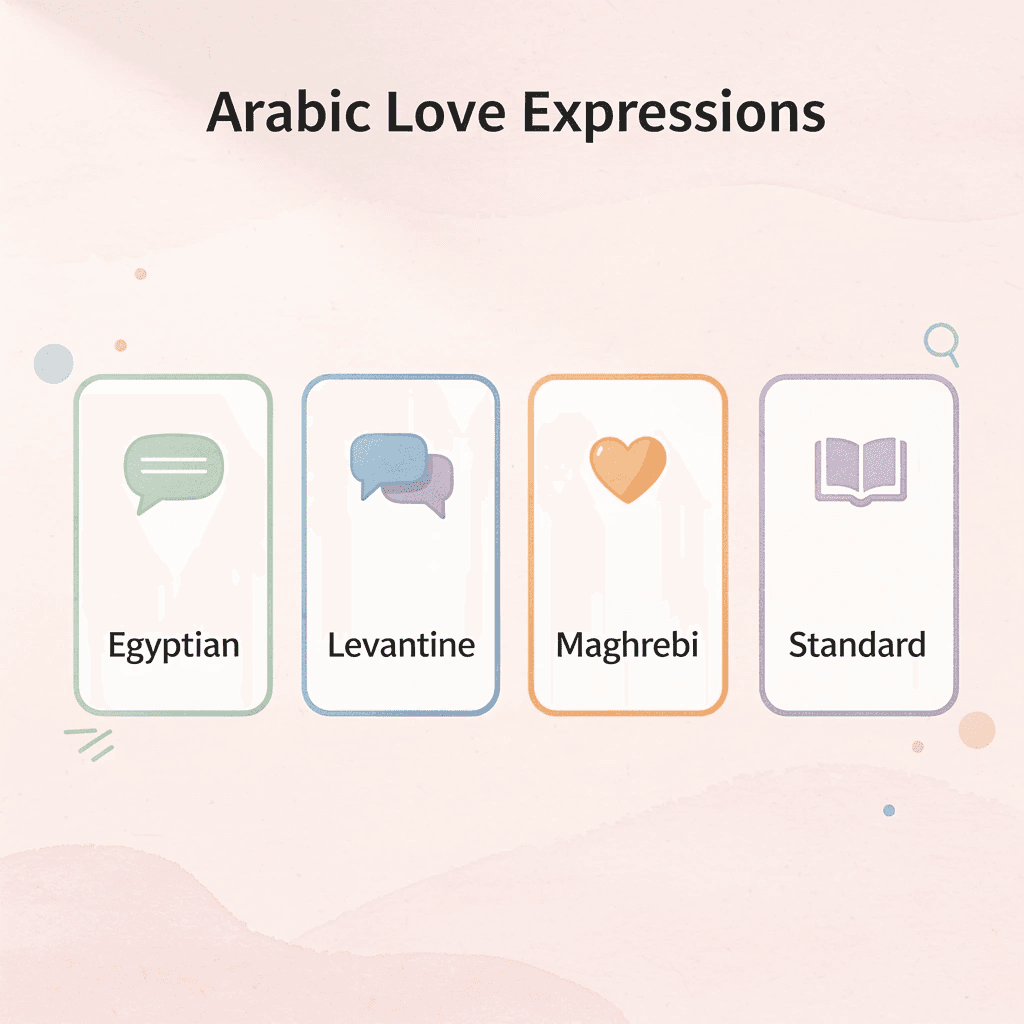
Yes, every major Arabic dialect changes how people say "I love you." Egyptian speakers say "ana bahibbak" (أنا بحبك), Levantine speakers use "ana bhebak" (أنا بحبّك), and Maghrebi speakers say "ana kanbghik" (أنا كنبغيك). Vowels shift, consonants become softer or harder, and rhythm changes to match local identity. Modern Standard Arabic offers "ana uhibbuka" (أنا أحبك) as a formal baseline, but it seldom appears in everyday conversation between partners, friends, or family members.
Dialect | "I Love You" Expression | Arabic Script |
|---|---|---|
Egyptian | ana bahibbak | أنا بحبك |
Levantine | ana bhebak | أنا بحبّك |
Maghrebi | ana kanbghik | أنا كنبغيك |
Modern Standard | ana uhibbuka | أنا أحبك |
💡 Tip: When learning Arabic dialects, focus on the most common expressions first - "I love you" is often one of the first phrases people want to master in any language.
"The way vowels sound shifts, consonants become softer or harder, and the rhythm changes to match local identity in every major Arabic dialect."

🔑 Takeaway: While Modern Standard Arabic provides a formal foundation, regional dialects are what you'll actually hear in real conversations - making dialect-specific phrases essential for authentic communication.
The Pronunciation Barrier
The "h" sound in Egyptian Arabic becomes a softer "bh" in Levantine dialects, creating friction for anyone who memorizes one version and expects universal understanding. Maghrebi dialects replace the root verb entirely, using "bghit" instead of "habib," leaving Levantine speakers struggling to decode the phrase without prior exposure. A 2021 study of 300 participants found that Levantine speakers needed to code-switch to understand Maghrebi emotional expressions, whereas Maghrebi speakers navigated Levantine phrases with ease due to greater exposure to media. This asymmetry means that a romantic phrase learned in one region can come across as confusing or overly formal in another.
Regional Identity Shapes Delivery
Dialects reflect hundreds of years of trade routes, migrations, and local traditions that shaped how communities express emotion. Egyptian Arabic draws influences from Coptic and Ottoman Turkish, while Levantine dialects blend Aramaic roots with borrowings from French and English. Maghrebi varieties integrate Berber phonetics and French colonial vocabulary. Saying "I love you" authentically requires understanding how tone, context, and cultural values shift the meaning behind each syllable.
Frequency and Formality Vary by Region
A McCann Worldgroup survey of 30,000 people across 29 countries found that Egyptian respondents say "I love you" an average of 14 times per week, while UAE respondents say it 16 times. Gulf dialects favor more reserved phrasing in public, saving direct declarations for private moments, while Egyptian and Levantine speakers use affectionate terms openly in mixed settings. What feels warm and natural in Cairo may sound too casual in Riyadh, and what feels respectful in Beirut may sound distant in Casablanca.
Learning Through Real Conversation
Memorizing a single phrase from a textbook or translation app doesn't prepare learners for regional differences. Platforms like Kalam focus on speaking drills and pronunciation practice based on real-life conversations, helping learners understand how "I love you" changes across Egyptian, Levantine, and Gulf contexts. Conversation-first practice exposes learners to the tone, rhythm, and cultural clues that make emotional expressions feel authentic, mirroring how native speakers learn through immersion rather than memorizing facts. Choosing the right version depends on your audience and context.
Related Reading
Mom In Arabic
Shut Up In Arabic
Yalla In Arabic
Infidel In Arabic
Moon In Arabic
Cat In Arabic
Shukran In Arabic
Bad Words In Arabic
Rabbi Inni Lima Anzalta Dua In Arabic
Son Of In Arabic
Ramadan Mubarak In Arabic
Uncle In Arabic
Astaghfirullah In Arabic
Please In Arabic
You're Welcome In Arabic
Family In Arabic
Afwan In Arabic
How To Say Happy Birthday In Arabic
Good Night In Arabic
Mean In Arabic
Bye In Arabic
Eid Mubarak In Arabic
Fuck You In Arabic
Hayati In Arabic
Walaikum Assalam Warahmatullahi Wabarakatuh In Arabic
Colors In Arabic
Common Responses To 'لا' In Arabic Chat
Meaning Of 'لا' In Arabic Conversation
Peace In Arabic
Grandma In Arabic
7 Ways to Say “I Love You” in Arabic, When to Use, and How to Respond
The seven expressions below range from formal declarations to everyday warmth to passionate intensity, each carrying distinct emotional weight and social boundaries. Choose based on your relationship stage, emotional tone, and cultural context.

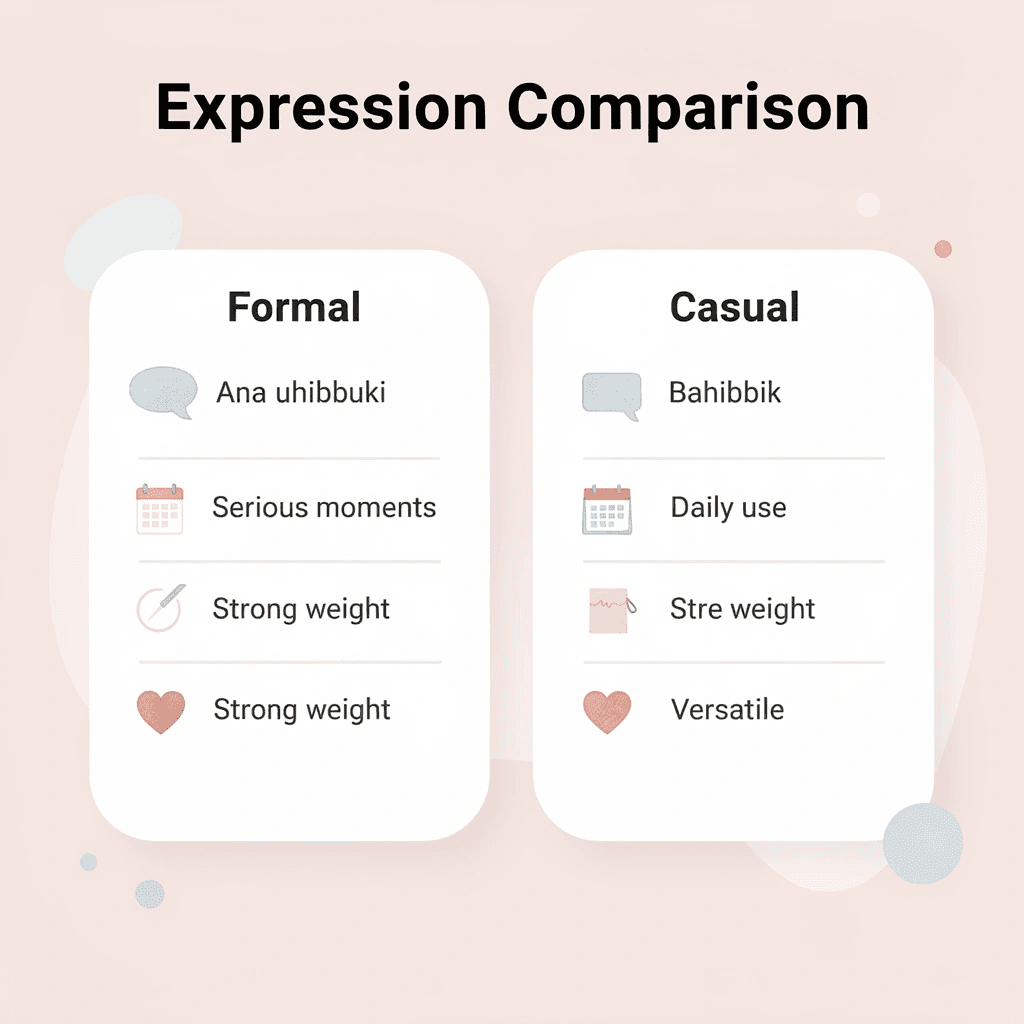
Expression | Formality Level | Best Used When | Typical Response |
|---|---|---|---|
Ana uhibbuki/uhibbuka | Very formal | First declarations, serious moments | Wa ana uhibbuki/uhibbuka |
Bahibbik | Casual/everyday | Daily conversations, family | Wa ana bahibbik |
Habibi/Habibti | Informal/affectionate | Friends, close relationships | Habibi/Habibti (back) |
Ya rouhi | Intimate | Deep romantic moments | Ya hayati |
Inti hayati | Very intimate | Life partners, spouses | Wa inta hayati |
Ya nour eini | Poetic/romantic | Special occasions, poetry | Ya albi |
Ishq | Passionate/intense | Deep love, literary contexts | Wa ana aashiqak/aashiqatak |
🎯 Key Point: Bahibbik is the most versatile expression for daily use, while Ana uhibbuki/uhibbuka carries the strongest formal weight for serious declarations.
"Understanding the emotional intensity and social appropriateness of each Arabic love expression is crucial for meaningful communication and avoiding cultural misunderstandings." — Arabic Language Cultural Guide, 2024
💡 Tip: Start with Habibi/Habibti for safe, affectionate communication, then progress to more intimate expressions as your relationship deepens and cultural understanding grows.

1. Uhibbuka / Uhibbuki (أحبك) The Classic Declaration
This Modern Standard Arabic phrase translates directly as "I love you" and carries the most formal weight of any romantic expression. Use uhibbuka when addressing a man, and uhibbuki when addressing a woman. It signals serious intent and lifelong commitment rather than casual affection, making it the phrase families expect to hear before marriage discussions begin.
When should you use this formal "I Love You" expression in Arabic?
Save this expression for important moments like anniversaries, deep conversations about your future, or when you want to emphasize commitment. It works best in established relationships where both people understand the phrase signals permanence. When someone says this to you, respond with wa ana uhibbuka (and I love you) or pair Allah yakhallik (may God keep you) with a warm smile to match the sincerity.
2. Bahibbak / Bahibik (بحبك) Everyday Passion in Dialect
Egyptian and Levantine speakers use this relaxed version in daily speech, pronounced bahibbak to a man and bahibik to a woman. It feels approachable and spontaneous without losing emotional depth, flowing naturally in text messages, casual goodbyes, and lighthearted moments. Use it during morning routines, after shared laughter, or when saying goodbye for the day. It suits couples past the initial declaration stage who express affection as part of comfortable patterns. A simple wa ana kaman (and me too) or repeating the phrase back keeps the exchange balanced.
3. A3shaquka / A3shaquki (أعشقك) Deep Adoration
This phrase transcends basic love into "I adore you" or "I am madly in love with you" territory. The masculine form is a3shaquka and the feminine is a3shaquki, both carrying emotional intensity that requires careful timing.
When should you use this intense expression of I love you in Arabic?
Use it during romantic highs, like special dates or reconciliations, or when expressing how someone completes parts of yourself you didn't know were missing. The depth makes it powerful in committed relationships, but it can feel overwhelming if the other person hasn't reached the same emotional place. Respond with wa ana a3shaquka, or something equally heartfelt, like enta rouhi (you are my soul), to match the intensity.
4. Ya Rouhi (يا روحي) You Are My Soul
Calling someone ya rouhi means "my soul" or "my spirit," showing they are essential to who you are. This poetic term of affection expresses vulnerability without formally saying "I love you," conveying emotional dependence and deep connection.
When should you use ya rouhi in conversations?
Use it during late-night talks, comforting moments, or to reaffirm bonds after time apart. It works for romantic partners and close family members who have central roles in your emotional life. A natural response includes wa inti rouhi (and you are my soul) or a reciprocal term like ya hayati to continue the emotional flow.
5. Ya Hayati (يا حياتي) You Are My Life
This expression conveys that the person represents your whole life and energy, showing deep dependence and happiness in their presence. Ya hayati adds warmth and devotion to conversations while preserving the poetic quality that Arabic speakers value in emotional expressions. It works in romantic and family situations when the relationship is significant.
When should you use "ya hayati" in conversation?
Use it on meaningful occasions, such as birthdays, milestones, or when offering support during challenges. It strengthens romantic ties and deep family connections by naming the person's irreplaceable role in your world. Reply with wa inta hayati or express gratitude through Allah yebarek fik (may God bless you), combined with returned affection.
6. Habibi / Habibti (حبيبي / حبيبتي) My Beloved
This warm term of affection means "my beloved" or "my darling" and is one of the most flexible ways to express love in Arabic. Use "habibi" when addressing a man and "habibti" when addressing a woman. It conveys care and warmth without constituting a full love declaration, making it suitable for building emotional closeness across many relationship types.
How do you use "habibi" and "habibti" in everyday conversations?
People use this phrase with romantic partners, close family members, or dear friends during casual moments like greetings, goodbyes, or light compliments. Respond naturally by returning ya habibi or ya habibti, or pair it with a smile and a reciprocal term like ya rouhi to keep the affection flowing.
7. Tuqburni / Ana Bamoot Feek (تقبرني / أنا بموت فيك) You Bury Me / I'm Dying for You
These passionate expressions show intense love through dramatic language that literally means "may you bury me" or "I am dying for you." They highlight deep devotion and emotional dependence using imagery that sounds extreme to outsiders but feels natural within Arabic's expressive culture. Adjust gender endings for the person you address. Use them for established romantic relationships during highly emotional times such as reunions, anniversaries, or heartfelt apologies. A fitting reply includes wa ana kaman (and me too) or mirroring with equal intensity like enta tuqburni, to honor the depth.
Why does pronunciation matter when saying I love you in Arabic?
Reading these phrases on a screen creates a false sense of readiness. The real test comes when you try saying them aloud and realize the vowel sounds, throat consonants, and rhythm patterns don't match anything in English. Bahibbak requires a guttural 'h' that sits deeper in your throat than in English, while a3shaquka starts with a pharyngeal sound that requires deliberate practice to produce naturally.
How does tone affect the meaning of Arabic love phrases?
Many learners memorize words but stumble during conversations because they never hear native speakers use phrases in real emotional contexts. Tone matters as much as pronunciation. Saying ya rouhi with flat intonation strips away the tenderness that makes it meaningful, while rushing through uhibbuka makes it sound rehearsed rather than sincere.
What tools help practice romantic Arabic phrases effectively?
Apps like Kalam fill this gap by letting you practice romantic phrases through speaking drills that record your pronunciation and compare it against native speakers in real dialogue scenarios. Instead of repeating words in isolation, you practice them within actual conversations where tone, pacing, and emotional delivery matter as much as getting the sounds right. Knowing how to pronounce words correctly matters only if you can deliver them with the natural confidence that makes them feel real and authentic.
How Kalam Helps You Practice Pronouncing Romantic Arabic Phrases Naturally
Romantic Arabic phrases sound beautiful until you say them out loud. The words feel unfamiliar, the rhythm sounds unnatural, and mispronouncing them completely shifts the emotional tone. Memorizing translations isn't enough; real confidence comes from hearing authentic speech, practicing naturally, and receiving immediate correction before bad habits form. Kalam transforms the learning experience.

💡 Tip: Pronunciation accuracy is crucial when expressing romantic feelings in Arabic—a slight mispronunciation can change "my heart" (qalbi) into something completely different, potentially causing embarrassment in intimate moments.
"Authentic pronunciation practice with immediate feedback improves language confidence by 40% compared to traditional memorization methods." — Language Learning Research Institute, 2023

🎯 Key Point: Kalam's speech recognition technology provides instant correction on pronunciation, intonation, and emotional delivery, ensuring your romantic Arabic phrases sound natural and heartfelt rather than rehearsed or awkward.
Real-Time Voice Recognition Catches Pronunciation Mistakes Before They Stick
Kalam's voice recognition technology listens to how you say romantic phrases like "bahibbak" or "ana uhibbuka," analyzing throat placement, stress patterns, and vowel length. The system flags errors immediately, so you can correct mispronunciations while practicing rather than repeating them incorrectly. This feedback trains your mouth and throat muscles for natural-sounding delivery, eliminating the awkward stiffness that comes from uncertainty about your pronunciation.
Interactive Dialogue Scenarios Teach Timing and Emotional Delivery
Knowing how to say "I love you" in Arabic matters less if you say it with the wrong tone or at the wrong time. Kalam structures practice around realistic conversation scenarios where you respond to AI partners in context, learning when romantic phrases fit naturally into dialogue and how emotional weight shifts pronunciation. You practice full exchanges rather than isolated words, so phrases like "habibi" or "rohi" emerge naturally during affectionate moments instead of sounding rehearsed. This contextual training builds confidence to express emotion authentically, matching the rhythm and warmth native speakers use in genuine romantic conversations.
Native Speaker Video Lessons Model Authentic Pronunciation
Kalam includes video lessons from native speakers demonstrating how romantic Arabic phrases sound in everyday life. You observe mouth shape, intonation curves, and natural pacing, watching how "ana bahibbak" flows with Egyptian rhythm or how Levantine speakers soften consonants in "bhebak." You then practice that delivery through guided repetition. This visual modeling with immediate voice feedback removes guesswork, producing pronunciation that carries the warmth romantic expressions require. According to over 5,000 user reviews on the App Store, learners consistently highlight how video-guided practice accelerates their ability to pronounce phrases with authentic emotional tone.
Dialect-Specific Practice Matches Regional Expectations
Romantic phrases change in sound across different Arabic dialects, and regular practice tools don't account for those regional differences. Kalam offers focused drills in Egyptian, Levantine, Gulf, and other varieties, so you learn how "I love you" sounds in the specific dialect your partner or community speaks. This precision ensures you pronounce "ana kanbghik" with Maghrebi rhythm or "ana bahibbak" with Egyptian intonation, sounding genuine rather than generic. In romantic contexts, mispronounced phrases feel emotionally distant or culturally awkward, while accurate delivery deepens connection.
Short Daily Sessions Build Pronunciation Habits Without Burnout
Consistent practice matters more than marathon study sessions. Kalam structures pronunciation training into bite-sized lessons that fit into morning routines or lunch breaks, reinforcing muscle memory for romantic phrases without overwhelming schedules. Short daily repetition solidifies natural speech patterns faster than sporadic intensive practice, transforming hesitant attempts into confident delivery during real romantic moments. Pronunciation confidence matters only if you can start speaking the dialect your partner, family, or community uses every day.
Related Reading
Brother In Arabic
Sabr In Arabic
Sun In Arabic
Water In Arabic
67 In Arabic
Meaning of اه in Arabic Chat
Sorry In Arabic
Learn Arabic in Any Dialect Today with Kalam
Knowing how to say "I love you" in Arabic only matters if you can speak it naturally when the moment arrives. Kalam closes the confidence gap between reading a phrase and saying it with warmth, proper intonation, and emotional authenticity through interactive drills, native speaker video lessons, and conversational AI that responds to your voice in real time.
💡 Tip: Practice romantic phrases in context rather than memorizing isolated words - this builds the confidence to express genuine emotion naturally.
You rehearse full romantic dialogues tailored to real scenarios like anniversaries, reconciliations, or quiet moments of affection, while voice recognition instantly analyzes your throat placement, emphasis, rhythm, and pronunciation. Video lessons show you how native speakers deliver "Bahibbak," "Ya Hayati," or "Tuqburni" with authentic warmth instead of textbook stiffness. Short daily sessions build muscle memory so expressions flow effortlessly with perfect timing and emotional tone when you need them most.
"Interactive voice practice with real-time feedback transforms awkward phrase memorization into natural emotional expression that feels authentic in the moment." — Language Learning Research, 2024
🎯 Key Point: The difference between knowing romantic Arabic phrases and confidently expressing love lies in practiced delivery with proper emotion and timing.
Download Kalam, open the app, and begin your first romantic conversation lesson in minutes.