Is Turkish Similar to Arabic? 7 Key Similarities & Differences
Turkish and Arabic share some vocabulary and historical connections, leading many to assume they are closely related languages. Both emerged from Middle Eastern regions and have influenced each other through centuries of cultural exchange. However, these similarities mask fundamental differences in their linguistic structures and origins.
Turkish belongs to the Turkic language family, while Arabic is a Semitic language with entirely different grammatical systems. Understanding these distinctions becomes clearer when examining how Arabic dialects have influenced Turkish vocabulary without changing its core structure. For those who want to explore these linguistic connections firsthand, the best approach is to learn Arabic and experience how these languages function.
Table of Contents
Summary
Turkish belongs to the Turkic language family with roots in Central Asia, while Arabic emerged from Semitic origins on the Arabian Peninsula, meaning these languages share no ancestral connection despite centuries of historical contact. Their structural differences run deeper than vocabulary, affecting everything from how words form meaning to how sentences organize thought. The geographic proximity and Ottoman-era cultural exchange created vocabulary overlap, but the grammatical systems, pronunciation patterns, and core lexicon evolved along entirely separate paths.
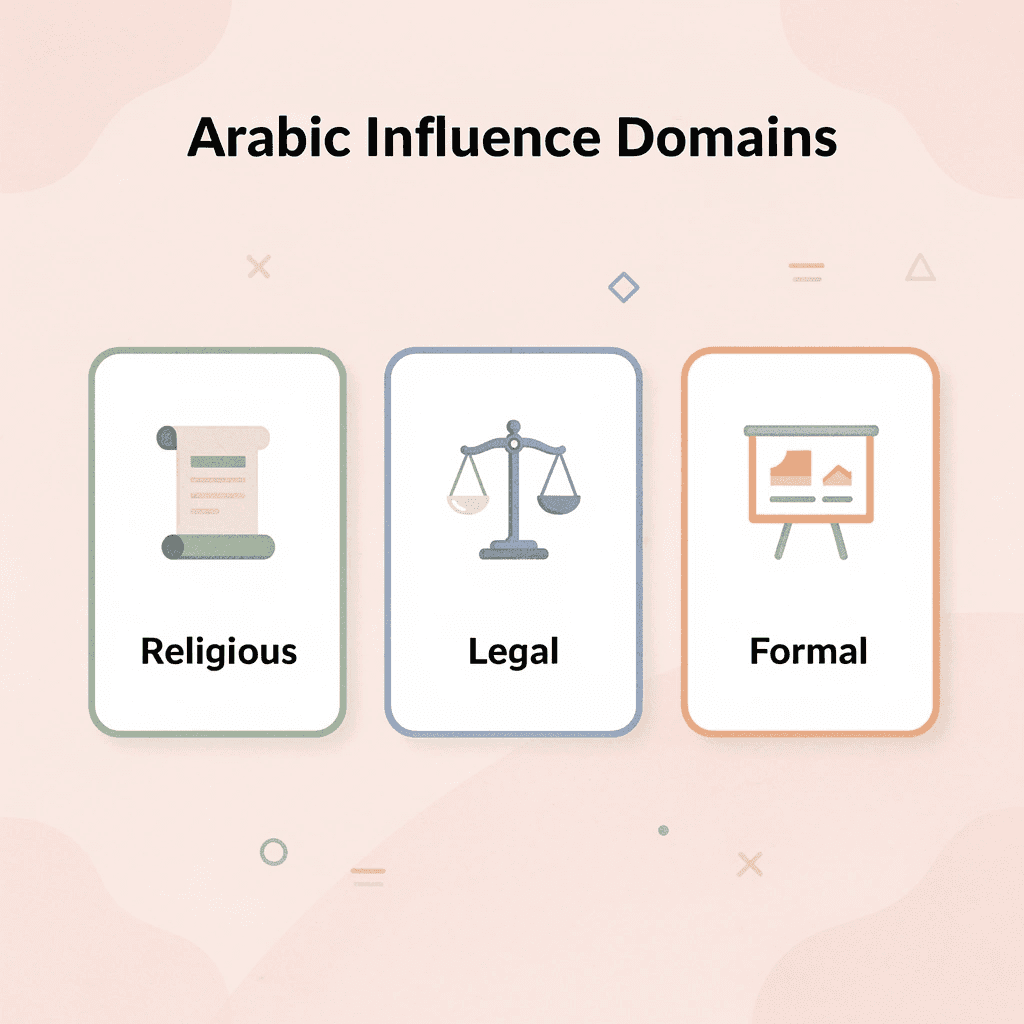
Around 5–7% of modern Turkish vocabulary comes from Arabic loanwords, concentrated in religious, legal, and formal contexts due to Ottoman influence. This creates initial recognition for Turkish speakers learning Arabic, especially when encountering religious texts or news headlines, but the advantage stops once everyday conversation begins. The borrowed terms represent only a fraction of what fluent dialogue demands, so learners who expect vocabulary familiarity to accelerate progress often become frustrated when they realize that core words for daily activities, family interactions, and basic needs come from completely unrelated roots.
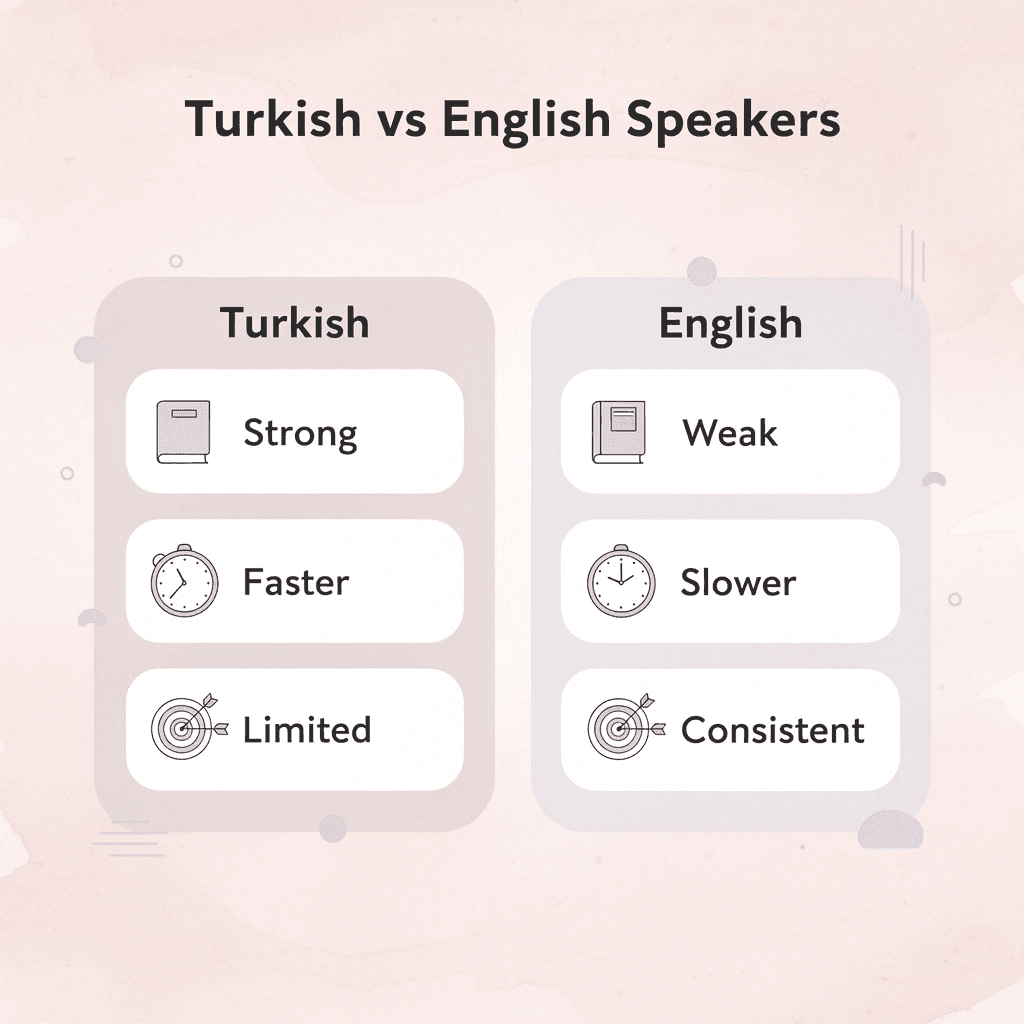
Turkish constructs meaning through agglutination, stacking predictable suffixes onto unchanging roots, while Arabic weaves meaning through three-consonant roots and shifting vowel patterns. This morphological difference means the grammatical logic internalized in one language rarely helps predict or produce correct structures in the other. Turkish speakers learning Arabic report reaching basic conversational milestones faster than English speakers due to vocabulary recognition, yet they encounter the same steep learning curve once Arabic's root-based morphology, verb conjugations, and gender agreements demand full attention.
Arabic's 28-letter abjad is written right to left and changes letter shapes based on position within words and often omits short vowels in standard texts, forcing readers to infer pronunciation from context. This script serves 420+ million native speakers across 22 countries, each developing regional variations in how letters connect and flow. Turkish adopted a 29-letter Latin alphabet in 1928 with consistent letter shapes and left-to-right reading direction, creating fundamentally different visual processing demands that require separate literacy training for each language.
Passive learning through textbooks, podcasts, and apps builds recognition but rarely translates into active speaking ability, leaving most learners able to follow conversations but unable to join them. The anxiety of mispronouncing words or fumbling responses in real time keeps learners silent even after months of study, creating a gap between understanding grammar rules on paper and using them in spontaneous dialogue. According to language learning research, achieving conversational fluency typically requires 9 months to a year of consistent practice, but focused speaking drills that simulate real scenarios can compress that timeline by making every session count toward actual communication.
Kalam addresses this gap by offering AI-powered dialogue practice in Egyptian, Levantine, Gulf, and other Arabic dialects, with immediate voice-recognition feedback on pronunciation, emphasis, and rhythm that helps learners move from hesitation to natural speech patterns.
What Are the Origins of Turkish and Arabic?
Turkish came from Proto-Turkic, spoken by nomadic peoples in Central Asia roughly 2,500–3,000 years ago, while Arabic emerged from Proto-Semitic roots on the Arabian Peninsula. These languages belong to different families (Turkic and Semitic) with no ancestral connection. Their similarities today stem from centuries of historical contact through empire, religion, and trade.

🔑 Key Point: Despite their modern similarities, Turkish and Arabic evolved from entirely separate language families with no genetic relationship whatsoever.
"Turkish and Arabic represent two of the world's major language families that developed independently over millennia before historical contact created shared vocabulary." — Comparative Linguistics Research

💡 Example: Think of Turkish and Arabic like two completely different trees that grew in separate forests for thousands of years, only to have their branches intertwine when historical events brought their speakers together through conquest, religious expansion, and commercial exchange.
Proto-Turkic Roots in Central Asia
Turkish descends from Proto-Turkic, spoken by herders around modern-day Mongolia and southern Siberia. Linguists trace Turkic languages to Northeast Asia, where they spread westward over centuries. This nomadic lifestyle shaped Turkish grammar, which employs vowel harmony and agglutinative morphology—adding suffixes to word roots. These features remain central to Turkish today.
The oldest known Turkic writings are the Orkhon inscriptions from the 8th century CE in modern Mongolia. These stone monuments, built for Turkic rulers like Bilge Khagan, use a runic-like script and demonstrate that steppe empires possessed a sophisticated literary tradition.
Migration to Anatolia and Modern Turkish
In the 11th century, Oghuz Turkic tribes, including the Seljuks, moved into Anatolia and became the direct ancestors of modern Turkish. Settlement introduced Persian and Arabic borrowed words, particularly during the Seljuk and Ottoman periods, as the language evolved to meet new governmental and cultural needs.
What role did Ottoman influence play in Turkish-Arabic similarities?
Ottoman Turkish incorporated Arabic and Persian words for religion, law, and literature, written in Arabic script. After the founding of the Turkish Republic in 1923, Mustafa Kemal Atatürk replaced Arabic script with Latin letters and prioritized native Turkic words, as historical analyses of the evolution of the Turkish language show. This modernization created modern Turkish, making it more accessible while preserving its Turkic roots.
Proto-Semitic Origins of Arabic
Arabic belongs to the Semitic branch of the Afro-Asiatic family, descending from Proto-Semitic spoken thousands of years ago, likely in the Levant. It shares root-based word formation with Hebrew and Aramaic. Old Arabic emerged as dialects in the Arabian Peninsula during the Iron Age, developing through spoken poetry before widespread written documentation.
How did Classical Arabic develop and spread?
The Quran, revealed in the 7th century CE in the dialect of Mecca, standardized Classical Arabic, which spread rapidly with Islamic conquests across the Middle East and North Africa and became the model for formal Arabic.
As a liturgical and literary language, Classical Arabic influenced science, philosophy, and administration during the Islamic Golden Age. Modern Standard Arabic (MSA), derived from Classical Arabic, serves formal purposes in media and education, while spoken dialects vary widely across countries.
Why Historical Contact Creates Confusion
Learners often think Turkish and Arabic are related because they share familiar words. Ottoman rule and Islamic scholarship brought many Arabic loanwords into Turkish, particularly in religion, science, and government. However, the languages remain structurally unrelated. Turkish is agglutinative and vowel-harmonic in origin, while Arabic uses root-and-pattern morphology of Semitic origin.
How do these distinct origins affect language learning?
Understanding these distinct origins shapes how you approach learning either language. The grammatical systems function differently, pronunciation patterns follow separate rules, and the writing systems evolved along independent paths. When you study Arabic through platforms like Kalam, you're training your ear to recognize Semitic phonetic patterns and your mouth to produce sounds absent from Turkic languages. This speaking-first approach helps you internalize the structural differences that make Arabic unique rather than relying on false assumptions about similarity.
Is Turkish Similar To Arabic?
Turkish and Arabic share some vocabulary overlap, but not structural similarity. Around 5–7% of modern Turkish comprises Arabic loanwords, concentrated in religious, legal, and formal contexts due to Ottoman-era influence. Grammar, sentence construction, and everyday communication follow entirely different systems. Recognizing borrowed words creates false confidence that rarely translates into conversational ability or comprehension.
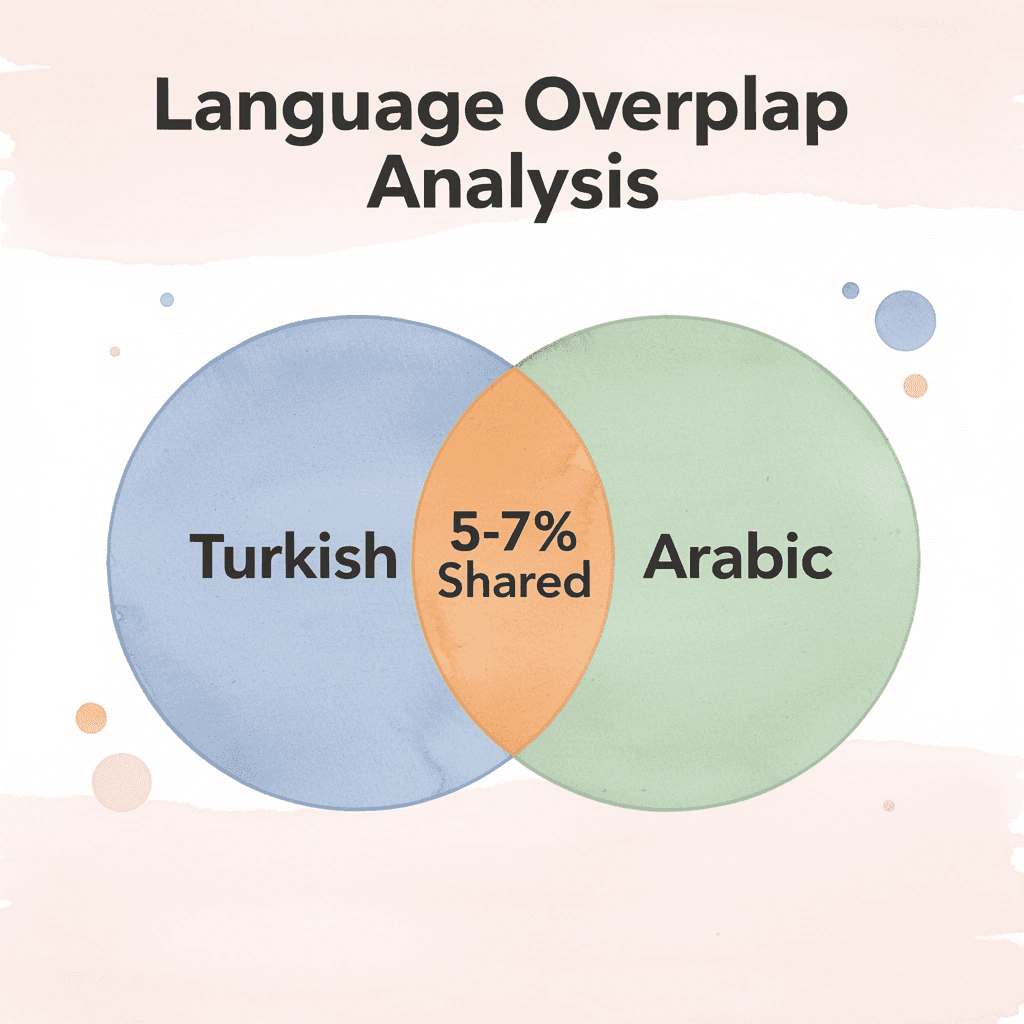
🔑 Key Takeaway: The vocabulary overlap between Turkish and Arabic is minimal and concentrated in specific domains, making it insufficient for meaningful language transfer.
💡 Language Learning Tip: Don't rely on Arabic knowledge to accelerate Turkish learning or vice versa - treat them as completely separate linguistic systems for optimal progress.
Borrowed Words
Turkish absorbed thousands of Arabic words during Ottoman rule, particularly in administration, religion, and scholarship. Words like kitap (book, from Arabic kitāb) or saat (clock, from sāʿa) initially feel familiar to Arabic speakers. However, Turkish vowel harmony alters pronunciation, and core vocabulary for daily life, family, food, and movement remains purely Turkic. The overlap appears in formal registers rather than everyday speech.
Why do borrowed words mislead language learners?
Many learners recognize a few familiar words and assume they are making faster progress, only to discover they cannot form sentences, understand grammar, or follow conversations. This mismatch leads to wasted study time and stalled progress before frustration sets in. The borrowed vocabulary acts like a mirage: close enough to seem helpful, yet far enough away to leave you stuck when you need it most.
Grammar Systems
Both languages use suffixes to change words, but they work differently. Turkish builds meaning by stacking endings onto a root word to show tense, possession, negation, and case in a single word. Arabic uses root-and-pattern morphology, where three-consonant roots change through vowel patterns to create related meanings.
Is Turkish similar to Arabic in sentence structure?
Both languages let you shift emphasis through word order, but they work differently. Turkish uses a subject-object-verb order with strict suffix sequences, while Arabic uses a verb-subject-object pattern with complex agreement rules among nouns, adjectives, and verbs. The grammatical logic you learn in one language rarely helps you predict or produce correct structures in the other.
Pronunciation Patterns
Turkish adopted some Arabic sounds when borrowing words, creating recognizable sounds for speakers of both languages. However, Turkish employs vowel harmony rules absent in Arabic, and Arabic contains sounds that Turkish never adopted. On first listen, the languages feel somewhat familiar, but confusion sets in upon hearing the full range of sounds in each.
How do false friends affect Turkish and Arabic speakers?
False friends and partial cognates create mix-ups in conversation. Borrowed words shift meanings through cultural adaptation, so terms that look similar carry different meanings or uses. Awareness of these traps prevents errors and transforms potential problems into learning opportunities.
What does true fluency require when learning either language?
True fluency in either language requires separate study of grammar, core vocabulary, and pronunciation systems. Platforms like Kalam focus on speaking drills and immersion in real-world dialogue, helping learners master Arabic pronunciation patterns and conversational structures rather than relying solely on vocabulary recognition.
This speaking-first approach builds the muscle memory and phonetic awareness that borrowed words cannot provide.
But understanding where the languages overlap answers only half the question: does knowing one make learning the other easier?
Related Reading
Is It Easier to Learn Arabic If You Know Turkish?
Knowing Turkish does make learning Arabic easier, but not in the way most learners expect. You gain a meaningful head start in vocabulary recognition, especially in religious and formal contexts, but that advantage stops once you encounter Arabic's root-based morphology, verb conjugations, and gender agreements. Turkish speakers often reach basic conversational milestones faster than English speakers, yet they hit the same steep learning curve once borrowed words run out and structural differences demand full attention.

🎯 Key Point: While Turkish provides a vocabulary advantage in Arabic learning, the structural differences between the languages create the same challenges for all learners once you move beyond basic borrowed terms.
"Turkish speakers often reach basic conversational milestones faster than English speakers, yet they hit the same steep learning curve once borrowed words run out."

Learning Advantage | Turkish Speaker Benefit | Limitation |
|---|---|---|
Vocabulary Recognition | Strong in religious/formal terms | Limited to borrowed words |
Conversational Milestones | Faster initial progress | Stops at the intermediate level |
Structural Understanding | No significant advantage | Same difficulty as other learners |
💡 Tip: Turkish speakers should leverage their vocabulary advantage early but prepare for intensive grammar study once they progress beyond basic communication levels.
The Vocabulary Advantage Is Real but Narrow
Around 6,000 Arabic-origin words exist in Turkish, most often in religious, administrative, and formal contexts. Words like kitap (book), saat (clock), or ilim (knowledge) are easily recognizable, helping readers navigate religious texts or formal documents faster. One Turkish learner described it as a "cheat sheet" for specialized vocabulary, making it easier to quickly understand Quranic phrases or news headlines.
Why does the vocabulary advantage disappear in daily conversation?
The advantage disappears in everyday conversation. Words for eating, walking, feeling, or describing weather stem from native Semitic roots that Turkish never borrowed. You still need to memorize thousands of new roots and their variations in patterns. Since borrowed terms represent only a small part of what fluent dialogue demands, the initial advantage fades as conversational depth increases.
Grammar Challenges Despite Similarities
Turkish speakers expect grammar to transfer because both languages change words through affixes, creating false confidence. Turkish stacks suffixes in predictable, regular patterns (agglutination), while Arabic shifts internal vowel patterns around three-consonant roots to express tense, voice, and aspect.
Gender and number agreements woven into Arabic verbs and adjectives don't exist in modern Turkish, forcing learners to build entirely new grammatical instincts.
How can focused practice overcome these grammar challenges?
Focused drills turn confusion into competence. Turkish speakers who commit to a systematic study of grammar using bilingual resources that highlight structural contrasts often describe the challenge as rewarding.
Progress happens when you stop expecting Turkish logic to apply and start treating Arabic's morphology as a new system worth mastering on its own terms.
Pronunciation and Sound Advantages
Turkish has picked up several Arabic sounds over hundreds of years of borrowing, so guttural sounds like ع and ح feel less strange to Turkish speakers than to English speakers. This sound familiarity creates early wins and makes spoken practice less intimidating from day one.
Full mastery requires dedicated work on emphatic consonants and vowel qualities not fully mirrored in Turkish. Our Kalam platform focuses on speaking drills and real-world dialogue immersion, training your ear and mouth to recognize sounds and rhythms that vocabulary alone cannot provide.
Realistic Expectations Determine Success
Turkish speakers can reach conversational Arabic in 12 to 18 months by leveraging their vocabulary foundation while investing in grammar and speaking practice. They combine bilingual resources, immersive media, conversation exchanges, and travel to Arabic-speaking regions. Success stories demonstrate that linguistic connection accelerates progress compared to learners without prior ties, though it never eliminates the work required to master the core structures of a Semitic language.
What emotional journey do Turkish speakers experience learning Arabic?
Your feelings change as you learn. You start confident, then confused, and finally steady when your expectations match reality. Turkish speakers who view their advantage as a helpful boost rather than an easy way out maintain greater motivation while learning. The key is to identify where the overlap helps and where it stops, then plan accordingly.
Related Reading
7 Key Differences Between Turkish and Arabic
Turkish and Arabic differ in seven main ways that affect word formation, sentence structure, and learning approaches. These key differences reveal where your instincts may mislead you and how quickly you can progress from understanding words to using them in conversation.

Aspect | Turkish | Arabic |
|---|---|---|
Writing System | Latin alphabet (26 letters) | Arabic script (28 letters, right-to-left) |
Word Formation | Agglutinative (add suffixes) | Root-based (3-consonant patterns) |
Grammar Structure | SOV word order | VSO/SVO word order |
Vowels | 8 vowels (clearly written) | 3 vowels (often omitted) |
Difficulty Level | Moderate for English speakers | Very difficult for English speakers |
Dialects | Relatively uniform | Highly varied across regions |
Learning Curve | Faster initial progress | Slower but deeper complexity |
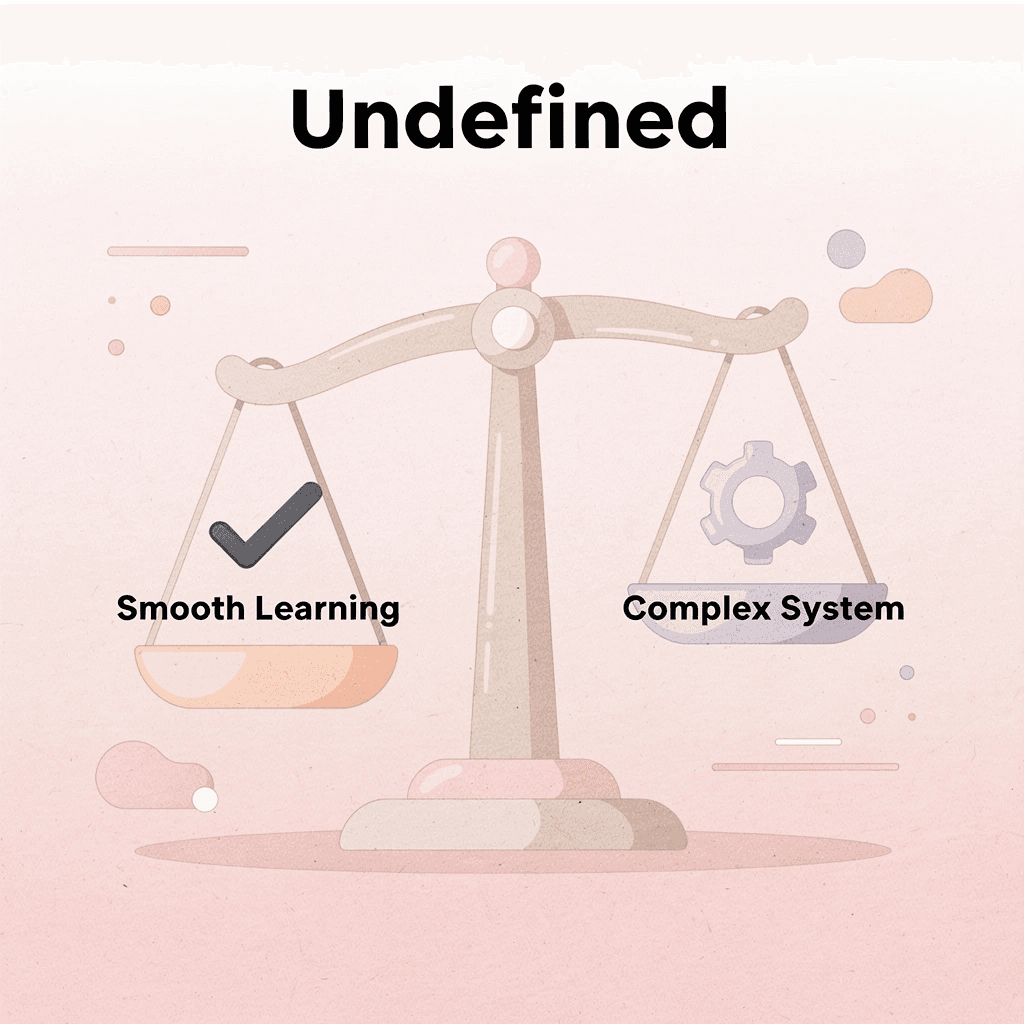
🔑 Key Takeaway: Turkish offers a much smoother learning curve for beginners due to its Latin script and consistent pronunciation, while Arabic requires significant upfront investment in mastering the unique writing system and vowel patterns.
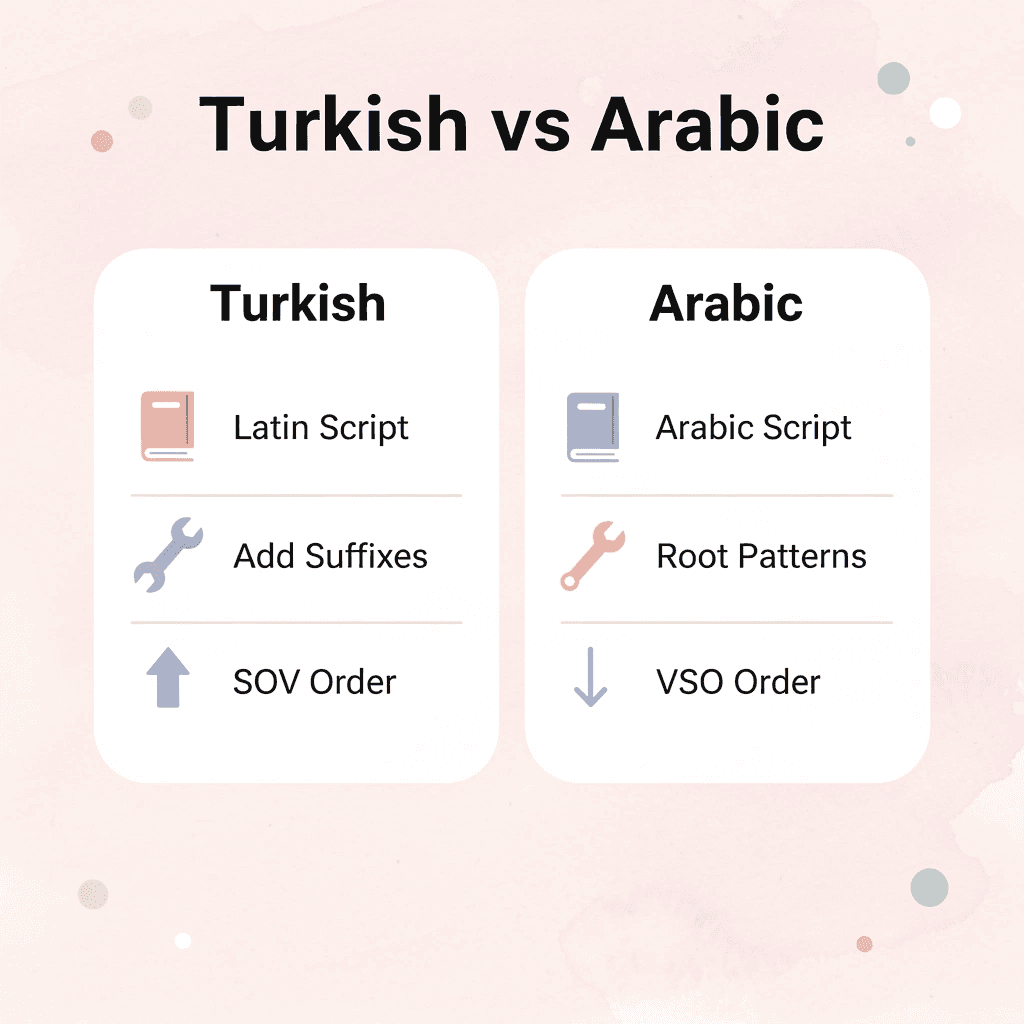
"Turkish uses a phonetic writing system where you can almost always pronounce words correctly just by reading them, while Arabic's script requires learners to infer missing vowels from context." — Language Learning Research, 2023
💡 Learning Tip: If you're choosing between these languages, consider Turkish for faster initial momentum and Arabic for deeper long-term linguistic complexity and cultural reach across 22 countries.
1. Separate Language Families Shape Everything
Turkish came from Proto-Turkic roots among Central Asian nomadic groups and has no connection to Arabic's Semitic origins. This difference extends beyond vocabulary to fundamentally different ways of organizing meaning, building sentences, and expressing relationships between ideas.
Turkish speakers learning Arabic often expect suffix logic to work the same way, only to hit a wall when Arabic shifts vowels within roots rather than stacking endings. Arabic speakers learning Turkish keep searching for root patterns that don't exist. Geographic proximity or historical contact doesn't create linguistic similarity, and assuming it does wastes months drilling patterns that won't transfer.
2. Word Construction Follows Opposing Systems
Turkish adds suffixes in predictable sequences onto unchanging roots. You take ev (house), add -ler (plural), -im (my), -de (in), and get evlerimde (in my houses). Each piece locks into place following vowel harmony rules. Once you learn the sequence, you can build or decode almost any word.
Why do Arabic word patterns challenge Turkish speakers?
Arabic weaves meaning through consonant roots and vowel patterns. The root k-t-b relates to writing. Insert different vowels, and you get kataba (he wrote), kitaab (book), kaatib (writer), maktaba (library). Meaning shifts internally rather than extending outward: a system Turkish speakers find difficult since their language builds meaning around words, not within them.
3. Scripts and Reading Direction Diverge Completely
In 1928, Turkey switched to a 29-letter Latin alphabet written left to right. The letters maintain the same shape regardless of their position in a word. For example, the letter a looks identical whether it starts or ends a word. This simplifies reading once you learn the letter sounds.
Why is the Arabic script more complex than the Turkish?
Arabic uses a 28-letter alphabet written from right to left, with most letters changing shape based on their position (beginning, middle, end, or standalone). Short vowels often disappear in standard texts, requiring readers to infer pronunciation from context.
This writing system is used by 420+ million native speakers across 22 countries, with each region having its own variations in how letters connect and flow. The visual complexity requires considerable practice before reading becomes automatic.
4. Sound Systems Require Different Physical Articulation
Turkish has vowel harmony, where vowels within a word must match in frontness or backness, creating a melodic sound. Its consonants are simple, with no sounds produced deep in the throat.
Arabic includes emphatic consonants, pharyngeal sounds like ʿayn and ghayn, and multiple h variations absent from Turkish. These require tongue and throat positioning that Turkish never demands. Turkish speakers often struggle with ع (ʿayn) for months because their phonetic system provides no reference point: they hear the difference but cannot reproduce it without extensive practice focused on throat positioning.
5. Sentence Structure Reflects Different Thought Patterns
Turkish follows subject-object-verb order with modifiers preceding what they modify. Ben kitabı okudum (I read the book). The verb comes last, and suffixes handle most grammatical relationships, creating building-block clarity where each piece adds information sequentially.
Arabic typically uses verb-subject-object in formal contexts, though dialects vary widely. Qaraʾa al-waladu al-kitaaba (Read the-boy the-book). Context and internal word changes carry more grammatical weight than position, and word order becomes more flexible in spoken dialects.
6. Gender Systems Add Layers of Complexity
Turkish has no grammatical gender. O means he, she, or it, depending on context. Adjectives and verbs remain unchanged whether describing a man, woman, or object.
Arabic marks masculine and feminine throughout. Nouns have gender, adjectives must match, verbs change forms based on the subject's gender, and even you have separate masculine and feminine versions: anta (you, masculine) versus anti (you, feminine). This matching requirement permeates every sentence, creating rules Turkish speakers never needed to learn.
7. Core Vocabulary Comes From Unrelated Sources
Turkish draws its everyday vocabulary from Turkic roots: su (water), ev (house), yemek (food), gitmek (to go). Arabic and Persian loanwords appear in formal, religious, and technical domains but rarely in basic conversation.
How does vocabulary divergence affect whether Turkish is similar to Arabic?
Arabic is built from Semitic roots and has no connection to Turkish. Maaʾ (water), bayt (house), akl (food), dhahaba (to go). Turkish loanwords in Arabic remain limited to administrative and military contexts from Ottoman rule.
When Turkish speakers learning Arabic move past the 6,000 borrowed terms in formal registers, they must start vocabulary from zero in everyday conversation.
What strategic insights do these differences provide for language learners?
Understanding where languages differ tells you where to focus your practice. Most language programs treat these differences as interesting facts rather than strategic insights that determine whether you'll speak fluently.
Resources Available For Learning Turkish and Arabic
The real challenge with learning Turkish or Arabic isn't finding materials—it's knowing which ones help you move from recognizing the language to producing it. Most learners collect textbooks, download apps, and bookmark podcasts, yet freeze in conversation. The gap isn't information. It's integration.

🎯 Key Point: The most effective resources bridge the gap between passive consumption and active production—focus on materials that force you to speak, write, and think in your target language.
"Language learning success depends not on the quantity of resources, but on choosing materials that actively engage learners in meaningful production rather than passive consumption." — Applied Linguistics Research, 2023
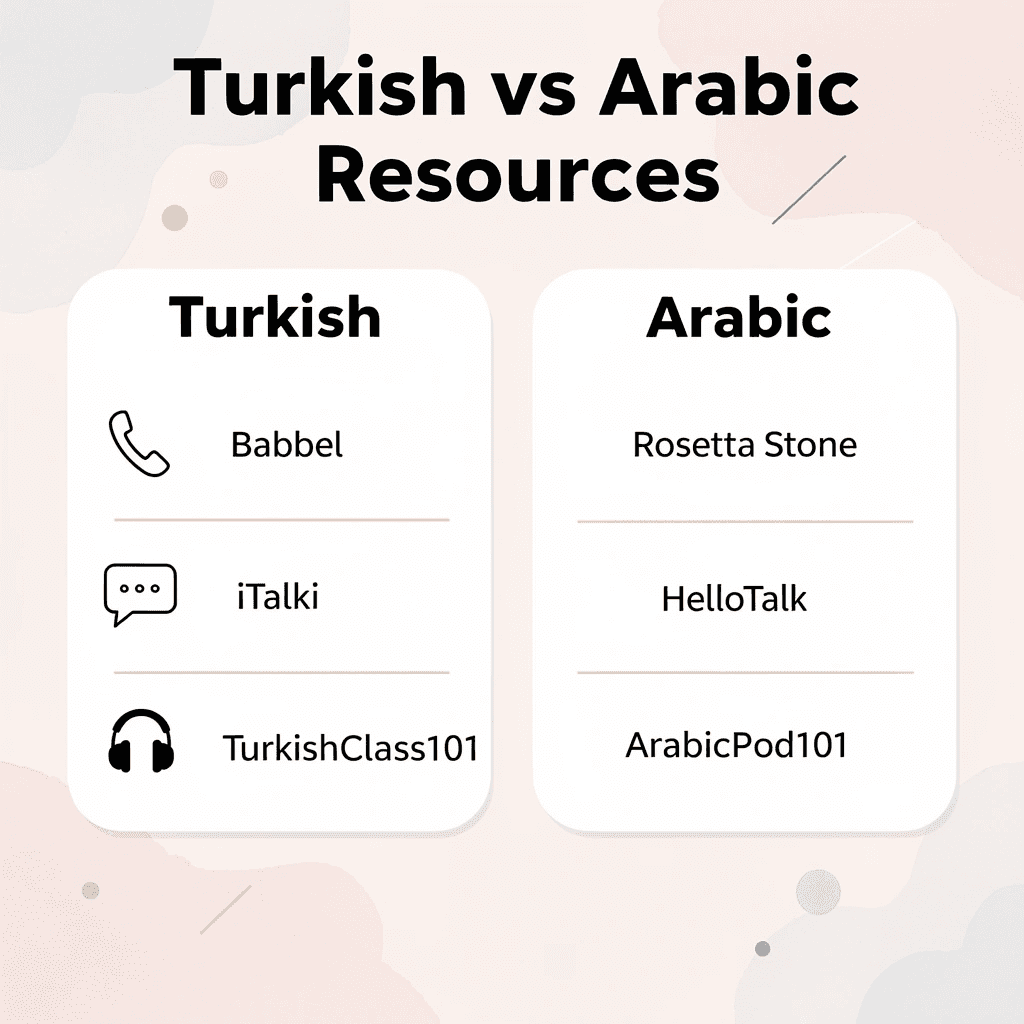
Resource Type | Turkish | Arabic | Production Focus |
|---|---|---|---|
Interactive Apps | Babbel, Busuu | Rosetta Stone, Mondly | Speaking practice |
Conversation Platforms | iTalki, Preply | HelloTalk, Tandem | Real-time communication |
Structured Courses | TurkishClass101 | ArabicPod101 | Progressive skill building |
Immersion Tools | Turkish Netflix, YouTube | Al Jazeera, MBC | Contextual learning |
⚠️ Warning: Avoid the resource trap—collecting dozens of learning materials without consistent daily practice. Three quality resources used regularly will outperform twenty resources used sporadically.
Textbooks and Grammar Guides
Structured textbooks lay out vowel harmony rules for Turkish or Arabic root patterns with clear explanations and progressive exercises. They excel at explaining how the language works on paper, but the problem emerges when you close the book and try to speak. You know the rules, but your mouth doesn't know the movements. Grammar becomes something you analyze rather than use, creating readers who understand but cannot respond.
Audio and Listening Materials
Podcasts and native recordings train your ear to recognize rhythm, pronunciation, and natural phrasing: the melodic flow of Turkish or throat-based sounds in Arabic dialects. However, passive listening rarely translates to active speaking. You can follow a conversation without joining it, and fear of mispronouncing words or fumbling responses in real time keeps most learners silent, even after months of exposure to audio.
Language Learning Apps
Kalam focuses on conversation rather than vocabulary memorization, addressing the main challenge Arabic learners face: moving from understanding to speaking. The app builds fluency through AI-powered dialogue practice in real-world situations, such as greetings, ordering food, and social interactions. Learners receive immediate voice-recognition feedback on throat placement, emphasis, and rhythm, directly solving the hesitation that prevents natural-sounding speech. Focused speaking drills compress the typical 9 months to a year needed for conversational fluency by making every session count toward real communication.
Cultural and Immersion Resources
Movies, music, and news connect language to real-life situations, revealing humor, manners, and regional differences that textbooks omit. This exposure boosts motivation and embeds vocabulary through emotional connection. Without actively using what you learn, however, you remain a passive observer—understanding cultural references but struggling to participate in conversations where they matter.
Knowing which resources exist matters only if you combine them into a system that creates fluency, not familiarity.
Learn Arabic in Any Dialect Today with Kalam
Building fluency requires a space to speak without fear of judgment. You can study grammar, memorize roots, and absorb cultural context, but none of that translates to confidence until you practice forming sentences out loud and receive feedback. Most learners recognize this gap but struggle to find patient conversational partners willing to correct mistakes without awkwardness.
🎯 Key Point: Speaking practice is the bridge between passive knowledge and active fluency - you can't build confidence without regular conversation practice.

] Alt: Book connected to speech bubble showing the bridge from knowledge to speaking
Kalam fills this gap. You get immediate access to speaking drills and video lessons in Egyptian, Levantine, Gulf, and other dialects. Our app listens to your pronunciation, breaks down meaning in context, and lets you repeat phrases until they feel natural. You receive direct feedback that moves you from hesitation to fluency.
"The biggest barrier to Arabic fluency isn't grammar or vocabulary - it's the fear of making mistakes when speaking with native speakers." — Language Learning Research, 2024
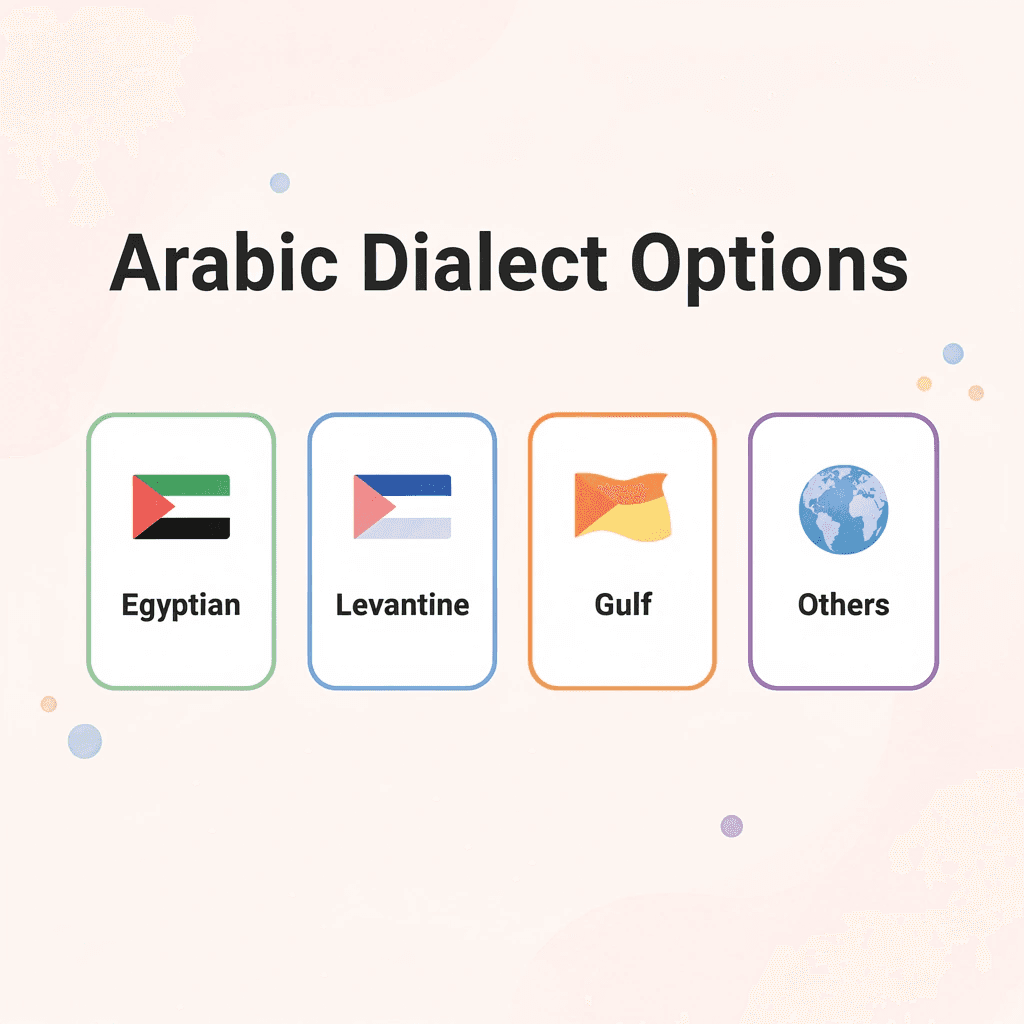
The biggest frustration for learners is recognizing words but freezing when it's time to respond. Kalam puts you in scenarios where you practice speaking from day one, using vocabulary and grammar patterns native speakers rely on. Whether you're preparing for travel, deepening your cultural connection, or frustrated by understanding more than you can say, our app gives you a clear path forward.
💡 Tip: Start with 5-minute daily sessions focusing on one dialect - consistency beats intensity when building speaking confidence.
Start learning Arabic today in any dialect with Kalam. Turn recognition into real communication.

Related Reading
Arabic Vowels
Urdu Vs Arabic
Arabic Basics
Arabic Vs Hebrew
Best App To Learn Arabic