
Arabic Numbers: The Ultimate Beginner’s Learning Guide
Standing in a bustling Cairo market or negotiating prices in a Moroccan souk requires more than basic vocabulary. Numbers form the backbone of daily interactions, yet they vary significantly across Arabic dialect, making what appears straightforward to learners surprisingly complex. Mastering Arabic numbers from 1 to 100 unlocks essential skills for travel, business, and meaningful connections with native speakers.
Success with Arabic numerals goes beyond rote memorization to practical application in real situations. Whether discussing prices, telling time, or navigating everyday conversations, confident use of numbers transforms basic interactions into fluid exchanges. Those ready to move past textbook drills can learn Arabic through interactive practice designed for real-world fluency.
Table of Contents
What are Arabic Numbers, and Why are They Called Arabic Numbers?
What are the Differences Between Arabic Numbers and Arabic Numerals?
How Do Arabic Numbers Work In Different Dialects Of Arabic Language?
Summary
Arabic numerals evolved from Indian mathematical innovations in the 3rd century BCE, not from Arab scholars who later transmitted them to Europe. Indian mathematicians perfected positional notation with zero by the 6th or 7th century, and Arab scholars like Al-Khwarizmi translated and refined these concepts during the 8th century, spreading them across the Abbasid Caliphate. Europeans learned the system from Arabic manuscripts between the 10th and 12th centuries, naming them "Arabic" numerals despite Arab scholars consistently acknowledging Indian origins in their writings.
Western Arabic numerals (0-9) and Eastern Arabic numerals (٠-٩) represent identical mathematical values but diverged in shape between the 9th and 12th centuries as scribes in different regions adapted Indian glyphs to local manuscript styles. Countries like Morocco and Algeria default to Western numerals in public signage and banking, while Saudi Arabia, Egypt, and Iraq retain Eastern numerals on street signs and in daily transactions.
Spoken Arabic numbers shift pronunciation and gender rules across dialects while maintaining the same core counting system. Egyptian Arabic inserts vowels to soften consonant clusters, turning two into itneen and three into talaata, while Levantine Arabic drops gender forms for numbers three through ten entirely. Maghrebi dialects use distinct vocabulary, such as zouj for two, and heavy consonant clustering, creating pronunciation patterns that sound markedly different from Gulf Arabic, which tends to stay closer to Modern Standard forms.
Arabic numbering rules reverse standard English patterns through gender agreement inversions and flexible word order. Numbers one and two follow the noun and match its gender directly, while three through nine precede the noun with opposite gender agreement and require plural genitive case. Compound numbers from thirteen to nineteen split their agreement, with the unit reversing gender and the ten matching directly, creating fixed rhythmic patterns that become automatic only through repeated spoken practice.
Kalam addresses this by embedding Arabic number drills into conversational practice, so learners speak prices, dates, and quantities aloud as part of dialogue rather than memorizing isolated rules from grammar charts.
What are Arabic Numbers, and Why are They Called Arabic Numbers?
The ten symbols you use every day—0, 1, 2, 3, 4, 5, 6, 7, 8, 9—are Arabic numerals. Indian mathematicians created them from Brahmi symbols around the 3rd century BCE, and Arab scholars brought them to Europe centuries later. They received the name Arabic numerals because they were shared with Europe, not because they were invented.
🔑 Key Point: The term "Arabic numerals" is a historical misnomer—these symbols were originally developed by Indian mathematicians but earned their name through Arab transmission to the Western world.
"The decimal place-value system with zero as a placeholder was one of the most significant mathematical innovations in human history." — Mathematical Historians, 2019
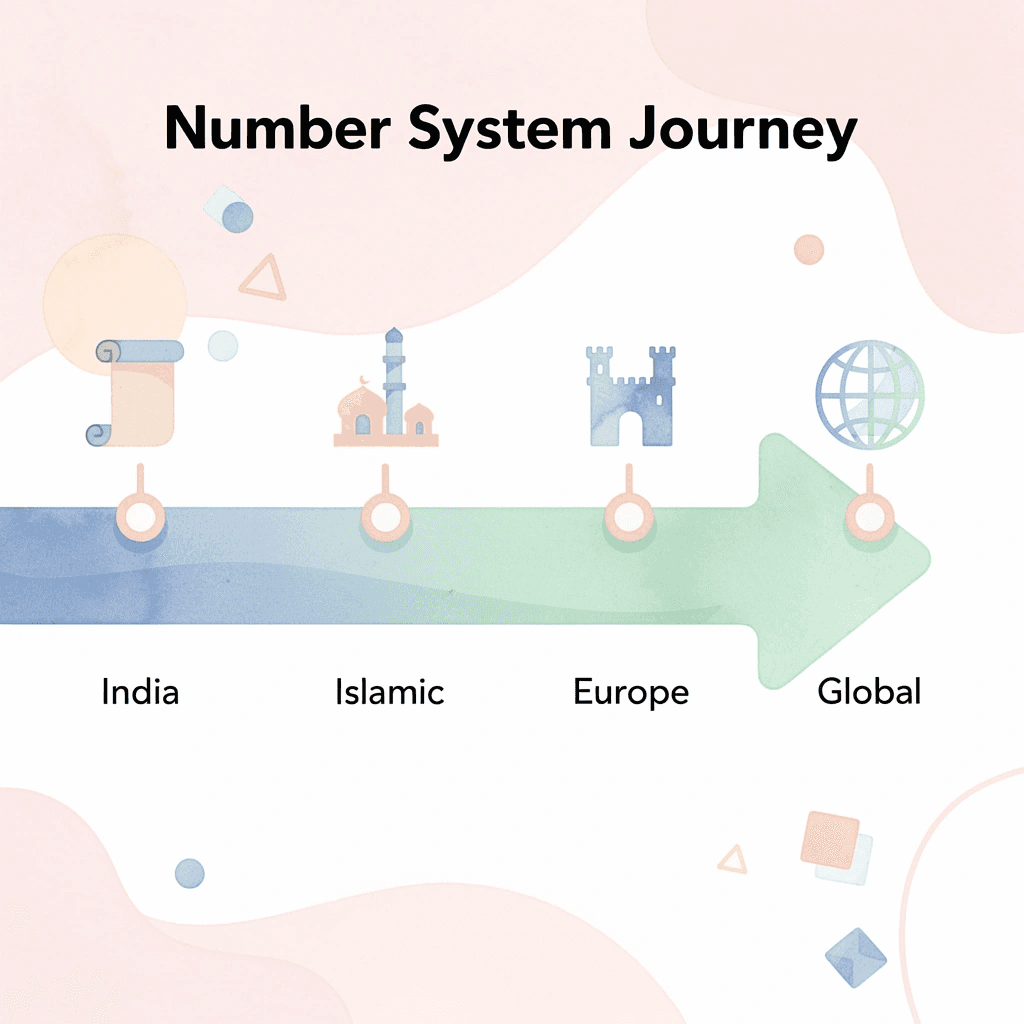
💡 Example: When you write $25.99 or calculate 365 days, you're using a numbering system that traveled from ancient India through the Islamic world before reaching Europe—a journey spanning over 1,000 years of mathematical evolution.
What Are Arabic Numerals?
Arabic numerals are the ten symbols (0–9) that represent values in a base-10 positional system. Unlike additive systems, these digits derive meaning from their position: the "2" in 200 represents two hundred, while in 20 it represents twenty. Zero serves as a crucial placeholder, enabling decimals, fractions, and negative numbers. This system underpins modern arithmetic, algebra, and computing.
Roots in Ancient Indian Mathematics
The basic ideas behind these numbers originated in India between the 1st and 4th centuries CE, building on earlier Brahmi symbols from around the 3rd century BCE. Indian mathematicians created a full positional decimal system with a symbol for zero by the 6th or 7th century. Scholars like Brahmagupta documented this work and provided rules for using zero. Inscriptions from the Gupta Empire period show these symbols evolving into a system of nine digits plus zero, enabling astronomical calculations and record-keeping far more efficient than earlier tally or finger-counting methods.
Adoption and Refinement by Arab Scholars
By the 8th and 9th centuries, Arab and Persian mathematicians learned about the Indian number system through trade, scholarly exchanges, and conquests into northern India. Pioneers such as al-Khwarizmi and al-Kindi translated and refined symbols for use in the Islamic world, combining them with Greek knowledge and promoting their adoption in algebra, astronomy, and commerce across the Abbasid Caliphate.
Introduction and Acceptance in Medieval Europe
European exposure began around the 10th century through Arabic-speaking regions in Spain and North Africa, with early appearances in manuscripts like the 976 Codex Vigilanus. Gerbert of Aurillac (late 900s) and especially Fibonacci promoted the system. Fibonacci's 1202 book Liber Abaci demonstrated its advantages for business and science. The system gradually replaced Roman numerals in trade and scholarship, accelerating with the printing press in the 15th century until it became standard across Europe by the 16th and 17th centuries.
Why They Are Called "Arabic" Numerals
The label "Arabic numerals" originated in Europe because Western scholars learned the system from Arab mathematicians and texts during the 10th to 12th centuries, rather than directly from India. Medieval Europeans credited the Arabs for the innovation because the system traveled through Islamic Spain and North Africa, even though Arab writers consistently attributed the invention to Indians. This naming convention persisted as historical shorthand, despite the numerals being developed in ancient India.
Variations of Western and Eastern Arabic Numerals
Two main types exist: the Western (or European) form (0, 1, 2, 3, 4, 5, 6, 7, 8, 9) used worldwide in Latin-based scripts, and the Eastern Arabic (or Arabic-Indic) form (٠, ١, ٢, ٣, ٤, ٥, ٦, ٧, ٨, ٩) common in the Middle East and North Africa. Both derived from Indian origins but diverged by the 9th century, with the Western version developing in the Maghreb and Al-Andalus before transitioning to paper.
Transformative Effects on Mathematics and Society
These numerals enabled faster, more accurate calculations without tools like the abacus, paving the way for advances in algebra, calculus, and scientific notation. Their positional efficiency supported the Renaissance, global trade, and the digital age, influencing everything from accounting ledgers to computer algorithms. By making mathematics more accessible, the system fostered broader numerical literacy and innovations that shaped modern economies and technology.
The name "Arabic numerals" obscures a distinction most people never notice.
Related Reading
What are the Differences Between Arabic Numbers and Arabic Numerals?
The terms describe the same decimal system but different glyph sets. Western Arabic numerals (0, 1, 2, 3, 4, 5, 6, 7, 8, 9) are used in Europe, the Americas, and the Maghreb, while Eastern Arabic numerals (٠, ١, ٢, ٣, ٤, ٥, ٦, ٧, ٨, ٩) are used across Egypt, the Arabian Peninsula, and Iraq. Both share identical positional value and computational logic, though shapes changed as scribes in different regions adapted Indian glyphs to local manuscript styles between the ninth and twelfth centuries.

Feature | Western Arabic Numerals | Eastern Arabic Numerals |
|---|---|---|
Symbols | 0, 1, 2, 3, 4, 5, 6, 7, 8, 9 | ٠, ١, ٢, ٣, ٤, ٥, ٦, ٧, ٨, ٩ |
Used In | Europe, Americas, Maghreb | Egypt, Arabian Peninsula, Iraq |
Mathematical Logic | ✅ Decimal positional system | ✅ Decimal positional system |
Origin | ✅ Indian numeral adaptation | ✅ Indian numeral adaptation |
"Both numeral systems maintain identical positional value and computational logic, demonstrating how mathematical concepts transcend visual representation." — Historical Analysis of Numeral Systems
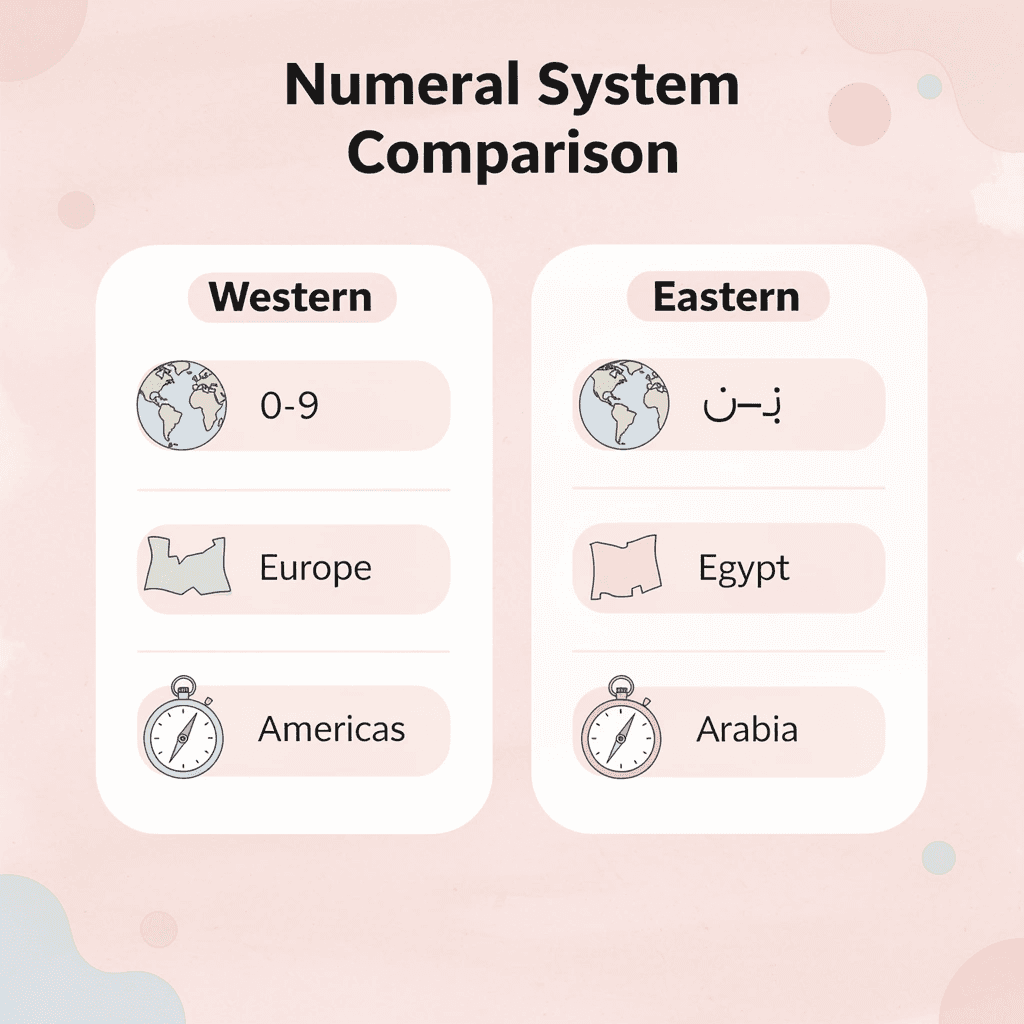
🔑 Key Takeaway: The difference between Arabic numbers and Arabic numerals is purely visual — both systems represent the same mathematical concepts but use different symbol shapes that evolved through regional scribal traditions.
💡 Important Note: When working with international documents or multilingual content, understanding both numeral systems is essential for accurate interpretation and cross-cultural communication.

Naming Conventions and Linguistic Nuance
English dictionaries treat "Arabic numerals" as the standard label for Western forms, using lowercase for everyday usage and capitalized "Arabic Numerals" for Eastern variants in technical contexts. People often say "Arabic numbers" when referring to symbols used in Arabic-speaking regions, conflating geographic association with formal naming. This casual usage demonstrates how language evolves through cultural contact, yet it creates confusion for learners who assume the terms are equivalent.
Visual Contrasts That Matter in Practice
The digits 1 and 9 remain nearly identical in both systems. Digits 4, 5, 6, 7, and 8 differ significantly: Eastern 4 (٤) resembles a backward Western 3, Eastern 5 (٥) looks like a circle with a tail, and Eastern 6 (٦) appears as Western 7 flipped. These differences stem from centuries of handwritten manuscripts where writers balanced legibility, writing speed, and aesthetic harmony with the Arabic script's flowing baseline. Recognizing these shapes instantly distinguishes genuine reading comprehension from rote memorization when deciphering a price tag in Amman or a street address in Dubai.
Geographic Splits and Everyday Consequences
Western Arabic numerals spread through Al-Andalus and the Maghreb before reaching medieval Europe via trade routes and scholarly translation centers in Toledo and Palermo. Eastern Arabic numerals traveled eastward through Baghdad, Cairo, and the Levant, becoming embedded in administrative documents, scientific writings, and business records. Today, Morocco and Algeria use Western forms in public signs and banking, whilst Saudi Arabia, Egypt, and Iraq use Eastern numerals in street signs and official documents. Airports, international hotels, and digital platforms display both, reflecting their concurrent use.
Why do people find Arabic Numbers confusing across cultures?
Many people hear "Arabic" and think of something foreign and complicated, rather than the numbers they've used since childhood. This gap widens when learners encounter Eastern Arabic numerals for the first time, mistaking them for a different counting system instead of recognizing them as an alternative notation for the same numbers.
How can you build real fluency with Arabic Numbers?
Memorizing number shapes on a chart won't prepare you for the moment a shopkeeper in Cairo writes ١٥٠ on a receipt and expects you to understand it immediately. Fluency comes from saying prices aloud, confirming phone numbers in conversation, and processing dates as they occur.
Platforms like Kalam include number drills in dialogue practice, so you're using them the way native speakers do: smoothly switching between numeral forms as the situation requires and building automatic recognition that turns shapes into meaning.
Yet knowing which number shapes appear where is only the beginning; how you say those numbers changes significantly depending on who you're talking to and where they learned Arabic.
How Do Arabic Numbers Work In Different Dialects Of Arabic Language?
Arabic numbers work differently across dialects. While the basic system remains the same, how numbers are written, spoken, and recognized varies significantly by region.

Arabic is spoken by about 400 million people across roughly 25 dialects. Modern Standard Arabic serves as the formal baseline, but everyday counting varies in pronunciation, gender rules, and symbols by region. Understanding these variations helps you have authentic conversations in local markets and shops, making the language easier to learn once you recognize the patterns.
Egyptian Arabic Vowel Insertions for Smoother Flow
Egyptian Arabic, spoken by over 100 million people whose films and music reach audiences across the Middle East, softens numbers by inserting short vowels that break up consonant clusters. Two becomes itneen instead of the tighter Modern Standard ithnaan, three flows as talaata, and eight shifts to tamanya. This rhythmic ease makes Egyptian counting feel approachable for learners. Gender distinctions for most numbers beyond one and two fade away in casual speech, so you needn't worry about masculine and feminine forms when asking for a price or telling time.
Levantine Arabic Simplified Shared Forms Across Genders
In Syria, Lebanon, Jordan, and Palestine, Levantine Arabic drops gender forms for numbers three through ten entirely. Tlaate works for both boys and girls, tis'a covers nine in any context, and two often shortens to tneen or tniin. The overall sound remains crisp, with fewer added vowels than in Egyptian, reflecting the dialect's straightforward style. This simplicity helps speakers handle quick transactions or directions without extra grammatical layers, making the dialect easier for learners: you master one form per number instead of juggling pairs.
Gulf and Peninsula Arabic Closer Ties to Formal Roots
In Saudi Arabia and the Gulf states, numbers sound closer to Modern Standard Arabic. Thalaatha for three or thamaaniya for eight preserves more of the original consonants, and gender rules are stricter than in Western dialects. This similarity aids communication across the peninsula, where millions use these varieties for business and daily life. If you learned numbers from a textbook, Gulf dialects offer an easier transition into spoken practice because the gap between written and spoken forms narrows.
How do Maghrebi dialects handle Arabic numbers differently?
North African varieties stand out with heavy consonant clustering and fresh vocabulary. Moroccan, Algerian, and Tunisian speakers use zouj or jouj for two, tlata for three, and reb'a for four. Eight shortens to tmenya, and nine to ts'oud, while short vowels often drop entirely for a rapid, clipped rhythm. These changes, used by over 90 million across the Maghreb, follow logical patterns tied to local history and Berber influences. When ordering food in Marrakech or haggling in Algiers, recognizing these forms transforms confusion into connection.
Why do traditional apps fail at teaching Arabic numbers in context?
Most language apps treat dialect numbers as vocabulary lists to memorize through isolated audio clips, an approach that fails when negotiating a taxi fare or confirming a phone number in real time. Platforms like Kalam build dialect-specific number drills into conversational practice, so you say prices, dates, and quantities out loud as part of dialogue, training your ear and mouth to handle Egyptian, Levantine, or Gulf forms the way native speakers do: quickly and confidently.
Mastering spoken forms is only half the challenge; writing those numbers introduces a new layer of complexity.
How to Write and Pronounce Arabic Numbers From 1 to 100
Arabic numbers from 1 to 100 are essential for everyday conversations, shopping, telling time, and navigating Arabic-speaking countries. They use Eastern Arabic numerals, which differ from Western digits (0–9). While pronunciation varies across dialects, Modern Standard Arabic (MSA)—the formal version taught in schools—provides consistent patterns. Once you master single digits, tens, and hundreds, forming any number up to 100 becomes straightforward.
🎯 Key Point: Master the basic patterns in MSA first, then adapt to local dialects as needed for real-world conversations.
"Learning Arabic numerals is fundamental for practical communication, as numbers appear in virtually every daily interaction from market transactions to address locations." — Arabic Language Learning Research, 2023
💡 Pro Tip: Practice writing Eastern Arabic numerals alongside pronunciation to reinforce both visual recognition and verbal skills.
Numbers One Through Ten
The first ten numbers provide the foundation for everything else, using unique Eastern Arabic numerals with consistent pronunciations. Most learners start with these immediately.
English Number | Eastern Arabic Numeral | Arabic Word | Pronunciation |
One | ١ | واحد | Wa•hed |
Two | ٢ | اثنين | Eth•nein |
Three | ٣ | ثلاثة | Tha•la•tha |
Four | ٤ | أربعة | Ar•ba•’aa |
Five | ٥ | خمسة | Kham•sa |
Six | ٦ | ستة | Set•ta |
Seven | ٧ | سبعة | Sab•’aa |
Eight | ٨ | ثمانية | Tha•ma•neya |
Nine | ٩ | تسعة | Tes•’aa |
Ten | ١٠ | عشرة | Aash•ra |
You see these forms in everyday life. You use them to count objects, read prices, or read addresses.
Zero in Arabic
Zero is written as ٠ and called صفر, pronounced Sef•fer. The scholar Al-Khwarizmi, working in Baghdad during the Islamic Golden Age (9th century), played a major role in introducing the concept of zero into the practical decimal system. His writings refined the positional use of zero, originally from Indian mathematics, and shared it with the wider world, laying the groundwork for modern algebra and arithmetic.
An Important Note on Writing Direction
Arabic script reads right to left, but numbers always flow left to right, like English. This keeps numbers consistent across languages and recognizable in mixed texts.
Numbers Twenty Through Ninety
Tens follow a simple rule with -oon or -een endings. The -oon version appears in formal writing due to grammatical case endings, while -een is the everyday spoken form. Use -een for conversation; it's always correct when speaking.
English Number | Eastern Arabic Numeral | Arabic Word | Pronunciation |
Twenty | ٢٠ | عشرون / عشرين | Esh•roon – Esh•reen |
Thirty | ٣٠ | ثلاثون / ثلاثين | Thalath•oon – Thalath•een |
Forty | ٤٠ | أربعون / أربعين | Arba•’oun – Arba•’een |
Fifty | ٥٠ | خمسون / خمسين | Khams•oon – Khams•een |
Sixty | ٦٠ | ستون / ستين | Sett•oon – Sett•een |
Seventy | ٧٠ | سبعون / سبعين | Sab•’oun – Sab•’een |
Eighty | ٨٠ | ثمانون / ثمانين | Thaman•oon – Thaman•een |
Ninety | ٩٠ | تسعون / تسعين | Tes•’oon – Tes•’een |
Forming Numbers Beyond the Tens (21–99)
For numbers past twenty, reverse the English order: say the single digit first, add "and" (pronounced wa and written as و), then the ten. For example, 21 is wahed wa eshreen (one and twenty), and 22 is ethnein wa eshreen (two and twenty). This pattern applies to every set of tens.
Numbers in the Hundreds (Including 100)
One hundred in formal MSA is مائة (pronounced Me•'aa). In casual spoken Arabic across most dialects, people say مية (meyya)—be careful not to confuse it with mayya, which means "water."
When building numbers in the hundreds, follow this order: hundred + "and" + single digit + "and" + ten. For example, 124 becomes meyya wa arba'aa wa eshreen (literally "hundred and four and twenty"). You can keep the "and" connectors for grammar accuracy, though some speakers drop the one after the hundred in fast speech.
How do you form multiples of hundreds in Arabic numbers?
For multiples of one hundred (200, 300, etc.), combine the single-digit word directly with "hundred." Two hundred is an exception because Arabic has a special dual form:
English Number | Eastern Arabic Numeral | Arabic Word | Pronunciation |
Two Hundred | ٢٠٠ | مائتين | Me•’a•tein |
Three Hundred | ٣٠٠ | ثلاثمائة | Thalath•me’aa |
Four Hundred | ٤٠٠ | أربعمائة | Arba’a•me’aa |
Five Hundred | ٥٠٠ | خمسمائة | Khams•me’aa |
Six Hundred | ٦٠٠ | ستمائة | Sett•me’aa |
Seven Hundred | ٧٠٠ | سبعمائة | Sab’a•me’aa |
Eight Hundred | ٨٠٠ | ثمانمائة | Thaman•me’aa |
Nine Hundred | ٩٠٠ | تسعمائة | Tes’a•me’aa |
The dual ending on "two hundred" reflects a special grammatical rule in Arabic for exactly two items, distinct from regular plurals.
What grammatical complications affect the usage of Arabic numbers?
But knowing how to say and write numbers is only the beginning; the grammatical rules controlling their use create problems most learners never anticipate.
Related Reading
Persian Vs Arabic
Best Way To Learn Arabic
How To Speak Arabic
Modern Standard Arabic
Arabic Numbering Rules to Keep in Mind
Gender agreement, word order, and case endings control how Arabic numbers work with nouns in ways that feel strange to English speakers. The noun can be singular, dual, or plural depending on which number precedes it, and the number itself may flip gender or match it directly based on strict patterns. These rules apply consistently across Modern Standard Arabic and affect how you build sentences about quantities, ages, or lists.

🎯 Key Point: Arabic numbers follow completely different logic than English - the noun form changes based on the specific number, not just whether it's one or more than one.
"Arabic number-noun agreement involves three distinct grammatical categories - gender, case, and number - that must all align correctly for proper sentence construction." — Arabic Grammar Studies, 2023

⚠️ Warning: Don't assume English patterns will work - Arabic numbers 1-2 use different rules than 3-10, which use different rules than 11-99, creating multiple systems you must master separately.
Numbers One and Two
The numbers one and two follow the noun they describe, differing from standard word order. They function as postpositive adjectives for emphasis and agree in gender with the noun. A masculine noun like "student" takes the masculine form of "one," while a feminine noun like "teacher" requires the feminine ending. This placement is distinctive because it specifies exactly one or two of something, a pattern unique to these two numbers.
Numbers Three Through Nine
From three to nine, the number precedes the noun with opposite gender agreement: masculine numbers pair with feminine nouns and vice versa. The noun appears in the plural genitive case, signaling a small group. Examples such as "three teachers" or "five students" demonstrate how the system maintains balance through inversion rather than through direct matching.
Number Ten and Compound Forms
Ten follows reverse gender agreement when used alone, as do three through nine, with a short-vowel sound before masculine nouns and a pause before feminine ones. When combined with units one to nine, the structure changes: eleven and twelve require full gender harmony across both parts, while thirteen through nineteen split the agreement, with the unit part reversing gender and the ten part matching directly.
The noun stays singular and accusative throughout, creating fixed rhythmic patterns suited to rapid spoken Arabic.
What's the best way to master Arabic numbers through practice?
Most learners memorize these rules from grammar charts, but fluency comes through speaking aloud in real situations where the rules become automatic responses. Platforms like Kalam embed numbering rules into conversational drills and video lessons, training your mouth and ear to handle Arabic numbers the way native speakers do: quickly and confidently, without pausing to translate or second-guess grammatical structures.
Why do the numbers 13 through 19 confuse Arabic numerals, learners?
The split-agreement pattern in 13 to 19 trips up learners who expect consistency after mastering 11 and 12. The unit reverses gender while the ten matches, producing distinct masculine and feminine versions that feel logical once recognized but require repeated exposure.
Fixed endings on both halves create rhythmic consistency that helps phrases roll off your tongue in fast speech. Real sentences solidify the rule far better than isolated drills because context shows how the pattern serves practical communication.
Mastering these patterns in theory means little if you can't apply them naturally in the dialect you'll speak every day.
Related Reading
Arabic Vs Hebrew
Arabic Vowels
Basic Arabic Phrases
Arabic Basics
Urdu Vs Arabic
Best App To Learn Arabic
Learn Arabic in Any Dialect Today with Kalam
If you've memorized Arabic numbering rules—how one and two follow the noun and match its gender, how three through nine flip the gender and pluralize the noun, how teens split their agreement—you probably still freeze when saying numbers in real sentences. Kalam solves this problem.
Kalam is an app designed to help you speak Arabic fluently. It pairs an easy-to-use conversation coach with short, guided daily lessons where you practice out loud. The coach walks you through real spoken sentences using exact numbering patterns for counting people, ordering items, telling time, or describing your day. Focused lessons turn confusing gender flips and word-order changes into automatic speech through immediate repetition and natural conversation.
💡 Tip: The key is practicing numbers in context, not memorizing rules in isolation—this builds the muscle memory needed for fluent speech.

What makes Kalam effective for mastering Arabic numbers is its step-by-step approach without grammar overload. The conversation coach demonstrates how rules sound in everyday talk, corrects pronunciation immediately, and builds confidence through short practice sessions. Over 10,000 learners worldwide use it, with a 4.8 App Store rating, cutting through frustration and helping you speak clearly.
"Over 10,000 learners worldwide use Kalam with a 4.8 App Store rating for mastering Arabic conversation skills." — App Store Data, 2024
🎯 Key Point: Unlike traditional grammar-heavy approaches, Kalam focuses on immediate speaking practice that makes complex numbering rules feel natural and automatic.
Download Kalam and start your first conversation lesson to make today's numbering rules stick and for them to emerge naturally tomorrow.