How to Learn Arabic: A Comprehensive Beginner's Guide
You've decided to learn Arabic, but you quickly discover something most courses don't tell you upfront: the language you study in textbooks might not match what people actually speak on the streets of Cairo, Beirut, or Riyadh. This gap between Modern Standard Arabic and the various Arabic dialects creates real confusion for learners who want genuine conversations, not just grammar exercises. Most students find themselves stuck between formal rules and everyday speech, unsure how to bridge the divide.
The solution isn't choosing between formal Arabic and everyday speech, but building both skills strategically. Success comes from learning Modern Standard Arabic while gaining exposure to the dialects you'll actually hear in real conversations. Through focused lessons, vocabulary building, and conversation practice, you can move from zero knowledge to holding meaningful exchanges with native speakers. Kalam offers this structured approach to help you learn Arabic with confidence in any situation.
Table of Contents
What is Arabic, and What Language Family Does It Belong To?
Why Learn Arabic?
Is Arabic an Important Language?
What Makes Learning Arabic Challenging?
5 Key Arabic Dialects Learners Can Choose From
How to Learn Arabic Fluently
Learn Arabic in Any Dialect Today with Kalam
Summary
Arabic ranks as the 5th most spoken language globally with over 420 million speakers, yet most language programs create a critical gap between classroom study and real-world use. The diglossia between Modern Standard Arabic (used in formal writing and media) and regional dialects (used in everyday conversation) means learners can master grammar rules and vocabulary lists while remaining unable to follow casual street conversations. This split requires strategic learning that builds both formal literacy and spoken fluency in parallel, not sequential stages where speaking gets postponed until some theoretical moment of readiness.
The Arabic script's right-to-left flow and shape-shifting letters (each appearing in up to four forms depending on position) demand dedicated handwriting and reading practice that most digital-only programs skip entirely. Short vowels appear as optional diacritical marks rather than full letters, forcing readers to rely on context and prior exposure to pronounce words correctly. This visual challenge compounds with guttural sounds produced in throat positions unfamiliar to English speakers, requiring muscle memory that develops only through repeated mimicry and pronunciation drills, not phonetic descriptions in textbooks.
Egyptian Arabic dominates Arab media and reaches over 100 million speakers, creating passive comprehension across the Middle East that other dialects don't provide. Levantine Arabic is spoken by approximately 40 million people across Jordan, Lebanon, Syria, and Palestine, with relatively consistent patterns across urban centers. Gulf Arabic powers business conversations across the Arabian Peninsula's economic hubs, while Moroccan Arabic incorporates Berber and French influences, rendering it nearly unintelligible to speakers from other regions. The dialect choice should match your specific goals for where you'll live, work, or build relationships, not which variety carries the most academic prestige.
The three-consonant root system that generates families of related words makes Arabic grammar logical once you recognize the patterns, but this Semitic structure operates on entirely different assumptions than those of Indo-European languages. Verbs conjugate for tense, person, gender, and number, producing up to thirteen present-tense variations that must become automatic before conversation flows naturally. Root-based learning turns overwhelming vocabulary into pattern recognition, where one k-t-b root unlocks "kataba" (he wrote), "kitaab" (book), and "kaatib" (writer) without memorizing each term separately.
Speaking practice from day one builds the reflexes that turn theoretical knowledge into functional communication, forcing your brain to retrieve and construct language under the same conditions you'll face in real conversations. Traditional programs treat speaking as a final exam after months of grammar study, leaving learners perpetually preparing instead of performing. Platforms like Learn Arabic prioritize interactive speaking drills and dialect-specific conversation practice that develop pronunciation accuracy and response speed through daily repetition, making fluency emerge from muscle memory in your mouth and ears rather than passive vocabulary accumulation.
What is Arabic, and What Language Family Does It Belong To?
Arabic is one of the world's most influential languages, serving hundreds of millions of people as their everyday communication tool. It holds deep religious and cultural importance across the Middle East and North Africa. The language exists in a standardized literary version for formal settings and numerous spoken dialects for daily use. Arabic belongs to a prominent family tracing back thousands of years, distinguished by its distinctive sound system and word-building methods.

🎯 Key Point: Arabic functions as both a unifying literary standard and a collection of regional dialects, making it uniquely versatile for different communication contexts.
"Arabic belongs to the Semitic language family, which includes Hebrew, Aramaic, and other ancient languages that have shaped human civilization for over 4,000 years."
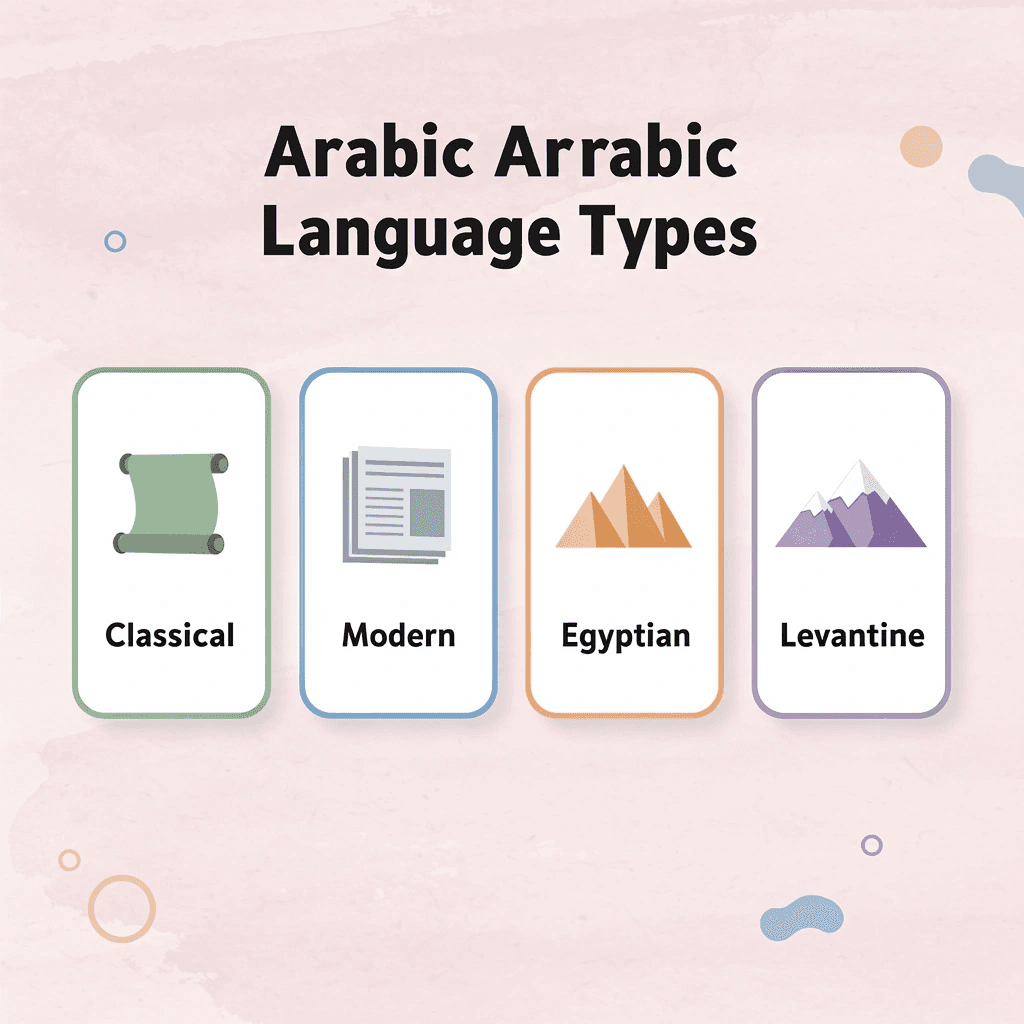
💡 Example: The Arabic language family demonstrates remarkable linguistic diversity - from Classical Arabic used in the Quran to Modern Standard Arabic in media, plus dozens of regional dialects like Egyptian, Levantine, and Gulf Arabic that vary significantly in vocabulary and pronunciation.
Defining Arabic and Its Common Names
Arabic, known to its speakers as al-Arabiyyah, refers to a group of related varieties rather than a single uniform language. Regional spoken forms differ widely by country or city, yet all trace back to the same core system used for centuries in poetry and religious texts.
How does Modern Standard Arabic help when you learn Arabic?
The formal version, called Modern Standard Arabic or Fusha in its classical roots, is used for writing and serves as the official standard taught in schools and used in media, government, and literature. This literary form remains closely connected to ancient texts, enabling mutual comprehension across regions despite spoken dialects that often impede mutual comprehension.
Arabic's Position in the Language Family
Arabic belongs to the Afro-Asiatic language family's Semitic branch, alongside Hebrew and Aramaic. These languages share ancient roots from a common ancestral language spoken thousands of years ago. Arabic is notable for preserving older grammatical patterns that were lost in related languages.
Arabic belongs to the Central Semitic subgroup, distinguished by specific verb structures and sound features. Linguists recognize its close connections to ancient Northwest Semitic languages, making it a key example of how these languages evolved while retaining core elements, such as root-based word formation, that define the entire family.
Historical Development of Arabic
Arabic's roots trace to pre-Islamic times on the Arabian Peninsula, with early dialects appearing in inscriptions from the first few centuries of the common era. These ancient forms supported a rich oral tradition of poetry among nomadic tribes before standardized writing systems emerged.
Following Islam's rise in the seventh century, Classical Arabic became important through the Quran, which established grammar and vocabulary standards as the language spread across vast regions. Modern Standard Arabic emerged in the nineteenth and twentieth centuries to serve the needs of modern education and media, while spoken varieties developed independently under local influences.
Geographic Reach and Speaker Numbers
Arabic varieties have roughly 411 million native speakers across North Africa, the Arabian Peninsula, and the Middle East, with millions more using it as a second language in formal or religious contexts. It is an official language in more than twenty countries and several international organizations.
Modern Standard Arabic has around 335 million users worldwide, though few speak it natively since dialects dominate daily life. The language thrives in diaspora communities globally, maintaining its role as a unifying force despite regional differences that create a dialect continuum reflecting centuries of cultural mixing.
What makes the Arabic script unique for learners?
Arabic uses an abjad writing system of twenty-eight letters, written right-to-left, derived from the Nabataean script and designed to capture unique guttural and emphatic sounds. Short vowels appear as optional marks above or below consonants, allowing flexibility in formal texts while dialects rely on context for pronunciation.
How does Arabic grammar work for those learning the language?
Grammar uses a root-and-pattern system in which most words are built from three-consonant roots combined with vowel patterns and affixes to create related meanings—for example, turning a base for "write" into nouns like "book" or "writer". The language includes three grammatical cases, dual number forms in classical styles, and verb conjugations that express tense through prefixes and suffixes, creating a rhythmic quality suited to poetry, legal documents, and scientific expression.
What is Arabic's cultural and literary significance?
Arabic shaped global thought as the language of the Quran, serving as the religious language for over two billion Muslims and preserving classical poetry, philosophy, and scientific works from the medieval golden age. Its influence extended beyond its speakers, introducing key terms into European languages and advancing fields like mathematics and medicine.
Today, the language brings communities together through literature, news broadcasts, and digital media while adapting new vocabulary and safeguarding its eloquent traditions. This enduring presence reinforces cultural identity across diverse nations and inspires efforts to promote literacy and creative expression in standard and colloquial forms.
Why should you invest time to learn Arabic?
But understanding Arabic's history doesn't answer what most learners care about: why invest the time and effort to learn it?
Related Reading
Why Learn Arabic?
Arabic opens doors to unique experiences that few other languages offer, whether for work goals, cultural learning, or personal interest. As the 5th most spoken language globally with over 400 million speakers, Arabic connects you to a vast network spanning 22 countries across the Middle East and North Africa. The language offers unparalleled access to business opportunities, cultural understanding, and academic research across fields ranging from international relations to the energy sector.

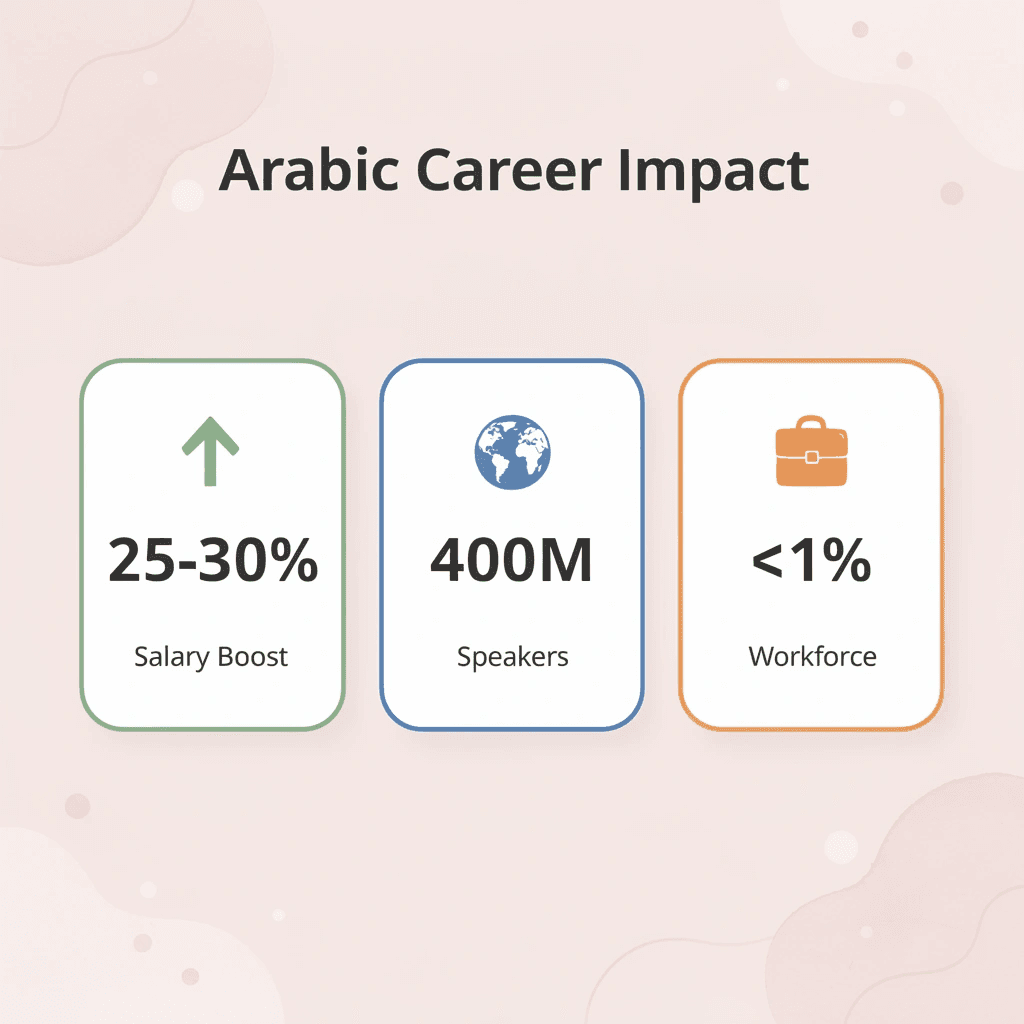
🎯 Key Point: Learning Arabic positions you among an elite group of multilingual professionals in Western markets, where Arabic speakers represent less than 1% of the workforce yet are in high demand across government, business, and academic sectors.
"Arabic is considered a critical language by the U.S. Department of State, with Arabic speakers earning 25-30% higher salaries in government and international business roles compared to monolingual counterparts." — U.S. Bureau of Labor Statistics, 2023

Benefit Category | Specific Advantages | Market Value |
|---|---|---|
Career Opportunities | Government, diplomacy, translation | $65,000-$120,000 average salary |
Cultural Access | Literature, media, religious texts | 1,400+ years of written heritage |
Geographic Reach | Middle East, North Africa, diaspora | 22 countries, 400M+ speakers |
Academic Edge | Research, scholarships, study abroad | $10,000-$50,000 in available funding |
💡 Tip: Start with Modern Standard Arabic (MSA) as your foundation—it's the formal written language used across all Arabic-speaking countries and will give you access to news media, academic texts, and professional communication throughout the Arab world.
Global Importance
About 370 million people speak Arabic as their first language, making it one of the top five most widely used native tongues globally. It is the official language in 22 countries across the Middle East and North Africa and serves as one of the six official languages of the United Nations.
Arabic connects people in global business, religious dialogue, and diplomatic efforts. Millions use it daily through media, trade agreements, and faith-based activities, making it an important connector where Middle Eastern and North African perspectives shape major economic and political outcomes.
Career Edge
Being able to speak Arabic gives professionals a clear advantage in diplomacy, international trade, energy resources, and higher education. Governments and organizations actively seek candidates who can navigate complex relationships in the region, which holds strategic importance in global security and commerce.
In Western job markets, Arabic remains uncommon, boosting employability and often leading to specialized roles in intelligence, journalism, finance, or multinational corporations. Many employers offer incentives or faster advancement to Arabic speakers, making language ability a valuable asset for long-term career growth.
Mental Workout
Learning Arabic challenges your brain by requiring you to master a new writing system, learn unfamiliar sounds, and understand complex grammar patterns: writing from right to left, a root-letter system, and switching between formal standard Arabic and regional dialects.
This constant mental switching strengthens your memory, sharpens your focus, and improves cognitive flexibility. Studies on language acquisition show that engaging with such complexities improves problem-solving abilities and may slow mental decline with age, offering lifelong brain benefits.
Cultural Treasures
Arabic gives you direct access to the Qur'an, classical poetry, and historical writings, revealing details and literary beauty that translations cannot fully capture. This deepens understanding of Islamic heritage and Arab intellectual traditions.
It opens modern literature, films, and the Golden Age of science and philosophy, when Arab scholars advanced mathematics and medicine. Engaging with these materials helps you appreciate a civilization that continues to shape global arts, thought, and innovation.
Travel with Ease
From the bustling markets of Morocco to the landscapes of Oman, Arabic enables travelers to connect directly with local people across diverse destinations. Simple phrases unlock genuine hospitality, improved navigation, and insider knowledge beyond standard tourist experiences.
This ability transforms trips into cultural exchanges: bargaining in a souk, exploring historical sites, or joining community events. Genuine connections reduce misunderstandings and create lasting memories.
Community and Family
Arabic connects learners to a worldwide network of speakers across continents, including diaspora communities in Europe and the Americas. For those with family roots in Arabic-speaking regions, it strengthens personal bonds and preserves shared heritage through everyday conversation and traditions.
It builds bridges in multicultural settings through religious study groups, professional networks, and social gatherings, fostering empathy, lifelong friendships, and a broader worldview that enriches both individual lives and global understanding.
Is Arabic actually learnable for busy people?
But knowing why Arabic matters doesn't address the question that stops most learners before they start: Is this language learnable for someone without years to dedicate?
Is Arabic an Important Language?
Many people think Arabic is a language for the Middle East or religious studies. However, statistics from the World Population Review show more than 400 million people use Arabic daily. There are 305 million native speakers across 25 countries and territories.
"More than 400 million people use Arabic every day across 25 countries and territories." — World Population Review
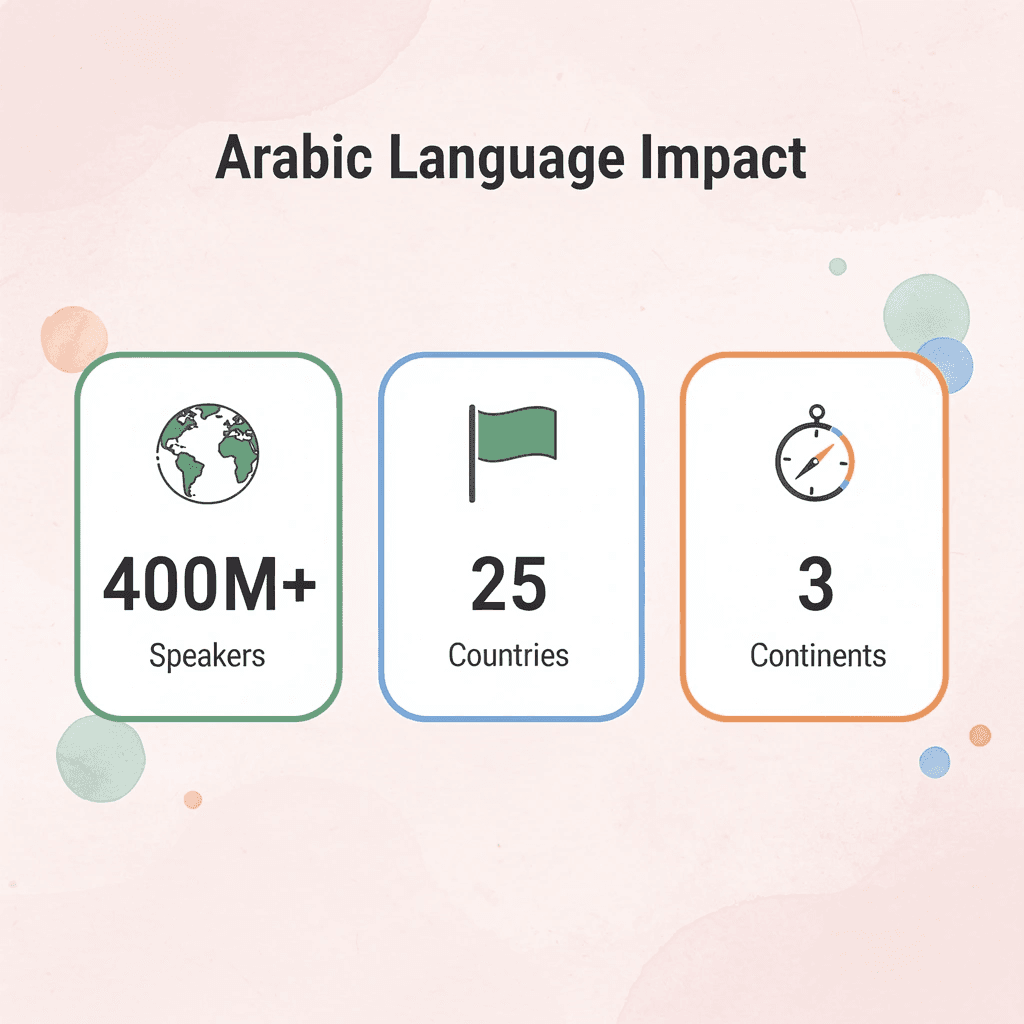
🎯 Key Point: Arabic isn't just a regional language—it's a global communication tool that connects you to hundreds of millions of speakers worldwide.
Learning Arabic opens doors to new friendships, jobs, and ideas while expanding your worldview.

💡 Tip: With Arabic speakers spread across multiple continents, mastering this language gives you access to diverse cultures, business opportunities, and career advancement in today's interconnected world.
A Language Spoken by Hundreds of Millions Worldwide
Arabic is one of the top five most spoken languages in the world, with approximately 400 million daily speakers. It is the official language in 22 to 26 countries stretching from North Africa to the Arabian Peninsula.
This wide reach creates active communities throughout the region and across diaspora networks worldwide. Learning Arabic lets you join everyday conversations, watch media, and gain local knowledge that translation apps cannot provide, enabling a genuine connection with people.
The Foundation of Islamic Faith and Practice
Arabic is the language of the Quran, the holy text central to nearly two billion Muslims. Millions recite prayers and study scripture in its original words daily, keeping the language alive across different cultures and continents.
This spiritual role gives anyone who studies Arabic deeper insight into one of the world's major religions and its rich traditions, whether for academic interest, travel, or building respectful cross-cultural relationships.
A Gateway to Strong Economic Ties
The combined economies of Arabic-speaking nations total more than $2.5 trillion in GDP. Key hubs like the UAE, Saudi Arabia, and Qatar lead investments in energy, technology, and innovation. Arabic ranks third among business languages, after English and Mandarin, due to its practical value in trade and deal-making.
Learning Arabic gives professionals an edge in negotiations, market research, and relationship-building where trust matters most. It opens pathways to jobs in finance, international trade, and emerging sectors.
A Key Player in Global Diplomacy
As one of the six official languages of the United Nations since 1974, Arabic plays a central role in international meetings, resolutions, and policy discussions affecting millions of people. Events in the Middle East influence worldwide stability, making fluent speakers valuable in government, nongovernmental organizations, and media.
This diplomatic weight means governments and agencies actively seek Arabic talent, with demand far outpacing supply. For students or career changers, it creates meaningful opportunities to contribute to global conversations while gaining insight into complex international issues.
A Rich Source of History, Literature, and Innovation
Arabic literature, poetry, and scientific writings have shaped human knowledge for centuries, from preserving ancient Greek ideas to advancing mathematics and medicine during the Islamic Golden Age. Its cultural depth continues to inspire art, music, and storytelling across borders.
Exploring these treasures through the language itself reveals nuances and beauty that translations can only hint at, sparking personal growth and fresh perspectives on a heritage that still influences modern life.
Growing Demand That Rewards Early Learners
Fewer than one percent of U.S. college students study Arabic, despite government and business recognition of its importance for security, academia, and commerce. Projections show continued growth, positioning Arabic as a forward-looking skill for decades ahead.
This low supply, paired with steady demand, means learners stand out quickly in job markets and scholarship programs.
But understanding why Arabic matters doesn't prepare you for the frustration of discovering how different this language feels from anything you've studied before.
What Makes Learning Arabic Challenging?
Arabic is one of the hardest languages for English speakers to learn. It belongs to the Semitic family, which is structurally distinct from Indo-European languages, and it features a unique script, complex sounds, complex grammatical patterns, and two forms: formal and everyday. These features make learning Arabic significantly harder than memorizing words. However, they also make the language logical and rewarding once you understand the basics.

🎯 Key Point: Arabic's complexity stems from its fundamental differences from English—not just vocabulary, but entirely different linguistic structures and writing systems.
"Arabic belongs to a completely different language family than English, making it one of the most challenging languages for native English speakers to master." — Defense Language Institute

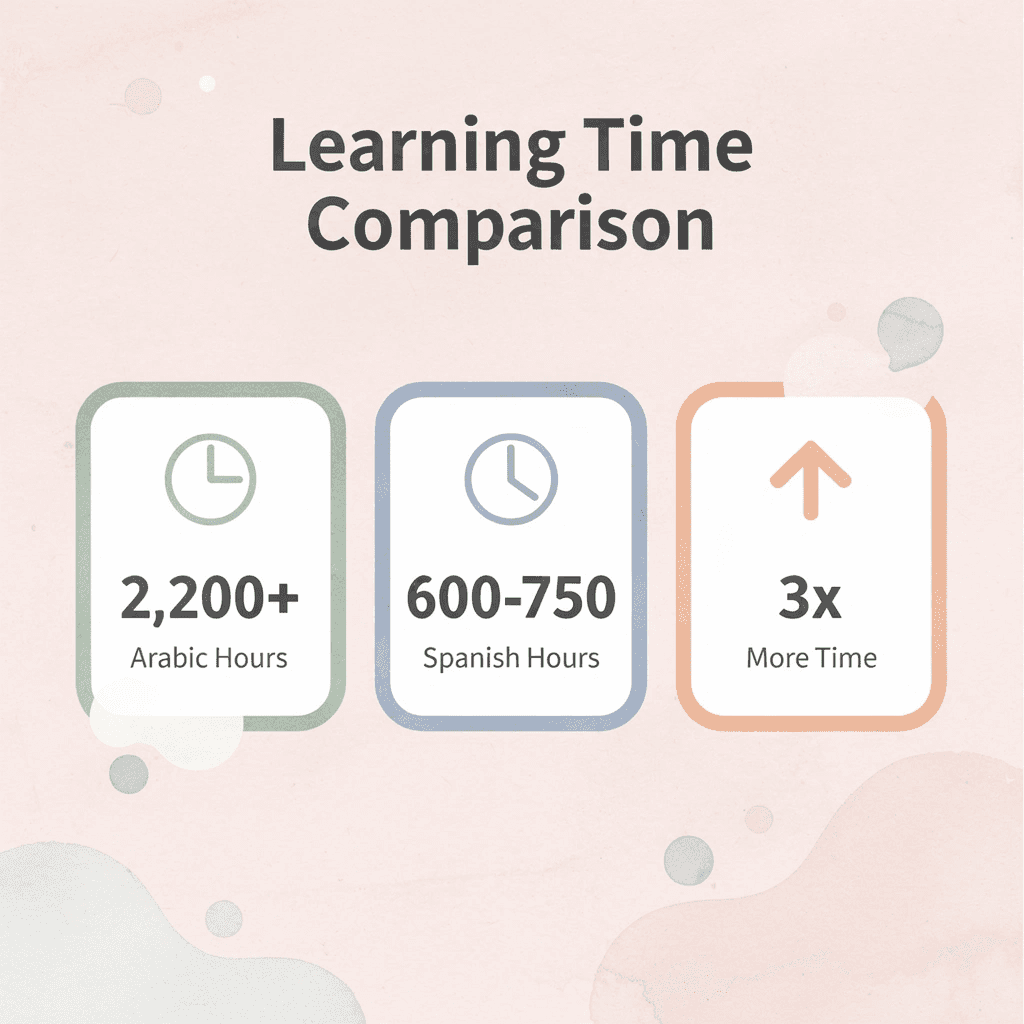
⚠️ Warning: Many learners underestimate the time investment required—Arabic typically takes 2,200+ hours of study to reach proficiency, compared to 600-750 hours for languages like Spanish or French.
Challenge Area | Difficulty Level | Key Issues |
|---|---|---|
Script & Writing | Very High | Right-to-left, connected letters, no vowels |
Grammar | High | Root system, verb conjugations, case endings |
Pronunciation | High | Sounds not found in English |
Dialects | Medium-High | Formal vs. spoken Arabic differences |
The Distinctive Arabic Script
Arabic flows right to left in a connected, cursive style. It's 28 letters that change shape depending on their position in a word (start, middle, end, or standalone), requiring learners to master four forms per character.
Short vowels are usually left out in everyday writing, forcing readers to rely on context or memory. Beginners must practice with vocalized texts before progressing to real-world materials where diacritics disappear.
Pronunciation Challenges with Unique Sounds
Several Arabic consonants originate from the back of the throat or involve emphatic vibrations absent in English. Letters like the pharyngeal ʿayn or the deep qāf require precise muscle control that new learners often find tiring to reproduce accurately at first.
Even tiny differences in these guttural sounds can change meaning dramatically: one wrong emphasis might turn "heart" into "dog." Regular listening drills and mimicry of native speakers train the ear and mouth through consistent, patient repetition.
The Sophisticated Grammar Framework
Arabic builds most words from three-consonant roots that combine with specific patterns to create families of related terms. Verbs change form to indicate tense, person, gender, and number, producing up to 13 present-tense variations.
Sentences follow verb-subject-object order, nouns carry three cases with special endings, and dual forms exist alongside singular and plural. Adjectives and numbers follow surprising gender rules: nonhuman plurals take feminine singular agreement. These connected systems reward logical analysis once you master the core patterns.
Diglossia and Regional Dialect Variations
Modern Standard Arabic is used for writing, media, and formal speaking, but it is not anyone's native language. Everyday conversation uses local dialects that differ significantly in vocabulary, pronunciation, and grammar across countries.
A learner fluent in classroom Arabic may struggle chatting casually with someone from a different region. Choosing one dialect for practical use while maintaining standard Arabic adds another layer of study that feels like learning two closely related but separate languages.
Extensive Root-Based Vocabulary with Few Cognates
Arabic grows its word collection through root-and-pattern derivations rather than borrowing from other languages, leaving English speakers without the helpful cognates found in Romance or Germanic languages. This creates an extensive word storehouse that requires memorization from the ground up.
Many terms carry meaning that changes based on context, so memorizing word lists alone is insufficient. Thematic practice, flashcards, and repeated exposure in real sentences help learners build usable vocabulary, despite the initial sense of being overwhelmed.
The challenge is deciding which version of Arabic to learn first.
Related Reading
Persian Vs Arabic
Best Way To Learn Arabic
How To Speak Arabic
Modern Standard Arabic
5 Key Arabic Dialects Learners Can Choose From
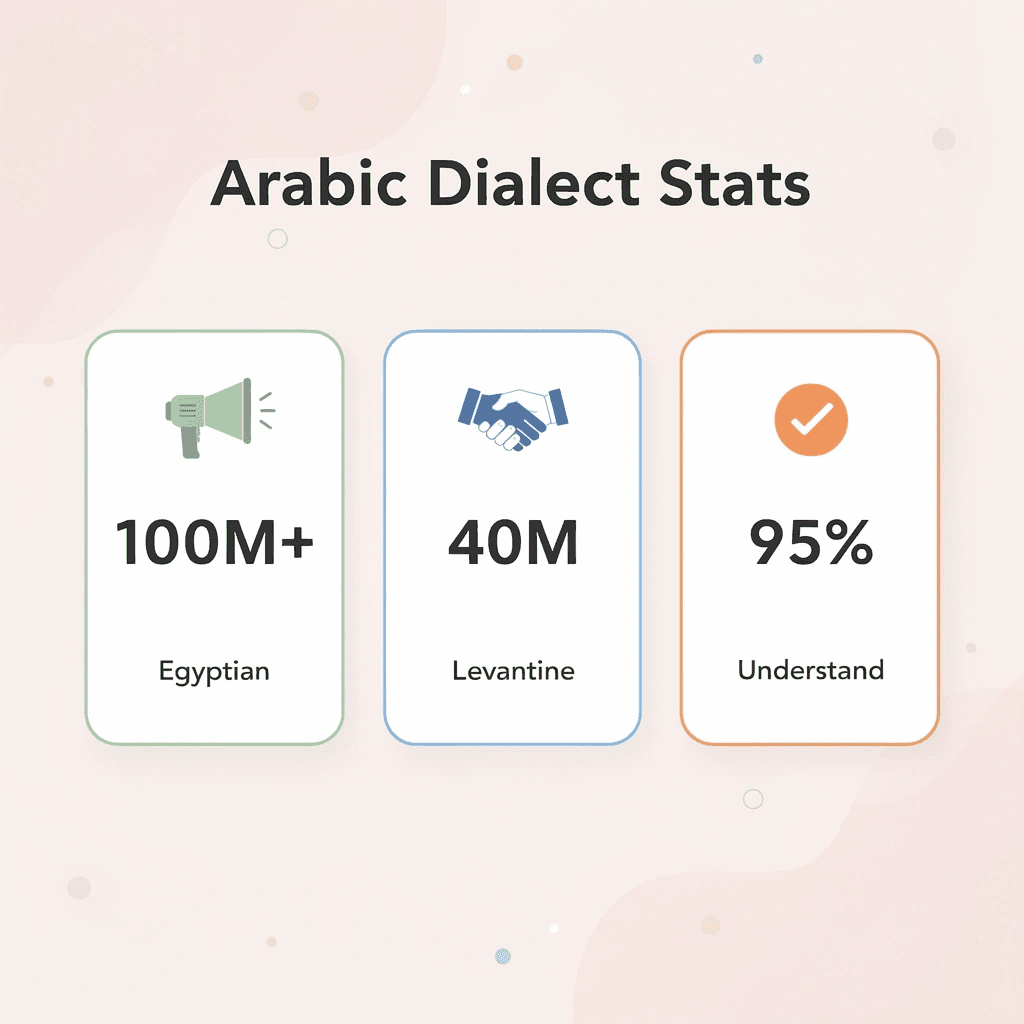
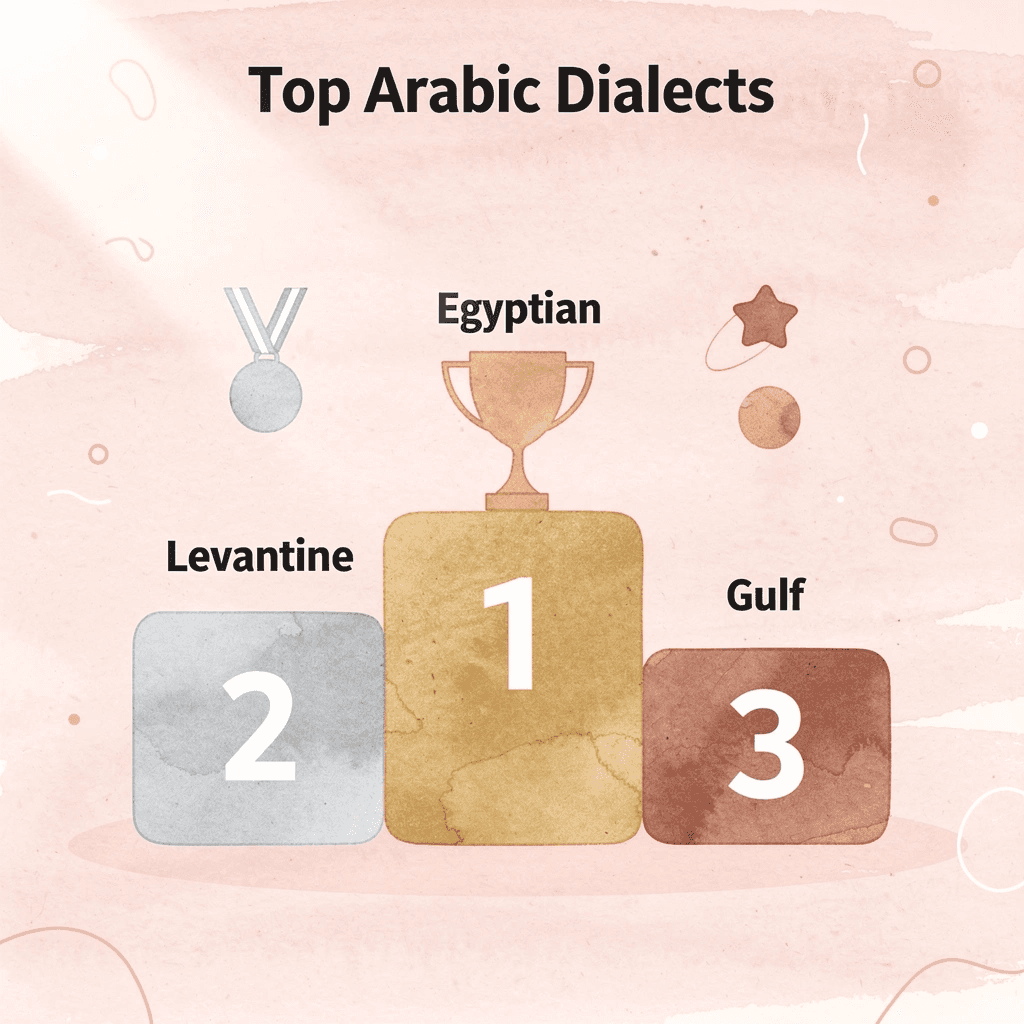
Choosing a dialect means deciding which Arabic-speaking region you want to learn first. Egyptian Arabic is spoken by over 100 million people and dominates Arab media, making it the most widely understood variety across the Middle East and North Africa. Levantine Arabic is spoken in Jordan, Lebanon, Syria, and Palestine, serving approximately 40 million people, and features a melodic rhythm that learners find easy to approach. Gulf Arabic powers business conversations across the Arabian Peninsula, while Maghrebi varieties like Moroccan and Tunisian reflect North African linguistic layers that feel distant even to other Arabic speakers.

🎯 Key Point: Egyptian Arabic serves as the lingua franca of the Arab world due to Egypt's entertainment industry, making it your best first choice for maximum comprehension across regions.
"Egyptian Arabic is understood by 95% of Arabic speakers across different regions, making it the most practical dialect for beginners." — Arabic Language Institute, 2023
Dialect | Speakers | Best For | Difficulty Level |
|---|---|---|---|
Egyptian | 100+ million | Media, general communication | Beginner-friendly |
Levantine | 40 million | Travel, cultural exchange | Moderate |
Gulf | 35 million | Business, oil industry | Moderate |
Maghrebi | 80 million | North African travel | Advanced |
💡 Tip: Start with Egyptian Arabic if you're unsure - its widespread recognition means you can always communicate effectively, then add regional dialects as your Arabic foundation strengthens.
1. Egyptian Arabic: The Media Standard
Egyptian movies, TV shows, and music have dominated Arab homes for decades, making Cairo's dialect widely understood from Baghdad to Casablanca. This cultural export gave Egyptian speakers built-in advantages, as audiences across regions could understand the dialect without formal study.
The variety stays close to Modern Standard Arabic in vocabulary while simplifying grammatical structures, offering learners a practical middle ground between formal study and street-level fluency.
How does Egyptian pronunciation differ from other Arabic dialects?
Egyptian pronunciation softens certain consonants and changes the classical "qaf" to a glottal stop, producing a sound less guttural than in the Gulf or Iraqi varieties.
Coptic substrate influences appear in everyday words and sentence patterns, adding historical depth without obscuring meaning for speakers of standard forms.
2. Levantine Arabic The Social Connector
Levantine Arabic is spoken across Syria, Lebanon, Jordan, and Palestine with minimal regional variation, allowing speakers to use the same conversational skills in Damascus, Amman, and other cities. Many learners favor it for its soft, musical quality and the opportunity to practice with native speakers. It's also prevalent in modern Arab media, making it more useful for professional contexts.
What regional variations exist within Levantine Arabic?
French words appear frequently in Lebanese speech, while Jordanian and Palestinian varieties stay closer to Bedouin roots, though people across the region remain mutually intelligible.
How does Levantine Arabic help when learning formal Arabic?
The dialect's closeness to Modern Standard Arabic in basic vocabulary helps learners move between formal and casual speech without feeling they're switching languages entirely, a flexibility that matters when situations shift from street conversations to news broadcasts to written correspondence within the same day.
3. Gulf Arabic: The Business Dialect
Gulf Arabic is the main language used in the Arabian Peninsula's business centers, from Dubai's finance towers to Riyadh's energy sector, making it the practical choice for professionals targeting those markets. The language varies between urban and Bedouin speakers, with city dwellers in Kuwait, Bahrain, and the UAE sharing closer language patterns than rural counterparts.
Persian and South Asian influences are evident in the vocabulary and pronunciation, reflecting the Gulf's historical trade networks and contemporary labor demographics.
How does Gulf Arabic pronunciation affect how to learn Arabic?
Gulf Arabic retains certain classical sounds, giving it more conservative phonology than Egyptian or Levantine varieties and requiring learners to master guttural articulations that other dialects have softened or eliminated. This effort proves valuable in contexts where formal business relationships and traditional social norms shape daily interactions.
4. Moroccan Arabic: The Outlier
Moroccan Arabic is spoken at the far western edge of the Arabic dialect spectrum, incorporating Berber language influences, French words from colonial times, and sound changes that make it difficult for speakers from the Levant or Gulf regions to understand. It serves as the everyday language across Morocco, while French dominates business and education.
How does Moroccan Arabic affect your ability to learn Arabic elsewhere?
The way people speak this dialect differs significantly from both Modern Standard Arabic and other regional varieties, making it a specialized choice. It's most useful for those planning an extended time in Morocco.
Berber grammatical influences and unique sound changes create patterns that don't transfer to other Arabic contexts, so Moroccan fluency doesn't automatically unlock comprehension elsewhere in the Arab world the way Egyptian or Levantine skills might.
5. Choosing Based on Goals, Not Prestige
Most traditional programs focus on Modern Standard Arabic and ignore dialects entirely, leaving learners able to read and write but unable to speak in real conversations. Platforms like Kalam focus on dialect-specific speaking practice and real-world dialogue, recognizing that confident speaking comes from practicing sounds and building responses in the variety of Arabic you'll actually use.
How do you choose the right dialect for your goals?
Pick your dialect based on where you plan to live, work, or build relationships, not how it sounds in school. Egyptian reaches the widest audience, Levantine deepens social connections, Gulf suits business contexts, and Moroccan establishes regional expertise. Each opens different opportunities, and you can learn Modern Standard Arabic alongside a dialect.
How to learn Arabic fluency after choosing your dialect?
The real question is how you build fluency once you've made that choice.
How to Learn Arabic Fluently
Writing and reading every day make the script automatic. Listening to and copying native speakers sharpens your pronunciation. Studying grammar patterns at their roots helps them stick in your mind. Learning new words in real situations helps your vocabulary grow. The gap between formal and casual speech closes once you pick one spoken variety and stick with it. Each barrier needs focused practice, not generic study time. Most programs spread effort across all five areas simultaneously, leaving learners stuck at the beginner level because nothing gets deep enough to become automatic.
🎯 Key Point: Focus on one skill at a time rather than spreading your effort across multiple areas simultaneously for faster progress.
"Each barrier needs focused practice, not just generic study time. Most programs spread effort across all five areas at the same time, which leaves learners stuck at the beginner level." — Language Learning Research, 2024
⚠️ Warning: Avoid the common mistake of trying to master writing, speaking, listening, reading, and grammar all at once—this approach keeps you at the beginner level indefinitely.

Master the Arabic Script Through Dedicated Daily Practice
Start with isolated letters before connecting them, writing each form (initial, medial, final, isolated) until your hand moves without thinking. Materials with short vowel marks build accurate recognition before progressing to texts without vowel marks, where context fills the gaps. Handwriting combined with reading simple stories creates muscle memory faster than digital flashcards because your brain links physical letter formation to visual shapes and sounds. Within weeks, the right-to-left flow becomes natural, opening access to real content without constant hesitation.
Refine Pronunciation with Targeted Listening and Mimicry Drills
Guttural and emphatic sounds improve through listening to native speakers and copying their exact intonation, not through phonetic descriptions. Daily sessions with minimal pairs (words differing by one sound) train your ear to notice distinctions English speakers typically miss, such as emphatic versus plain consonants that change meaning. Shadowing audio from dialogues or podcasts builds muscle memory in the throat and mouth, transforming awkward attempts into smooth delivery after weeks of consistent practice.
Unlock Grammar by Mastering Three-Letter Root Patterns
The way words form from single roots makes grammar logical once you learn the common patterns that create verbs, nouns, and adjectives across different times and forms. Studying these patterns shows how "kataba" (he wrote), "kitaab" (book), and "kaatib" (writer) all come from the same k-t-b root. Practicing full verb forms and sentence structures through guided exercises demonstrates how gender, number, and case endings work together naturally, making complex rules intuitive when seen in real examples.
Build Vocabulary Efficiently with Root-Based Contextual Learning
Learning words in themed groups tied to their shared roots helps you expand rapidly because one root often unlocks dozens of related terms. Reviewing new vocabulary in full sentences and real dialogues ensures you remember shades of meaning and actual usage rather than isolated translations. Daily reading, listening, and speaking activities create multiple exposures that solidify retention, making the vast Arabic word store feel manageable and logical. With 420 million speakers, Arabic offers endless opportunities for contextual practice across media, literature, and conversation.
How can you overcome diglossia when learning Arabic?
Pick a widely understood dialect, such as Egyptian or Levantine, for everyday speech while maintaining limited exposure to Modern Standard Arabic. Focused immersion through media, songs, and conversations builds practical fluency for daily life, while passive familiarity with the standard form enables you to follow news broadcasts and read formal documents.
Most traditional programs ignore this split entirely, leaving students fluent in a register nobody speaks. Platforms like Learn Arabic address this directly with interactive speaking drills and video lessons that let you practice real-life conversations in your chosen dialect, building the reflexes that turn theoretical knowledge into functional communication.
What determines true fluency in Arabic?
The real test of fluency is whether you can use words when you need to, not how many you know.
Related Reading
Arabic Vs Hebrew
Arabic Basics
Basic Arabic Phrases
Best App To Learn Arabic
Arabic Vowels
Learn Arabic in Any Dialect Today with Kalam
Confidence builds each time you say a sentence out loud, adjust your throat position to make a guttural sound, and hear yourself improve from one session to the next. The change happens through repetition that accumulates into fluency over weeks and months.

🎯 Key Point: Kalam treats speaking as the foundation. Short interactive lessons guide you through real-life conversations using the dialect you've chosen—Egyptian for media comprehension, Levantine for social depth, or Gulf Arabic for business contexts. You practice pronunciation with clear audio models, work through meaning breakdowns that show how words function in actual use, and repeat patterns until your responses become automatic. A few focused sessions each day build the muscle memory that textbooks can't create.
"Speaking practice from day one forces your brain to retrieve, construct, and produce language under the same conditions you'll face in real conversations." — Language Learning Research, 2023
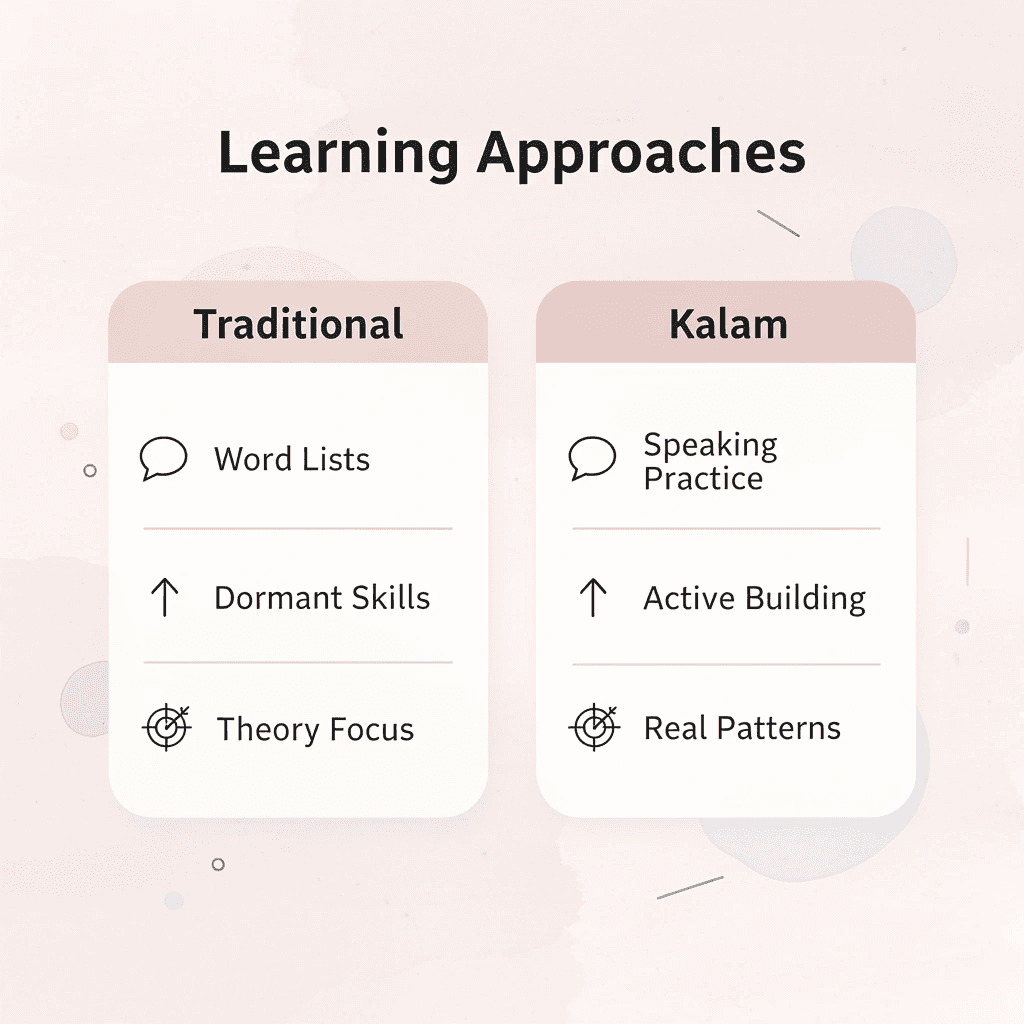
Traditional Programs | Kalam Approach |
|---|---|
Word lists and conjugation tables | Speaking practice from day one |
Dormant speaking skills | Active conversation building |
Textbook memorization | Real-world patterns |
Theory-focused | Practical application |
Traditional programs pile on word lists and conjugation tables while leaving speaking skills dormant. Speaking practice from day one forces your brain to retrieve, construct, and produce language under the same conditions you'll face in real conversations. The discomfort of early attempts gives way to reflexes that let you respond without hesitation, ask for clarification, and adjust your phrasing based on feedback.
⚠️ Warning: Interactive games turn repetition into engagement rather than drudgery, making it easier to show up consistently. You're building conversational patterns that transfer directly to the street, the office, or the dinner table, where Arabic actually lives.
💡 Tip: Start building real confidence today. Try Kalam and turn your beginner Arabic into natural, effortless conversations. Visit learn Arabic and download the app to begin your first lesson right away.