Arabic Dialects: Key Varieties and Which One to Learn First
You've decided to learn Arabic, but then you discover something unexpected: there isn't just one Arabic. Egyptian, Levantine, Gulf, Moroccan—the spoken varieties differ so much that a phrase mastered in Cairo might draw blank stares in Casablanca. Each Arabic dialect carries distinct features that reflect its region's unique history and culture. Understanding what sets each variety apart helps you choose which one matches your goals, whether you're planning to work in Dubai, connect with family in Lebanon, or explore North African culture.
Choosing the right dialect can feel overwhelming when you're just starting out. Instead of guessing which variety suits you best or wasting months on the wrong approach, you need guidance tailored to your specific needs. The key is moving past the confusion of choosing between Modern Standard Arabic and regional spoken forms with practical tools that matter for your journey. That's exactly what you'll find when you learn Arabic through a structured platform designed for your goals.
Table of Contents
Can People Speaking Different Arabic Dialects Understand Each Other?
Practical Advice for Students Starting with Modern Standard Arabic
Summary
Arabic operates through diglossia, a two-tier system in which Modern Standard Arabic serves for formal writing and speech, while regional dialects are used for daily conversation. Research from Frontiers in Education shows that educated speakers fluidly blend formal vocabulary into colloquial grammar, creating Educated Spoken Arabic that lands somewhere between the two extremes. This hybrid register proves far more useful than either pure form in isolation, yet most learners waste months debating which variety to study when real fluency requires comfort across the entire spectrum.
Geographic proximity determines mutual intelligibility more than any other factor. A 2020 study by linguists Emma Trentman and Sonia Shiri found that native Arabic speakers understood 96 percent of their own dialect but still caught 89 percent of unfamiliar ones in listening tests. That seven-point gap shrinks further between neighboring regions like Palestine and Syria, where Levantine dialects share enough vocabulary and pronunciation that conversations flow effortlessly, while an Egyptian meeting a Moroccan faces steeper challenges due to Maghrebi Arabic's heavier Berber and French influences.
Egyptian Arabic reaches over 100 million speakers and dominates regional media through decades of Cairo's film and television output. This widespread exposure makes Egyptian pronunciation familiar even to people who've never visited Egypt, functioning almost like a lingua franca among educated speakers from different countries. The dialect's cultural penetration gives learners immediate access to vast entertainment libraries and broader passive recognition across Arab populations compared to more localized varieties.
Media consumption quietly builds cross-dialect comprehension without formal study. A teenager in Tunis grows up hearing Cairo slang through comedy shows, while a professional in Riyadh follows Lebanese influencers on Instagram. This passive exposure creates asymmetric understanding, where Maghrebi speakers often comprehend eastern dialects more easily than the reverse, simply because Egyptian and Levantine content dominates regional entertainment and trains ears to recognize unfamiliar patterns instinctively.
Choosing the right dialect requires matching language study to concrete plans rather than abstract utility. A business professional relocating to Dubai gains nothing from mastering Egyptian slang, while someone with Iraqi grandparents needs Mesopotamian Arabic to access family stories that formal language can't touch. Professional sectors also create clear paths, with over 300 million Arabic speakers worldwide generating natural specialization: energy industry roles require Gulf Arabic, and media positions benefit from the prevalence of Levantine Arabic in news networks.
Kalam addresses this by offering structured speaking practice in Egyptian, Levantine, Gulf, and other dialects through conversation drills and authentic dialogue, building muscle memory in your chosen variety.
Understanding Diglossia and Arabic Dialects
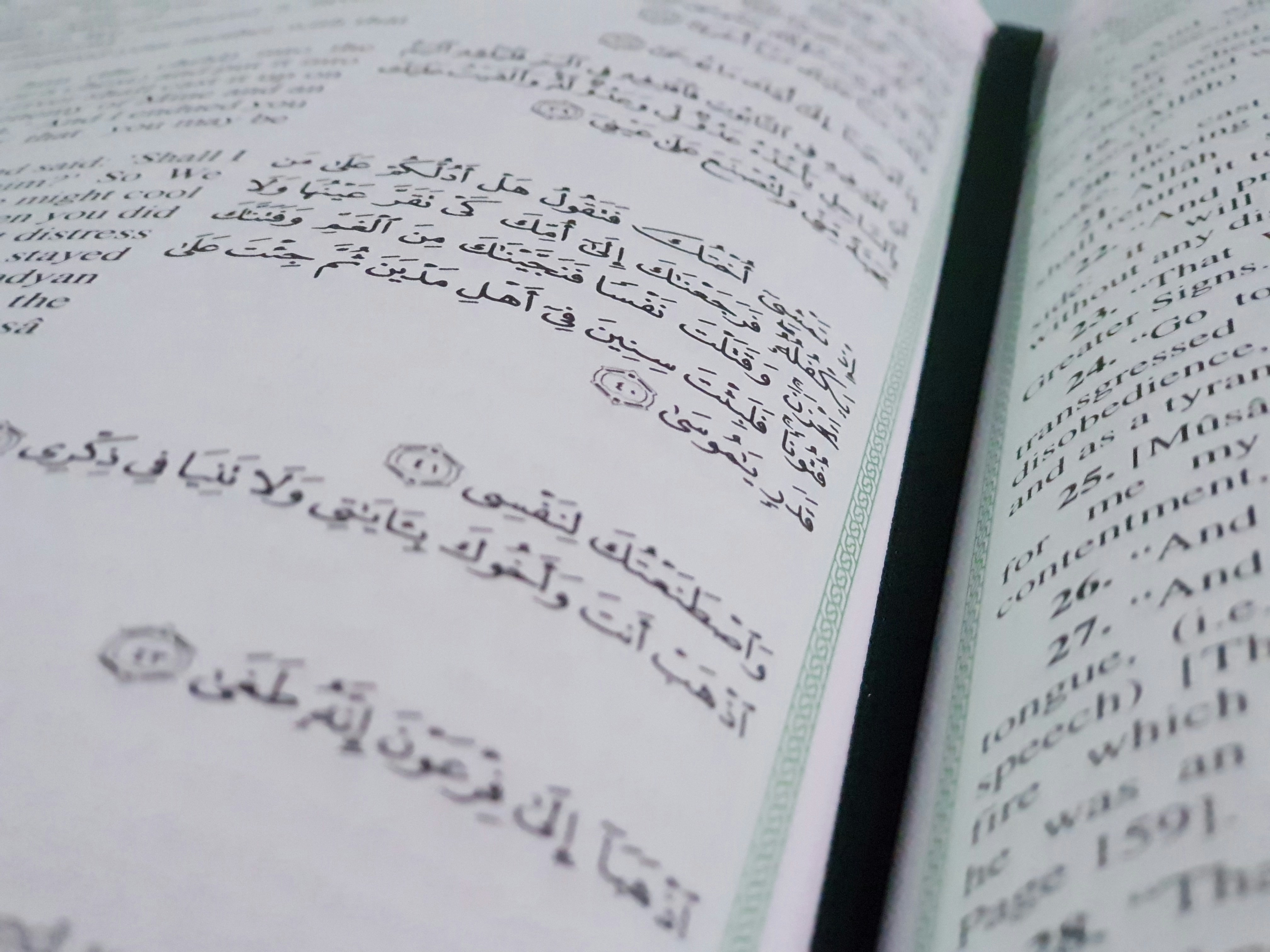
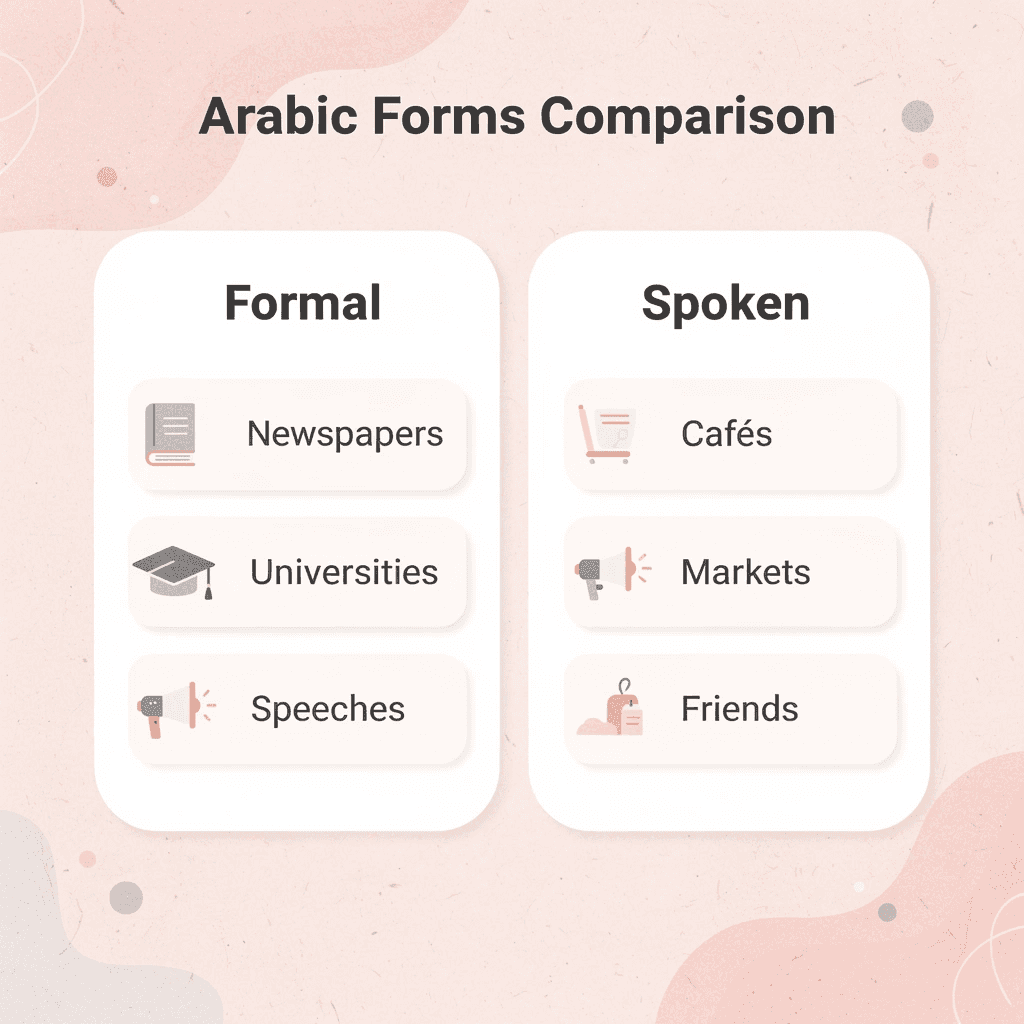
Arabic works through a language split that native speakers don't notice but confuses learners. Modern Standard Arabic appears in newspapers, formal speeches, and university lectures with correct grammar and classical vocabulary. In a Cairo café or Beirut market, people speak something completely different—without case endings, filled with regional words, and shaped by hundreds of years of local change. This dual system, called diglossia, has persisted for over a thousand years, and understanding it determines whether you'll communicate or merely read textbooks.

🎯 Key Point: Diglossia means Arabic has two distinct forms—formal written Arabic for official contexts and spoken dialects for everyday conversation. Mastering both is essential for real-world communication.
"This dual system, called diglossia, has worked for over a thousand years, and understanding it decides whether you'll actually communicate or just read textbooks."
💡 Tip: Don't get discouraged by the complexity—most Arabic learners focus on Modern Standard Arabic first, then add dialect skills based on their specific regional interests and communication goals.
How do formal and colloquial Arabic dialects function differently?
The formal variety serves as the written standard across 22 countries, uniting different groups through shared media and education. No child learns it at home; schools teach it systematically, much like Latin once spread through European institutions. Colloquial dialects handle everything else: family conversations, street negotiations, workplace banter, and daily life. These spoken forms vary so much that a Moroccan and an Iraqi might struggle to understand each other without switching to the formal register.
What makes the middle ground so important for Arabic dialects?
Arabic conversations blend formal vocabulary into everyday grammar, creating what linguists call Educated Spoken Arabic. A political discussion at a Damascus dinner table might follow Syrian pronunciation and sentence patterns while borrowing terms like "democracy" or "infrastructure" from Modern Standard Arabic. This mixed style feels natural to native speakers and proves more useful than either extreme alone.
How do Arabic speakers navigate between formal and colloquial speech?
Research from Frontiers in Education shows how Arabic speakers move fluidly along a spectrum, adjusting formality based on context, audience, and topic without conscious effort. Arabic isn't two competing languages—it's a continuum where most speakers operate in the flexible middle. Learners who grasp this spectrum early avoid wasting time on formal rules absent from real conversation or dialects too geographically specific to enable communication across the Arab world.
What choice do new Arabic learners face?
Newcomers face an immediate choice: start with Modern Standard Arabic to read and understand widely, or jump into a specific dialect to speak immediately. Traditional programs push the formal variety first, assuming students will later acquire a dialect through immersion.
That path works for academic researchers or journalists, but it leaves casual learners unable to order coffee or ask for directions after months of study. The grammar they've memorized sounds stiff and bookish in everyday situations, and native speakers respond with polite confusion.
How do Arabic dialects affect learning strategy?
Choosing a dialect first creates the opposite problem: you gain conversational fluency quickly within one region, but you cannot read a news article or follow a formal presentation without struggling through unfamiliar vocabulary and grammar structures.
Apps like Kalam address this by teaching dialects through structured speaking practice and real-world dialogue, building conversational confidence in the variety you'll use, then adding formal elements as your goals expand. The platform recognizes that most learners need to speak before they need to write policy papers, and that motivation survives when early wins feel real.
How does code-switching work in Arabic dialects?
Once you understand the spectrum, moving between registers becomes a skill rather than a burden. Native speakers adjust their language the way you'd change tone when shifting from a job interview to a text message. The formal variety provides technical precision and cross-regional clarity. Dialects offer warmth, humor, and cultural texture. Fluency means knowing when each serves you best.
What's the real challenge with fluency in Arabic dialects?
The challenge isn't choosing one variety over another: it's recognizing that Arabic fluency requires comfort across the continuum. Most learners waste energy debating which form to study when the real question is how to navigate between them without losing momentum or confidence.
But knowing diglossia exists doesn't tell you which specific dialect aligns with your goals or why Egyptian Arabic dominates the media while Levantine varieties carry different social weight.
What are the Principal Arabic Dialects?
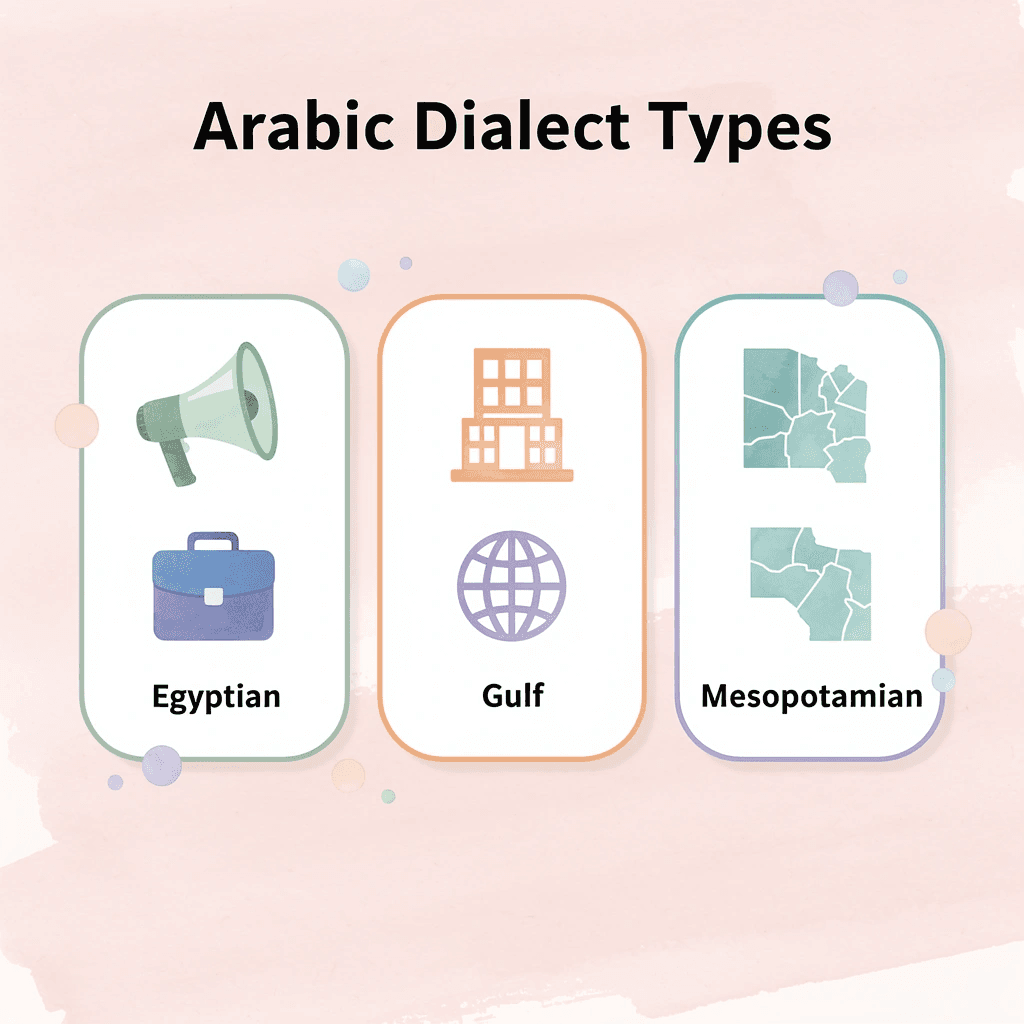
The main Arabic dialects divide along geographic lines, shaped by hundreds of years of migration, trade, and contact with neighboring languages. Egyptian Arabic is the most common in North Africa and reaches the largest audience through the media. Levantine Arabic covers Syria, Lebanon, Jordan, and Palestine with a smooth, easy-to-understand sound. Gulf Arabic is used in the Arabian Peninsula's oil-rich states. Mesopotamian Arabic is the main dialect in Iraq and its borderlands. Maghrebi Arabic stretches across Morocco, Algeria, and Tunisia, with influences so distinct that speakers from the eastern Arab world often struggle to understand it. Each variety has distinct pronunciation patterns, vocabulary, and grammatical shortcuts that differ from Modern Standard Arabic and from each other.
💡 Key Point: Egyptian Arabic dominates media and entertainment across the Arab world, making it the most widely understood dialect despite regional differences.
"Maghrebi Arabic is so linguistically distinct that mutual intelligibility with other Arabic dialects can be as low as 30-40% without prior exposure." — Linguistic Studies on Arabic Dialectology
🔑 Takeaway: Understanding the geographic distribution of Arabic dialects is essential for choosing which variety to learn based on your specific goals and target regions.
Dialect | Region | Key Characteristics |
|---|---|---|
Egyptian Arabic | North Africa | Most widely understood through media exposure |
Levantine Arabic | Syria, Lebanon, Jordan, Palestine | Smooth pronunciation, easy comprehension |
Gulf Arabic | Arabian Peninsula | Used in oil-rich states, business contexts |
Mesopotamian Arabic | Iraq and borderlands | Regional specificity, historical influences |
Maghrebi Arabic | Morocco, Algeria, Tunisia | Highly distinct, challenging mutual intelligibility |

What makes Egyptian Arabic so widely understood?
Egyptian Arabic is spoken by over 100 million people and is used in many countries beyond Egypt. Cairo's film industry made movies, television shows, and music for many decades. These films and shows spread throughout the Arab world, making Egyptian pronunciation and slang familiar to people across the region. This wide exposure gives Egyptian Arabic a big role in how people from different countries communicate with each other. Educated speakers from different countries often use it almost like a common language.
How does Egyptian Arabic simplify learning for beginners?
The dialect simplifies certain classical sounds and borrows from Coptic, Turkish, French, and English. You hear it in street markets, political debates, and comedy shows, where its directness clarifies complex ideas.
Learners often choose Egyptian Arabic first because comprehension transfers quickly to media consumption, and native speakers across the region recognize it instantly. Platforms like Kalam teach Egyptian Arabic through conversation drills and real-world dialogue, building speaking confidence in the variety that unlocks the most content and broadest understanding among Arab populations.
What makes Levantine Arabic distinctive among Arabic dialects?
Levantine Arabic flows across the eastern Mediterranean, with a musical quality that many learners find easier to replicate than the sounds of Gulf or Maghrebi Arabic. Cities like Beirut, Damascus, and Amman share similar language patterns, though rural areas have local variations. The dialect remains relatively close to Modern Standard Arabic in vocabulary, helping learners transition between formal reading and everyday conversation.
How do historical influences shape Levantine Arabic today?
Historical layers of Aramaic, Greek, and French enrich its vocabulary, reflecting centuries of trade and cultural exchange. Levantine speakers code-switch smoothly, incorporating formal terms into everyday speech when discussing politics or technology. This flexibility serves both social and professional contexts across the Levant.
What makes Gulf Arabic unique among Arabic dialects?
Gulf Arabic is the main language spoken across the Arabian Peninsula, where over 30 dialects create regional differences. Bedouin heritage shapes pronunciation and vocabulary in rural areas, while major cities like Dubai and Riyadh blend traditional forms with loanwords from English and Persian. The dialect retains classical sounds absent elsewhere, giving it a character that feels both rooted in tradition and rapidly evolving.
Why is Gulf Arabic important for professional careers?
Economic power concentrated in Gulf states has made this variety more important in business and media. Oil wealth funds satellite channels and digital platforms that broadcast Gulf Arabic across the region, though it lacks the deep cultural reach of Egyptian Arabic in entertainment. Learners targeting careers in finance, energy, or international relations often prioritize Gulf Arabic for its professional relevance.
What makes Mesopotamian Arabic unique among Arabic dialects?
Mesopotamian Arabic is centered in Iraq and extends into neighboring areas of Syria, Turkey, and Iran. The dialect divides into northern and southern branches, reflecting historical migration patterns. Deep roots in Aramaic and Persian give it vocabulary and grammatical features that distinguish it from Egyptian or Levantine Arabic.
Why is Mesopotamian Arabic challenging for learners?
Political instability has limited Iraq's media output compared to Egypt or Lebanon, keeping Mesopotamian Arabic relatively localized despite its use by millions of speakers. The variety's "qeltu" and "gilit" subtypes mark regional and social distinctions, making it one of the more challenging dialects for outsiders to master.
For anyone working in Iraq or studying its literary traditions, this dialect is essential, offering cultural nuances that formal Arabic cannot convey.
Related Reading
Can People Speaking Different Arabic Dialects Understand Each Other?
Yes, but with important caveats. A 2020 study by linguists Emma Trentman and Sonia Shiri found that native Arabic speakers understood 96 percent of their own dialect but still caught 89 percent of unfamiliar ones in listening tests. That seven-point drop matters less than expected, especially considering how media exposure, shared Modern Standard Arabic education, and conversational patience close the gap quickly.
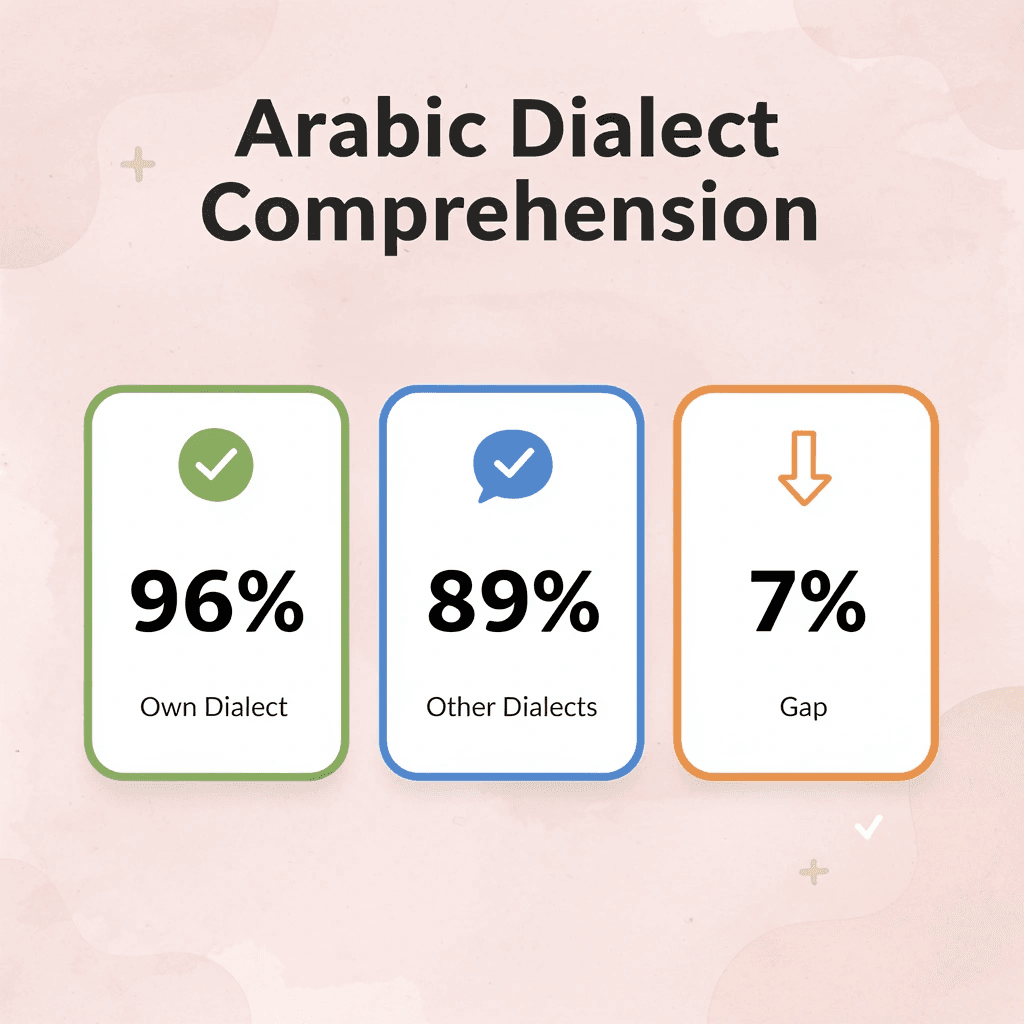
🔑 Key Takeaway: The comprehension gap between Arabic dialects is surprisingly small - just 7 percentage points - making cross-dialect communication much more feasible than commonly believed.
"Native Arabic speakers understood 96 percent of their own dialect but still caught 89 percent of unfamiliar ones in listening tests." — Trentman & Shiri, 2020

💡 Insight: Media exposure and shared educational backgrounds in Modern Standard Arabic serve as powerful bridges, helping speakers navigate unfamiliar dialects with remarkable success.
Modern Standard Arabic as the Everyday Bridge
Children across the Arab world learn Modern Standard Arabic in school, where they use it for reading, news, and formal communication. When local dialects create barriers during travel or meetings, people switch to this common form to maintain conversation.
This flexibility addresses concerns about regional differences. Anyone with basic Modern Standard Arabic can handle most daily situations, turning potential language barriers into a practical bridge that encourages travel and cross-cultural exchange.
Easy Flow Within Close Dialect Families
People who speak Levantine Arabic, such as those from Palestine and Syria, understand each other without difficulty. Their dialects share similar vocabulary, grammar, and pronunciation. Geographic proximity facilitates comprehension and enables straightforward daily communication. This closeness strengthens friendships across borders and eases everyday life.
Tougher Crossings Between Distant Dialects
A speaker of Egyptian Arabic might struggle to understand someone from Morocco or Algeria. Maghrebi Arabic has significant differences in pronunciation and vocabulary, and some meaning can be lost when speakers talk quickly.
Maghrebi varieties often have the lowest overlap with eastern dialects, creating the biggest challenges for quick understanding. Slowing down or using shared words eases communication, showing that distance does not sever all connections.
Main Building Blocks That Shape Understanding
Grammar rules, common words, and phonetics determine whether dialects work together. Small changes in word order or sounds can alter meaning, but the Arabic foundation typically conveys the main message across dialects.
These elements explain why some dialect pairs work well together while others need adjustment. Recognizing patterns lets speakers adapt quickly, making conversations clearer without formal instruction.
Personal Experience and Conversation Setting Make a Difference
Hearing different regional dialects and discussing varied topics affects how well people understand each other. Travelers who watch regional shows or visit places develop faster comprehension. Simple everyday topics work better across different groups than specialized ones.
Relaxed settings allow more back-and-forth conversation, turning potential confusion into personal growth. Staying curious and open yields richer connections.
How is media exposure helping Arabic dialects connect across regions?
Popular Egyptian and Levantine movies, songs, and social media reach listeners everywhere, familiarising people with other speaking styles. Maghrebi speakers in particular often follow eastern content more easily, creating a helpful one-way flow.
A 2020 study by linguists Emma Trentman and Sonia Shiri tested native Arabic speakers who understood 96% of their own dialect but caught 89% of unfamiliar ones in listening tests. This gap demonstrates that media and contact build stronger connections between regions.
Which Arabic dialect should you prioritize for your learning goals?
But understanding percentages and geographic patterns leaves one critical question: which dialect deserves your limited time and energy when each opens different doors?
How to Choose Which Arabic Dialect to Learn
Picking the right Arabic dialect means comparing your personal goals against the main types: Egyptian, Levantine, Mashriqi (Gulf), Mesopotamian, and Sudanese. These spoken forms differ in pronunciation, vocabulary, and cultural context, but learning any one will enable daily conversation across much of the Arab world when combined with basic Modern Standard Arabic for formal needs.

🎯 Key Point: Focus on what fits your travel plans, job goals, family ties, or cultural interests. This approach turns language study into a rewarding, targeted experience.
Dialect | Best For | Geographic Reach |
|---|---|---|
Egyptian | Media consumption, tourism | Most widely understood |
Levantine | Business, cultural depth | Syria, Lebanon, Palestine, Jordan |
Gulf (Mashriqi) | Oil industry, business | UAE, Saudi Arabia, Kuwait |
Mesopotamian | Regional connections | Iraq, parts of Syria |
Sudanese | Specialized regional work | Sudan, parts of Egypt |
"Egyptian Arabic is understood by most Arabic speakers due to Egypt's dominant media industry and cultural influence across the Arab world." — Arabic Language Institute, 2023
⚠️ Warning: Don't choose a dialect based on perceived difficulty alone. The most important factor is alignment with your goals - a dialect you're motivated to use will always be easier to master than one that feels disconnected from your real-world needs.
How do personal goals influence Arabic dialect choice?
Consider why Arabic matters to you and where you'll use it most. If you travel to Egypt, you'll need Egyptian Arabic for daily conversation. If you go to the UAE or Saudi Arabia, learn Mashriqi (Gulf) Arabic instead.
People who speak Arabic at home have a strong reason to learn their family's dialect. Learning Sudanese Arabic, for instance, lets you communicate with Sudanese relatives, while Mesopotamian Arabic connects you to Iraqi family roots. Learning your family's dialect strengthens relationships and deepens your cultural connection.
Which Arabic dialects work best for professional development?
Professional paths make the decision clear. Business professionals in the Persian Gulf energy sector choose Mashriqi Arabic because it is important in oil-rich economies.
Learners interested in media, film, or Arab culture might choose Egyptian or Levantine Arabic, whose vibrant output in songs and dramas provides constant real-world practice. Academic study also benefits from the regional nuances of these dialects that formal instruction cannot capture.
Which Arabic dialects offer the broadest utility?
Popularity matters because some dialects travel beyond their home borders. Egyptian Arabic is the most widely recognized across the Arab world, thanks to decades of Egyptian films, music, and television reaching audiences from North Africa to the Gulf. Levantine Arabic follows closely, offering strong passive understanding in neighboring countries and facilitating conversations for travelers and remote workers.
How do regional Arabic dialects compare in reach?
Mashriqi, Mesopotamian, and Sudanese Arabic serve localized needs. Gulf Arabic gains ground in business and modern media from the Arabian Peninsula, while Mesopotamian Arabic connects you with Iraqi communities and overlaps with Gulf speech. Sudanese Arabic remains effective within Sudan and parts of South Sudan, though its reach narrows outside those areas. High-utility dialects like Egyptian or Levantine maximize flexibility when no single country dominates your plans.
Assessing Learning Curve and Resources
Levantine Arabic appeals to beginners for its straightforward grammar, familiar sentence flow, and accessible pronunciation. Egyptian Arabic ranks equally high, with abundant textbooks, apps, YouTube channels, and conversation partners to accelerate early progress.
Mashriqi, Mesopotamian, and Sudanese varieties present steeper learning curves due to unique sounds and regional vocabulary, though resources continue to grow, especially for Gulf Arabic, given rising economic interest. All main dialects share enough core structure with Modern Standard Arabic that prior exposure reduces confusion. Egyptian and Levantine options offer abundant media for immersion, while targeted courses for other dialects reward focused effort in those specific regions.
Prioritizing Personal Motivation and Enjoyment
Steady progress depends on genuine interest. If Lebanese music, Syrian television, or Jordanian hospitality excites you, Levantine Arabic will keep study sessions meaningful. Those who love Egyptian cinema, pop culture, or classic literature thrive with Egyptian Arabic because new phrases unlock beloved songs or films.
Fascination with Gulf traditions, Iraqi poetry, or Sudanese storytelling transforms these dialects from school tasks into cultural adventures. Emotional connection sustains practice over months or years. Learning one dialect prepares you for others, since shared roots make subsequent varieties quicker to acquire once you understand the underlying system.
How should you combine Arabic dialects with Modern Standard Arabic?
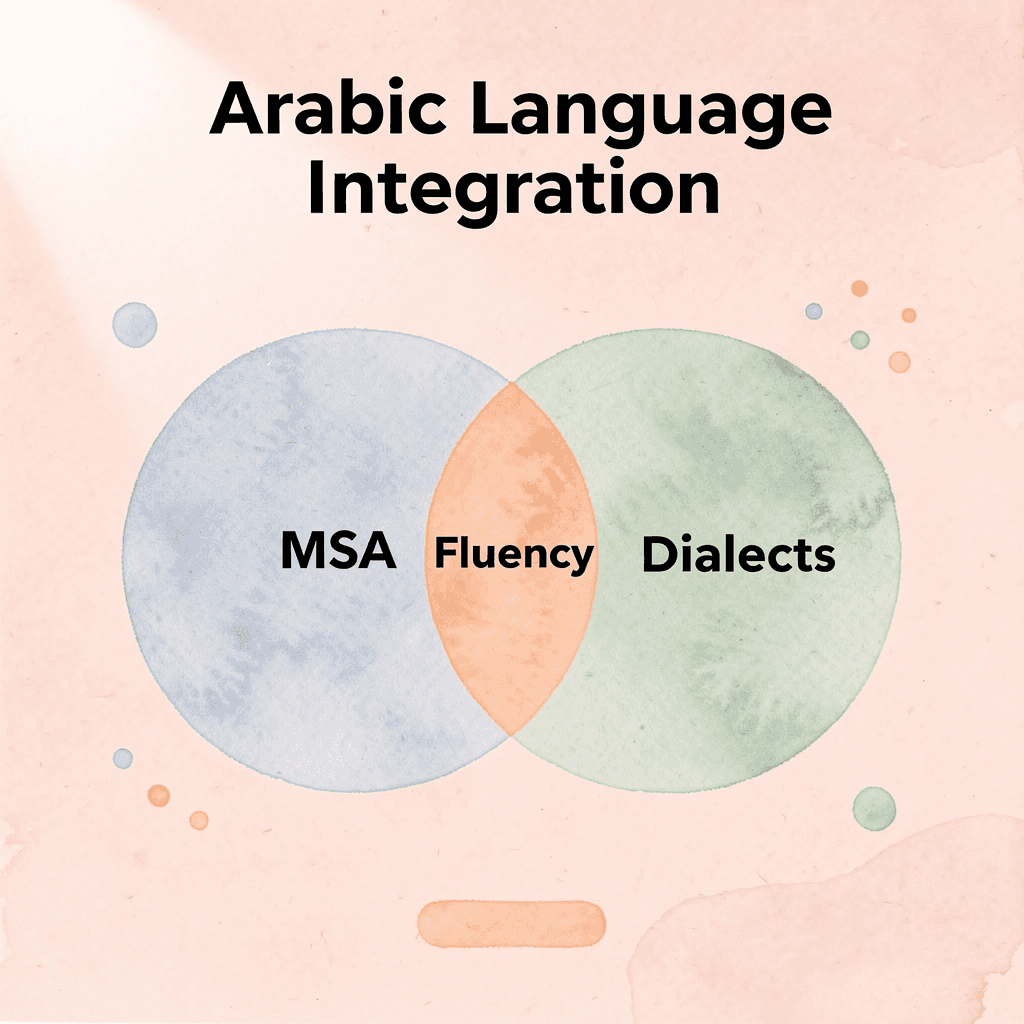
Pair your chosen spoken dialect with Modern Standard Arabic from the beginning. MSA provides the grammar foundation, formal vocabulary, and reading and writing skills needed for news, documents, education, and official settings, while your dialect handles everyday conversation. Native speakers naturally shift between varieties depending on context.
What are the benefits of learning MSA alongside Arabic dialects?
Starting with MSA alongside a dialect prevents confusion and speeds up spoken progress by showing connections between formal and everyday forms. Egyptian or Levantine learners often notice helpful overlaps that ease transitions; the same principle applies to Mashriqi, Mesopotamian, or Sudanese paths. This combination lets you read road signs in MSA while chatting comfortably in the local dialect.
Related Reading
Persian Vs Arabic
Best Way To Learn Arabic
How To Speak Arabic
Modern Standard Arabic
Practical Advice for Students Starting with Modern Standard Arabic
Students who start learning Modern Standard Arabic build a strong foundation in grammar and can access formal written and spoken materials across the entire Arab world. However, daily communication mixes this standard form with regional dialects, so you should gradually shift rather than make a sudden change. This guide provides step-by-step strategies to build confidence, improve your skills, and achieve natural-sounding speech while maintaining your formal proficiency.

🎯 Key Point: Modern Standard Arabic serves as your essential foundation, but real-world fluency requires understanding how formal Arabic blends with local dialects in everyday conversations.
"Modern Standard Arabic provides the grammatical backbone that makes learning regional dialects significantly easier, as students can recognize formal structures within informal speech patterns." — Arabic Language Learning Research, 2023
⚠️ Warning: Don't abandon your MSA foundation when transitioning to dialectal Arabic. The biggest mistake students make is treating these as completely separate languages rather than complementary skills that work together.
How can you gradually integrate Arabic dialects into your learning?
Learners who start with Modern Standard Arabic benefit most by treating advancement as a steady blending process rather than an overnight shift to local speech patterns. Begin with conversations that remain mostly formal, then gently add regional touches—approximately 90% standard features and 10% colloquial ones—before progressing toward a more balanced mix or a dialect-dominant style for casual exchanges.
This measured pace mirrors how fluent speakers communicate and helps prevent frustration from trying to master everything at once.
What benefits does step-by-step integration provide?
This approach builds confidence through small, achievable wins at each stage. Students maintain their strong MSA base for reading, writing, and formal situations while gradually adapting to casual settings.
Over time, the balance shifts naturally through exposure, helping learners sound more authentic while retaining the precision that MSA provides.
Identify and Streamline Unnecessary Formal Structures
Look for formal traits that rarely appear in spoken conversations: specific verb endings, full case markings, and literary wording. Simplify or drop them to free mental energy for practical adjustments. Instead, focus on core spoken patterns that locals use most often.
Prioritizing these changes early creates space to absorb practical differences in how words flow and connect. This targeted simplification keeps the learning load manageable while sharpening listening and production skills. Retained MSA knowledge supports formal needs, ensuring versatility across situations.
Concentrate on High-Impact Dialect Adjustments for Daily Use
Focus on the most common dialect changes in pronunciation, phrases, and everyday vocabulary that appear in real conversations. These foundational elements deliver quick, noticeable improvements and help beginners participate sooner, closing the gap between textbook MSA and authentic language.
Steady work on these parts quickly builds practical fluency, turning theoretical learning into real fluency.
Commit to Regular Real-Life Practice Sessions
Talking to people regularly is the best way to learn how to blend different types of Arabic. It lets you add local language naturally while keeping your formal skills strong. Find opportunities to speak with language partners, tutors, or language apps to test and improve your blend in real situations. Repeated practice in authentic contexts helps solidify these changes and reveals nuances that studying alone cannot teach.
With regular practice, learners sound more like native speakers in casual conversation while maintaining formal Arabic skills. This habit builds confidence and reveals areas needing improvement. After weeks and months, the change feels natural, yielding Arabic skills suited to both everyday and professional contexts.
How can supportive tools enhance learning Arabic dialects?
Kalam is an app designed to support this gradual method through interactive speaking drills, video lessons, and practice with realistic conversational AIs tailored for different scenarios. Learners engage in real-life conversations through brief daily lessons, combining speaking drills, interactive questions, and flashcard review to build speaking skills without unnecessary extra content.
What makes immersive practice effective for Arabic dialects?
This hands-on setup supports step-by-step progress by giving students immediate opportunities to use MSA basics in real conversations that naturally incorporate everyday language adjustments. The platform features conversation coaches who help students practice different language blends safely, track their progress, and build speaking skills without stress.
Kalam turns general tips into real progress through easy-to-use tools and personalized learning paths.
Related Reading
Basic Arabic Phrases
Urdu Vs Arabic
Arabic Vowels
Arabic Vs Hebrew
Best App To Learn Arabic
Arabic Basics
Learn Arabic in Any Dialect Today with Kalam
Practice needs to happen every day, not in your head alone. Choosing Egyptian for media reach or Levantine for conversational warmth means nothing if the dialect remains theoretical. You need structured speaking practice that turns patterns into reflexes, pronunciation guides that catch errors before they become habits, and real dialogue scenarios that prepare you for actual exchanges.
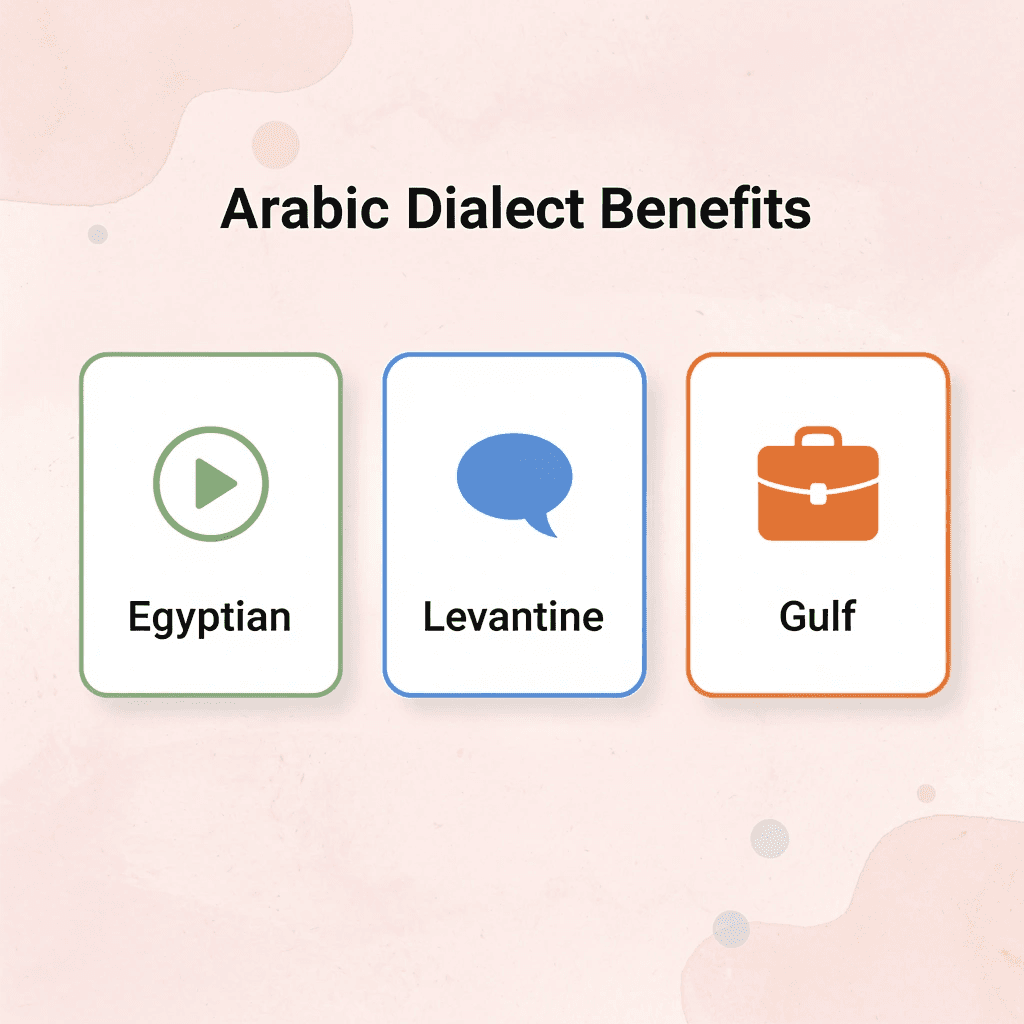
💡 Tip: Choose your dialect based on your specific goals - Egyptian for understanding movies and shows, Levantine for natural conversations, or Gulf for business opportunities in the region.

Kalam gives you conversational practice in Egyptian, Levantine, Gulf, or other varieties matched to your travel plans, family connections, or interests. Our platform uses pronunciation guides, explanations of phrase meanings, and interactive exercises that make practice enjoyable rather than frustrating. You get personalized lessons that help you speak naturally and with confidence.
"Daily practice transforms theoretical knowledge into conversational fluency - consistency matters more than perfection." — Language Learning Research, 2024
🎯 Key Point: The difference between knowing Arabic and speaking Arabic comes down to consistent daily practice with real conversational scenarios.
Start speaking your chosen Arabic dialect today. Try Kalam and take the next step toward fluent, everyday Arabic.