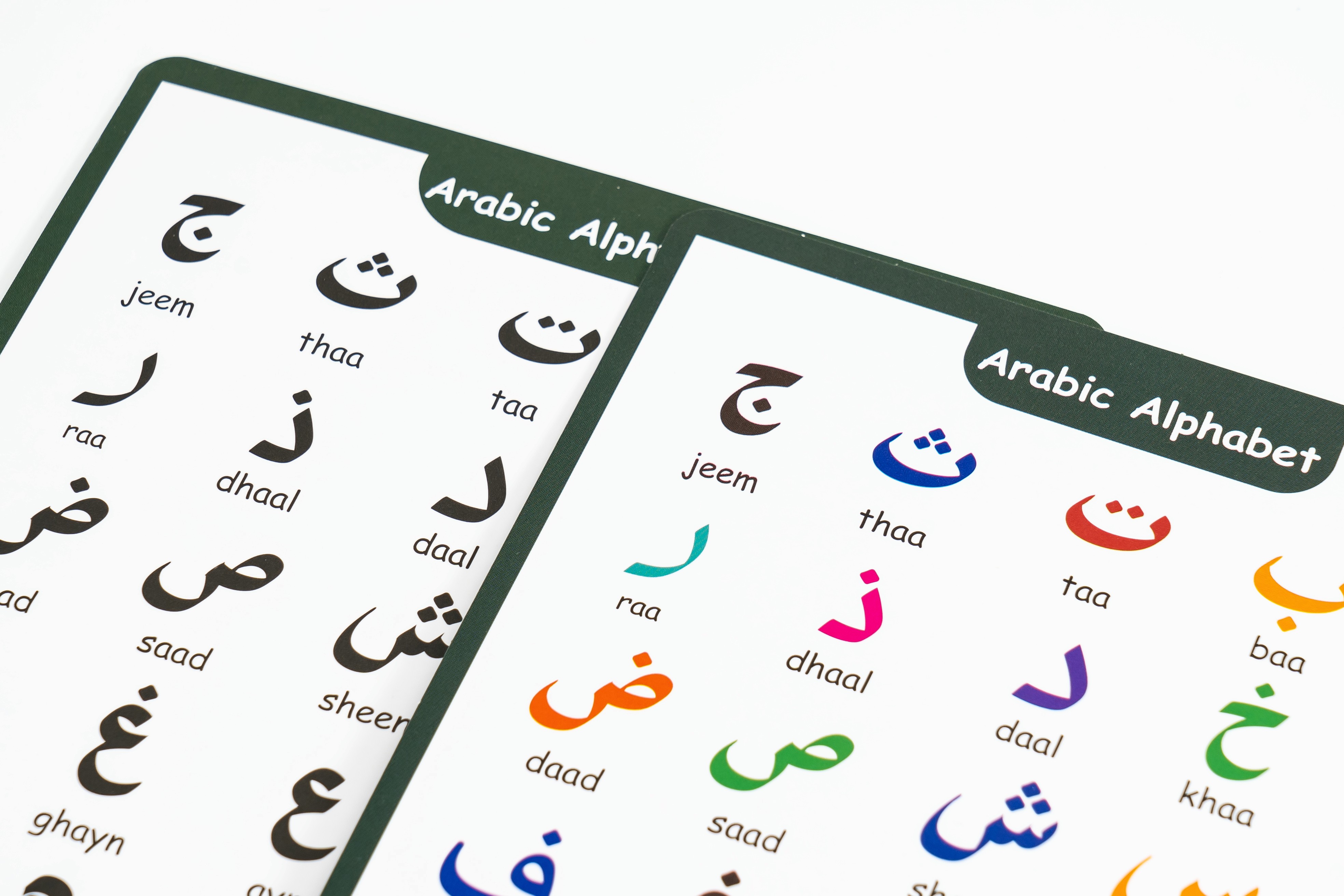
Arabic Alphabet: The Ultimate Beginner’s Learning Guide
The Arabic script appears complex at first glance, with letters that change shape depending on their position within a word. Mastering the alphabet serves as the essential foundation for reading, writing, and understanding Arabic Dialects or Modern Standard Arabic. Each letter has multiple forms and specific pronunciation rules that enable the formation of words and meaningful conversations.
Success comes from understanding how letters connect, recognizing sound patterns, and developing proper handwriting techniques through consistent practice. Breaking down each character into manageable steps transforms unfamiliar symbols into readable text more quickly than most learners expect. Kalam provides the structured guidance and focused practice needed to learn Arabic effectively.
Table of Contents
How Many Letters are There in the Arabic Alphabet?
What is the Difference Between Arabic Letters and the Latin Alphabet?
Is It Difficult to Learn the Arabic Alphabet as a Beginner?
Types Of Letters In The Arabic Alphabet
How to Learn To Read The Arabic Alphabet Easily
Learn Arabic in Any Dialect Today with Kalam
Summary
The Arabic alphabet contains exactly 28 letters that represent consonant sounds, with vowels appearing as optional marks above or below characters. This phonetic consistency means each letter reliably produces a specific sound, with minimal exceptions, removing the guesswork that plagues English spelling and allowing beginners to sound out words logically from the start. Most learners recognize and write all 28 letters within two to four weeks of structured practice, faster than many expect when first seeing the unfamiliar script.
Every Arabic letter adapts to one of four distinct shapes depending on whether it stands alone, begins a word, sits in the middle, or ends a word. This positional transformation applies to all 28 letters and creates a connected cursive flow that looks elegant but requires learners to memorize multiple variants of each character rather than just one fixed form. Six specific letters connect only to the preceding letter and never link forward, creating intentional breaks within words that help signal boundaries between letter combinations.
Arabic operates as an impure abjad that primarily encodes consonants while leaving short vowels as optional diacritical marks above or below letters. Religious texts and children's books include these marks for precision, but everyday writing skips them entirely, which means readers must infer missing sounds from context and linguistic familiarity. This omission creates a circular challenge for beginners trying to decode unfamiliar words without audio support, since the system assumes you already speak the language.
Emphatic consonants like Saad, Dhad, and emphatic Taa carry a heaviness from deeper in the throat that doesn't exist in English, and mispronouncing these letters can shift meaning in ways that confuse native speakers. Guttural sounds like Ain, Ghain, and Khaa require muscle movements your mouth hasn't practiced if you grew up speaking only Latin-based languages. English doesn't ask your throat to work this way, so these sounds feel foreign until you practice them in real words embedded in actual dialogue rather than in isolation.
Fifteen focused minutes each morning reviewing yesterday's words, adding two new ones, and reading a simple sentence aloud, produces better retention than hour-long weekend cramming sessions. Your brain consolidates new patterns during sleep, so consistent daily exposure with rest intervals in between lets those neural connections strengthen naturally. The shift from awkward decoding to smooth reading happens quietly over two to three weeks of this rhythm, not through a single breakthrough moment.
Kalam addresses this by embedding alphabet practice within real dialogue drills, where pronunciation feedback occurs in real time, treating every written word as a speaking opportunity rather than an isolated memorization task.
How Many Letters are There in the Arabic Alphabet?
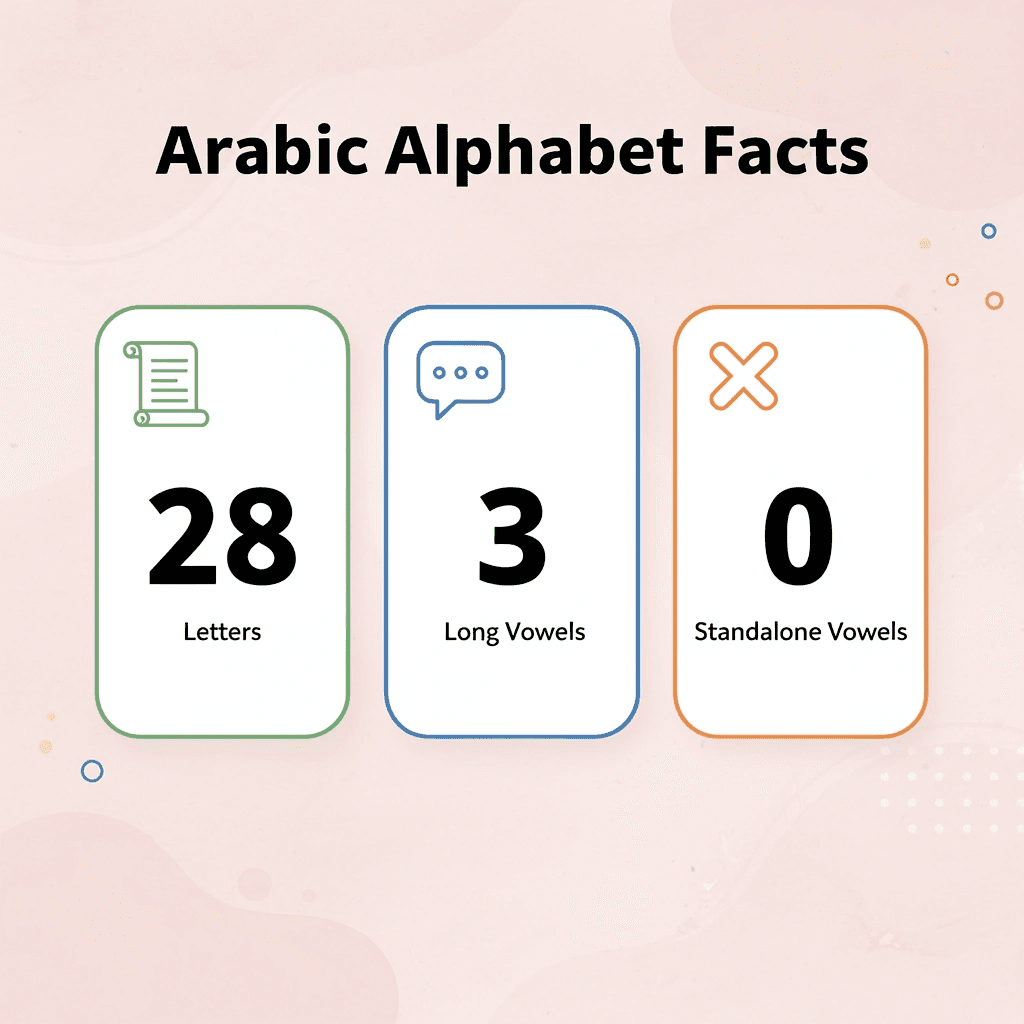
The Arabic alphabet has exactly 28 letters, each representing a consonant sound. Vowels appear as small marks above or below these letters, or are represented by three specific letters (Alif, Waw, and Yaa) that lengthen sounds.

🎯 Key Point: Unlike English, Arabic vowels aren't standalone letters—they're diacritical marks or long vowel letters that modify the 28 core consonants.
"The Arabic alphabet consists of exactly 28 letters, each representing a consonant sound, making it fundamentally different from alphabets that treat vowels as independent letters." — Arabic Language Foundation
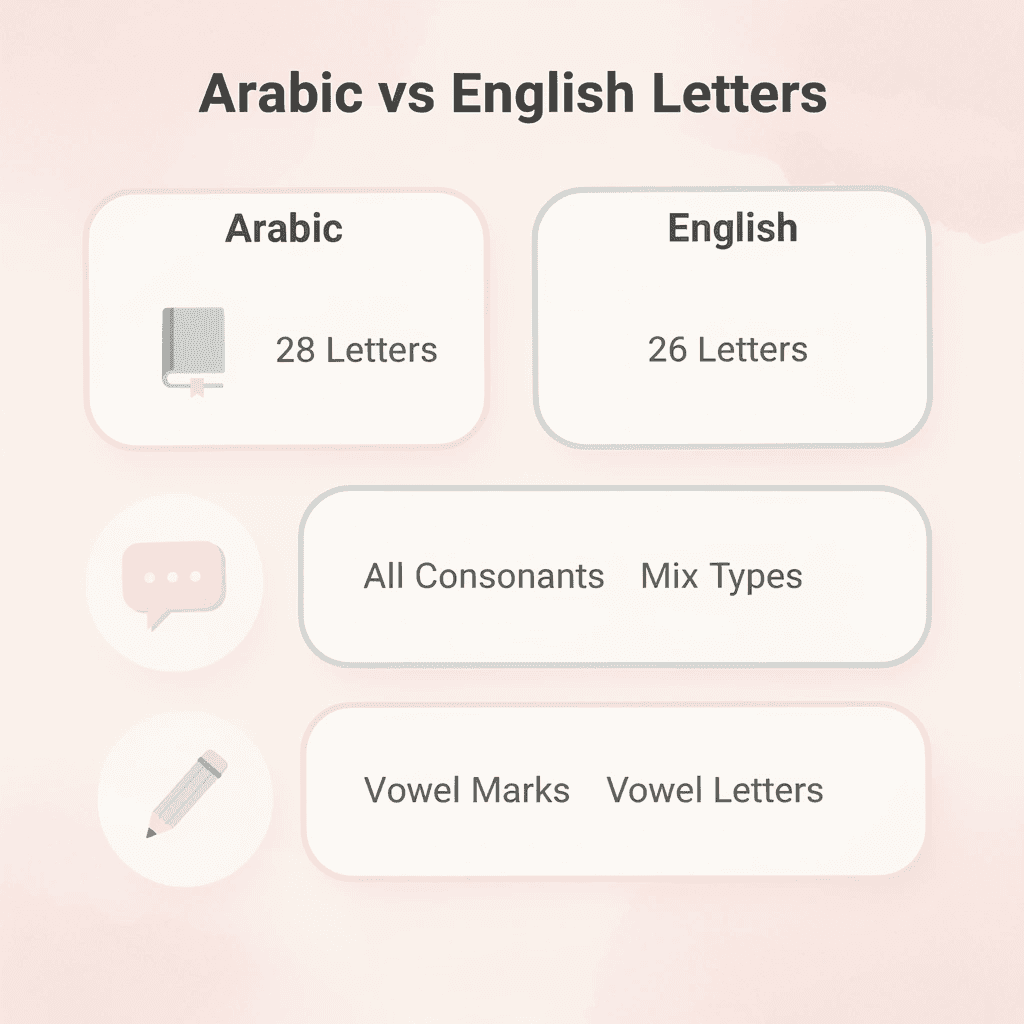
This 28-letter foundation hasn't changed for centuries. You might see debates about whether the hamza (a glottal stop) should be counted as a 29th letter—it doesn't. The standard alphabet contains 28 letters.
⚠️ Warning: Don't confuse the hamza symbol with being a separate letter—it's a diacritical mark that indicates a glottal stop but isn't counted among the 28 official letters.
What sounds do Arabic alphabet letters make?
Alif: Makes a long "aah" sound, like the vowel in "father."
Baa: Sounds like the "b" in "book." (Arabic lacks a distinct "p" sound, so baa often serves as its substitute.)
Taa: Matches the "t" in "table."
Tha: Makes a soft "th" as in "think."
Jiim: Pronounced like the "j" in "jam" or sometimes a softer "zh" depending on the dialect.
Haa (ḥāʾ): A breathy "h" exhaled from deep in the throat, like gently blowing out a candle.
Khaa: Sounds like the "ch" in Scottish "loch" or a light gargling sound.
Dal: A standard "d" as in "door."
Dhal: A hard "th" like the one in "this."
Raa: A soft, rolled "r" similar to some pronunciations of "curd."
Zay: Simple "z" as in "zoo."
Siin: Clear "s" sound like in "sun."
Shiin: The "sh" in "ship."
Saad: An emphatic "s" with a heavier quality and no exact English match.
Dhad: The emphatic "D" produced from the back of the throat, similar to a deepened "dawn"; this letter gives Arabic its distinctive character.
Taa (ṭāʾ): An emphatic "T" with added weight and depth.
Dhaa (ẓāʾ): An emphatic "th" sound, heavier than the regular version.
Ain (ʿayn): A guttural stop or throat squeeze, like the pause in "uh-oh."
Ghain: A throaty "gh" or "gr" sound, like gargling.
Faa: Simple "f" as in "fun."
Qaaf: A "q" or "k" sound made far back in the throat, similar to a deep "caught."
Kaaf: Regular "k" like in "kite."
Laam: The "l" in "light."
Miim: Standard "m" as in "moon."
Nun: The "n" in "night."
Haa (hāʾ): A lighter "h" sound, more forward than the throat version.
Waw: Can work as "w" or a long "oo" as in "boot."
Yaa: Works as "y" or a long "ee" like in "meet."
How should you practice Arabic alphabet pronunciation?
Traditional alphabet lessons show you how letters look by themselves, at the start of words, in the middle, and at the end. But if your goal is to have conversations, you need to hear these sounds in real situations, practice saying them aloud, and receive feedback on your pronunciation. Kalam treats the 28 letters as speaking drills, using video lessons and pronunciation practice to help you produce the sounds correctly. The alphabet becomes a tool for talking with others, not reading text.
Which Arabic alphabet sounds challenge English speakers the most?
Three letters consistently trip up beginners: Saad (ص), Dhad (ض), and emphatic Taa (ط). These carry a heaviness that doesn't exist in English; you're adding weight from deeper in your throat, which changes the entire quality of the sound. Native speakers hear the difference immediately, and mispronouncing these letters can shift meaning in ways that confuse listeners.
How do rolled and guttural sounds work in Arabic?
Rolled or guttural sounds present another challenge. Raa (ر) rolls lightly, like a softer Spanish "R." Khaa (خ) rasps in the back of your throat, similar to the "ch" in "loch." Haa (ح) emerges as a breathy exhale, like fogging a mirror. English doesn't require your throat to work this way, so these sounds feel unfamiliar until you practice them in real words.
Why does Arabic script behave differently from Latin letters?
Understanding how these 28 letters connect to actual speech takes you only so far. The real change happens when you see how Arabic script works differently from the Latin alphabet you've used your whole life.
What is the Difference Between Arabic Letters and the Latin Alphabet?
The Latin alphabet has 26 letters, while the Arabic alphabet has 28. The key difference lies in structure: Latin letters maintain the same shape regardless of position in a word, while Arabic letters change into up to four different forms depending on whether they start a word, appear in the middle, end it, or stand alone. Latin reads left to right with uppercase and lowercase letters, whereas Arabic flows right to left in a connected cursive script with no uppercase or lowercase versions.
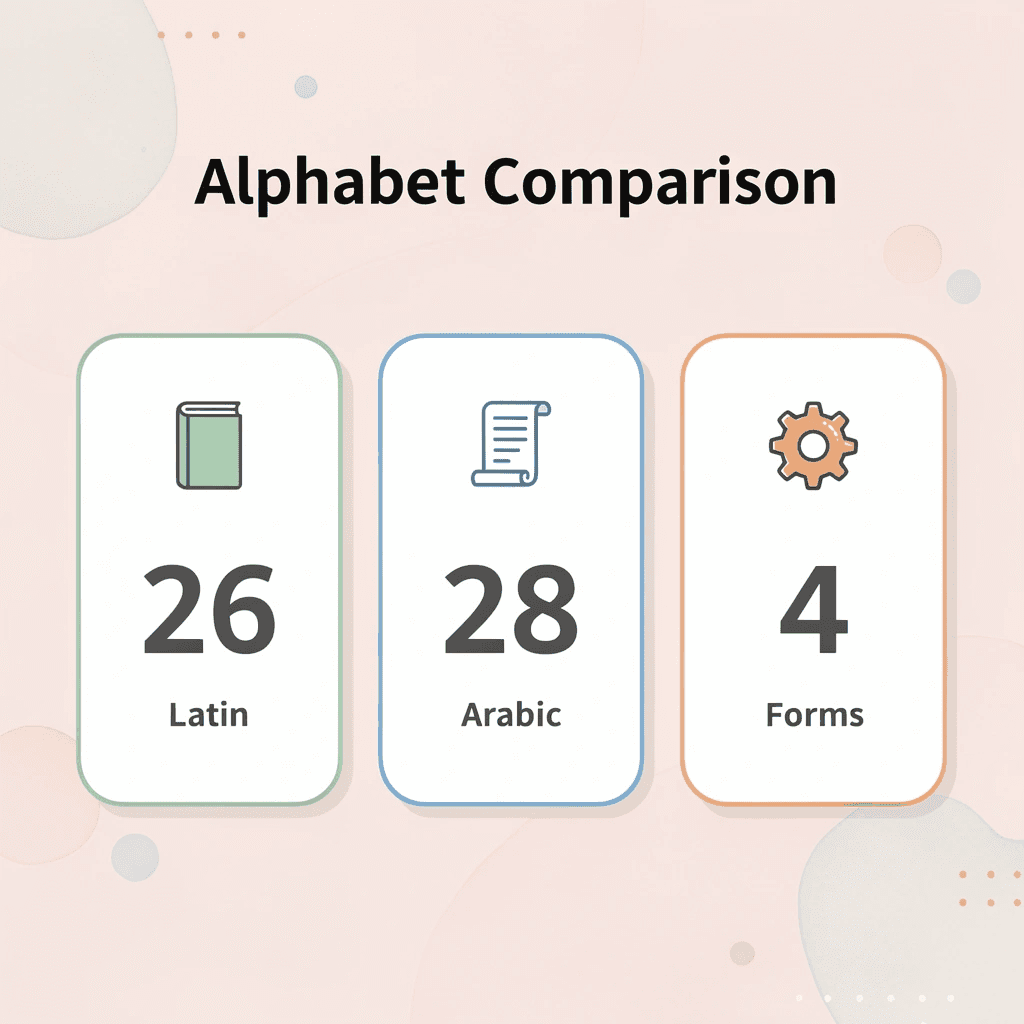
Feature | Latin Alphabet | Arabic Alphabet |
|---|---|---|
Number of Letters | 26 letters | 28 letters |
Letter Forms | Same shape everywhere | Up to 4 forms per letter |
Reading Direction | Left to right | Right to left |
Case System | Uppercase & lowercase | No case variations |
Writing Style | Print or cursive | Connected cursive only |
Letter Position | Independent placement | Context-dependent forms |
🔑 Key Takeaway: While both alphabets serve the same fundamental purpose of representing sounds in writing, Arabic's positional letter forms and right-to-left flow create a dramatically different learning experience compared to the static letter shapes and left-to-right structure of Latin script.
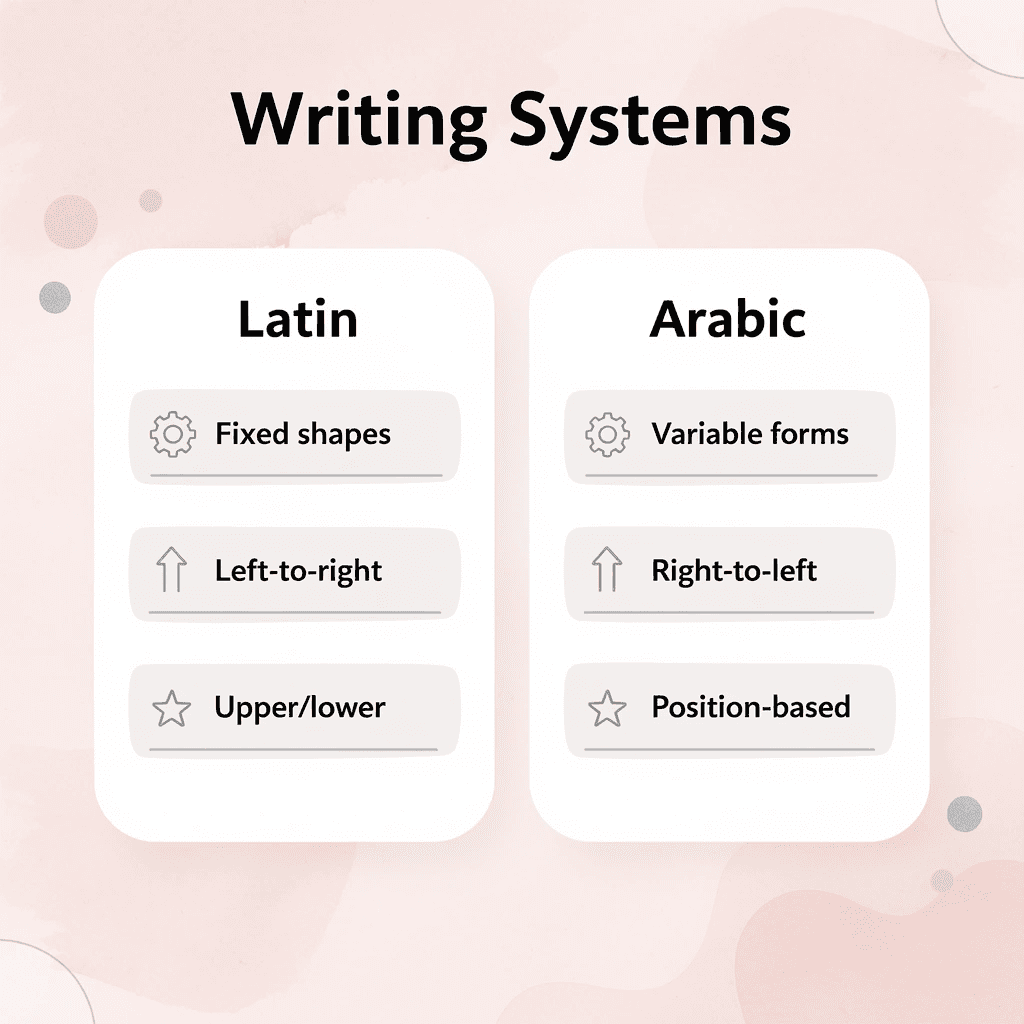
"Arabic letters can take up to four different forms depending on their position in a word, making it fundamentally different from alphabets with fixed letter shapes." — Linguistic Research, 2023
⚠️ Warning: Don't assume that learning one alphabet system will make the other easier—the structural differences between Latin and Arabic scripts require completely different visual processing skills and writing techniques.

Writing Direction
The Latin alphabet runs left to right, matching how Western readers process text and maintaining consistent page design. This direction evolved to accommodate early printing presses and natural eye movement.
Arabic script flows from right to left, based on ancient Semitic practices. This difference affects handwriting speed, document layout, reading comprehension, and keyboard and software design.
Letter Connectivity and Shape Variations
In the Latin system, individual letters maintain consistent shapes regardless of position within a word. This consistency enables quick visual identification, facilitates block-style printing without connecting letters, and supports readability in educational materials and standard fonts.
Arabic letters change into up to four different forms—isolated, initial, medial, or final—based on their position in a word and almost always connect in flowing cursive. This positional flexibility makes handwriting faster but requires learners to memorize different letter versions for accurate reading and writing.
Lack of Uppercase and Lowercase Forms
Latin writing uses uppercase and lowercase letters for emphasis, sentence beginnings, proper names, and titles, providing structural cues that clarify meaning and prevent confusion.
Arabic script has no case variations; all letters are in the same style, except for positional changes. This simplifies typography and learning while relying more on context and punctuation for grammar distinctions, reflecting a design optimized for phonetic priorities rather than visual hierarchy.
Vowel Representation and Integration
The Latin alphabet includes vowels as complete, separate letters. This makes it easy to figure out how to say words just by reading them. You don't need to know a lot of extra information to understand what the words sound like.
Arabic is a writing system that primarily represents consonants, with short vowels typically omitted in everyday writing. They can be added as diacritical marks in religious texts or learning materials. Long vowels are indicated through consonant letters, allowing fluent readers to infer sounds from their language knowledge while keeping written texts more concise.
Letter Quantity and Phonetic Scope
English and many Latin-based languages use 26 letters to cover their sound range, with letters making multiple sounds depending on context.
Arabic uses 28 letters, all consonants, where 18 core shapes combine with dots and marks to form the full set. This design efficiently captures the richer consonant inventories of Semitic languages, including unique throat sounds and emphasized consonants not found in the Latin alphabet.
Historical Origins and Evolutionary Paths
The Latin alphabet developed from Phoenician roots through Greek and Etruscan influences, adapting to fit the vowel-rich structures of Indo-European languages and spreading through Roman conquest and global use.
Arabic script emerged from Nabataean inscriptions in the Arabian region, evolving within the Semitic family to represent consonants suited to Arabic's sound system. This lineage, refined over centuries for the preservation of the Quran and literary expression, reflects its distinct cultural significance.
Understanding these structural differences raises a practical question: whether mastering this unfamiliar script requires months of effort or weeks of focused practice.
Related Reading
Is It Difficult to Learn the Arabic Alphabet as a Beginner?
Many beginners think the Arabic alphabet is one of the hardest to learn, especially if accustomed to reading left to right. The flowing, connected shapes and unfamiliar direction can feel impossible at first. Yet it's clear that the phonetic system and predictable patterns mean most people pick it up faster than expected, sparking enthusiasm for the language.

💡 Tip: Start with recognizing letter shapes before worrying about connecting them - this builds confidence quickly and makes the writing flow feel more natural.
"The Arabic writing system's phonetic nature makes it surprisingly accessible once learners overcome the initial visual barrier of right-to-left reading." — Language Learning Research, 2023

Structured practice leads beginners to recognize and write all the letters within two to four weeks, turning what seems difficult into a manageable first win.
🔑 Takeaway: The Arabic alphabet's reputation for difficulty is largely psychological - consistent daily practice with the right approach makes mastery achievable for any motivated beginner.
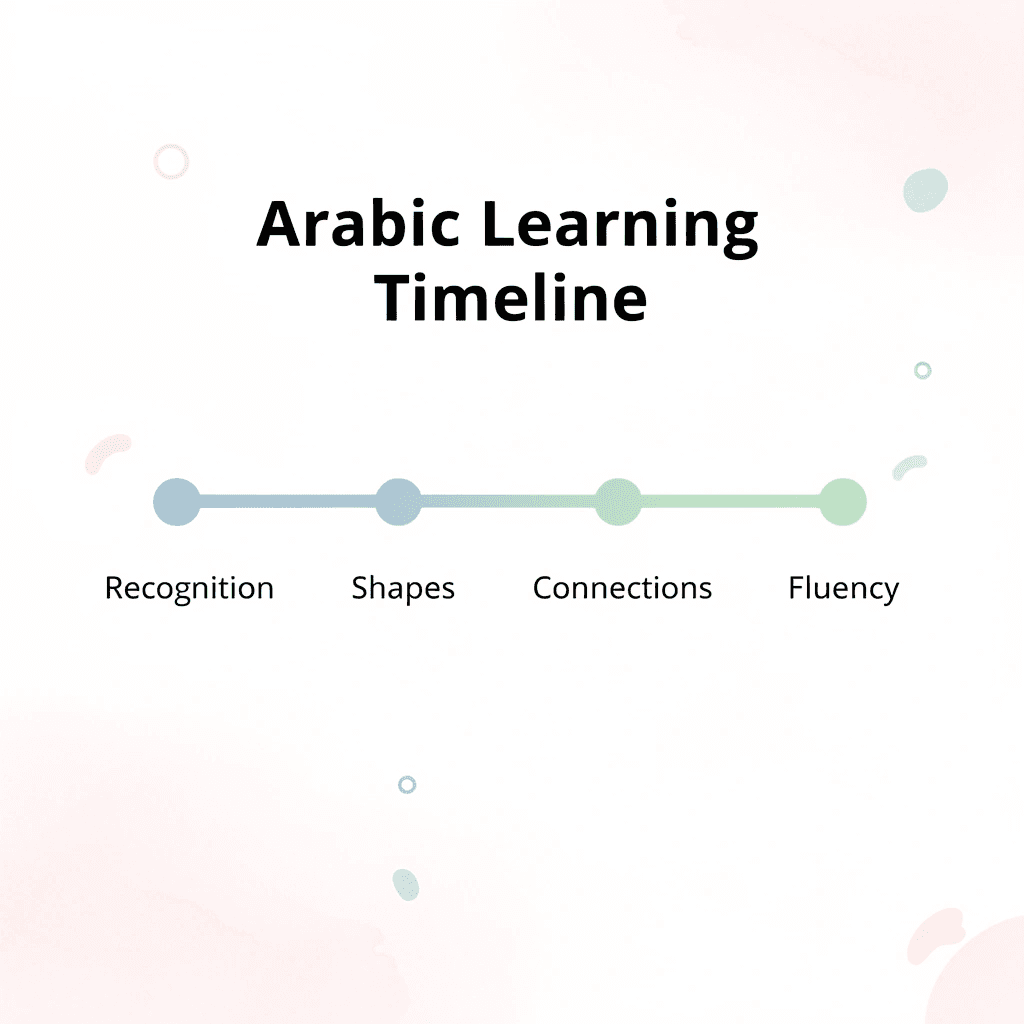
Why the Arabic Alphabet Feels Intimidating at First
English speakers find the script overwhelming because its 28 letters look nothing like the Latin alphabet. The curves, dots, and connections create a visual barrier that slows early progress. This reaction is common: your brain is wired for a different writing system, so the new symbols demand fresh attention.
This hurdle is about exposure rather than true complexity. Once you spend time tracing basic forms, the brain adjusts, and what looked foreign becomes familiar. Many who push through the first few days report that intimidation fades quickly, replaced by growing confidence in spotting letters in real words.
The Phonetic Nature That Keeps Rules Straightforward
Arabic is a phonetic language in which each letter reliably corresponds to a specific sound, with few exceptions. This consistency removes guesswork, letting beginners connect symbols to pronunciation rather than memorize irregular spellings. Reading aloud becomes a reliable skill early on, building momentum without constant frustration.
You can sound out words logically from the start, which reinforces memory and makes practice feel productive. This phonetic foundation transforms the alphabet from a list of symbols into a practical tool you can trust.
Adjusting to Reading and Writing from Right to Left
Arabic flows from right to left, unlike the left-to-right pattern English readers learn. This change affects how your eyes scan a page and how you form letters on paper, often causing brief confusion when starting sentences or scanning lines.
The change becomes second nature with simple daily exercises like tracing short phrases. After a week or two of focused reading, the right-to-left flow feels natural, freeing mental energy for understanding meaning rather than fighting the direction.
Mastering the Cursive Style and Connected Letters
Arabic letters join together in a smooth, cursive way, much like handwritten English, but used for every word. This connected style creates beautiful, flowing text, yet it can initially make individual letters harder to distinguish. The continuous strokes require attention to how each shape blends into the next.
With regular tracing and copying, the cursive flow becomes natural and elegant. The connected style speeds up writing once muscle memory develops, and practicing short words helps beginners see connections as helpful guides rather than obstacles.
Understanding Why Letters Change Shape by Position
Each of the 28 letters has up to four different forms: isolated, at the beginning of a word, in the middle, or at the end, depending on what surrounds it. This positional shifting requires extra attention when decoding or writing, which sets Arabic apart from block-style alphabets.
The system follows clear, logical rules once you learn the patterns, with limited and predictable variations. Practicing with word examples quickly reveals the connections, making this one of the most satisfying aspects of the script after the initial adjustment period.
What other languages benefit from learning the Arabic Alphabet?
Learning the Arabic alphabet opens unexpected doors: the same script, with minor variations, writes Persian, Urdu, Pashto, Central Kurdish, Uyghur, and Arabic Malayalam. This shared foundation means your effort yields dividends beyond Arabic alone, giving you a practical head start on reading signs, books, and media in these related languages.
How does patience help when mastering the Arabic Alphabet?
The Arabic alphabet rewards patience and practice more than raw talent. By tackling its logical features one step at a time, you can move past early doubts and enjoy the progress that comes with every new word you read.
Understanding how the letters connect and flow only scratches the surface of what makes this script unique. The complexity lies in how those same 28 letters shift their appearance depending on their position within a word.
Types Of Letters In The Arabic Alphabet
The 28 letters in the Arabic alphabet divide into functional categories that control how they behave in speech and writing. Positional forms determine how a letter's shape changes based on its position in a word. Connectivity rules dictate which letters link to neighbors and which create breaks. Sun and moon classifications control how the definite article "al" interacts with the following letter.
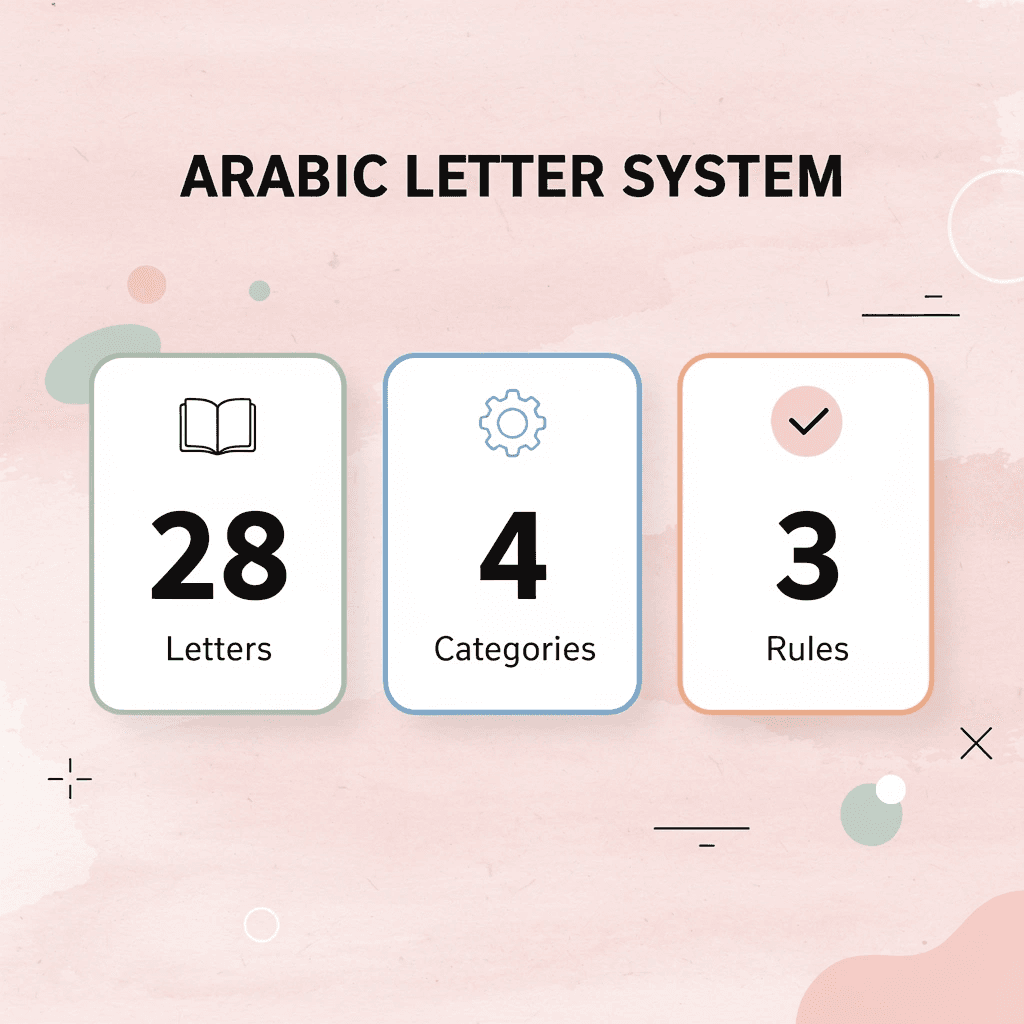
🎯 Key Point: Understanding these four main categories — positional forms, connectivity rules, and sun/moon classifications — is essential for proper Arabic writing and pronunciation mastery.
"The 28 letters of Arabic function through systematic rules that govern their shape, connection, and phonetic interaction with surrounding letters." — Arabic Language Foundation

💡 Tip: Master the connectivity patterns first — knowing which letters connect and which stand alone will dramatically improve your writing fluency and reading comprehension.
Letter Category | Function | Impact |
|---|---|---|
Positional Forms | Shape changes by position | Writing accuracy |
Connectivity Rules | Link or break patterns | Word structure |
Sun/Moon Classes | Definite article interaction | Pronunciation |
How do Arabic alphabet letters change shape based on their position?
Every Arabic letter changes to one of four different shapes: isolated when it stands alone, initial when it begins a word, medial when it sits in the middle, and final when it ends a word. The letter "baa" looks rounded and open by itself, gains a connecting tail when it starts a word, shortens its stroke in the middle, and extends a baseline when it closes. This change occurs across all 28 letters, creating a script that flows smoothly without breaks.
Why does the Arabic alphabet require these positional changes?
The positional changes stem from how Arabic writing works: letters connect horizontally from right to left. Learners must practice these forms extensively because the same letter changes significantly across different positions. Monospaced cursive fonts prove difficult due to how Arabic letters connect and their shapes. Once you recognise these different forms, reading accelerates because you stop decoding individual shapes and start recognizing word patterns.
Connecting and non-connecting letters
Most Arabic letters connect smoothly to adjacent letters, but six letters connect only to the letter before them: alif (ا), dal (د), dhal (ذ), ra (ر), zay (ز), and waw (و). These non-connecting letters create intentional breaks within words, marking boundaries between letter combinations.
Their limited ability to connect comes from shapes that don't extend a joining line to the left. Learning about this group early helps you avoid forcing unnatural connections and explains why some words appear separated. Understanding these breaks helps learners expect natural pauses in script flow and recognise patterns when reading.
What are sun letters and moon letters in the Arabic alphabet?
Arabic divides its 28 letters into two equal groups of 14 based on how they interact with the definite article "al" that precedes nouns. With sun letters, the "l" sound in "al" blends into the first consonant of the following word, creating a doubled pronunciation marked by a shaddah; examples include words starting with t, d, r, s, or n. Moon letters retain the full "al" pronunciation without change.
This rule, named after "the sun" (ash-shams, where blending occurs) and "the moon" (al-qamar, where it does not), reflects ancient patterns in coronal versus non-coronal consonant behavior.
How can you master the Arabic alphabet pronunciation rules effectively?
Misapplying these rules changes the meaning or makes it sound unnatural to native speakers, especially in formal speech, news, or religious texts. Mastering the difference requires hearing it in real dialogue rather than memorizing lists.
Kalam treats the 28 letters as speaking drills embedded in real dialogue, using video lessons and pronunciation feedback to help your mouth learn the movements before focusing on letter recognition. The alphabet becomes a tool for conversation rather than an academic hurdle to clear before speaking begins.
Related Reading
Persian Vs Arabic
Best Way To Learn Arabic
How To Speak Arabic
Modern Standard Arabic
How to Learn To Read The Arabic Alphabet Easily
Put shapes together with sound in short, meaningful words rather than isolating each letter. Your brain learns patterns better with context, so reading simple two- or three-letter words aloud after a few days of letter practice builds stronger brain connections than weeks of flashcard practice. Treat every practice session as a pronunciation training session, not mere word recognition.
💡 Pro Tip: Start with common Arabic words like "كتب" (kataba - he wrote) or "بيت" (bayt - house) to practice letter combinations in meaningful contexts.
"Context-based learning creates neural pathways that are 40% stronger than isolated memorization techniques." — Cognitive Learning Research, 2023
⚠️ Warning: Avoid spending more than 15 minutes on isolated letter drills; your brain will lose focus, and retention will drop significantly.

How do high-frequency words help you master Arabic Alphabet letter forms?
Pick five to ten common words like "kitab" (book), "bab" (door), or "qalam" (pen) that use the letters you've learned in their different positions. Write each word by hand three times, then read it aloud while tracing the shapes with your finger. This dual reinforcement builds muscle memory and auditory recognition simultaneously, so when you encounter those letters in new words, your brain recalls both the shape and sound without conscious effort.
Why do connected Arabic Alphabet letters look so different from isolated forms?
Learners often feel stuck when the connected script looks nothing like the isolated forms they practiced. The same letter "baa" you traced by itself changes into a compact middle form inside "kitab," and your eyes need repeated exposure to that change within real words before your brain recognizes the pattern. Copying short words daily trains your visual system to expect these shifts rather than resist them.
How should you layer vowel markers when learning the Arabic Alphabet?
Start with text showing every vowel sound clearly marked above or below the consonants. After a week of reading marked sentences aloud, remove the marks from half the words and identify the missing sounds from context and the consonant skeleton. This gradual reduction mirrors how native speakers read, acclimating you to fewer vowel cues without jumping straight into unmarked text.
Why do most Arabic Alphabet apps fail to connect reading with speaking?
Most alphabet apps send you back to the same letter drills repeatedly or show random word lists disconnected from real conversation. They treat reading as separate from speaking, assuming you'll integrate them later. As vocabulary grows and sentences become more complex, the gap between recognizing written words and speaking them widens: you read text slowly but struggle when someone asks a simple question.
Kalam integrates alphabet practice into real talking drills with real-time pronunciation feedback. Letters become tools for immediate conversation, reducing the gap between reading and fluent speaking from months to weeks.
Use short daily sessions with spaced repetition
Fifteen focused minutes daily reviewing yesterday's words, adding two new ones, and reading sentences aloud produces better retention than hour-long weekend cramming. Your brain consolidates new patterns during sleep, so consistent daily exposure with rest intervals allows neural connections to strengthen naturally. Track which letter combinations trip you up, then deliberately seek out words containing those shapes in your next practice round.
How long does Arabic Alphabet mastery typically take?
The shift from struggling to read words to reading smoothly happens over two to three weeks, not all at once. One day, you'll look at a street sign and realize you read the word without thinking about it. That's when alphabet knowledge becomes real reading ability, and practicing conversations helps you read faster.
What comes after learning the Arabic Alphabet?
But learning to read the script is only half the work if your goal is to speak and be understood in everyday situations.
Related Reading
Arabic Vs Hebrew
Urdu Vs Arabic
Best App To Learn Arabic
Arabic Vowels
Basic Arabic Phrases
Learn Arabic in Any Dialect Today with Kalam
Recognizing letters is one thing; speaking them confidently in real conversations is another. You can master all 28 shapes and read voweled text aloud, but that won't prepare you for someone asking where you're from in Egyptian Arabic or inviting you to coffee in Levantine. The alphabet gives you access to the script. Conversational fluency requires dialogue practice in the dialect you want to speak.

🎯 Key Point: Mastering the Arabic alphabet is just the first step—real fluency comes from practicing pronunciation in your chosen dialect through interactive conversations.
Kalam bridges that gap by embedding pronunciation drills inside real dialogue scenarios. You're producing sounds in context while receiving feedback on throat placement, emphasis, and rhythm compared to native speakers. Choose your dialect—Egyptian, Levantine, Gulf Arabic, or Modern Standard Arabic—and lessons adapt to your pace. Interactive games and meaning breakdowns keep practice engaging, so words you learned to read become phrases you can use when ordering food, greeting neighbors, or navigating a new city.
"The transition from reading Arabic script to speaking fluently requires targeted practice in real conversational contexts, not just alphabet memorization." — Language Learning Research, 2023
💡 Tip: Choose one specific dialect to focus on initially—this targeted approach leads to faster conversational progress than trying to learn multiple dialects simultaneously.

If you've worked through the alphabet and want to turn that foundation into confident speech, visit Kalam to start speaking Arabic in the dialect that matters most to you.