 Kalam
Qaf Often Becomes G
In Baghdadi Arabic, many words with ق use a hard g. MSA قال (qāla), 'he said,' becomes gāl, and قلب, 'heart,' becomes galub. If you only learned MSA, this single change can make familiar words hard to recognize.
Iraqi Arabic is the spoken language of Iraq and of a large diaspora in the US, Sweden, the UK, Australia, and beyond. It is full of everyday words like شكو ماكو (shaku maku), 'what's up?', that you will never find in a Modern Standard Arabic textbook.
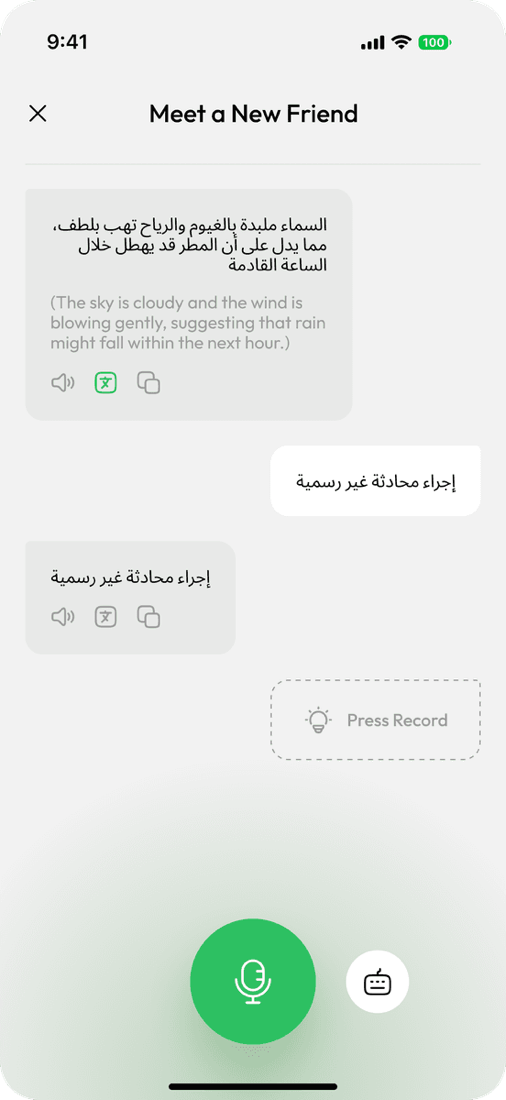
Kalam helps you speak it. Choose Iraq, practice real conversations with an AI partner, and get pronunciation feedback on sounds like the Iraqi g and ch, so you can finally talk with your family instead of listening from the sidelines.
 1,000,000+ learners
For many Iraqi families abroad, Arabic is the language of grandparents, holidays, and calls home. Learning the dialect lets you answer in Iraqi instead of English, follow the stories, and keep the language alive for the next generation.
Iraqi Arabic developed in a region that absorbed Aramaic, Persian, and Turkish influences over centuries. That history shows up in everyday vocabulary, making Iraqi one of the most distinctive and colorful Arabic dialects you can learn.
Iraq has a rich tradition of music and poetry, from the classical Iraqi maqam to stars like Kadim Al Sahir. Knowing the dialect lets you follow songs, comedy, and social media content the way Iraqis themselves hear it.
Iraqi Arabic shares many features with Kuwaiti and other Gulf dialects, like شلونك؟ (shlōnak?) for 'how are you?'. Learning Iraqi gives you a head start on understanding Arabic across the northern Gulf.
In Baghdadi Arabic, many words with ق use a hard g. MSA قال (qāla), 'he said,' becomes gāl, and قلب, 'heart,' becomes galub. If you only learned MSA, this single change can make familiar words hard to recognize.
Iraqi Arabic frequently turns ك into a ch sound, written چ in Iraqi spelling. كان (kān), 'was,' becomes چان (chān), and كلب, 'dog,' becomes chalib. Not every k changes, so you learn these words one by one.
MSA ماذا تريد؟ (mādhā turīd?) becomes شتريد؟ (shitrīd?) in Iraqi. 'Now' is هسّه (hassa), 'there is' is أكو (aku), and 'there isn't' is ماكو (maku). These words show up in nearly every conversation.
Like other dialects, Iraqi drops MSA's case endings and dual verbs. The future uses راح (rāḥ), as in راح أروح (rāḥ arūḥ), 'I'm going to go.' Once you learn a few patterns like this, you can build sentences quickly.
The same everyday phrases, the way a textbook says them and the way people actually say them.
Large Iraqi communities live in Michigan, San Diego, Sweden, the UK, Germany, and Australia. If you grew up understanding Iraqi Arabic but answering in English or Swedish, Kalam helps you turn that understanding into real speaking.
Iraqi hospitality is legendary, and meals with in-laws can last for hours. Speaking even basic Iraqi Arabic earns warmth and respect, and it means your partner is no longer translating every conversation at the table.
Aid workers, journalists, and business professionals who work with Iraqis build trust faster in the dialect. MSA is understood, but Iraqi Arabic is what people use when they relax, joke, and speak openly.
Fans of Iraqi music, poetry, and food often want to go deeper. Learning the dialect opens up song lyrics, comedy, and family recipes in a way that translations cannot.
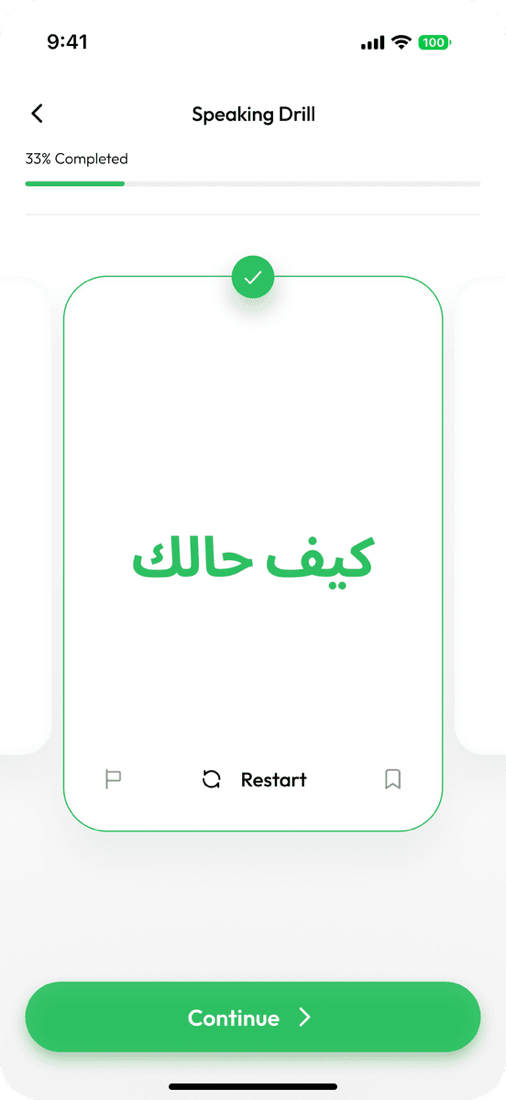
When you start, you pick the country your family is from. Choose Iraq and your lessons, drills, and conversations use Iraqi Arabic, not textbook MSA or a dialect your family does not speak.
Kalam listens as you speak and flags sounds that need work, from the Iraqi g and ch to ع and ح. You try again, compare, and steadily replace a textbook accent with one your relatives recognize.
Free Talk lets you practice real-life scenarios in Iraqi Arabic, like greeting relatives, ordering food, or making plans with a friend. You speak out loud and build the habit of responding without translating in your head.
Short video lessons introduce Iraqi phrases in context, and flashcards help them stick. When a word or grammar point is unclear, tutor Q&A lets you ask about it and get a straightforward explanation.
Set a daily goal and keep your streak going. A few minutes of speaking every day adds up quickly and keeps the dialect fresh between family calls and visits.
شكو ماكو؟ (shaku maku?) literally asks 'what is there and what isn't?' and means 'what's new?'. Friends also greet with شلونك؟ (shlōnak?), and a common reply is زين، الحمد لله (zēn, al-ḥamdu lillāh), 'good, thank God.'
كلّش (kullish) means 'very,' هواية (hwāya) means 'a lot,' and خوش (khōsh), borrowed from Persian, means 'good' or 'nice,' as in خوش ولد (khōsh walad), 'a good guy.' Use them and Iraqis will notice immediately.
Linguists divide Iraqi Arabic into gilit and qeltu varieties, named after how each says 'I said.' Gilit is spoken by most Baghdadis and southern Iraqis, while qeltu is heard in Mosul and was historically spoken by Baghdad's Christian and Jewish communities.
Tea is served in small glasses called استكان (istikān), and hosts keep refilling them. Iraqis call loved ones عيني (ʿēni), literally 'my eye,' and say تفضّل (tfaḍḍal) to invite you in or offer you food.
Trusted by Iraqi Arabic Learners Worldwide
“Kalam is my new favorite way to learn Arabic. The app feels super well-made, and you can tell the people behind it really care. I love that I can practice speaking whenever I'm out and about — it's way more natural than just memorizing words.”
Abdullah ShebaitaKalam learner · App Store review“Has all the features I've been looking for. Loving its simplicity and efficiency — it's also great for people looking to travel!”
“It has been such a breeze learning Arabic through Kalam! I have been on a learning journey and finally found something that just works.”
4.7★★★★★
Can't find what you're looking for? Email our team, we read everything.
Iraqi Arabic, also called Mesopotamian Arabic, is the spoken Arabic of Iraq. People use it at home, at work, and in daily life, while MSA is used for writing, news, and formal speeches. Baghdadi Arabic is the most widely understood variety in the country.
They are the two main branches of Iraqi Arabic. Gilit dialects, spoken in Baghdad and the south, say gilit for 'I said.' Qeltu dialects, found in Mosul and parts of northern Iraq, say qeltu. Most learners start with Baghdadi gilit because it is the most widely understood.
Not exactly. Iraqi Arabic is usually classified as Mesopotamian Arabic, but it shares many words and sounds with Kuwaiti and other Gulf dialects. Southern Iraqi speech is especially close to Gulf Arabic, and Gulf speakers generally understand Iraqis well.
Gulf and Levantine speakers usually understand Iraqi with some effort, and Iraqis understand Egyptian and Levantine from media. Some Iraqi words, like aku and maku, are unfamiliar elsewhere, but everyday conversation across dialects works with a little adjustment.
No. Iraqi Arabic is a spoken language you can learn directly, and starting with it gets you talking to family much faster. If you later want to read Arabic, MSA comes easier because you already know the sounds and much of the core vocabulary.
Yes, and that is one of the most common starting points. Many heritage learners follow family conversations but struggle to respond. Kalam's speaking drills and Free Talk practice are designed to turn passive understanding into confident speaking.
It depends on your starting point and how often you practice. Learners who speak for a few minutes every day usually notice real progress within weeks, and heritage learners often move faster because the sounds are already familiar.
Most big language apps teach Modern Standard Arabic, and few offer Iraqi Arabic at all. Kalam lets you choose Iraq and practice with speaking drills, pronunciation feedback, and an AI conversation partner. Over 1,000,000 learners use Kalam, rated 4.7 stars on the App Store.
The most widely understood dialect, thanks to Egyptian film, TV and music.
شامي Lebanon, Syria, Palestine, JordanSoft, melodic and spoken across the Levant and its huge diaspora.
خليجي Saudi Arabia, UAE, Kuwait, QatarKhaleeji Arabic for living, working and building relationships in the GCC.
أردني JordanA clear, accessible Levantine variety with its own everyday expressions.
دارجة Morocco, Algeria, TunisiaNorth African Darija, full of Amazigh and French influence.
لهجات Not sure yet?See how they differ and which one fits your family, your travels or your work.
Answer a few quick questions and get a learning plan built around your dialect. It takes two minutes.