 Kalam
Najdi vs Hejazi
Saudi Arabia has several dialect regions. Najdi is spoken in Riyadh and the center, while Hejazi is spoken in Jeddah, Mecca, and Medina in the west. Najdi asks 'what?' with وش (wesh), while Hejazi uses إيش (ēsh).
Saudi Arabic is what people speak in Riyadh offices, Jeddah cafes, and family majlis gatherings across the Kingdom. It is closely related to other Gulf dialects, and it sounds very different from the Modern Standard Arabic you hear on the news or read in textbooks.
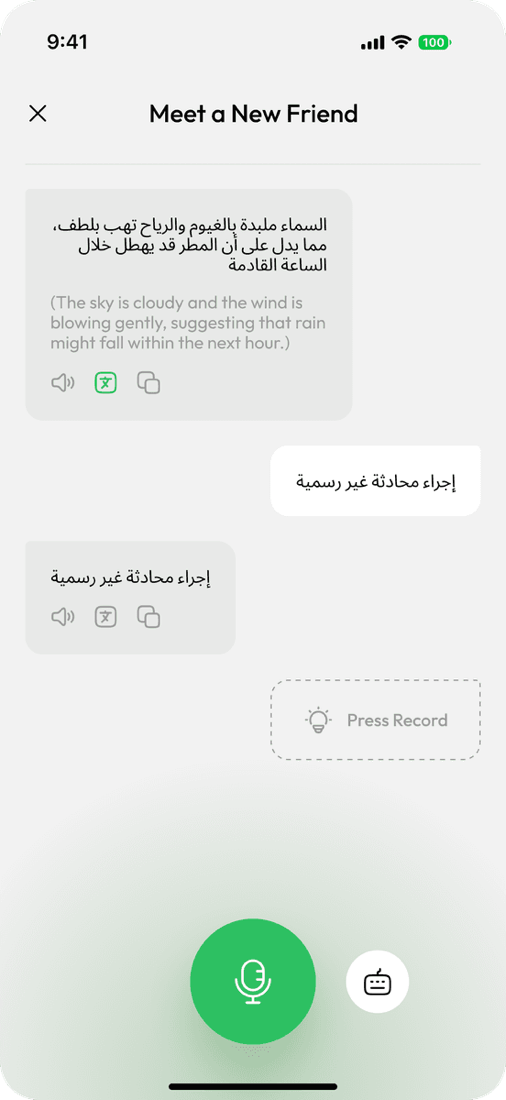
Kalam teaches you to speak it. Choose Saudi Arabia, practice real conversations with an AI partner, and get pronunciation feedback, whether you are an expat settling into Riyadh or Jeddah or reconnecting with Saudi family.
 1,000,000+ learners
Millions of expats live and work in Riyadh, Jeddah, and Dammam. English gets you through the office, but Saudi Arabic helps with landlords, drivers, shop owners, and colleagues, and it shows you are invested in the place you live.
Business in Saudi Arabia runs on relationships. Greeting colleagues with هلا والله (hala wallāh) and handling small talk in the dialect builds rapport that English alone cannot, especially outside big international firms.
Saudi dialects, especially Najdi and Eastern Province speech, share a lot with Kuwaiti, Qatari, Bahraini, and Emirati Arabic. Learning Saudi Arabic gives you a foundation for understanding Arabic across the whole Gulf region.
If you have Saudi roots but grew up abroad, the dialect is how you connect with relatives during visits and holidays. Speaking it confidently makes family gatherings feel like home instead of a conversation you watch from outside.
Saudi Arabia has several dialect regions. Najdi is spoken in Riyadh and the center, while Hejazi is spoken in Jeddah, Mecca, and Medina in the west. Najdi asks 'what?' with وش (wesh), while Hejazi uses إيش (ēsh).
MSA ماذا تريد؟ (mādhā turīd?) becomes وش تبي؟ (wesh tibi?) in Najdi and إيش تبغى؟ (ēsh tibgha?) in Hejazi. 'Now' is الحين (al-ḥīn) in Riyadh and دحين (daḥīn) in Jeddah. Learning these pairs helps you follow both regions.
Most Saudi speakers pronounce ق as a hard g, so قهوة (coffee) is gahwa and قال (he said) is gāl. MSA uses a deep q sound instead. Once you hear this shift, many familiar MSA words become easy to spot.
Saudi dialects drop MSA case endings and use shorter forms. 'I want' is أبي (abi) in Najdi and أبغى (abgha) in Hejazi, and 'not' is often ما (ma) or مو (mū). You can start forming useful sentences quickly.
The same everyday phrases, the way a textbook says them and the way people actually say them.
You moved to Saudi Arabia for work and want more than English small talk. Saudi Arabic helps you handle errands, understand colleagues, and get to know neighbors, making a multi-year posting feel like home.
If you travel to the Kingdom for projects, conferences, or client meetings, Saudi Arabic helps you build relationships faster. Small talk over gahwa and dates matters, and the dialect turns formal meetings into real connections.
Maybe one parent is Saudi, or you grew up abroad and lost your Arabic. Kalam helps you rebuild your speaking so you can talk with grandparents, cousins, and family friends in their own dialect.
Pilgrims performing Hajj or Umrah meet Hejazi speakers in hotels, shops, and taxis. Knowing everyday Saudi phrases makes the trip smoother and lets you connect with local people beyond basic greetings.
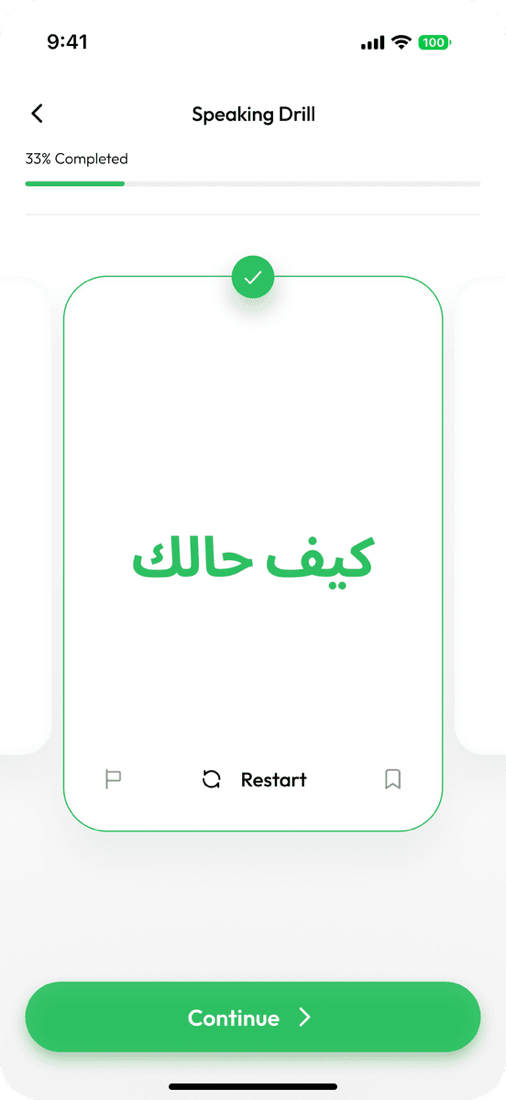
Pick Saudi Arabia when you start and your lessons, drills, and conversations focus on Saudi Arabic. You learn the words people actually use in the Kingdom, not textbook MSA or a generic mix of dialects.
Every lesson gets you speaking. Kalam listens and flags sounds that need work, like the Saudi g for ق or the ع in يعطيك العافية, so you sound natural rather than like you are reading a script.
Free Talk is an AI conversation partner for scenarios like chatting with a colleague, ordering at a cafe, or talking to a landlord. You practice responding out loud, so real conversations in Riyadh or Jeddah feel familiar.
Short video lessons introduce Saudi phrases in context, and flashcards help them stick. When something is unclear, tutor Q&A lets you ask about grammar or usage and get a clear answer.
Busy schedules make consistency hard. Daily goals and streaks keep you practicing for a few minutes every day, which adds up to real speaking confidence over weeks and months.
Saudis welcome guests with حيّاك الله (ḥayyāk allāh) and هلا (hala). You will also hear يعطيك العافية (yaʿṭīk al-ʿāfya), 'may God give you strength,' said to anyone who is working, from colleagues to cashiers.
أبشر (abshir) is one of the most Saudi words you can learn. It means 'consider it done' or 'with pleasure,' and you hear it whenever someone agrees to help. Pair it with تم (tamm), 'done' or 'agreed,' for quick confirmations.
Saudis say مرّة (marra) for 'very,' as in حلو مرّة (ḥilw marra), 'really nice,' and زين (zēn) for 'good.' In Riyadh you will also hear واجد (wājid) for 'a lot,' a word shared with other Gulf dialects.
Saudi hospitality centers on قهوة عربية (gahwa ʿarabiyya), cardamom coffee poured into small cups and served with dates in the مجلس (majlis). Gently shaking your cup when you hand it back signals you have had enough.
Trusted by Saudi Arabic Learners Worldwide
“Kalam is my new favorite way to learn Arabic. The app feels super well-made, and you can tell the people behind it really care. I love that I can practice speaking whenever I'm out and about — it's way more natural than just memorizing words.”
Abdullah ShebaitaKalam learner · App Store review“Has all the features I've been looking for. Loving its simplicity and efficiency — it's also great for people looking to travel!”
“It has been such a breeze learning Arabic through Kalam! I have been on a learning journey and finally found something that just works.”
4.7★★★★★
Can't find what you're looking for? Email our team, we read everything.
Arabic is the official language. Saudis use MSA for writing, news, and official settings, but speak regional dialects in daily life: Najdi around Riyadh, Hejazi around Jeddah, Gulf Arabic in the Eastern Province, and southern dialects near Yemen. English is widely used in business.
Najdi, from central Arabia, is closer to Bedouin and Gulf speech, with words like wesh (what) and abi (I want). Hejazi, from Jeddah, Mecca, and Medina, is more urban and mixed, with ēsh (what) and abgha (I want). Speakers of both understand each other easily.
They overlap heavily. Eastern Province speech is a Gulf dialect, and Najdi shares many words with Kuwaiti and Qatari Arabic, while Hejazi is more distinct. If you learn Saudi Arabic, you will understand much of what you hear in Kuwait, Qatar, Bahrain, and the UAE.
Many expats manage with English at work, especially in Riyadh and Jeddah. But Arabic makes daily life, from government offices to small shops, much easier, and Saudis tend to warm up quickly when you make the effort to speak their dialect.
No. Saudi Arabic is a spoken language you can learn directly, and it gets you into real conversations faster. MSA is useful later for reading signs, news, and documents, and it comes easier once you already speak a dialect.
Yes. Basic Saudi phrases help with hotels, taxis, shopping, and asking for directions in Mecca and Medina, where Hejazi Arabic is the local dialect. Many workers there come from other countries too, so clear, simple Arabic goes a long way.
It depends on how often you practice. Learners who speak for a few minutes every day usually handle greetings and simple exchanges within weeks. Living in the Kingdom speeds things up, because you can use new phrases the same day you learn them.
Most big language apps teach Modern Standard Arabic, which Saudis do not use in everyday conversation. Kalam lets you choose Saudi Arabia and practice with speaking drills, pronunciation feedback, and an AI conversation partner. Over 1,000,000 learners use Kalam, rated 4.7 stars on the App Store.
The most widely understood dialect, thanks to Egyptian film, TV and music.
شامي Lebanon, Syria, Palestine, JordanSoft, melodic and spoken across the Levant and its huge diaspora.
خليجي Saudi Arabia, UAE, Kuwait, QatarKhaleeji Arabic for living, working and building relationships in the GCC.
أردني JordanA clear, accessible Levantine variety with its own everyday expressions.
دارجة Morocco, Algeria, TunisiaNorth African Darija, full of Amazigh and French influence.
لهجات Not sure yet?See how they differ and which one fits your family, your travels or your work.
Answer a few quick questions and get a learning plan built around your dialect. It takes two minutes.