Learn Moroccan Arabic and Speak Darija Like a Local
Moroccan Arabic, called Darija, is what Moroccans speak at home, in the souk, and on WhatsApp. It blends Arabic with Amazigh, French, and Spanish influences, and it sounds very different from the Arabic of Cairo or Beirut. If your family is Moroccan, Darija is the language you want.
Kalam teaches Darija as a spoken language. Choose Morocco, practice everyday conversations with an AI partner, and get feedback on your pronunciation, so you can talk to your family, your friends, and the taxi driver in Casablanca with confidence.
Darija is the everyday language of most Moroccans, used at home, in markets, and on social media. MSA appears in schools, news, and official documents, but conversations at the dinner table and in the street happen in Darija.
Connect With Your Moroccan Family
Millions of people of Moroccan descent live in France, Spain, Belgium, the Netherlands, and beyond. If your family speaks Darija and you mostly answer in French, Dutch, or English, learning it changes every visit and every call home.
Travel Beyond the Tourist Script
In the medinas of Marrakech and Fes, a few words of Darija change how people treat you. Bargaining, asking for directions, and chatting over mint tea all go better when you say واخا (wakha) instead of 'okay.'
A Gateway to the Maghreb
Moroccan Darija belongs to the Maghrebi dialect family along with Algerian and Tunisian Arabic, and it shares much of their vocabulary and grammar. Learning Darija gives you a strong foundation for understanding North African Arabic more broadly.
Darija vs MSA and Middle Eastern Arabic
How Darija Differs From MSA and Middle Eastern Arabic
Darija drops many short vowels, creating consonant clusters that surprise learners. MSA كتاب (kitāb), 'book,' becomes ktab, and many words start with two consonants in a row. This is a big reason Darija sounds fast to Egyptians and Levantines.
02
Different Everyday Words
Where MSA says ماذا تريد؟ (mādhā turīd?), Darija says شنو بغيتي؟ (shnu bghiti?). 'Now' is دابا (dāba), 'good' is مزيان (mezyān), and 'a lot' is بزاف (bezzāf). Most of these words are rarely used in the Middle East.
03
New Verb Patterns
Darija marks the present with ka- or ta-, as in كناكل (kanākul), 'I eat' or 'I'm eating.' The first person singular uses n-, so نكتب (nekteb) means 'I write,' while in Egyptian and Levantine Arabic the n- form means 'we write.'
04
Mutual Intelligibility Is One-Sided
Moroccans usually understand Egyptian and Levantine Arabic from TV and music, but many Middle Easterners struggle with Darija at first. That gap is why learning Darija itself, rather than another dialect, matters if you want to talk with Moroccans.
Phrase guide
Moroccan Arabic vs textbook Arabic
The same everyday phrases, the way a textbook says them and the way people actually say them.
EnglishModern Standard ArabicMoroccan Arabic
How are you?كيف حالك؟kayfa ḥāluk?لاباس؟ / كي داير؟labas? / ki dāyer?
What do you want?ماذا تريد؟mādhā turīd?شنو بغيتي؟shnu bghiti?
I don't knowلا أعرفlā aʿrifما عرفتشma ʿreftsh
Nowالآنal-ānداباdāba
Goodجيدjayyidمزيانmezyān
A lot / veryكثيرًا / جدًاkathīran / jiddanبزافbezzāf
You grew up hearing Darija from your parents but answering in French, Dutch, Spanish, or English. Now you want to speak with your grandparents, follow family conversations, and feel at home during summers in Morocco.
Partners of Moroccan Speakers
Visiting a Moroccan family means long meals, plenty of tea, and many questions. Speaking Darija, even simply, shows respect and makes relatives far more comfortable, and your partner no longer has to translate every sentence.
Travelers and Long-Stay Visitors
Whether you are spending a month in Marrakech, surfing in Taghazout, or working remotely from Rabat, Darija helps you live like a resident. It makes daily errands easier and conversations with neighbors more genuine.
MSA Students Who Want to Speak
If you studied MSA and found that Moroccans did not answer you in it, Darija is the missing piece. Your MSA vocabulary helps, but you need the spoken patterns to hold a real conversation in Morocco.
How Kalam Teaches Darija
How Kalam Teaches You to Speak Moroccan Arabic
Pick Morocco and Learn Real Darija
Select Morocco when you start, and your lessons, drills, and conversations use Moroccan Darija. You learn the words Moroccans use every day instead of formal phrases that sound out of place in a Casablanca cafe.
Pronunciation Feedback on Tricky Sounds
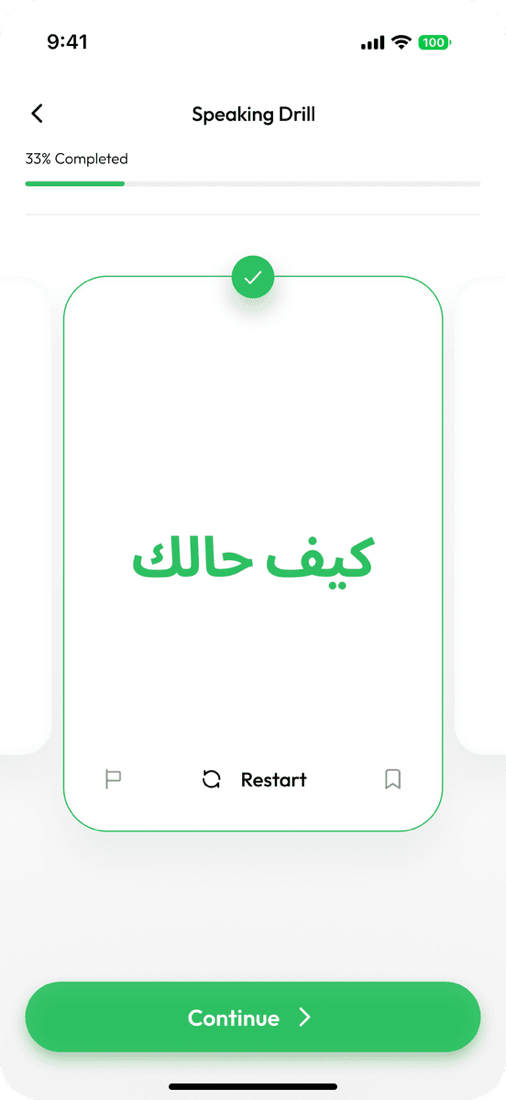
Darija's consonant clusters and sounds like ق, خ, and غ take practice. Kalam's speaking drills listen as you talk and point out where to adjust, so words like بغيت (bghit) and خويا (khuya) come out naturally.
Free Talk Conversation Practice
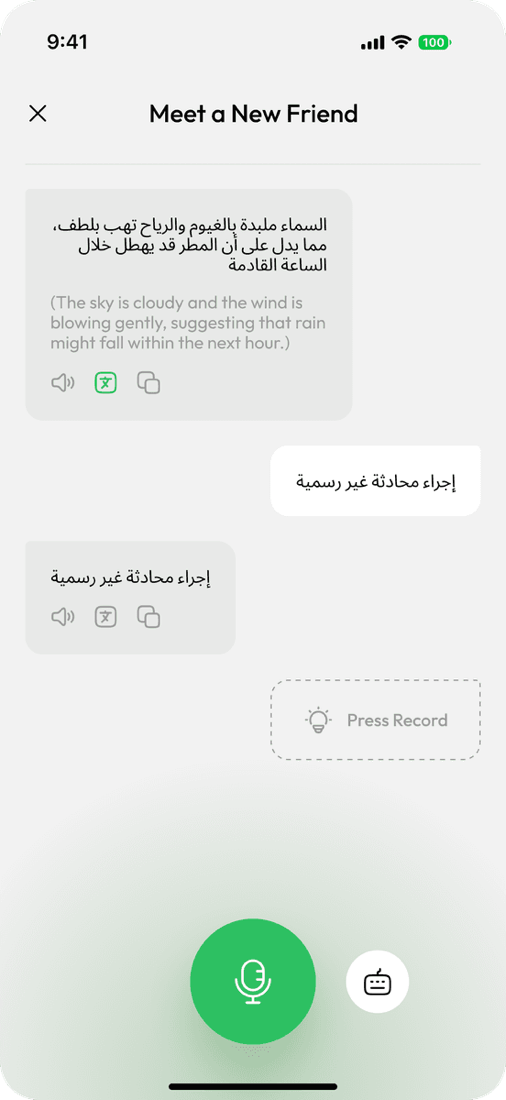
Free Talk is an AI conversation partner that runs real-life scenarios in Darija, like haggling in a souk, ordering at a cafe, or catching up with an aunt. You practice speaking out loud, not tapping answers.
Short Video Lessons and Flashcards
Short video lessons introduce Darija phrases in context, and flashcards help you remember them. When a word or grammar point confuses you, tutor Q&A lets you ask about it and keep moving.
Daily Goals and Streaks
Daily goals and streaks keep you practicing a few minutes every day. Consistent speaking practice is what turns passive understanding of Darija into the confidence to answer back.
واخا (wakha) means 'okay,' صافي (ṣāfi) means 'that's it' or 'enough,' and ماكاين مشكل (makayn mushkil) means 'no problem.' Say بسلامة (bslāma) for goodbye. These few words carry a surprising share of daily conversation.
Deep Amazigh Roots
Morocco's Amazigh (Berber) heritage runs deep, and Tamazight has been an official language alongside Arabic since 2011. Darija carries Amazigh influence in its sounds, grammar, and vocabulary, and even سكسو (seksu), couscous, is an Amazigh dish and word.
French and Spanish Loanwords
French gave Darija words like طوموبيل (ṭomobil), 'car,' and many Moroccans mix French into everyday sentences. Spanish, especially in the north, left words like كوزينة (kuzina), 'kitchen,' and سيمانة (simana), 'week.'
Hospitality Around Mint Tea
Tea, أتاي (atay), is central to Moroccan hospitality, and refusing a glass can seem cold. Hosts say مرحبا بيك (marḥba bik), 'welcome,' and guests thank the cook after a meal with الله يخلف (llah ykhlef).
Trusted by Moroccan Arabic Learners Worldwide
“Kalam is my new favorite way to learn Arabic. The app feels super well-made, and you can tell the people behind it really care. I love that I can practice speaking whenever I'm out and about — it's way more natural than just memorizing words.”
Abdullah ShebaitaKalam learner · App Store review
“Has all the features I've been looking for. Loving its simplicity and efficiency — it's also great for people looking to travel!”
“It has been such a breeze learning Arabic through Kalam! I have been on a learning journey and finally found something that just works.”
4.7★★★★★
FAQ
Frequently Asked Questions About Moroccan Darija
Can't find what you're looking for? Email our team, we read everything.
What is Darija?
Darija, from an Arabic word meaning 'common' or 'colloquial,' is the spoken Arabic of Morocco. The term is also used in Algeria and Tunisia. Moroccan Darija is what most Moroccans speak at home and in daily life, while MSA is used mainly for writing and formal settings.
Is Moroccan Arabic the same as Darija?
Yes. 'Moroccan Arabic' and 'Moroccan Darija' refer to the same spoken language, which Moroccans call الدارجة (ad-dārija). It differs from MSA in vocabulary, pronunciation, and grammar, and it has no single official spelling.
Can Moroccans understand other Arabic dialects?
Mostly yes. Moroccans grow up hearing Egyptian and Levantine Arabic in TV series, films, and music, so they usually understand them. The reverse is harder, because Darija's vocabulary, dropped vowels, and loanwords are less familiar to speakers in the Middle East.
Is Darija hard to learn?
Darija's fast rhythm and consonant clusters take some getting used to, but its grammar is simpler than MSA's. Speaking it out loud every day is the fastest way to adjust, which is why Kalam focuses on speaking drills and conversation practice from the first lesson.
Do I need to know MSA or French first?
No. You can start Darija directly. MSA helps with some vocabulary and French helps with loanwords, but neither is required. Many heritage learners already understand more Darija than they think, and speaking practice brings that passive knowledge to the surface.
How is Darija written?
Darija is usually written in Arabic script, and online it is often typed in Latin letters with numbers standing in for Arabic sounds, like 3 for ع and 7 for ح. There is no standardized spelling, so the same word appears several ways.
Is Moroccan Darija the same as Algerian Arabic?
They are closely related Maghrebi dialects and share a lot of vocabulary and grammar, especially Moroccan and western Algerian speech. Each has its own words and accent, and Tunisian differs further, so speakers sometimes adjust to understand each other fully.
How is Kalam different from other Arabic apps?
Most big language apps teach Modern Standard Arabic, which Moroccans rarely speak in daily life. Kalam lets you choose Morocco and practice Darija with speaking drills, pronunciation feedback, and an AI conversation partner. Over 1,000,000 learners use Kalam, rated 4.7 stars on the App Store.
 Kalam