Lebanese Arabic is the everyday language of Lebanon and of millions in the diaspora, from Montreal to Sydney to São Paulo. It is the Arabic of family dinners, Beirut cafes, and voice notes from your teta, and it sounds nothing like the formal Arabic taught in textbooks.
Kalam teaches you to speak it, not just read about it. Pick Lebanon, practice real conversations with an AI partner, get feedback on your pronunciation, and learn the mix of Arabic, French, and English that makes Lebanese sound Lebanese.
If your parents or grandparents are from Lebanon, Lebanese Arabic is the language of their jokes, stories, and phone calls home. Formal Arabic will not help you follow a family lunch, but the dialect lets you finally answer back instead of smiling and nodding.
Understood Across the Levant and Beyond
Lebanese Arabic is a Levantine dialect, so speakers from Syria, Palestine, and Jordan understand it easily. Lebanese music, TV dramas, and talk shows also travel across the Arab world, which means your Lebanese is welcome far beyond Beirut.
Unlock Lebanese Music and TV
From Fairuz classics to pop stars like Nancy Ajram and Elissa, Lebanese artists dominate Arab playlists. Knowing the dialect lets you catch lyrics, punchlines, and talk-show banter that subtitles flatten or skip entirely.
Get More Out of Beirut
Whether you are visiting Hamra and Gemmayzeh or spending a summer in the mountains, Lebanese Arabic turns you from a tourist into a guest. Shopkeepers, drivers, and neighbors switch from English to Arabic the moment you show you can keep up.
Lebanese Arabic vs MSA
Lebanese Arabic vs MSA: What Changes When You Speak
Modern Standard Arabic is used for news, books, and official documents. Lebanese people read and write MSA, but nobody uses it to order a manoushe or chat with a cousin. Everyday life in Lebanon happens in the dialect.
02
Everyday Words Are Different
In MSA, 'how are you?' is كيف حالك؟ (kayfa ḥāluk?). In Lebanon it is كيفك؟ (kīfak?). 'What do you want?' turns from ماذا تريد؟ (mādhā turīd?) into شو بدّك؟ (shu baddak?), and 'now' becomes هلّق (halla').
03
The Qaf Becomes a Glottal Stop
In Beirut and most Lebanese cities, the letter ق is pronounced as a glottal catch, so قلب (heart) sounds like 'alb and قهوة (coffee) like 'ahwe. Druze and many rural speakers keep the full q, which you will notice in some villages.
04
Simpler Grammar, Faster Speaking
Lebanese drops MSA's case endings and dual verb forms and uses short particles instead. 'I want' is بدّي (baddi), and the present tense takes a b- prefix, as in بحكي (baḥki), 'I speak.' Learn these patterns and sentences come quickly.
Phrase guide
Lebanese Arabic vs textbook Arabic
The same everyday phrases, the way a textbook says them and the way people actually say them.
EnglishModern Standard ArabicLebanese Arabic
How are you?كيف حالك؟kayfa ḥāluk?كيفك؟kīfak?
What do you want?ماذا تريد؟mādhā turīd?شو بدّك؟shu baddak?
More people of Lebanese descent live outside Lebanon than inside it, in Brazil, the US, Canada, Australia, France, and beyond. If you understand your family but freeze when it is your turn to talk, Kalam is built for you.
Partners Marrying Into Lebanese Families
Meeting the in-laws goes very differently when you can greet them in their dialect. A few confident sentences at the first family lunch earn more goodwill than any gift, and full conversations come quickly with daily practice.
Travelers and Summer Visitors
Summers in Lebanon mean weddings, beach days in Batroun, and long dinners in the mountains. Lebanese Arabic helps you bargain, give a taxi driver directions, and follow the conversation at the table instead of waiting for a translation.
Fans of Lebanese Music and Media
If you have Fairuz on repeat or follow Lebanese comedians and creators online, learning the dialect lets you understand them directly. You will catch the wordplay and slang that never makes it into subtitles.
How Kalam Teaches Lebanese Arabic
How Kalam Teaches You to Speak Lebanese Arabic
Choose Lebanon, Learn Lebanese
When you start, you pick the country your family is from. Choose Lebanon and your lessons, drills, and conversations use Lebanese Arabic, not textbook MSA or a generic mix of dialects.
Speaking Drills With Pronunciation Feedback
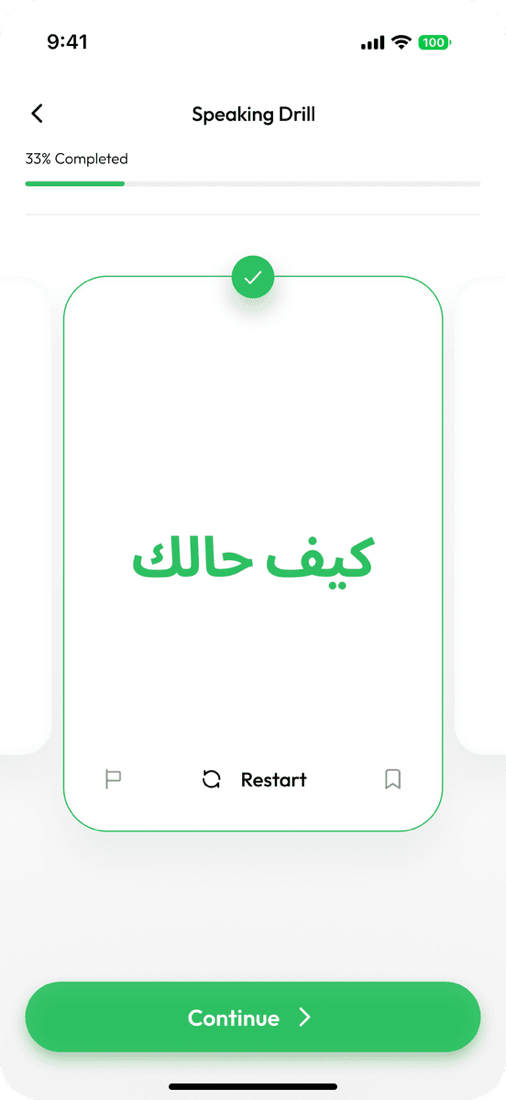
Every lesson asks you to say phrases out loud. Kalam listens and flags sounds that need work, like the Lebanese glottal stop or the ح in مرحبا (marḥaba), so you sound natural instead of reading from a script.
Free Talk With an AI Partner
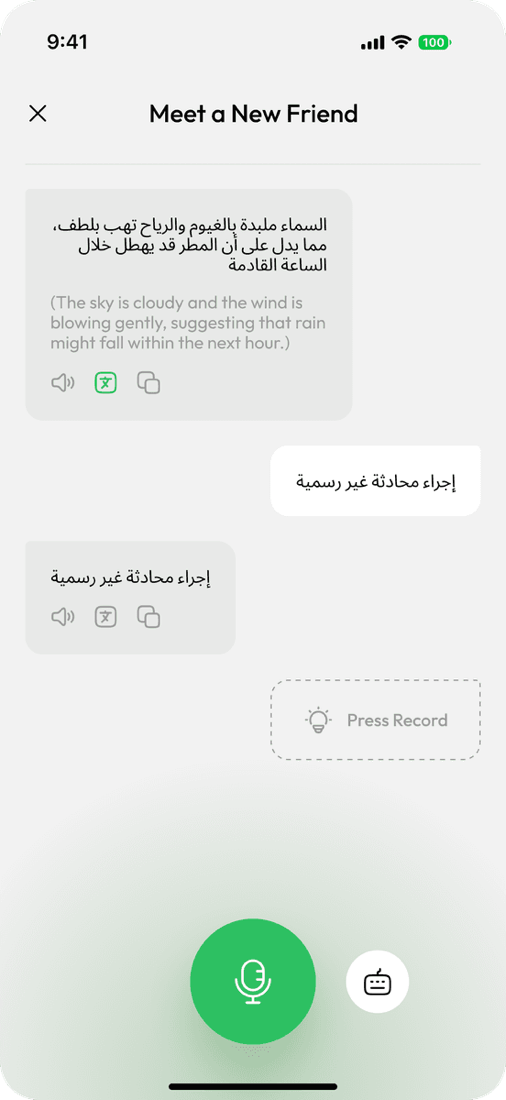
Free Talk lets you practice real-life scenarios in Lebanese Arabic, like ordering at a cafe, catching up with a cousin, or agreeing on a taxi fare. Practice as often as you want without worrying about making mistakes.
Short Video Lessons, Flashcards, and Tutor Q&A
Bite-sized video lessons introduce new phrases in context, and flashcards help you lock in vocabulary. When something is confusing, tutor Q&A lets you ask about grammar or usage and get a clear answer.
Daily Goals and Streaks
Set a daily goal and build a streak. Ten focused minutes of speaking every day does more for fluency than an occasional long study session, and streaks make it easy to keep showing up.
This famous greeting mixes English, Arabic, and French in one breath, and it is genuinely how many Beirutis talk. Lebanese speakers switch languages mid-sentence, saying ميرسي (merci) for thanks or 'bonjour' alongside مرحبا (marḥaba).
Words of Warmth and Hospitality
Guests hear أهلا وسهلا (ahla w sahla) at the door and تفضّل (tfaḍḍal) as food arrives. Thank a host who cooked for you with يسلمو إيديك (yislamu īdēk), literally 'bless your hands.'
Endearments You Will Hear Constantly
Lebanese is famously affectionate. حبيبي (ḥabībi) is used for friends and even strangers, and تقبرني (toʾborni), 'may you bury me,' means you love someone so much you hope to go before them.
Small Words That Sound Lebanese
Fillers like يلّا (yalla), 'come on' or 'let's go,' and شو (shu), 'what,' are everywhere. Add كتير (ktīr) for 'very' and هلّق (halla') for 'now,' and your Arabic instantly sounds like Beirut rather than a textbook.
Trusted by Lebanese Arabic Learners Worldwide
“Kalam is my new favorite way to learn Arabic. The app feels super well-made, and you can tell the people behind it really care. I love that I can practice speaking whenever I'm out and about — it's way more natural than just memorizing words.”
Abdullah ShebaitaKalam learner · App Store review
“Has all the features I've been looking for. Loving its simplicity and efficiency — it's also great for people looking to travel!”
“It has been such a breeze learning Arabic through Kalam! I have been on a learning journey and finally found something that just works.”
4.7★★★★★
FAQ
Frequently Asked Questions About Lebanese Arabic
Can't find what you're looking for? Email our team, we read everything.
What language do Lebanese people speak?
Lebanon's official language is Arabic, and day to day people speak Lebanese Arabic, a Levantine dialect. French and English are widely used in schools, business, and casual speech, and Armenian is spoken in the Armenian community. MSA is reserved for writing and news.
Is there a separate Lebanese language?
When people search for the 'Lebanese language,' they usually mean Lebanese Arabic. Some call it a language of its own because it differs so much from MSA, but linguists classify it as a variety of Arabic within the Levantine group.
Is Lebanese Arabic the same as Levantine Arabic?
Lebanese is one variety of Levantine Arabic, alongside Syrian, Palestinian, and Jordanian. They are mutually intelligible, but Lebanese has its own vowels, vocabulary, and heavy French influence. If your family is Lebanese, learning Lebanese specifically helps you sound like them.
Why do Lebanese people mix French and English?
Lebanon was under French mandate from 1920 until independence in 1943, and French-language schooling remains common. English has grown through universities, business, and media. The result is natural code-switching, where one sentence moves between Arabic, French, and English.
Do I need to learn MSA first?
No. Lebanese Arabic is a spoken language, and you can start speaking it directly. If you later want to read newspapers or literature, MSA becomes easier because you already know the sounds, word roots, and much of the core vocabulary.
Will Syrians and Palestinians understand my Lebanese?
Yes. Lebanese, Syrian, Palestinian, and Jordanian Arabic are all Levantine dialects and are highly mutually intelligible. Egyptians and Gulf Arabs also generally understand Lebanese thanks to its music and television, though you may adjust a few words.
How long until I can hold a conversation?
It depends on your starting point and how often you practice. Heritage learners who already understand some Lebanese often progress quickly once they start speaking daily. Short, consistent sessions of speaking drills and Free Talk build confidence faster than occasional long ones.
How is Kalam different from other Arabic apps?
Most big language apps teach Modern Standard Arabic. Kalam teaches spoken dialects, so you choose Lebanon and practice Lebanese Arabic from the first lesson with speaking drills, pronunciation feedback, and an AI conversation partner. Over 1,000,000 learners use Kalam, rated 4.7 stars on the App Store.
 Kalam