
What is the Best Way to Learn Arabic for Beginners?
Choosing between Modern Standard Arabic and Arabic dialects can be confusing for most beginners, leading them to spend months on approaches that don't align with their goals. Many learners struggle because they can't understand real conversations or navigate everyday situations despite studying for extended periods. The key lies in selecting the right foundation and focusing on practical skills that build genuine communication ability.
Success comes from mastering essential vocabulary, core grammar patterns, and consistent speaking practice rather than getting overwhelmed by complex textbooks or slow-moving courses. A structured approach helps beginners build confidence quickly by prioritizing what actually works in real-world situations. Whether the goal involves travel, family connections, or career advancement, the right platform makes all the difference when you're ready to learn Arabic.
Table of Contents
Summary
Arabic reaches 420 million speakers worldwide according to IstiZada, yet the language fragments into over 30 distinct dialects shaped by geography and history. Most learners waste months studying Modern Standard Arabic only to discover they can't understand everyday conversations in Cairo, Beirut, or Casablanca. The gap between formal written Arabic and spoken dialects creates a practical barrier that traditional textbook methods fail to address.
The Foreign Service Institute classifies Arabic as Category IV, requiring approximately 2,200 hours of study for proficiency. That number intimidates beginners, but the real challenge isn't the language itself. It's the mismatch between memorizing passive vocabulary and practicing active speaking. Learners who prioritize pronunciation drills and conversation from day one close the fluency gap faster than those who delay speaking until they feel "ready."
Arabic proficiency holds official status in 26 countries spanning the Middle East and North Africa, creating specialized demand in diplomacy, intelligence, energy, and international finance. Western employers actively recruit Arabic speakers precisely because qualified candidates remain scarce. That scarcity translates into faster career advancement and premium compensation in fields where understanding regional dynamics shapes outcomes.
Functional communication requires around 300 high-frequency words, with confidence in pronunciation, not 3,000 words recognized on paper but unusable under pressure. The three-consonant root system accelerates learning once you recognize how patterns repeat, generating entire word families through predictable transformations. Focusing on common roots first reveals connections that comprehensive grammar charts bury under overwhelming detail.
Right-to-left script and emphatic consonants with no English equivalent frustrate beginners who measure progress by reading speed rather than speaking ability. What feels foreign in week one becomes automatic by week six through consistent five-minute writing drills. Many learners report that mastering the script delivers the first real confidence boost, proof that genuinely difficult skills become second nature through daily repetition instead of weekend cramming.
Kalam addresses this by drilling pronunciation and dialogue patterns from day one, using speaking exercises that target the specific sounds and sentence structures English speakers miss in Egyptian, Levantine, Gulf, or Modern Standard Arabic.
What is Arabic, and What are the Diverse Dialects?
Arabic covers a much wider range of language types than most people learning it expect. According to IstiZada, the language has 420 million speakers worldwide, but what they speak changes dramatically from Cairo to Casablanca. You won't find a single "Arabic" in everyday conversation—instead, Classical Arabic is kept alive in religious texts, Modern Standard Arabic is taught in schools and used in formal media, and regional dialects have been shaped by hundreds of years of migration, trade, and cultural exchange. The Arabic you choose to learn depends completely on who you want to talk with and why.
"Arabic has 420 million speakers around the world, but what they speak changes dramatically from region to region." — IstiZada Language Statistics
🎯 Key Point: Arabic isn't one language—it's a family of related varieties that serve different purposes in different contexts.
💡 Tip: Before starting your Arabic journey, first identify whether you need Classical Arabic for religious study, Modern Standard Arabic for formal communication, or a specific regional dialect for everyday conversation.
Arabic Type | Primary Use | Best For |
|---|---|---|
Classical Arabic | Religious texts, the Quran | Islamic studies, religious scholarship |
Modern Standard Arabic | Formal media, education | News, academic work, official documents |
Regional Dialects | Daily conversation | Travel, business, casual communication |

Classical Arabic: The Foundation
Classical Arabic emerged between the seventh and ninth centuries as the language of the Quran and early Arabian poetry. It established grammar rules so detailed that they still define what educated speakers consider "proper" Arabic today. Case endings, verb moods, and precise vocabulary display an eloquence that scholars study, but no one uses at the breakfast table. It persists in religious practice, academic research, and literary analysis, connecting all Arabic speakers to shared heritage while remaining frozen in time: a reference point rather than a living conversation.
Modern Standard Arabic The Bridge
Modern Standard Arabic updates classical Arabic to meet modern needs, borrowing new words for technologies, political ideas, and concepts that didn't exist in the seventh century. You'll find it in newspapers, government documents, television news broadcasts, and formal speeches across the Arab world. Schools teach it through structured lessons rather than playground chatter, meaning most native speakers learn it the same way you will: through deliberate study. It serves as a unifying language for communication across the Arab world, allowing a Moroccan journalist and a Syrian diplomat to understand each other perfectly in writing, even if their spoken dialects differ significantly.
The Spoken Varieties
Conversations happen in regional dialects shaped by geography, history, and local influences. Egyptian Arabic dominates Arab media due to decades of film and music production, making it widely recognized across the region. Levantine Arabic, spoken in Syria, Lebanon, Jordan, and Palestine, has a musical rhythm closer to formal structures.
Gulf Arabic retains Bedouin roots and classical echoes across the Arabian Peninsula, while Iraqi Arabic blends Persian and Turkish influences. Maghrebi Arabic diverges most significantly, combining Arabic foundations with substantial Berber, French, and Spanish elements, creating a fast-paced sound that many speakers from the east find challenging.
What's the best way to learn Arabic for real conversations?
The gap between formal Arabic and spoken dialects creates a significant challenge for learners. You might master Modern Standard Arabic grammar and still struggle to order coffee in Amman or understand a conversation in Tunis. Speaking requires different skills from reading.
Platforms like Kalam prioritize pronunciation drills and conversation practice over passive vocabulary lists, recognizing that fluency develops through active speaking. Practicing real dialogue patterns from day one narrows the gap between formal study and everyday communication faster than most textbook methods allow.
How do Arabic dialects reflect cultural diversity?
This linguistic diversity shows how language evolves to meet human needs across distances and histories. Each dialect bears the mark of the people who shaped it, from ancient trade routes to modern media exchanges. Shared roots in Classical Arabic maintain enough common ground that the language hasn't fragmented into separate tongues. The challenge for learners isn't choosing between "correct" and "incorrect" Arabic, but understanding which variety suits your goals and building the speaking confidence to use it. But knowing which Arabic to learn matters only if you understand why you're learning it.
Related Reading
Why Learn Arabic?
Arabic opens professional doors that remain closed to most. The language holds official status in 26 countries spanning the Middle East and North Africa, creating demand for speakers in diplomacy, intelligence, energy, journalism, and international finance. Western employers recruit Arabic speakers because so few candidates possess this skill, leading to specialized jobs, faster advancement, and higher pay.

💡 Tip: Arabic proficiency can increase your salary potential by 15-25% in government and international business roles compared to monolingual candidates.
"Arabic speakers are among the most sought-after linguists in the global job market, with demand consistently outpacing supply across multiple industries." — U.S. Bureau of Labor Statistics
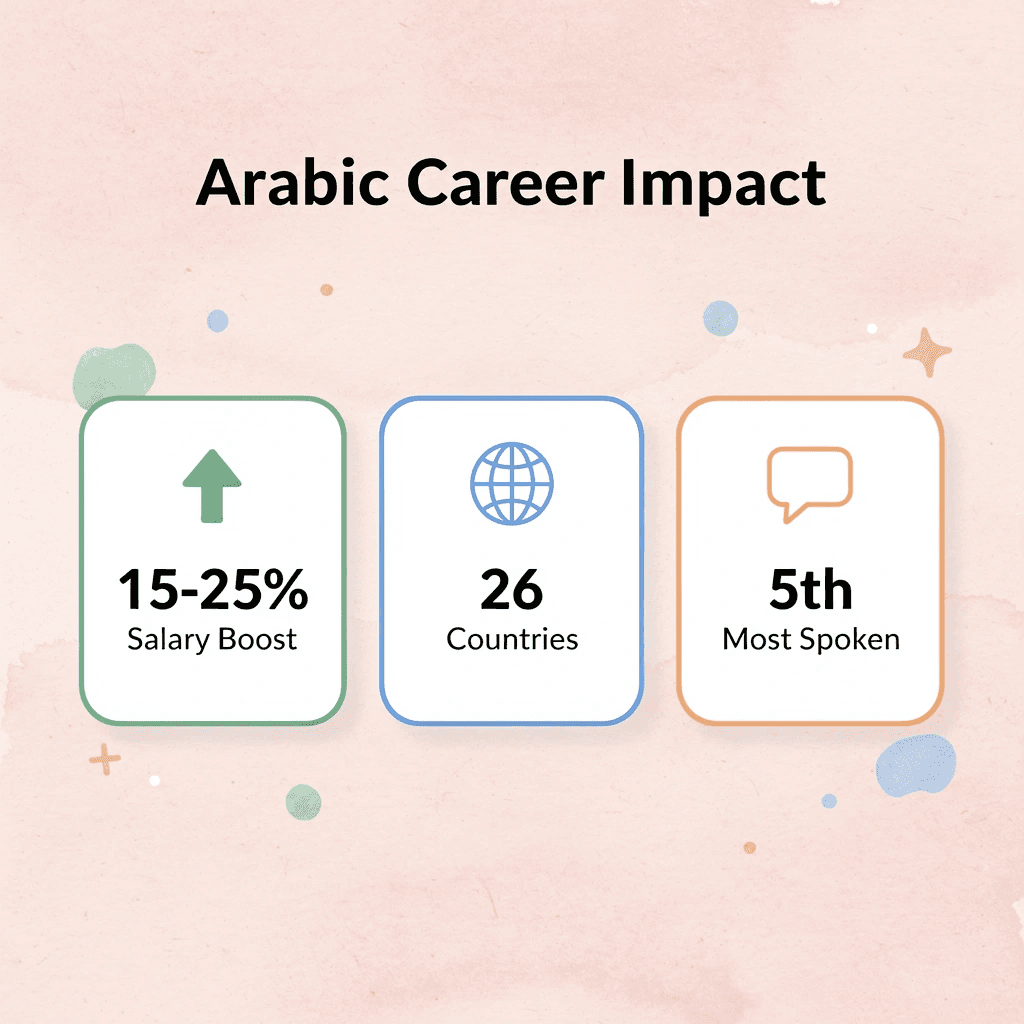
🎯 Key Point: With Arabic being the 5th most spoken language globally but having limited Western speakers, you'll enter a high-demand, low-supply market that values your expertise.
Career Leverage
Government agencies and multinational corporations compete for professionals who can navigate Arabic-speaking markets and relationships. The strategic importance of the Middle East in global security and commerce requires people who understand not just words but context, nuance, and cultural frameworks that shape negotiations and partnerships. Arabic proficiency signals a commitment to cross-cultural competence in regions where trust builds slowly, and misunderstandings carry high costs. Finance firms expanding into Gulf markets, energy companies managing regional operations, and media organizations covering geopolitical developments all face the same challenge: too few qualified candidates who can work effectively in Arabic.
Cognitive Expansion
Learning Arabic changes how your brain processes language. The right-to-left script, consonant-based root system, and grammatical gender force your mind to build new pattern recognition systems. You cannot rely on cognates or familiar structures the way Spanish or French learners do.
Every session strengthens memory, sharpens attention to detail, and builds mental flexibility that extends beyond language into problem-solving and analytical thinking. Research on bilingualism shows these cognitive benefits compound over time, possibly delaying age-related mental decline and improving executive function.
What's the best way to learn Arabic through active practice?
Traditional classroom methods treat this complexity as a vocabulary problem, pushing memorization of written words that rarely appear in conversation. Learners end up fluent on paper but silent in practice. Platforms like Kalam prioritize pronunciation drills and dialogue from day one. Speaking ability develops through active practice, not passive study. Training your mouth and ears alongside your eyes closes the gap between knowing Arabic and using it faster than textbook methods allow.
Cultural Access
Arabic unlocks the Quran in its original form, whereas translation inevitably loses layers of meaning embedded in word choice, rhythm, and structure. Classical poetry, philosophical texts from the Islamic Golden Age, and contemporary literature reveal details that English versions cannot capture. Arab scholars preserved and advanced Greek philosophy, developed algebra, and pioneered medical knowledge while Europe experienced the Dark Ages. Direct access to these contributions through their original language transforms how you understand Arab culture and the intellectual foundations of modern science and mathematics. Modern Arabic media—novels, films, journalism—offers perspectives on global events that Western coverage often misses or misinterprets.
Practical Connection
Simple Arabic phrases transform travel across Morocco, Egypt, Jordan, and Oman from passive tourism into genuine conversation. Local people respond differently when you make the effort, opening doors to experiences that guidebooks never mention. Markets become places to practice negotiating. Directions turn into conversations. Meals shift from transactions to invitations. These moments of connection matter more than perfect grammar. The question isn't whether Arabic offers value, but whether you're willing to speak it badly before you speak it well.
Is Arabic a Challenging Language to Learn?
Most people think Arabic is one of the hardest languages in the world. According to the Foreign Service Institute (FSI), Arabic is classified as a Category IV language, requiring around 2,200 hours for English speakers to reach professional proficiency. This intimidating statistic often discourages learners before they begin.
🔑 Key Point: The FSI classification is based on traditional classroom learning methods, not modern, immersive approaches that can significantly reduce learning time.
"Arabic is classified as a Category IV language, requiring around 2,200 hours for English speakers to reach professional proficiency." — Foreign Service Institute

Difficulty does not mean impossibility. With the right learning method, consistent exposure, and practical use, Arabic becomes far more approachable than its reputation suggests. The challenge is not the language itself, but how it is taught and learned.
⚠️ Warning: Don't let statistical averages discourage you—these numbers reflect outdated teaching methods, not your personal potential with modern learning techniques.
The Arabic Writing System
The script runs right to left with 28 letters that change shape based on their position in a word. Short vowels are often omitted. Learners must train their eyes to read smoothly without the familiar left-to-right flow or complete vowel markers of English. The system follows clear, predictable patterns once you practice connecting letters and recognizing common forms. Daily writing drills transform the challenge into a satisfying skill.
Pronunciation Hurdles
Arabic has several sounds made deep in the throat or with emphasis patterns that lack direct English equivalents. This makes them difficult to hear and repeat accurately at first, and these differences can lead to misunderstandings until your ear adjusts through repeated listening. Focused listening exercises and speaking with native recordings help most learners master these sounds quickly. What starts as frustration becomes rewarding, giving your spoken Arabic an authentic ring that boosts confidence in real conversations.
Grammar and Root-Based Structure
Words build from three-consonant roots that shift meaning through patterns, while verbs change form based on gender, number, and tense differently from English. This root system creates dense connections that can overwhelm beginners who try to memorize each word individually. Learning common roots reveals logical patterns that speed up vocabulary growth. Tackling one pattern at a time shows how elegantly the language works, transforming complexity into a tool for faster recall.
The Gap Between Formal and Everyday Arabic
Modern Standard Arabic, used in books and news, differs noticeably from spoken dialects across regions. Choosing one variety early can feel limiting when travel or conversation requires another. Starting with one clear path, whether formal or a popular dialect, lets you build a strong base before branching out. Many successful students find that focusing on practical spoken Arabic first keeps motivation high and makes the formal side feel like a natural next step.
Building Vocabulary With Few Shared Words
Arabic shares few roots or everyday words with English, so learners must start from the beginning and learn new words by understanding how they are used in sentences rather than recognizing them quickly.
What's the best way to learn Arabic vocabulary effectively?
The language's logical patterns and repeated roots mean that once you learn a core set, related words appear everywhere. Spaced repetition apps and real-life examples help vocabulary stick, and many learners describe the moment when sentences suddenly make sense as one of the most exciting breakthroughs in their studies. Arabic requires more time and effort than many other languages, but the rewards—deeper cultural insight, new friendships, and personal growth—make every hour invested feel meaningful.
How to Learn the Arabic Language as a Beginner
Arabic is spoken by over 400 million people across the Middle East, North Africa, and beyond. Learning it opens access to vibrant cultures, business networks, religious texts, and global media. While its script, grammar, and regional variations can seem challenging at first, a clear, step-by-step method makes them manageable for motivated learners.

🎯 Key Point: Arabic opens doors to 22 Arabic-speaking countries and provides access to centuries of literature, from classical poetry to modern journalism.
"Arabic is the fifth most spoken language globally, with 422 million native speakers making it essential for international business and diplomacy." — Ethnologue, 2023

⚠️ Warning: Don't try to master all dialects at once. Focus on Modern Standard Arabic (MSA) first, then add one regional dialect that matches your goals.
Understanding Arabic Dialects
Arabic operates with diglossia: Modern Standard Arabic (MSA), the formal version used in writing, news, and official settings, and spoken dialects used in daily life. MSA remains consistent across countries, making it ideal for reading and professional communication, while dialects vary significantly in vocabulary, pronunciation, and sentence structure.
Which Arabic dialect should you prioritize when choosing the best way to learn Arabic?
Major dialect groups include Egyptian (widely understood because of popular media), Levantine (spoken in Syria, Lebanon, Jordan, and Palestine), Gulf Arabic, and Maghrebi (North African varieties). If you plan to travel or live in a specific region, focus on that local dialect after learning the basics of MSA. The two forms differ enough that learning the wrong one early can slow your conversational progress.
Setting Clear Learning Goals
Figure out your exact reasons for studying Arabic—travel, career, cultural appreciation, or personal fulfillment—since strong motivation sustains you through difficult phases. Set specific, measurable targets like "hold a 5-minute conversation in six months" or "read simple news articles in one year."
Create a flexible weekly schedule that fits your lifestyle by allocating time to different skills rather than cramming. Review your goals monthly and adjust as needed to ensure steady advancement without burnout.
Mastering the Arabic Script
The Arabic alphabet has 28 letters written from right to left in a flowing cursive style. Most letters change shape depending on their position in a word. Short vowels appear as small marks above or below letters rather than as separate characters. Spend the first few weeks tracing letters, saying them aloud with audio guides, and copying short words repeatedly. Free online charts and practice apps help you recognise letters faster until reading feels natural.
Building Vocabulary and Grammar
Arabic builds words from three-consonant roots that branch into related terms, letting you learn dozens of connected words at once. Focus first on the 500 most common words and phrases covering everyday needs, such as greetings, food, directions, and numbers. Pair this with core grammar rules such as gender agreement for nouns and adjectives, basic verb tenses, and simple sentence order. Daily drills on these elements help you construct original sentences rather than memorize isolated lists.
Improving Listening and Pronunciation
Arabic has unique sounds: emphatic consonants and the throaty "ayn" that don't exist in English. Familiarise yourself with the rhythm and intonation by listening daily to native speakers through podcasts, songs, or videos in your chosen variety. Say phrases out loud right after you hear them and record yourself to compare. This active copying helps you move from understanding to speaking with confidence, making conversations easier to follow.
Practicing Speaking with Conversation Tools
Speaking practice from day one helps you remember new words and structures much better than studying alone. Work with language partners, apps, platforms, or guided drills to speak naturally and build confidence. Kalam is an easy-to-use Arabic conversation coach for speaking practice. Our conversation-based method helps learners master the language quickly, with over 10,000 members achieving results.
Immersing Yourself in Arabic Media and Culture
Surround yourself with authentic Arabic content by watching television series or YouTube channels, listening to music, or following the news with subtitles. This exposure teaches natural phrasing, cultural references, and slang that textbooks rarely cover. Join online communities, language exchange apps, or local meetups to discuss what you hear and read. Real-life engagement accelerates vocabulary and listening skills toward genuine fluency.
Maintaining Consistency and Tracking Progress
Short daily study sessions work better than long cramming sessions because regular exposure strengthens neural pathways and improves retention. Connect Arabic to an existing daily habit, such as your morning coffee or evening commute. Keep a simple journal of new words, make weekly recordings of yourself speaking, and take self-tests to track your progress. Celebrate small wins and review your original goals to ensure steady advancement toward speaking Arabic with confidence. Picking the right tools determines whether your daily study sessions build real skill or become a comfortable habit.
Related Reading
Modern Standard Arabic
Persian Vs Arabic
Madinah Arabic
Arabic For Beginners
Duolingo Arabic
Busuu
Is Arabic Hard To Learn
Memrise
Pingo Ai
Alifbee
How To Speak Arabic
Resources Available For Learning Arabic Fluently
The tools you choose determine whether daily practice builds real fluency or comfortable repetition. Structured courses provide grammar foundations, media consumption trains your ear to natural speech patterns, and conversation-focused apps turn knowledge into speaking ability. Effective resources force you to produce language rather than rely on passive recognition.
💡 Tip: Focus on resources that require active output - speaking, writing, and constructing sentences - rather than just passive input like listening or reading alone.
"The most effective language learning happens when students are forced to produce language rather than simply recognize patterns." — Applied Linguistics Research, 2023
Resource Type | Primary Benefit | Best For |
|---|---|---|
Structured Courses | Grammar foundations | Beginners need a systematic approach |
Media Consumption | Natural speech patterns | Intermediate learners are improving their listening |
Conversation Apps | Speaking practice | All levels want real-time interaction |
Writing Platforms | Active production | Students building written fluency |
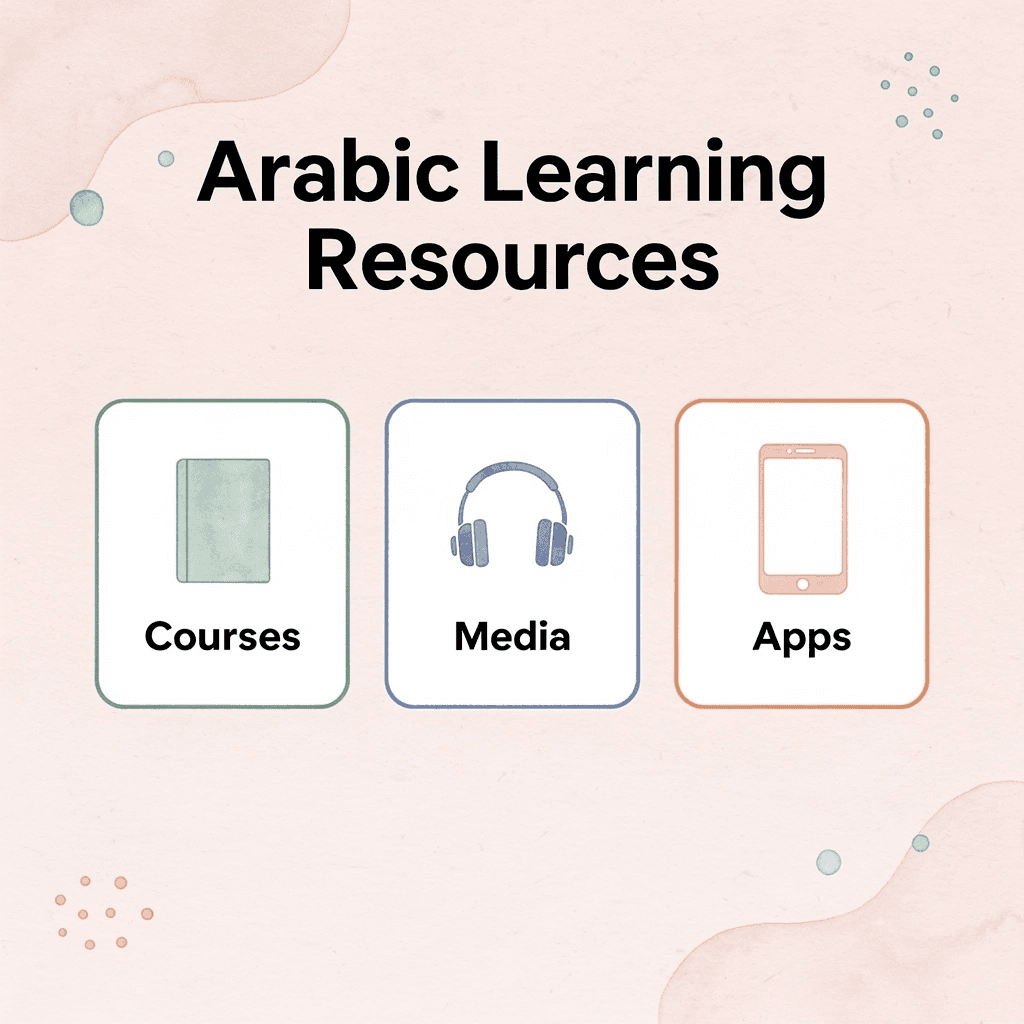
🔑 Takeaway: The best Arabic learning resources combine structured lessons with real-world application - giving you both the grammatical framework and the practical skills to use Arabic confidently in actual conversations.
Structured Online Courses Build Systematic Knowledge
Online programs like ArabicPod101 and Mango Languages offer a clear progression from basic phrases to complex grammar, breaking the language into digestible lessons. These platforms teach verb conjugations, word order, and particles that connect ideas in formal Arabic. Courses explaining these systems equip learners to construct new sentences rather than memorize fixed phrases. However, learners often complete lessons successfully yet struggle in real conversations, revealing the gap between understanding grammar rules and applying them under pressure.
Arabic Media Trains Real-World Comprehension
Watching Egyptian sitcoms, listening to Levantine podcasts, or streaming Gulf news channels exposes you to pronunciation variations, colloquial expressions, and speaking speeds that textbooks omit. Arabic functions as an official language across 23+ countries, each with distinct pronunciation patterns and vocabulary preferences that media consumption helps you recognize.
A comedy show from Beirut teaches you how Lebanese speakers shorten words and blend sounds in ways formal study cannot capture. Music embeds vocabulary through repetition and rhythm, making words stick without deliberate memorization. The challenge surfaces when you understand media passively but cannot produce similar speech yourself—a common frustration when listening practice dominates speaking drills.
Grammar Books Provide Reference Depth
Physical textbooks like "Alif Baa" and "Al-Kitaab" remain standard resources because they explain grammar concepts with precision that apps often skip. They show why certain verb forms exist, how root patterns create word families, and which case endings change meaning in formal contexts.
Advanced learners return to grammar references when hitting plateaus, using detailed explanations to understand subtleties that intermediate materials gloss over. However, learners can spend months studying grammar tables but still struggle to order food in Cairo, proving that understanding rules doesn't automatically translate into conversational fluency.
How do conversation apps prioritize speaking from day one?
Kalam takes a different approach by addressing pronunciation and speech patterns from the start. It uses AI conversations that adapt to your level and require real-time responses. Our platform focuses on sounds English speakers commonly miss, everyday sentence structures, and building confidence to speak imperfectly while improving. When you practice making language instead of recognizing it, the gap between studying Arabic and using it closes faster than with traditional methods. Recording your voice, comparing it to native speakers, and repeating until your muscles remember the patterns builds the speaking habit that passive study never creates.
What's the best way to learn Arabic consistently?
But having the right tools matters only if you show up to use them consistently.
Learn Arabic in Any Dialect Today with Kalam
Consistency wins over intensity when learning a new language. Ten minutes daily produces better results than weekend marathons because your brain needs repetition spaced over time to wire new pronunciation patterns and recall pathways. Kalam removes friction by making practice feel like conversation rather than homework, with short speaking drills tailored to Egyptian, Levantine, Gulf, or Modern Standard Arabic that fit into your commute or coffee break. You're training your mouth to produce sounds and your ears to catch nuances that textbooks miss.
💡 Tip: Focus on daily consistency rather than perfect sessions. Your brain builds language pathways through regular repetition, not cramming.

The real test arrives when you stop studying and start speaking. Most learners delay conversation until they feel "ready," which never comes because perfection isn't the goal—functional communication is. You need vocabulary to navigate a taxi ride, order food, ask directions, and handle basic social exchanges. That threshold sits around 300 high-frequency words combined with pronunciation confidence, not 3,000 words you recognize on paper but can't produce under pressure. Kalam prioritizes this practical fluency by drilling phrases and sounds you'll use in daily life, whether planning a trip to Cairo, connecting with Arabic-speaking colleagues, or building a foundation for deeper study.
"Functional communication requires around 300 high-frequency words with pronunciation confidence, not thousands of words you can't produce under pressure." — Language Learning Research
🎯 Key Point: Practical fluency beats academic knowledge—focus on words and phrases you'll use in real conversations.
The gap between where you are now and where you want to be shrinks one spoken sentence at a time. Start with the dialect that matches your goals, practice pronunciation daily until it's automatic, and speak badly before you speak well. Learning Arabic doesn't require heroic effort—it requires showing up consistently with a system that makes speaking the center of your practice.
Action Step | Time Required | Impact |
|---|---|---|
Choose your dialect | 5 minutes | Focused learning path |
Daily pronunciation practice | 10 minutes | Automatic sound production |
Start speaking immediately | Daily | Real communication skills |
🔑 Takeaway: Arabic fluency comes from consistent speaking practice, not perfect preparation—start speaking badly today to speak well tomorrow.
Related Reading
Arabic Vowels
Basic Arabic Phrases
Arabic Basics
Best App To Learn Arabic
Arabic Vs Hebrew
Urdu Vs Arabic