Persian Vs Arabic: Key Similarities and Differences
Many people confuse Persian and Arabic, assuming these Middle Eastern languages are closely related or even identical because they share the same script. The reality reveals two completely distinct linguistic families with different origins, sounds, and cultural identities. While they share some borrowed vocabulary due to historical contact, Persian belongs to the Indo-European family, alongside English and Spanish, while Arabic belongs to the Semitic family. Understanding these differences helps clarify which language aligns better with your personal or professional goals.
Recognizing the distinctions between these languages enhances cultural awareness and communication skills across diverse regions. Arabic offers access to over twenty countries and numerous regional varieties, from Levantine to Gulf Arabic dialects, making it valuable for business, travel, and cultural connections. Those interested in exploring this linguistic diversity can learn Arabic through practical conversation-focused methods that build real-world communication skills.
Table of Contents
Persian Vs Arabic: How Did These Ancient Languages Evolve?
Are There Any Similarities Between Persian and Arabic?
Which Language Has a Larger Global Speaker Base?
Persian Vs Arabic: Key Differences
Main Pronunciation Challenges in Persian and Arabic, and How to Overcome Them
Learn Arabic in Any Dialect Today with Kalam
Summary
Persian evolved through three stages of simplification over 2,500 years within the Indo-European family, while Arabic standardized around a 7th-century sacred text that crystallized its literary form even as spoken varieties diverged widely. Old Persian, from 550 to 330 BCE, had complex grammar with cases and genders that gradually disappeared through Middle Persian and into New Persian, which adopted the Arabic script after the 7th-century conquest while preserving its Indo-European sentence structure. Arabic's transformation moved in the opposite direction, with diverse tribal dialects coalescing into a poetic koine that the Quran then fixed in Classical Arabic through 8th- and 9th-century grammatical codification based on sacred texts and pre-Islamic poetry.
Arabic reaches roughly five times as many people worldwide, with over 400 million speakers using Arabic daily across dialects and Modern Standard forms, compared to Persian's 80 to 90 million users across Farsi, Dari, and Tajik. Arabic holds official status in more than 20 countries spanning continents, while Persian is concentrated in just three nations (Iran, Afghanistan, and Tajikistan). This geographic footprint provides Arabic institutional support through education systems, government operations, and media outlets that sustain daily usage among hundreds of millions, in contrast to Persian's concentrated regional presence, which limits natural growth opportunities.
Persian absorbed thousands of Arabic loanwords after the 7th-century Islamic conquest, with 40% of Persian vocabulary coming from Arabic in religion, law, science, and philosophy, though everyday Persian speech relies on far fewer borrowings (closer to 10 to 20 percent). The flow moved overwhelmingly in one direction, with Persian speakers modifying the 28-letter Arabic alphabet by adding exactly four letters (p, ch, zh, g) to capture sounds Arabic lacked. Yet Persian endured as a literary language because its pre-existing imperial prestige and strong court culture refused erasure, unlike regions where local tongues yielded entirely to Arabic during the same period.
Arabic pronunciation demands mastery of guttural consonants (the deep "q" in ق, the throaty ع) and emphatic consonants (ص, ض, ط, ظ) that require tongue retraction and slight throat tightening, sounds that don't exist in most other languages. Persian softens or eliminates many of these sounds, replacing ق with a gentler "gh" and simplifying emphatics while introducing its own crisp consonants like "p" and "ch" through four extra script letters. Both languages treat vowel duration and quality as meaning-makers rather than stylistic choices, with Arabic distinguishing short "a" from long "aa" to turn "kataba" (he wrote) into "kaataba" (he corresponded with) based solely on vowel length.
Arabic constructs meaning through a sophisticated root system using three consonants that shift via vowel patterns and affixes to generate families of related words, while Persian abandons this entirely and builds words through prefixes, suffixes, and compound formations without roots or gender distinctions. Arabic maintains three grammatical cases in classical forms and marks gender across nouns, adjectives, and verbs, creating agreement patterns that Persian simply ignores. This structural incompatibility means translating between the two requires complete reconstruction rather than word-for-word substitution, despite the 40% vocabulary overlap that creates surface-level familiarity.
Kalam addresses the gap between recognizing shared vocabulary and actually conversing by centering every lesson on speaking from day one, using interactive voice-recognition drills that provide instant feedback on throat placement, vowel length, and rhythm for challenging sounds within real phrases rather than isolated repetition.
Persian Vs Arabic: How Did These Ancient Languages Evolve?
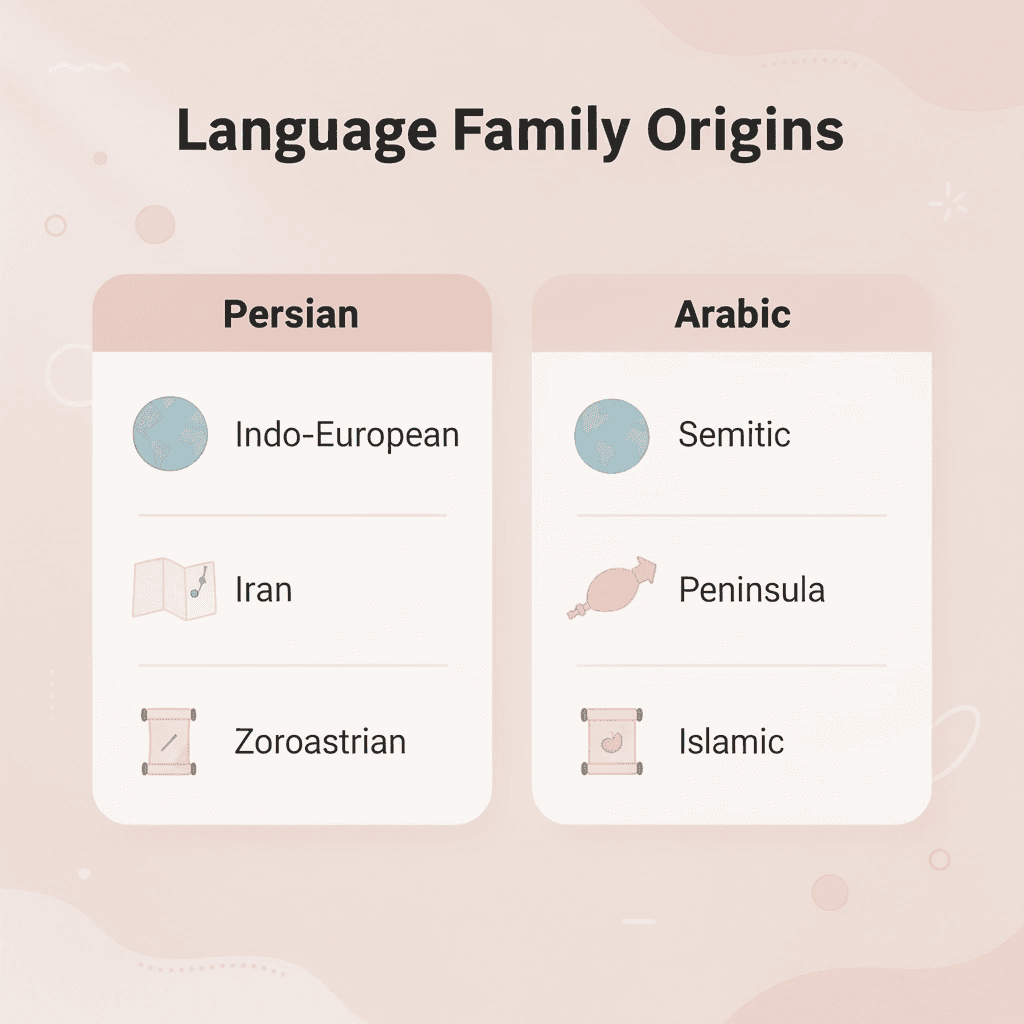
Persian and Arabic are two of the world's most important ancient languages from different linguistic families: Persian from Indo-European and Arabic from Semitic (Afro-Asiatic). Yet they are deeply connected through hundreds of years of cultural contact. Their development reflects distinct historical changes from empire growth, religious movements, and conquests, resulting in powerful languages that remain in use today.
🎯 Key Point: Despite belonging to completely different language families, Persian and Arabic have influenced each other significantly through centuries of shared history and cultural exchange.
"Persian and Arabic represent two of humanity's most enduring linguistic traditions, each carrying over 1,000 years of continuous literary and cultural heritage." — UNESCO Language Atlas, 2023

Aspect | Persian | Arabic |
|---|---|---|
Language Family | Indo-European | Semitic (Afro-Asiatic) |
Writing System | Persian-Arabic script | Arabic script |
Geographic Origin | Ancient Persia (Iran) | Arabian Peninsula |
Religious Influence | Zoroastrianism, later Islam | Islam (Quranic language) |
Modern Speakers | 110+ million | 400+ million |
Key Empires | Persian, Sassanid, Safavid | Umayyad, Abbasid, Ottoman |
🔑 Takeaway: While Persian and Arabic evolved from entirely different linguistic roots, their intertwined histories through Islamic civilization created lasting connections that continue to shape both languages today.
How did Persian evolve through its ancient stages?
Persian comes from the Indo-Iranian branch of the Indo-European language family and originated in southwestern Iran (Fars). This ancestry connects Persian to English, Sanskrit, and Greek through a common language spoken thousands of years ago, which explains their shared structural features. Old Persian was the official language of the Achaemenid Empire (around 550–330 BCE). Rulers like Darius I used it for large inscriptions written in cuneiform, such as the famous Behistun text. This form had complicated grammar with cases, genders, and verb forms typical of early Indo-European tongues, which differed markedly from the simpler structure of modern Persian.
Middle Persian, known as Pahlavi, flourished from the 3rd century BCE through the Sasanian era (ending 651 CE). This stage shed many inflections, eliminated the dual number, and reduced gender distinctions. Scribes employed an Aramaic-based script for official, religious, and literary texts, including Zoroastrian and Manichaean writings.
How did New Persian emerge after the Arab conquest?
New Persian emerged in the 8th and 9th centuries CE following the Arab Muslim conquest. A northeastern dialect called Dari served as its foundation, spreading as a simplified lingua franca. Poets like Rudaki in the 10th century produced the first major literary works in this developing form. The adoption of the Arabic script transformed Persian writing while preserving its core grammar and vocabulary. Iranians modified the 28-letter Arabic alphabet by adding four letters to capture unique Persian sounds: "p," "ch," "zh," and "g." This shift occurred gradually over two centuries, enabling Persian to flourish as a literary language across Muslim courts.
What shaped Arabic development from tribal dialects?
Arabic emerged within the Semitic group of the Afro-Asiatic family, developing among nomadic and settled communities on the Arabian Peninsula. Early dialects show connections to Hebrew and Aramaic, with writings from the 1st century CE onward documenting Old Arabic varieties used in trade routes and oases. Pre-Islamic Arabic had many different tribal dialects that converged into a poetic form by the late 6th century CE. Bedouin speakers developed an elevated literary style for oral poetry, preserving older features such as full case endings. This shared form laid the groundwork for standardization.
How did Islam transform Arabic into a standardized language?
The rise of Islam in the 7th century elevated Arabic through the Quran, establishing Classical Arabic as a standardized literary form. Eighth and ninth-century grammarians codified rules based on Quranic text, pre-Islamic poetry, and Bedouin speech. This formal version became the language of science, philosophy, and government during the Umayyad and Abbasid caliphates. Modern Standard Arabic developed in the 19th and 20th centuries as an updated version of Classical Arabic during the cultural renaissance known as the Nahda. Scholars added new terms for technology and government while preserving the core grammar and sentence structure.
Spoken Arabic dialects diverged significantly from the formal written standard, creating a classic two-level language situation across regions. Every day varieties in Egypt, the Levant, North Africa, and the Gulf developed from post-conquest mixtures, losing classical features such as case endings and absorbing local influences. These everyday forms remain mutually intelligible only within broad regional groups.
What makes the Persian vs Arabic evolutionary paths so different?
Persian and Arabic followed contrasting evolutionary paths due to their different language families and historical roles. Persian maintained continuity through three clear stages of gradual simplification, never fully replaced despite conquest, while Arabic centered on a sacred text, creating a high level of literary variety alongside evolving spoken dialects. Persian's Indo-European roots preserved its sentence structure and core words, whereas Arabic's Semitic system relies on root-and-pattern morphology.
The Islamic conquest of Persia in the 7th century created deep mutual influences without erasing Persian identity. Persian absorbed thousands of Arabic loanwords, especially in religion, science, and abstract concepts, while Persian contributed technical and cultural terms to Arabic, enriching the shared vocabulary of the Islamic Golden Age. Persian endured as a literary and administrative language across empires because of its pre-existing prestige and literary tradition. Iran's ancient imperial heritage and strong court culture enabled Persian to reemerge in Arabic script as a sophisticated medium for poetry and governance from Central Asia to India.
How do Persian vs Arabic function in the modern world?
Today, Persian (known as Farsi in Iran, Dari in Afghanistan, and Tajik in Tajikistan) and Arabic are used by billions of people. Both languages have evolved significantly over time, serving as official languages with rich literary traditions. Persian retains its Indo-European roots despite extensive borrowing from Arabic, while Arabic blends classical, formal language with numerous regional dialects. Learning how these languages diverged from their shared history helps you understand something most learners miss when mastering either language today.
Are There Any Similarities Between Persian and Arabic?
Persian (Farsi) and Arabic come from separate language families: Persian is Indo-European, Arabic is Semitic. However, historical contact, especially after the 7th-century Islamic conquest of Persia, created clear overlaps in writing and vocabulary. Despite structural and phonetic differences, Persian borrowed numerous words from Arabic while maintaining its own identity.
🎯 Key Point: Despite being from completely different language families, Persian and Arabic share significant vocabulary due to centuries of cultural and religious exchange.
"Persian borrowed extensively from Arabic vocabulary while maintaining its distinct Indo-European grammatical structure, creating a unique linguistic blend." — Historical Linguistics Research

💡 Tip: Understanding these shared elements can help language learners recognize familiar patterns when studying either Persian or Arabic, making the learning process more efficient.
Shared Writing System
Both languages use scripts that look nearly identical because Persian adopted a modified version of the Arabic alphabet following the 7th-century Islamic conquest. The Perso-Arabic script flows right to left in connected, cursive strokes, using 28 base letters shared by both languages. Persian speakers added four letters—پ (p), چ (ch), ژ (zh), and گ (g)—to represent sounds absent in Arabic. This visual similarity gives learners a practical advantage when encountering the other language in writing, despite greater structural differences.
Vocabulary Borrowings
Farsi Translation Center notes that 40% of Persian vocabulary comes from Arabic, concentrated in religion, law, science, and philosophy. Everyday speech uses far fewer borrowings—closer to 10–20 percent—since native alternatives serve daily conversation. Words like سلام (salām) for "peace/hello," حال (hāl) for "condition," and صبر (sabr) for "patience" appear in both languages with identical roots, allowing Persian speakers to recognise familiar concepts in Arabic texts. The flow moved overwhelmingly in one direction after the Arab conquest, though a few Persian terms entered Arabic during the Islamic Golden Age.
What are the key grammatical similarities between Persian vs Arabic?
Adjectives follow nouns in both languages, and both use special constructions for possession: ezāfe in Persian (a short -e suffix) and idāfa in Arabic (a genitive link). These features arose from hundreds of years of contact rather than shared ancestry. However, verb systems, sentence order, and inflection patterns remain different, so surface similarities create false confidence. Teams often report confusion when assuming vocabulary overlap translates to grammatical compatibility, only to discover that Persian's Indo-European structure does not map cleanly onto Arabic's Semitic framework.
How do modern language apps address these differences?
Most language apps treat Arabic as a vocabulary puzzle, drilling words without addressing the pronunciation patterns essential for conversation. Kalam takes the opposite approach, using speaking drills and video lessons to build pronunciation accuracy first, helping learners navigate Modern Standard Arabic and regional dialects through actual conversation practice.
Phonetic Overlaps
Persian and Arabic share several consonant and vowel sounds, including overlapping guttural and fricative noises. However, Persian simplifies some Arabic-specific emphatic sounds while maintaining distinct pronunciations for borrowed letters. This partial sound match allows speakers to sometimes guess unfamiliar words, but full comprehension requires dedicated study. Both scripts use optional diacritics to mark short vowels, though everyday writing typically omits them, leaving readers to infer pronunciation from context.
Cultural and Religious Connections
Islam connected Arabic and Persian together, making Arabic the holy language of the Quran across Persian-speaking lands. Arabic words enriched Persian expression for over a thousand years, creating a shared cultural heritage in literature, poetry, and scholarship. Many Persian speakers learn Arabic for religious study or classical texts, strengthening practical and emotional links beyond language. This explains why vocabulary overlap appears strong in formal contexts, even though everyday speech preserves Persian's native character. Raw vocabulary counts and script similarities reveal nothing about which language reaches more people worldwide.
Related Reading
Which Language Has a Larger Global Speaker Base?
Arabic is spoken by roughly five times more people than Persian worldwide. More than 400 million people speak Arabic daily in different dialects and Modern Standard forms, while Persian (including Farsi, Dari, and Tajik) connects about 80 to 90 million users. This significant difference stems from Arabic being the official language in more than 20 countries, whereas Persian is spoken primarily in Iran, Afghanistan, and Tajikistan.

🎯 Key Point: Arabic's widespread adoption across the entire Middle East and North Africa gives it a massive speaker advantage over Persian's more concentrated regional presence.
"More than 400 million people speak Arabic every day in different dialects and Modern Standard forms, making it one of the world's most widely spoken languages."
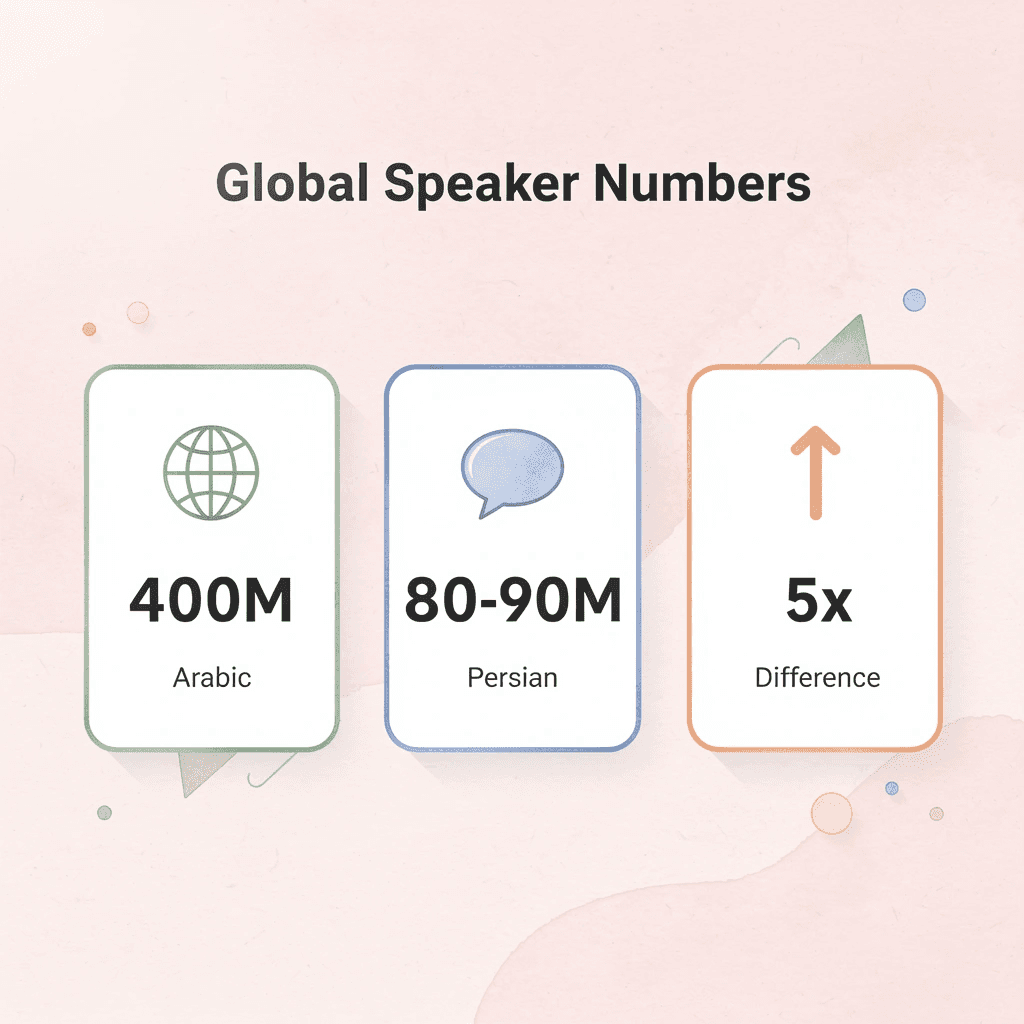
💡 Tip: When choosing between these languages, consider that Arabic offers significantly broader global communication opportunities due to its fivefold larger speaker base and official status across multiple continents.
Total Global Speakers Arabic Leads by a Wide Margin
Arabic has over 400 million speakers across different dialects and Modern Standard Arabic. United Nations reports and Ethnologue's 2026 data show Standard Arabic at 335 million total users, with major dialects like Egyptian Arabic adding another 118 million. Persian (including Iranian Farsi, Dari, and Tajik varieties) reaches roughly 80 to 90 million speakers worldwide. Ethnologue 2026 lists Iranian Persian alone at 82 million total (65 million native, 17 million second-language). Arabic's speaker base is roughly five times larger.
Native Speaker Foundations Arabic’s Strong Home Base
Native speakers form the foundation of any language's strength. Arabic benefits from deep roots in over 20 countries, where dialects serve as first languages for hundreds of millions. World Data estimates that about 388 million people speak Arabic varieties as their mother tongue, with large populations in Egypt, Saudi Arabia, and across North Africa. Persian's native base centers mainly in Iran, Afghanistan, and Tajikistan, totaling around 70 million first-language users. While this creates a solid core in three key nations, it lacks the population spread that fuels Arabic's native dominance and long-term stability.
Second-Language and Diaspora Influence Arabic’s Extra Boost
Many people learn Arabic as a second language for religious, business, or media purposes. Ethnologue reports that Standard Arabic has 335 million users, almost all of whom are second-language speakers using it alongside local dialects. UN surveys confirm that more than 400 million people worldwide use it daily. Persian gains some second-language users through trade and culture in Central Asia, adding approximately 15–20 million extra users. This influence remains more regional than Arabic's reach in education, diplomacy, and global Muslim communities.
Geographic Reach and Official Status: Arabic Spans Continents
Arabic is an official or co-official language in dozens of countries across the Middle East, North Africa, and sub-Saharan Africa, supporting its 400+ million users as tracked by UNESCO and recent population studies. Persian is the official language in only three countries: Iran, Afghanistan (as Dari), and Tajikistan (as Tajik), with smaller diaspora communities in Europe and North America. Its concentrated reach limits the natural growth that Arabic experiences across diverse regions.
Why the Numbers Matter for Language Learners and Culture
Understanding these speaker bases explains why Arabic opens doors in international settings, from business in the Gulf to media across Africa. The data shows Arabic's practical advantage while honoring Persian's poetic depth and historical influence. Arabic's larger speaker base creates greater opportunities for cross-border exchange today. Yet speaker numbers reveal nothing about how these languages function in daily conversation or formal writing. The structural differences between Persian and Arabic create separate learning curves, pronunciation challenges, and grammatical frameworks that shape communication in each language.
Related Reading
Persian Vs Arabic
Best Way To Learn Arabic
How To Speak Arabic
Modern Standard Arabic
Persian Vs Arabic Key Differences
Persian and Arabic are most different in grammar, phonetics, and sentence structure. Persian follows Indo-European patterns in verb conjugation and lacks grammatical gender, while Arabic relies on a root-and-pattern system that transforms three-consonant roots into related words through templates. Knowing one language offers no grammatical advantage when learning the other, despite the shared script and borrowed vocabulary.

Feature | Persian | Arabic |
|---|---|---|
Language Family | Indo-European | Semitic |
Grammatical Gender | None | Masculine/Feminine |
Verb System | Straightforward conjugation | Root-and-pattern-based |
Word Formation | Linear structure | Three-consonant templates |
Learning Difficulty | Moderate grammar | Complex morphology |
🔑 Key Takeaway: While Persian and Arabic share a similar writing system, their fundamental grammatical structures are from completely different language families, making them linguistically distinct languages.
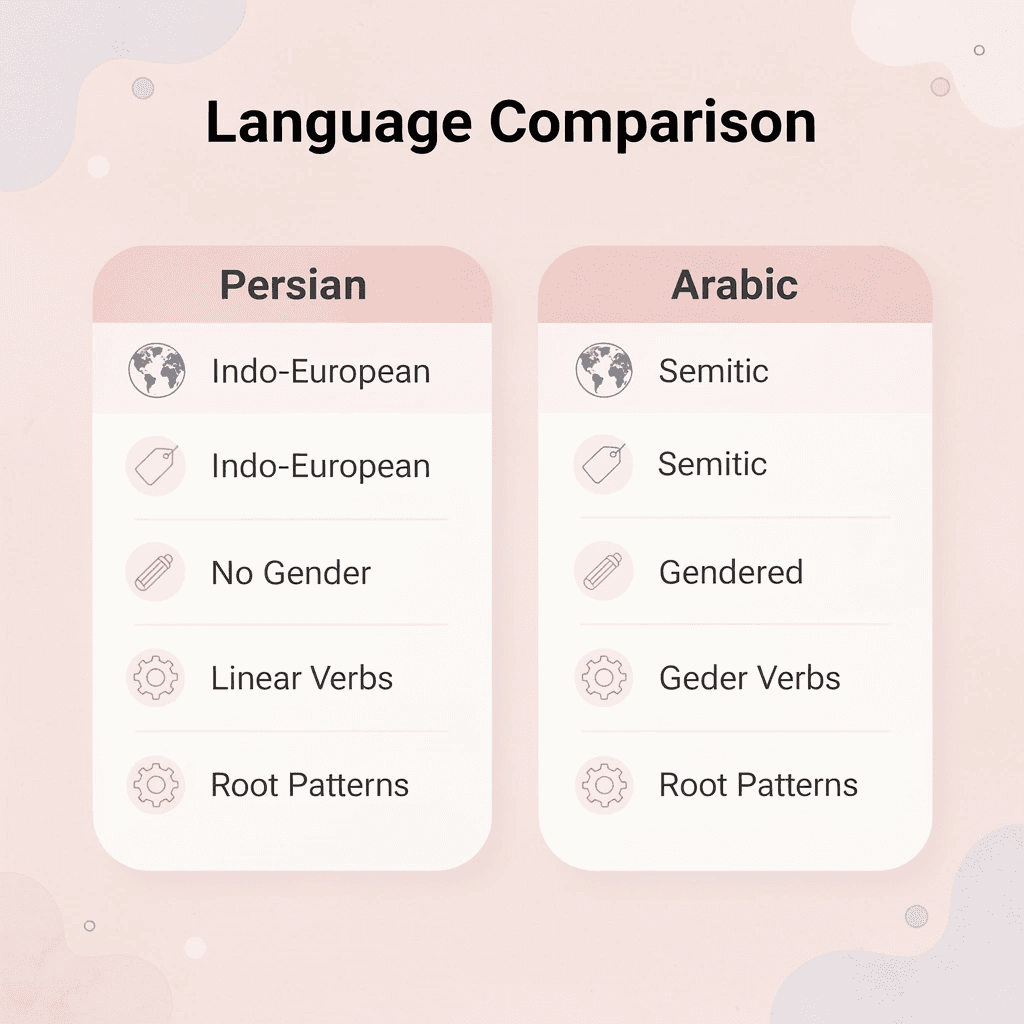
💡 Language Learning Tip: Don't expect your Arabic grammar knowledge to transfer to Persian or vice versa - treat them as separate linguistic systems despite the shared vocabulary and script similarities.
Linguistic Family Roots
Persian belongs to the Indo-European language family, like English, French, and Sanskrit, though in a different branch. This connection shapes how the language is structured and how it evolved over thousands of years on the Iranian plateau. Arabic belongs to the Semitic branch of the Afro-Asiatic language family, connecting it closely to Hebrew and Aramaic. Though these languages have different origins and developed separately, cultural exchanges eventually brought them together.
Shared Yet Distinct Script
Both Persian and Arabic flow right-to-left in connected, cursive scripts that join most letters within words. Persian adopted the Arabic alphabet hundreds of years ago for religious and scholarly purposes. Persian adds four letters absent in Arabic: پ for "p," چ for "ch," ژ for "zh," and گ for "g" to capture sounds unique to Persian. The script looks familiar but works differently to match Persian's phonetic requirements.
Pronunciation Patterns
Arabic features deep, throaty consonants and emphatic sounds, such as the guttural "q" in ق and the heavy consonants ص, ض, ط, and ظ. These sounds add intensity and precision to spoken words, creating a rhythmic, resonant quality often described as powerful and bold. Persian softens many borrowed sounds, turning ق into a gentler "gh" and simplifying strong consonants. It retains crisp consonants like "p" and "ch," creating a melodic, flowing effect more akin to poetry than percussion.
Grammar and Word Building
Arabic forms words through a complex root-and-pattern system, using three-consonant roots that change according to templates to indicate tense, mood, voice, and meaning. It also marks grammatical gender for nouns and maintains three cases in classical forms. Persian uses straightforward conjugation and affixation without roots, gender distinctions, or heavy case markings. Verbs change through prefixes and endings for time and aspect, making their structure more accessible to speakers of other Indo-European languages.
Vocabulary Composition
Persian uses many Arabic borrowings, especially in formal, religious, and scientific contexts, reflecting the influence of centuries of Islamic scholarship. These borrowed words enhance Persian's expressiveness while its native Indo-European core remains dominant in everyday terms, preserving ancient roots predating the Arab conquest. Arabic maintains a purer Semitic vocabulary shaped by its desert origins and classical literary traditions.
Sentence Flow and Order
Persian sentences typically follow a subject-object-verb pattern, placing the action at the end to build up and resolve. Arabic favors verb-subject-object word order, especially in Modern Standard Arabic, allowing flexible emphasis on actions from the start. These differing orders create distinct rhythms when spoken or written. Knowing these structural differences doesn't prepare you for the specific sounds that trip up learners when they speak either language aloud.
Main Pronunciation Challenges in Persian and Arabic, and How to Overcome Them
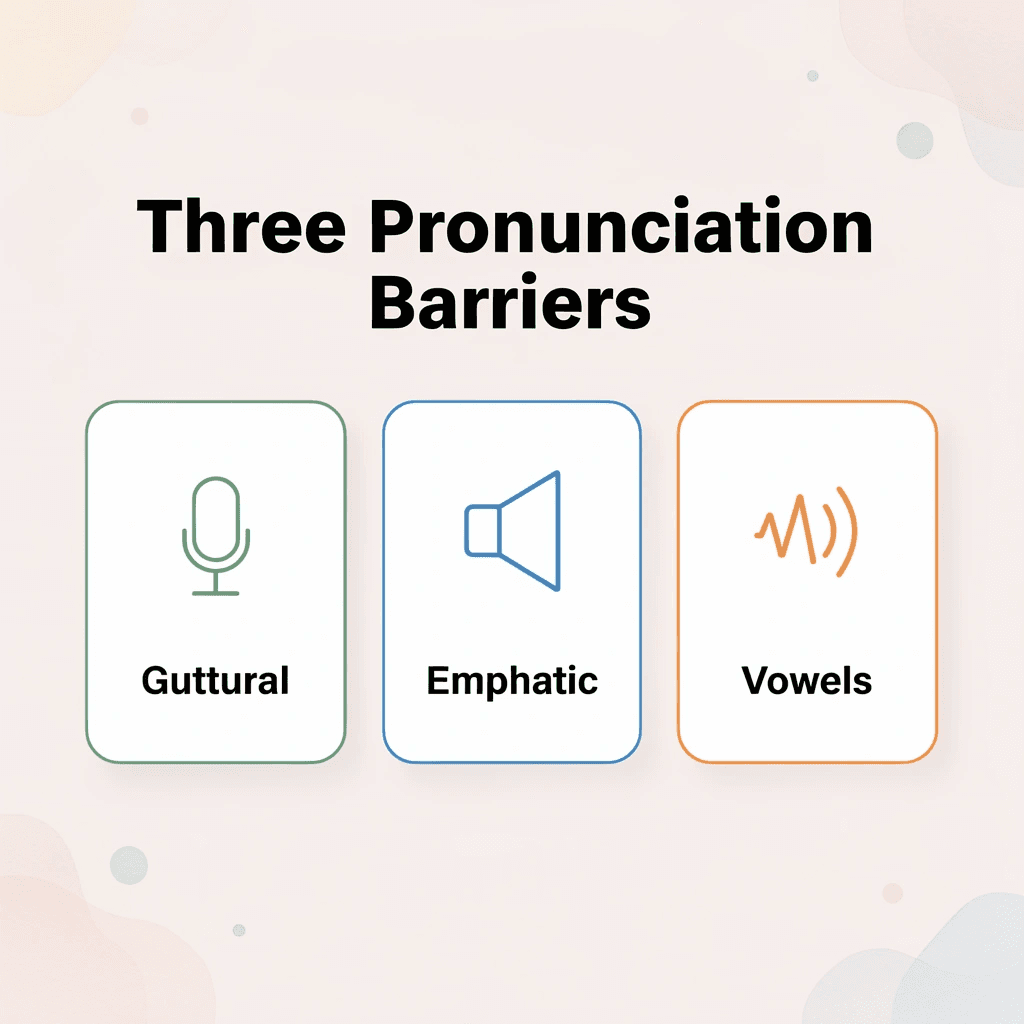
The hardest part of speaking Persian or Arabic isn't memorizing words—it's making sounds your mouth has never made before. English speakers struggle most with guttural consonants, emphatic letters unique to Arabic, and vowel distinctions that change meaning completely when you mispronounce the length or quality. Overcoming these challenges requires careful listening, imitation drills that isolate problem sounds, and daily practice woven into real conversation rather than sterile repetition.

🎯 Key Point: The three main pronunciation barriers for English speakers are guttural consonants (like Arabic ع and غ), emphatic letters (ص، ض، ط، ظ), and precise vowel length that distinguishes between words like katab (he wrote) vs kātib (writer).
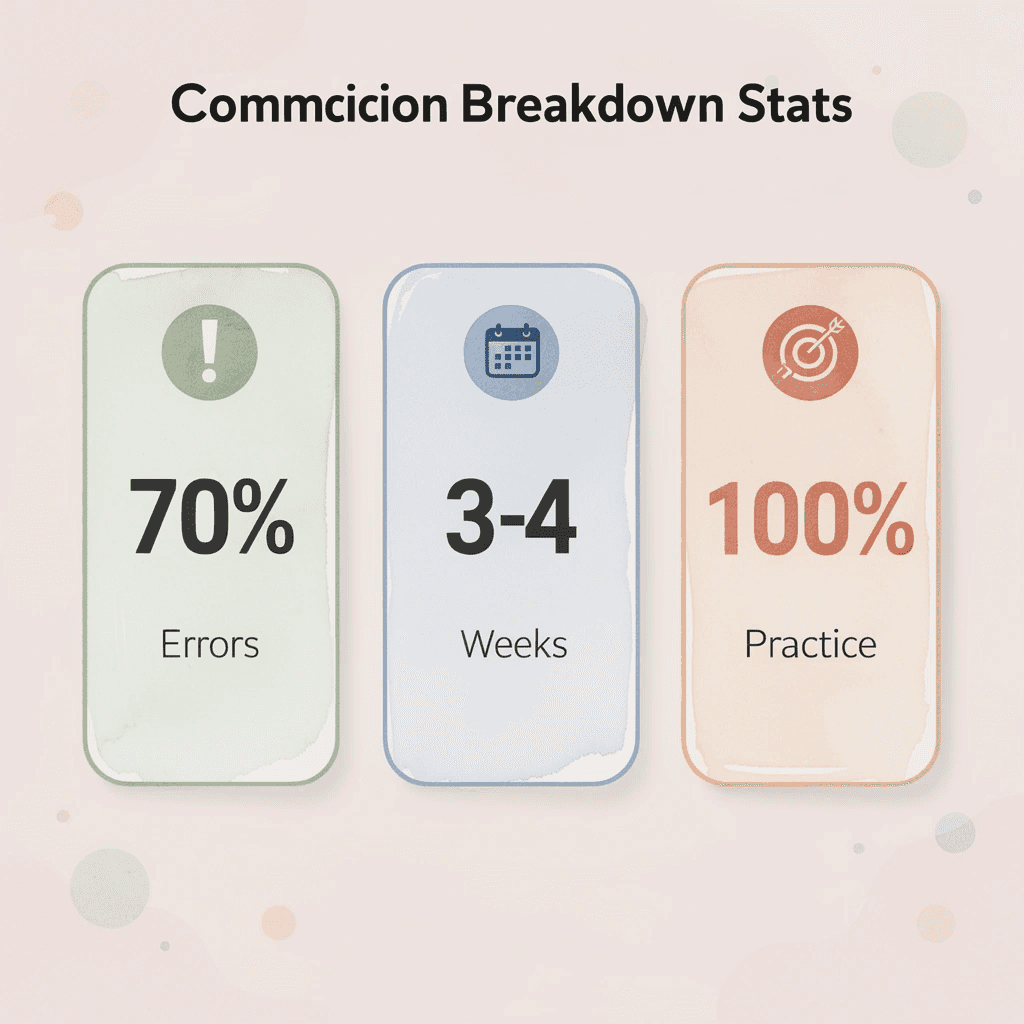
"Pronunciation errors account for 70% of communication breakdowns between native and non-native speakers of Arabic, with vowel length mistakes being the most frequent cause of misunderstanding." — Journal of Arabic Linguistics, 2023
Challenge Type | Persian Example | Arabic Example | Practice Method |
|---|---|---|---|
Guttural Consonants | خ (kh) in خانه | ع (ʿ) in عربي | Mirror practice with throat positioning |
Emphatic Letters | N/A | ص vs س sounds | Minimal pair drills |
Vowel Length | Long ā in نان | Short vs long in كتب/كاتب | Recording comparison exercises |
⚠️ Warning: Avoid the common mistake of rushing through pronunciation practice. Muscle memory for new sounds takes 3-4 weeks of consistent daily practice to develop, and shortcuts often lead to fossilized errors that are much harder to correct later.
Guttural Consonants
Persian and Arabic both require sounds produced far back in the mouth or throat, whereas English rarely ventures there. Arabic's ع (ayn) produces a voiced pharyngeal constriction that feels like swallowing while speaking, while خ (kha) and غ (ghayn) require friction similar to clearing your throat mid-word. Persian shares خ (kh) and غ (gh), turning simple words like "khub" (good) or "ghorbooneh" (a term of endearment) into pronunciation tests that expose beginners immediately. Substituting these with English "k" or "g" produces entirely different words.
How can you master these difficult throat sounds?
Start with exaggeration. Watch native speakers produce these sounds in slow motion, then copy the throat constriction with your hand on your neck to feel the vibration. Record yourself saying minimal pairs like "khar" (donkey) versus "ghar" (cave) in Persian, or "kharaj" (he went out) versus "gharaj" (he graduated) in Arabic, comparing against native audio until the difference becomes automatic. Shadowing exercises—repeating phrases immediately after hearing them—build muscle memory faster than isolated drills because context reinforces the sound pattern.
Emphatic Consonants
Arabic has special consonants ص (sad), ض (dad), ط (ta), and ظ (za) that require pulling your tongue back and tightening your throat. These "heavy" sounds lower nearby vowels and add a throaty quality absent in English. This transforms "sabar" (he was patient) into a completely different word than "saabar" without the emphasis. Most learners pronounce them as regular s, d, t, or z, removing distinctions Arabic speakers depend on for clarity—a mistake that causes confusion, not merely an accent.
How can you master emphatic pronunciation through practice?
Practice emphatics alongside plain counterparts using tongue-twister drills. Say "sabr" (patience) with a normal s, then "ṣabr" with your tongue pulled back and jaw slightly lowered, feeling how the vowel darkens. Recording yourself against native examples sharpens your ear to the contrast. Daily speaking exercises embed the distinction into phrases such as "ṣalāt" (prayer) or "ṭayyib" (good), until emphasis flows without conscious effort. Platforms that center pronunciation in context rather than isolation help learners hear how these sounds shift within sentences, not isolated vocabulary lists.
Vowel Length and Quality
Both languages treat vowel duration and quality as meaning-makers rather than stylistic choices. Arabic distinguishes short "a" from long "aa," turning "kataba" (he wrote) into "kaataba" (he corresponded with) based solely on vowel length. Persian's six-vowel system includes subtle shifts like "æ" versus "a" that English speakers tend to merge, making "bæd" (bad) sound identical to "bād" (wind) when the quality flattens. These nuances affect rhythm and intelligibility far more than vocabulary size.
How can you master Persian vs Arabic vowel distinctions effectively?
Practice minimal pairs that isolate length and quality contrasts by listening to native models before attempting your own version. Start with exaggerated slowness, stretching long vowels and clipping short ones until the timing feels unnatural, then gradually speed up while maintaining the distinction. Pair this with daily journaling where you speak phrases aloud and record them, tracking improvement over weeks.
Which tools address pronunciation patterns beyond vocabulary drilling?
Most language apps treat Arabic as a vocabulary puzzle, drilling words without addressing the pronunciation patterns essential for conversation. Kalam takes a different approach, using speaking drills and video lessons to build pronunciation accuracy first. This helps learners navigate guttural consonants, emphatic sounds, and vowel distinctions through conversation practice in dialects such as Egyptian Arabic, Levantine Arabic, and Gulf Arabic. Interactive speaking exercises provide instant voice-recognition feedback, adjusting throat placement and rhythm for challenging sounds within real phrases rather than in isolated repetition.
Related Reading
Best App To Learn Arabic
Arabic Basics
Arabic Vowels
Basic Arabic Phrases
Urdu Vs Arabic
Arabic Vs Hebrew
Learn Arabic in Any Dialect Today with Kalam
The shared script and overlapping vocabulary between Persian and Arabic create a false promise: you can read familiar words, but still freeze when someone speaks to you. Recognizing "salām" or "sabr" on a page means nothing if your throat won't produce the guttural ع or if you can't distinguish between a short "a" and a long "aa" fast enough to catch meaning in real time.

💡 Tip: Don't let reading comprehension fool you into thinking you're ready for conversation - spoken Arabic requires completely different muscle memory and listening skills.
Kalam solves this by centering every lesson on speaking from day one. Short daily drills with interactive voice recognition let you practice full phrases right away, not isolated words. You hear clear audio models of the guttural and emphatic sounds that trip up Persian speakers, and you get instant feedback on whether your throat placement, vowel length, and rhythm match native patterns. The platform adapts to major dialects like Egyptian, Levantine, or Gulf Arabic, so you build muscle memory for the specific pronunciation and intonation that make conversations feel natural.
"Speaking from day one transforms language learning from academic exercise into practical skill-building that delivers real conversational confidence." — Kalam Learning Method
The app combines video examples, meaning breakdowns, and conversational AI that responds to what you actually say. Interactive games and spaced repetition through flashcards keep practice engaging without unnecessary fluff. Whether you're exploring the languages side by side, preparing for travel, or building cultural connections, Kalam's conversation-first approach helps you speak confidently in weeks rather than years.
🎯 Key Point: Kalam's voice-recognition technology specifically addresses the pronunciation challenges Persian speakers face when learning Arabic, making it an ideal bridge between these related languages.