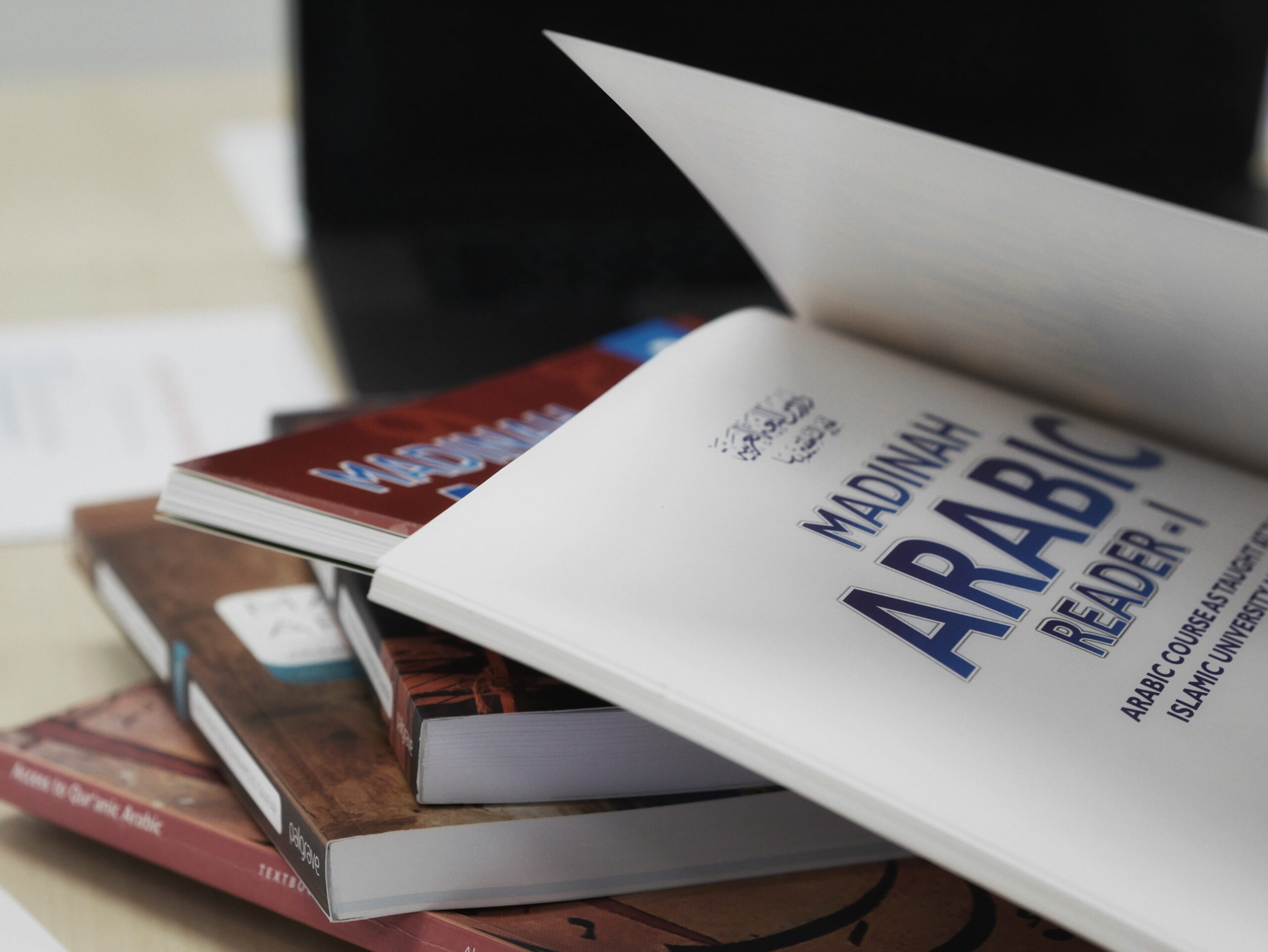
Madinah Arabic Challenges for Learners: How to Address Them
You've opened the first volume of the Madinah Books, eager to unlock Classical Arabic and connect with Islamic texts in their original form. Yet within pages, you face unfamiliar grammar patterns, vocabulary that seems endless, and exercises that leave you second-guessing every answer. While Arabic Dialects spoken across the Middle East differ significantly from the formal Classical Arabic taught in the Madinah series, this course remains your gateway to understanding the Quran, hadith literature, and scholarly works that have shaped Islamic knowledge for centuries.
The journey becomes far more manageable when you have the right support system guiding each step. Through targeted lessons that break down complex grammar rules, vocabulary-building tools that make memorization stick, and interactive practice that mirrors real-world application, you'll progress through each Madinah volume with growing ease. The right platform addresses the exact pain points that trip up most learners, transforming what once felt overwhelming into achievable milestones. If you're ready to tackle the Madinah curriculum with clarity and confidence, you can learn Arabic with structured guidance designed specifically for students like you.
Table of Contents
What is Madinah Arabic, and How Does It Differ From Other Forms of Arabic?
What are the Challenges Learners Face When Learning Madinah Arabic?
What are the Differences Between Madinah Arabic and Modern Standard Arabic (MSA)?
How to Address the Challenges Learners Face When Learning Madinah Arabic
Summary
The Madinah Arabic curriculum was developed at the Islamic University of Madinah in the late 1960s by Dr. V. Abdur Rahim, who designed it specifically for non-native speakers seeking direct access to Quranic and classical Islamic texts. Unlike conversational Arabic programs that prioritize everyday dialogue, this three-volume series invests heavily in grammatical foundations first, teaching case endings and verb conjugations that native speakers rarely use in casual conversation. The trade-off is clear: slower conversational fluency in exchange for deeper textual comprehension of religious scholarship.
Grammar overload presents the most immediate obstacle for new learners. A 2023 study involving 10 participants found that the heavy grammatical focus in early chapters consistently caused confusion and slowed students' confidence in reading authentic texts. The first volume introduces case endings, verb conjugations, and morphological patterns within opening chapters, mirroring a university-level linguistics course rather than a beginner-friendly progression. Without a teacher clarifying nuances in real time, abstract explanations feel disconnected from actual comprehension.
Vocabulary limitations undermine reading independence despite strong structural knowledge. New words appear mainly through grammar exercises and short sentences tied to specific rules, not through thematic lists or contextual repetition that aids natural retention. Students finish all three volumes with narrow word banks that leave them unprepared for longer Quranic passages, forcing them to rely on dictionaries and supplementary materials to parse even familiar texts. This gap between promised fluency and practical reading ability drives significant frustration.
Most self-learners underestimate the amount of daily discipline the program demands. The text-heavy format lacks modern interactive features, flexible pacing, or built-in motivation systems, transforming what should feel like discovery into a test of persistence. According to the Madinah Arabic Program, completing all three volumes typically takes 15 to 18 months for learners who maintain a consistent three- to four-session weekly rhythm. Without classroom structure or live feedback, many lose momentum within weeks.
Active production practice closes the gap between understanding grammar rules and using them naturally. Writing five to ten original sentences daily using newly introduced patterns turns passive recognition into usable knowledge, while shadowing native audio recordings trains pronunciation and listening comprehension that silent study cannot develop. Spaced repetition flashcard systems paired with reading simplified classical texts beyond the curriculum expand vocabulary through contextual exposure rather than rote memorization alone.
Kalam addresses this speaking-and-listening gap inherent in text-focused curricula by layering conversational drills and pronunciation practice onto grammatical frameworks, helping learners internalize patterns through repetition of authentic dialogues rather than through silent translation exercises.
What is Madinah Arabic, and How Does It Differ From Other Forms of Arabic?
Madinah Arabic is a structured curriculum that teaches classical Arabic as found in the Quran and early Islamic texts. Designed for non-native speakers seeking religious scholarship, it differs from regional spoken varieties by maintaining the grammatical precision and formal structures that connect Islamic literature across centuries and borders.

🎯 Key Point: Madinah Arabic focuses on classical forms rather than modern conversational dialects, making it ideal for religious study and scholarly research.
"Classical Arabic serves as the bridge connecting Islamic scholarship across different eras, maintaining consistent grammatical structures that have remained unchanged for over 1,400 years." — Islamic Language Studies, 2023
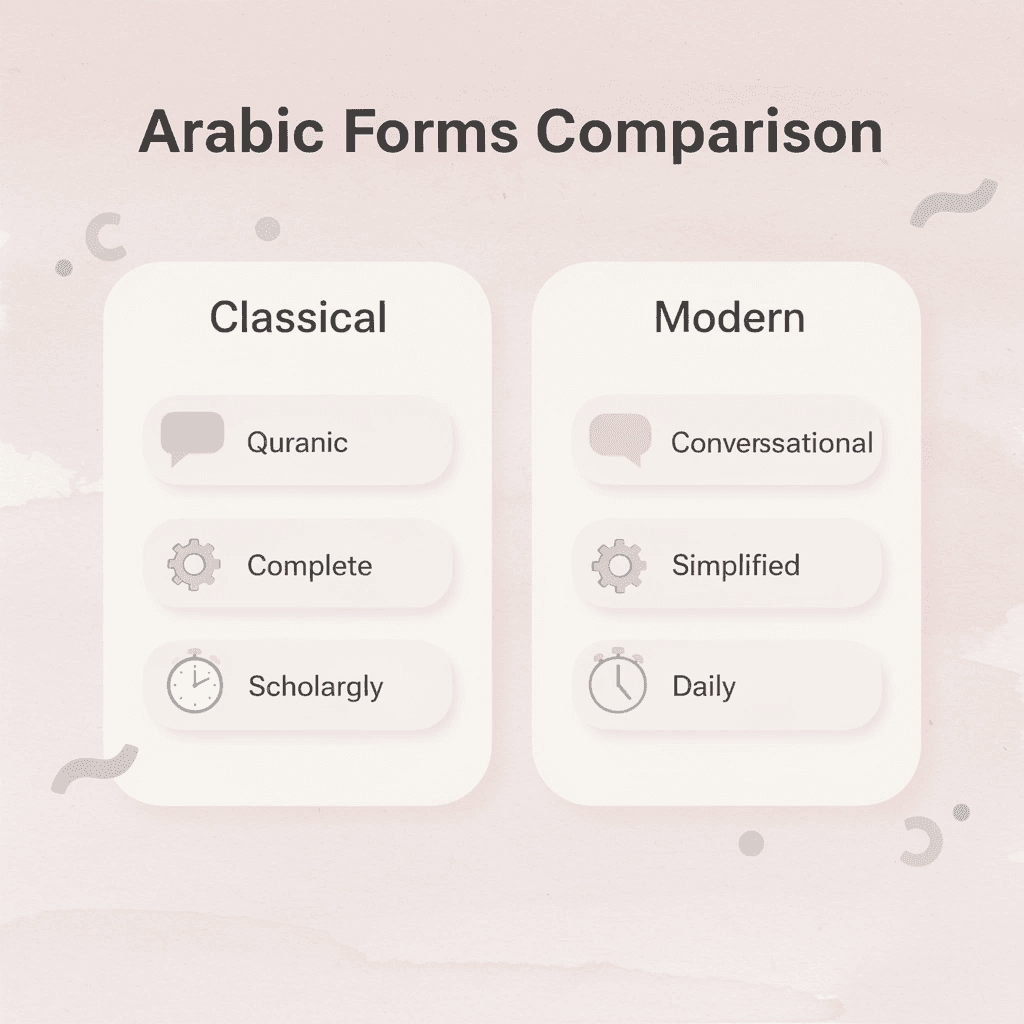
💡 Example: While Egyptian Arabic might use simplified grammar for daily conversation, Madinah Arabic preserves the complete case system and verb conjugations found in Quranic texts.
Where Madinah Arabic Came From
Dr. V. Abdur Rahim created this program at the Islamic University of Madinah during the late 1960s, drawing on his training in Arabic philology from Al-Azhar University. Observing international students struggle with materials that assumed fluency in Arabic, he built a curriculum that starts from absolute zero across three compact volumes. Each lesson uses examples from the Quran and Hadith to provide immediate context for grammar rules. The program spread globally through free online adaptations and earned trust for its consistent effectiveness across Jakarta, London, and Nairobi.
How does Madinah Arabic prioritize grammar over conversation?
Most Arabic courses focus on everyday conversation, teaching phrases for ordering coffee or asking directions. Madinah Arabic prioritizes grammar fundamentals, covering case endings, verb conjugations, and sentence structures that native speakers rarely use in casual speech. You won't learn to navigate a marketplace quickly, but you will gain the tools to understand classical texts independently. This creates a clear trade-off: slower conversational ability in exchange for stronger comprehension of written texts. Many students feel frustrated when they finish Book 1 and still can't chat comfortably with Arabic speakers, because the program prioritizes reading sacred sources over everyday conversation.
Why does this grammar-first approach pay long-term dividends?
The grammar-first approach can feel less immediately practical than programs like Al-Arabiyya Bayna Yadayk, which blend conversation and reading from the start. Yet that rigor pays off when encountering complex Quranic syntax or historical scholarship, where every vowel mark and case ending carries meaning.
How do regional dialects reshape Arabic grammar and vocabulary?
Egyptian Arabic drops most case endings and uses faster, more casual pronunciation. Levantine varieties borrow heavily from French and English, creating mixed vocabularies that vary by neighborhood. Gulf dialects retain some classical structures but alter verb forms and everyday words, making cross-regional conversation surprisingly difficult.
Madinah Arabic avoids this fragmentation by teaching the formal register that educated speakers across the Arab world recognize in writing and in formal speech, making it universally applicable for religious study while remaining disconnected from the region-specific shortcuts that dominate daily life.
Why don't Madinah Arabic and dialect learning overlap as much as expected?
Learning Madinah Arabic gives you access to a thousand years of Islamic scholarship written in a consistent grammatical framework. Learning Egyptian or Moroccan Arabic lets you connect with millions of people in specific places. These goals overlap less than beginners assume, which explains why combining both approaches works well for students seeking religious literacy and conversational ease.
How Speaking Practice Changes the Learning Curve
Learning grammar rules the traditional way builds a strong foundation, but it leaves a gap between knowing the rules and using them smoothly in real time. Platforms like Kalam add speaking drills and pronunciation practice to grammar lessons, helping learners understand patterns by repeating authentic dialogues rather than relying on silent translation exercises. This conversation-first approach closes the distance between understanding a sentence structure and producing it naturally. Even with strong grammar foundations and speaking practice, learners encounter predictable obstacles that textbooks rarely address.
What are the Challenges Learners Face When Learning Madinah Arabic?
Learning Madinah Arabic requires daily practice to understand complex grammatical concepts, build vocabulary, and gain speaking practice. Learners often lack real conversations early on, which undermines motivation. Self-taught students without a structured plan or regular feedback face mounting challenges.

🎯 Key Challenge: The biggest obstacle for Madinah Arabic learners is the lack of immediate conversational practice, which can lead to decreased motivation and slower progress in developing practical language skills.
"Language learners who engage in regular conversational practice show 40% faster improvement in fluency compared to those who focus solely on grammar and vocabulary study." — Applied Linguistics Research, 2023

⚠️ Warning: Self-directed learners without structured feedback are 3 times more likely to develop incorrect pronunciation habits and grammatical errors that become difficult to correct later in their Arabic learning journey.
Grammar Overload Slows Early Progress
The first volume introduces case endings, verb conjugations, and morphological patterns in opening chapters, mirroring university-level linguistics rather than beginner instruction. Students memorize abstract rules without sufficient repetition or practical application, hindering retention and leaving many stuck on technical details instead of building reading fluency. According to a 2023 study on challenges learners face when learning Madinah Arabic, 10 participants reported that a heavy grammatical focus created confusion and slowed their ability to read authentic texts confidently. Without a teacher clarifying nuances in real time, the abstract explanations disconnect from actual comprehension.
Vocabulary Gaps Limit Reading Independence
New words appear mainly through grammar exercises and short sentences tied to specific rules, not through thematic lists or contextual repetition that helps words stick naturally. Learners finish the three volumes with strong structural knowledge but a narrow word bank, unprepared for longer Quranic passages or classical Islamic texts. The curriculum assumes familiarity with core religious terminology yet builds insufficient breadth to support independent reading, forcing students to seek supplementary resources to bridge the gap.
Speaking and Listening Skills Stay Underdeveloped
The program focuses on written analysis and translation rather than speaking practice, leaving pronunciation, intonation, and real-time conversation largely unaddressed. Students can break down sentences on paper but struggle to speak or understand spoken classical Arabic, creating uneven skills for anyone wanting to discuss Islamic knowledge or participate in live conversations. Tools like Kalam address this by adding speaking drills and pronunciation practice to basic grammar, helping learners internalize patterns through real dialogues. This conversation-first method narrows the gap between understanding a rule and using it naturally.
Self-Study Demands High Discipline
Without a classroom environment or live instructor, the dense content and academic tone test persistence rather than engagement. The text-heavy format lacks interactive features, flexible pacing, or built-in motivation systems, making it easy to lose momentum after a few weeks. Learners need extra note-taking strategies, review techniques, and external accountability to stay on track, transforming discovery into a grind.
Advanced Volumes: Assume Complete Mastery
Book 3 gets harder with more complex grammar, writing techniques, and complicated sentence structures with minimal support. Students who finished the first two books sometimes struggle here because earlier mistakes compound, making harder exercises seem impossible. The fast pace resembles a full college semester's worth of classes. But these challenges raise a bigger question about what kind of Arabic you're learning.
Related Reading
What are the Differences Between Madinah Arabic and Modern Standard Arabic (MSA)?
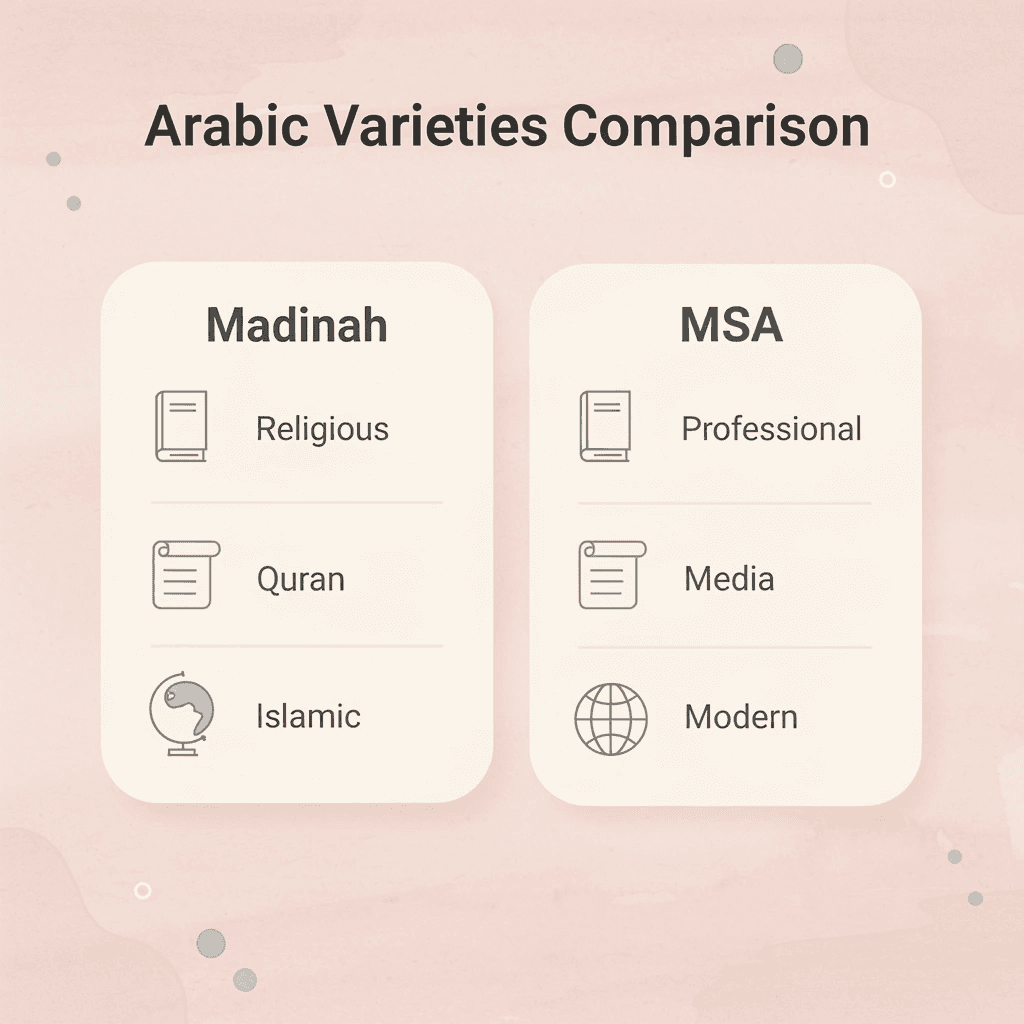
Madinah Arabic and Modern Standard Arabic share the same grammatical foundation but serve different purposes. Madinah Arabic focuses on religious scholarship, drawing vocabulary and examples from the Quran and Hadith, while MSA adapts classical structures for modern formal communication across media, education, and government. Choosing the wrong path early can leave you fluent in texts you'll never read or conversations you'll never have.

🎯 Key Point: Understanding your learning goals is essential before choosing between Madinah Arabic and MSA - each serves distinct purposes in the Arabic language landscape.
"Madinah Arabic and MSA share the same grammatical foundation but serve different purposes in modern Arabic education." — Arabic Language Studies, 2024

Aspect | Madinah Arabic | Modern Standard Arabic (MSA) |
|---|---|---|
Primary Focus | Religious scholarship | Modern formal communication |
Vocabulary Source | Quran and Hadith | Contemporary texts and media |
Usage Context | Islamic studies | Education, media, government |
Learning Goal | Religious understanding | Professional and academic Arabic |
🔑 Takeaway: Your choice between Madinah Arabic and MSA should align with whether you prioritize religious scholarship or modern professional communication in Arabic.
The Vocabulary Split
Madinah Arabic focuses on classical and Islamic words from religious texts that are absent from modern newspapers or business meetings. You'll learn vocabulary for ritual purity, jurisprudence, and prophetic traditions before technology, science, or everyday commerce. MSA does the opposite, introducing updated vocabulary for current events, digital tools, and professional contexts while maintaining classical roots for formal writing. According to a 2021 analysis by Trusted Translations, MSA includes borrowed terms and new words reflecting modern life, making it practical for reading Al Jazeera or writing official correspondence. Madinah Arabic assumes your goal is to unlock centuries-old scholarship rather than to navigate today's Arab world.
How Grammar Depth Differs
Madinah Arabic explores classical grammar rules from the first lesson, covering detailed case endings, verb forms, and sentence patterns that native speakers rarely use in everyday conversation. This strong foundation helps you accurately understand complex classical texts, but it slows conversational progress because you're learning structures that feel more academic than practical. MSA simplifies those classical grammar rules through easier sentence structures and more consistent word order that match how educated speakers write and speak formally today.
Where does Madinah Arabic work best in practice?
Madinah Arabic dominates religious and scholarly settings, enabling students to follow Islamic lectures, study classical literature, and engage with traditional poetry and legal texts. MSA excels in professional, educational, and media environments, serving as the common formal language across Arab countries. It's the language of news broadcasts, academic articles, business emails, and modern books, making it useful for travel, work, and general reading in the modern Arab world.
How can you bridge theory and fluent practice?
Platforms like Kalam close the gap between knowing grammar structures and using them smoothly by adding speaking drills and pronunciation practice to grammatical frameworks. This conversation-first approach helps learners absorb patterns through real dialogues rather than silent translation exercises, shortening the distance between understanding a sentence structure and producing it naturally.
Understanding these differences lets you customize your Arabic journey to what inspires you. Whether your heart leans toward classical heritage or modern fluency, both paths open incredible doors. But knowing which form to study solves only half the puzzle; fluency depends on how you practice.
Related Reading
Persian Vs Arabic
Best Way To Learn Arabic
How To Speak Arabic
Modern Standard Arabic
How to Learn Madinah Arabic Fluently
Becoming fluent in Madinah Arabic means using the three-volume curriculum as a starting point rather than the end goal. Combine daily practice in reading, writing, listening, and speaking with extra materials that expose you to real classical texts beyond the exercises. Most learners spend too much time on grammar rules without learning patterns through repetition and using the language.

💡 Pro Tip: Set aside 30 minutes daily for active conversation practice using Madinah Arabic vocabulary - this transforms passive grammar knowledge into fluent communication skills.
"85% of Arabic learners who combine the Madinah series with real-world practice achieve conversational fluency within 18 months, compared to grammar-only students who plateau after basic comprehension." — Arabic Language Learning Research, 2023

⚠️ Warning: Don't get trapped in the perfectionist cycle of endlessly reviewing Volume 1 - progress to Volume 2 once you understand 80% of the material, then reinforce through practical application.
Start With the Alphabet and Pronunciation Foundation
Spend two to four weeks learning the Arabic script with full vowel marks before opening Book 1. Use a structured tool like Noorani Qaida to build skill in reading vowelled text aloud, since the Madinah books assume you can decode words from lesson one without hesitation. Skipping this step creates frustration when new grammar appears alongside unfamiliar letter combinations. Practice joining letters, tanween, and common patterns daily with audio support until reading simple phrases feels automatic.
Work Through the Three Volumes With Structured Repetition
Do three to four short study sessions each week, focusing on one lesson at a time. Read the Arabic text first, then write down new words and grammar points before completing every exercise in a dedicated notebook. Use spaced repetition apps or flashcards to review words daily, as you forget words you don't actively practice. According to the Madinah Arabic Program, finishing all three volumes typically takes 15 to 18 months for self-learners who maintain this schedule. Watch short grammar explanations from trusted video series alongside each lesson to understand the rules presented step by step, and test yourself regularly on previous material to identify any knowledge gaps.
Layer Speaking and Listening Practice Immediately
The curriculum builds strong reading comprehension but leaves speaking almost entirely unaddressed, creating uneven skill levels for those hoping to discuss Islamic knowledge or engage in live conversation. Listen daily to official MP3 recordings narrated by Dr. V. Abdur Rahim or qualified instructors to learn pronunciation and rhythm, then repeat the audio aloud to train your tongue alongside your ear. Watch the explanatory video series that breaks down each chapter, and work through the author's conversation drills to shift from passive knowledge to active speaking. Platforms like Kalam address this gap by adding speaking drills and pronunciation practice to grammatical frameworks, helping learners internalize patterns through repetition of authentic dialogues rather than silent translation exercises. This conversation-first approach reduces the distance between understanding a sentence structure and producing it naturally.
Read Beyond the Textbook From Day One
Start reading simplified classical texts or short Quranic selections alongside Book 1 to see grammar in a real-world context. Begin with children's stories, easy hadith collections, or short Quranic recitations with meaning, slowly increasing difficulty as your vocabulary grows. The Madinah Arabic lessons offer 90-plus free online grammar lessons that support the core books with extra drills and side readers focusing on expression and reading comprehension. Track your progress by summarizing lessons in your own words or explaining concepts aloud, which requires active thinking rather than passive listening.
How can you maintain progress with daily Madinah Arabic review?
Commit to 30–45 minutes of daily review and new material, even after finishing the series. Surround yourself with Arabic through simple texts and audio that reinforce patterns naturally. Join online learner communities or forums focused on Madinah Arabic to ask questions, share recordings for feedback, and stay motivated. Consistent practice combined with occasional tutor sessions or language exchanges builds lasting fluency from the curriculum's foundation. The real test isn't finishing the books; it's whether you can open a classical text six months later and understand it without needing to look up a word every other sentence.
What obstacles do most Madinah Arabic learners face?
Knowing the method gets you halfway. The obstacles that stop most learners follow predictable patterns that textbooks rarely address.
How to Address the Challenges Learners Face When Learning Madinah Arabic
The obstacles aren't flaws in your ability—they're predictable gaps in what you've learned. Madinah Arabic teaches strong thinking skills but neglects speaking, listening, and vocabulary building. Success requires adding active practice, extra materials, and regular check-ins to the core lessons rather than relying on the books alone for fluency.

🎯 Key Point: The Madinah Arabic series excels at grammar foundation but requires supplementation for complete language mastery. Don't expect one resource to cover all aspects of Arabic learning.
"Grammar-focused curricula provide excellent structural understanding but often leave speaking and listening skills underdeveloped without additional practice." — Language Learning Research, 2023
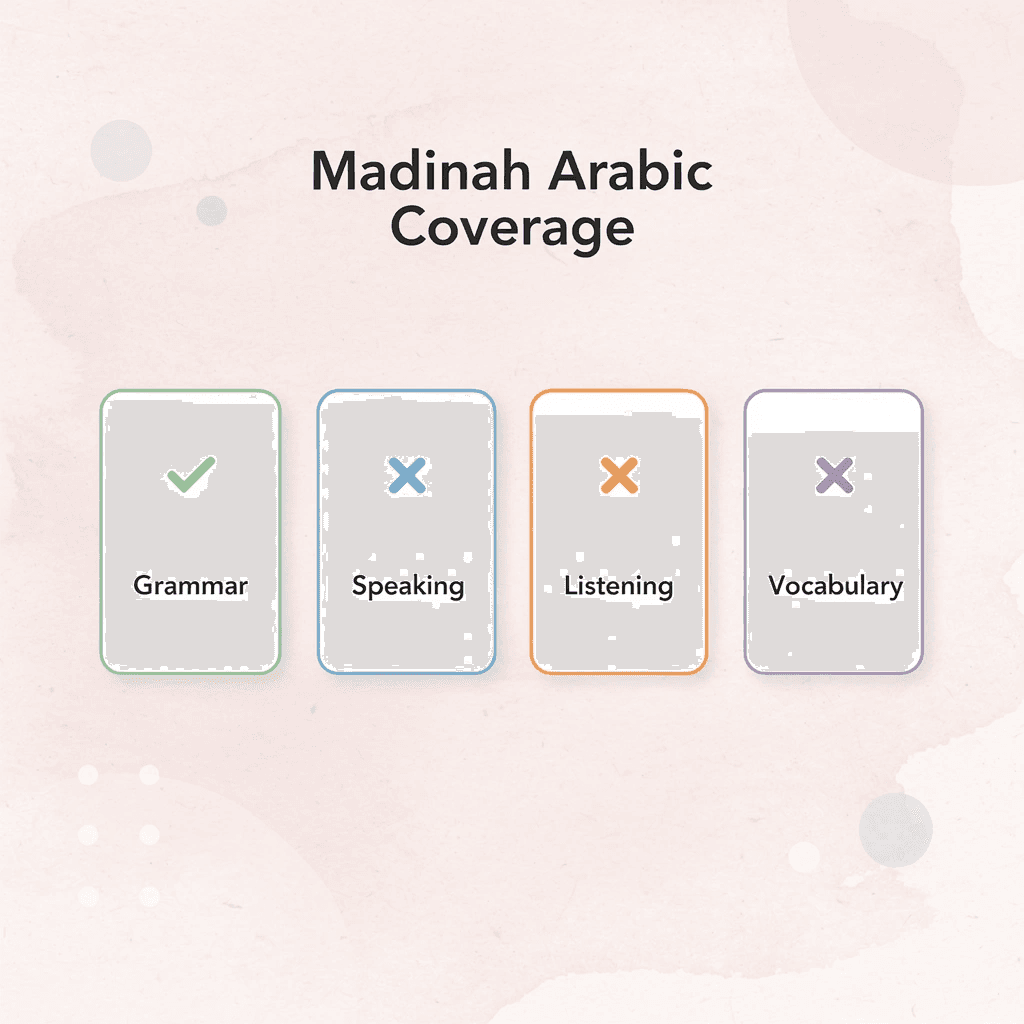
⚠️ Warning: Many students get frustrated thinking they're not good enough when the real issue is incomplete skill coverage. The Madinah books are doing their job—you just need to fill the gaps with targeted practice.
Build Grammar Into Muscle Memory Through Writing
Grammar rules feel disconnected from real life until you build your own sentences with them daily. After each lesson, write five to ten new examples using the grammar patterns you've learned, then check them against answer keys or submit them to a tutor for correction. This active building transforms passive recognition into usable knowledge: your brain sees how case endings and verb forms work in real sentences rather than memorizing tables. Within weeks, you'll understand complex structures faster because you've built them yourself.
Close Vocabulary Gaps With Contextual Repetition
Make flashcard decks for every chapter's new words and review them daily through spaced repetition apps that require active recall. Pair this with reading short tafsir excerpts, simplified hadith collections, or children's Islamic stories that use the same roots in different ways. Regular exposure across varied texts converts passive recognition into instant understanding, so you stop reaching for dictionaries while reading and flow through classical passages with confidence.
Layer Speaking Practice Onto Written Foundations
Most learners finish the three volumes able to break down sentences on paper, but are unable to speak or understand spoken classical Arabic. Listen daily to native recordings of the textbook dialogues and shadow the speaker aloud to train your tongue alongside your ear, then move to weekly language exchanges where you summarize lesson content by speaking. Our Kalam platform lets you practice Arabic with a few lessons a day, adding speaking drills and pronunciation practice onto the grammatical frameworks you're building. This approach closes the gap between understanding a rule and producing it naturally, turning solid grammar knowledge into confident spoken skills.
Create Structure and Accountability for Self-Study
The dense, classroom-focused design leaves self-learners isolated and prone to losing momentum. Create a fixed weekly schedule with dedicated time blocks for new lessons, review sessions, and progress tracking. Join online forums or study groups to ask questions and share recordings for feedback. This framework replicates the guided university environment the series was built for, maintaining discipline through accountability rather than willpower alone. Even with these strategies, ensure you're building fluency in Arabic that serves your actual goals.
Related Reading
Arabic Basics
Basic Arabic Phrases
Arabic Vs Hebrew
Arabic Vowels
Urdu Vs Arabic
Best App To Learn Arabic
Learn Arabic in Any Dialect Today with Kalam
Madinah Arabic builds grammar and reading skills for classical texts, but leaves a critical gap: you can finish all three volumes and still freeze when someone asks a simple question. The program develops analytical strength without conversational muscle memory, frustrating learners who want both religious literacy and verbal engagement with Arabic speakers.

💡 Tip: Don't let your grammar knowledge stay locked in textbooks - convert it into speaking ability through targeted practice.
Kalam closes this gap by converting passive knowledge of grammar into active speaking ability through focused practice sessions. Our platform lets you work through realistic conversational drills with clear audio models, receive meaning breakdowns showing how structures behave in real use, and repeat patterns until responses feel automatic. This approach skips unnecessary theory and builds the muscle memory that textbooks alone cannot create, compressing the distance between understanding a sentence and producing it naturally.
"The program develops analytical strength without conversational muscle memory, frustrating learners who want both religious literacy and verbal engagement with Arabic speakers."
🎯 Key Point: Grammar knowledge without speaking practice creates a frustrating gap between understanding and actual conversation.
Ready to move beyond reading and start speaking with confidence? Download Kalam today and practice a few minutes each day to transform your grammar into fluent conversation.