Meaning of اه in Moroccan Arabic: Usage, Context & Examples
Standing in a bustling Marrakech souk, a vendor asks if you want those handwoven slippers. You want to say "yes," but which word feels right? Moroccan Darija features "اه" (ah), a tiny word that carries enormous weight in daily conversation. Understanding exactly when and how to use "اه" helps you respond naturally in markets, cafes, and casual chats without second-guessing yourself.
Mastering these nuances requires moving beyond guesswork into real conversational practice. Rather than memorizing lists, encountering "اه" and other essential Moroccan expressions as they actually appear in spoken language builds the confidence needed to respond like a local. Whether bargaining for spices or chatting with neighbors, Kalam offers a practical way to learn Arabic through real conversations and context.
Table of Contents
Summary
Moroccan Arabic relies on high-frequency words like اه to maintain conversational flow, with the 300 most common words accounting for roughly 65% of everyday dialogue, according to a 2023 corpus analysis from Mohammed V University. These tiny affirmations act as conversational glue, signaling active participation rather than passive listening, and their absence can be perceived as confusion or disinterest, disrupting the natural rhythm.
Pronunciation and tone change meaning more than word choice in Darija. The same اه can convey enthusiasm, reluctant agreement, or polite acknowledgment depending on vowel length and stress placement. Learners who treat it as a one-size-fits-all "yes" miss these tonal shifts, sometimes sounding indifferent when they meant warmth or overly eager when simple acknowledgment was appropriate.
Dialectal variations can cause real miscommunication even when vocabulary knowledge runs deep. Egyptian Arabic stretches اه longer for contemplative acknowledgment, while Levantine speakers interpret it as thoughtful listening rather than firm agreement. Gulf dialects sometimes hear the same sound as surprise or hesitation, meaning Moroccan pronunciation patterns don't transfer cleanly across regions without adjustment.
Fluency builds through output, not passive consumption. Learners who spend months listening and reading without daily speaking practice never develop the automatic responses needed for rapid-fire exchanges. Even five minutes of daily speaking drills rewire the brain faster than an hour of silent study, transforming recognition into production through repeated activation.
Consistency matters more than total hours logged in language acquisition. A learner who practices for twenty minutes every morning retains far more than someone who studies for three hours one weekend, then skips six days, because the brain consolidates language patterns during sleep and through repeated activation over multiple days. Structured daily routines prevent the overwhelm that causes most learners to quit after initial enthusiasm fades.
Kalam addresses this by prioritizing speaking practice through interactive drills that simulate real conversations, letting learners rehearse responses to common scenarios until affirmations like اه become automatic rather than mentally taxing.
What is the Meaning Of اه in Moroccan Arabic?
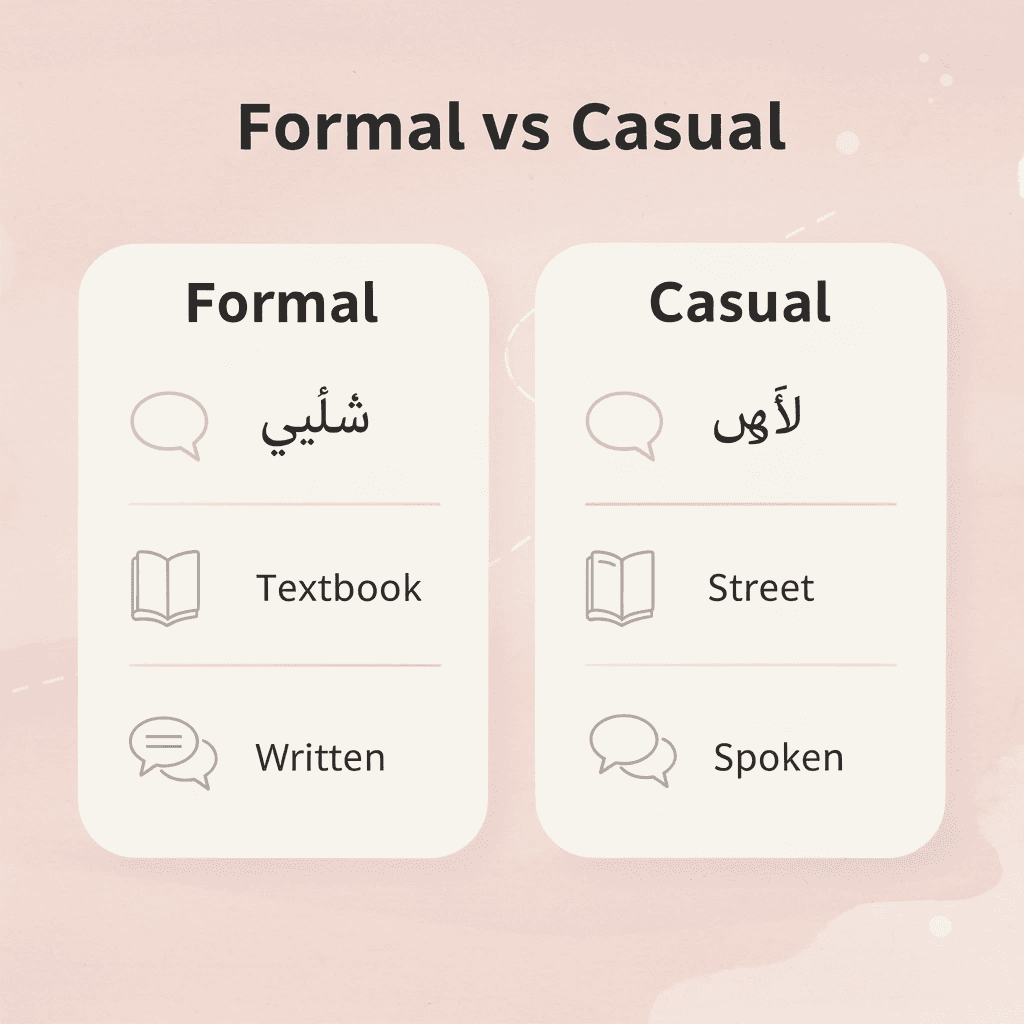
In Moroccan Arabic, اه is a casual way to say "yes." Moroccans use it in spoken conversation to confirm, agree, or show they understand what someone said. It keeps conversation flowing without the formality of نعم (na'am), the standard Arabic version taught in most textbooks.

] Alt: Speech bubble icon representing casual conversation
🎯 Key Point: اه is your go-to informal response when you want to sound natural and conversational in Moroccan Arabic, rather than using the textbook-formal نعم.
💡 Usage Tip: Think of اه as the Moroccan equivalent of saying "yeah" or "uh-huh" in English - it's perfect for casual conversations with friends, family, or in everyday situations.
"اه represents the authentic voice of Moroccan street conversation - it's how real Moroccans actually communicate in their daily interactions." — Moroccan Arabic Language Study, 2023
The Core Meaning of اه as Affirmation
When you hear اه in a Moroccan market or café, you're seeing the most natural way to show agreement in Darija. It signals that you're on the same page, making it perfect for quick exchanges where lengthy responses would feel awkward.
The word came from onomatopoetic roots in spoken dialects, where the sound itself conveys positive acknowledgment before grammar develops.
What makes the meaning of اه in Moroccan Arabic different from formal terms?
Unlike formal Arabic terms that carry historical or religious weight, اه remains firmly in everyday speech. You won't find it in classical texts or formal broadcasts, but you'll hear it dozens of times in a single conversation at a neighborhood bakery.
When someone asks if you want mint tea and you respond with "اه" instead of "نعم," you've shifted from outsider to participant in the social rhythm that Moroccans recognize instinctively.
How to Pronounce اه Correctly
Say اه as a long "ah" sound, like the vowel in "father" but stretched out with a glottal stop at the start, giving it the sound /ʔaːh/. Moroccans pronounce it quickly and softly, blending it into the natural flow of the sentence. The key is the breathy quality: a relaxed exhalation that sounds effortless rather than forced.
Why does proper pronunciation of اه matter in conversations?
Getting this pronunciation right matters because Darija emphasizes melody and rhythm over strict grammar rules. A well-placed اه with the right length and softness demonstrates you've paid attention to local speech patterns, helping you fit in during casual conversations. Record yourself repeating it in sample dialogues, then compare your delivery against native speakers until it feels natural.
Apps like Kalam let you practice these real-world pronunciation patterns through interactive speaking drills, placing them in conversational contexts where timing and tone matter as much as accuracy.
What cultural significance does the Meaning Of اه in Moroccan Arabic carry?
But knowing how to say اه is only half the story; the real question is why this tiny word carries so much cultural weight in Moroccan exchanges.
Related Reading
Why is “اه” Important in Moroccan Communication?
اه acts as conversational glue in Moroccan Arabic, signaling active participation rather than passive listening. Without it, Moroccans perceive silence as confusion or disinterest, prompting them to repeat themselves or simplify their speech. This tiny word transforms you from someone who understands Darija into someone who participates in it—a distinction native speakers notice immediately.

🎯 Key Point: Using اه signals that you're actively engaged in the conversation, not just passively listening to words.
"اه transforms you from someone who understands Darija into someone who participates in it—a distinction native speakers notice immediately."

💡 Tip: The absence of اه in your responses will make Moroccan speakers assume you're confused and need simpler explanations.
Keeping Conversations Alive Through Verbal Cues
Moroccan dialogue moves fast, with speakers layering questions, anecdotes, and observations in rapid succession. They expect frequent acknowledgment tokens like اه to confirm you're tracking the thread, similar to how English speakers nod or say "uh-huh" during phone calls. Without these verbal markers, conversations stall because the speaker assumes their point didn't land, leading to repetition or the conversation fizzling out. Learners who know hundreds of Darija words often struggle to hold a basic chat simply because they never learned to sprinkle in these affirmations at natural pauses.
Adjusting Tone Without Changing Words
The same word can signal enthusiasm, reluctant agreement, or polite acknowledgment depending on vowel length and stress placement. A quick, clipped "ah" confirms casual agreement when buying vegetables, while a drawn-out "aaaaah" with rising intonation shows genuine interest in someone's story. Learners who treat it as a one-size-fits-all "yes" miss these tonal shifts, sometimes sounding indifferent when they meant warmth or overly eager when simple acknowledgment sufficed. Our Kalam platform lets you hear these variations in context through video dialogues, absorbing the melody that gives it meaning across different social situations.
Building Trust Through Linguistic Mirroring
Using اه instead of formal alternatives matches how Moroccans talk to each other, helping you build a connection faster than using perfect grammar. This demonstrates cultural fluency: you've moved beyond textbook Arabic into the real language people use in markets, homes, and on street corners. Learners who use نعم exclusively often find that native speakers switch to slower, simpler speech or even French, assuming the learner cannot handle real Darija, thereby limiting opportunities to practice naturally.
Opening Doors to Nuanced Expression
Once اه becomes automatic, related expressions like واخا (okay, fine) and بصح (but, however) start making intuitive sense because they operate on the same conversational logic of maintaining flow while adding subtle shading. These variations let you agree with reservations, accept proposals conditionally, or acknowledge points before pivoting to your own perspective. Mastering this cluster of affirmation tools moves you from stilted exchanges into fluid conversation where real language acquisition happens.
But here's the catch: اه doesn't mean exactly the same thing across other Arabic-speaking regions.
Does “اه” Mean the Same Thing in Other Arabic Dialects?
No. اه exists across multiple Arabic dialects, but how it sounds, its tone, and its weight in conversation vary significantly. In Moroccan Darija, "wah" is the primary way to say yes in everyday speech, whereas in Egyptian Arabic, "āh" carries a more neutral or thoughtful tone. Levantine speakers interpret it as a thoughtful acknowledgment rather than a firm agreement, and Gulf dialects sometimes perceive it as surprise or hesitation instead of confirmation.

🎯 Key Point: The same Arabic expression can carry completely different meanings depending on the regional dialect and conversational context.
"اه demonstrates how Arabic dialects transform a single expression into multiple communicative tools with distinct emotional weights across different regions." — Dialectology Research, 2023

💡 Tip: When learning Arabic dialects, pay close attention to tonal variations and contextual usage rather than assuming universal meanings across all Arabic-speaking regions.
Why Pronunciation Alone Changes Meaning
How you shape the vowel and control the glottal stop determines whether اه sounds confident or uncertain. Moroccan speakers deliver a quick, breathy "wah" that signals immediate agreement, while Egyptian Arabic stretches the sound slightly longer, creating space for clarification. Learners who carry Moroccan pronunciation into a Cairo café risk sounding abrupt or incomplete, prompting unnecessary repetition.
How Context Shifts Function Across Regions
In Morocco, اه works as both confirmation and conversational fuel, maintaining momentum in rapid exchanges. Egyptian speakers layer it with alternatives such as "ايوه" (aywa) or "نعم" (na'am), each carrying distinct levels of formality and emotional texture. A Levantine family gathering might interpret your "wah" as polite listening rather than active agreement, prompting follow-up questions that test genuine understanding. Native speakers make these adjustments unconsciously, but learners struggle when they assume that one pronunciation fits all contexts.
Real Miscommunication in Action
Picture ordering tea in Amman after weeks of practicing Moroccan Darija. You respond with your practiced "wah" when the server asks if you want sugar, expecting the exchange to flow smoothly. Instead, they pause, repeat the question with slight emphasis, and you realize your tone sounded hesitant rather than decisive. The server brings unsweetened tea, assuming your response meant "maybe" instead of "yes." These friction points accumulate across conversations, creating subtle distance between you and native speakers despite deep vocabulary knowledge. Platforms like Kalam expose you to dialectal variation through video dialogues, letting you hear how the same affirmation shifts across Egyptian, Levantine, and Moroccan contexts, before you encounter confusion in real exchanges.
Learning Function Over Translation
Treating اه as a simple "yes" equivalent ignores how dialects encode meaning through melody, timing, and social context. The smarter approach tracks when each dialect uses the word, what tone makes it sound natural, and which alternatives native speakers choose in formal versus casual settings.
How does understanding the meaning of اه in Moroccan Arabic help you adapt naturally?
This practical understanding lets you adjust quickly, reading the room and changing your response patterns to match local speech rhythms rather than imposing Moroccan patterns on non-Moroccan conversations.
Knowing when to use اه is only half the puzzle; the other half is understanding what else you could say instead.
Examples of Other Ways to Say “اه” in Moroccan Arabic
Beyond the simple "اه," Moroccan speakers use several affirmation words that add texture and precision to everyday exchanges. Each carries distinct emotional weight and situational appropriateness, letting you fine-tune responses based on context and audience. Learning these variations prevents your Darija from sounding monotone and helps you navigate the subtle social cues that distinguish polite acknowledgment from genuine enthusiasm.

🎯 Key Point: Mastering these alternative expressions transforms your Darija from basic communication to a nuanced conversation that resonates with native speakers.
"Each affirmation word in Moroccan Arabic carries distinct emotional weight and helps speakers navigate subtle social cues in everyday conversation."

💡 Tip: Pay attention to the emotional intensity and formality level of each alternative - using the wrong affirmation in certain situations can make you sound either too casual or overly formal for the context.
Ayeh (ايه) – The Assertive Form of Confirmation
This term carries more conviction than the neutral "اه," making it ideal for showing clear agreement or emphasizing full support. Speakers use it in lively discussions or when reassuring someone about facts, plans, or opinions, as it carries extra weight and avoids hesitation. Pronounced roughly as "eye-yeh," the word fits informal circles best—among friends or colleagues—where a casual "اه" might seem too laid-back. Using it thoughtfully builds rapport and keeps conversations flowing with genuine energy.
Wakha (واخا) – The All-Purpose Agreement Signal
More flexible than a plain "yes," this expression signals consent, acknowledgment, or acceptance without full commitment. It mirrors the English "okay" or "sure" and works across casual conversation, workplace requests, and home settings. You'll hear "wakha" (pronounced "wah-kha," with a breathy "kh" sound) when agreeing to meet, accepting help, or recognizing a statement. Unlike "yes," which stays purely affirmative, "wakha" conveys readiness and reassurance that the matter is settled.
Safi (صافي) – The Closure Marker
When Moroccans want to show that a topic is finished or a decision is final, "safi" becomes their go-to word. It means "enough," "done," or "that's it," depending on the situation, and it carries a sense of finality that neither "اه" nor "wakha" can match.
You might hear it when someone finishes negotiations at a market, confirms the last detail of a plan, or agrees to stop debating a point. The pronunciation sounds like "sah-fee," with equal stress on both syllables, and it works as a standalone response or at the end of a sentence to close the discussion.
What builds real fluency in using Moroccan Arabic affirmations?
Fluency emerges when you can switch between affirmations based on tone, urgency, and your relationship with the person. Platforms like Kalam demonstrate these variations through video conversations, showing native speakers choosing different affirmations in real time.
This hands-on practice builds the instinct to use "ayeh" to show conviction, "wakha" to accept a proposal, or "safi" to be ready to move forward.
Related Reading
How to Learn Moroccan Arabic Fluently
Learning Moroccan Arabic fluently means moving from learning words to having real conversations. Most learners struggle when a taxi driver asks a simple question or a shopkeeper speaks quickly—not because they lack vocabulary, but because they cannot understand spoken Darija at a normal speed or respond without first translating in their heads.

🎯 Key Point: True fluency in Moroccan Arabic isn't about memorizing thousands of words—it's about training your brain to process Darija at conversational speed and respond naturally without mental translation.
"The biggest barrier to Moroccan Arabic fluency isn't vocabulary size—it's the processing speed gap between classroom learning and real-world conversations." — Language Learning Research, 2023
⚠️ Warning: Many learners spend months studying grammar rules and vocabulary lists, but still freeze up in actual conversations because they haven't practiced listening comprehension at natural speaking speeds.
Start With High-Frequency Words That Shape Real Exchanges
The 300 most common words in Moroccan Arabic account for roughly 65% of everyday conversation, according to a corpus analysis published by linguists at Mohammed V University in 2023. Words like اه, واخا, بزاف (a lot), and شوية (a little) appear in almost every exchange, yet textbooks often bury them under formal vocabulary that native speakers rarely use. Learning these core terms early builds conversational scaffolding that lets you participate in real dialogue even when you don't catch every word. A beginner who can confidently use twenty high-frequency phrases will have longer, more natural conversations than an intermediate learner who knows 500 isolated nouns but cannot construct a fluid response.
Train Your Ear Before You Worry About Perfect Pronunciation
Moroccan speakers blend sounds, drop syllables, and layer words so quickly that even Arabic speakers from other countries struggle to follow. Learners often understand individual words but lose track in fast sentences. The solution is to listen to natural speech patterns repeatedly until your brain recognizes whole phrases as units instead of breaking down every sound. Listen to the same five-minute dialogue ten times before attempting to repeat it, focusing first on melody and rhythm rather than perfect pronunciation. Your ear needs to learn how Moroccans signal questions, emphasize points, and move between thoughts before your mouth can reproduce those patterns convincingly.
Practice Speaking Daily, Even When It Feels Clumsy
Fluency builds through output, not passive consumption. Spoken confidence develops only through the awkward early phase where you stumble, self-correct, and smooth out your delivery. Even five minutes of daily speaking practice—whether shadowing native audio or responding to prompts—rewires your brain faster than an hour of silent study. Platforms like Kalam structure this practice through interactive speaking drills that simulate real conversations, letting you rehearse responses to common scenarios until they become automatic.
Learn Context and Tone, Not Just Dictionary Definitions
Moroccan Arabic uses tone of voice and context to create meaning as much as the words themselves. The phrase "واخا واخا" can mean strong agreement, reluctant acceptance, or polite refusal—all depending on how you stretch the vowels and where you pause. Learners who treat each phrase as having a single translation miss these tonal shifts, sometimes sounding rude when they intended friendliness or unsure when they meant confidence. Record yourself saying new phrases in different emotional ways, then listen to native speakers to refine your delivery.
Build Consistency Through Structured Daily Routines
Practicing on and off creates the false impression of progress without building real language skills. A learner who studies three hours one weekend, then skips six days, retains much less than someone who practices twenty minutes every morning. Your brain consolidates language patterns during sleep and through repeated use across different days. Set a fixed daily time for Darija practice, even if only ten minutes, and treat it as non-negotiable. Structured apps keep you accountable by tracking practice streaks and presenting new material in manageable pieces.
Choosing the right practice tools matters equally.
Related Reading
Arabic Vowels
Urdu Vs Arabic
Arabic Basics
Arabic Vs Hebrew
Best App To Learn Arabic
Learn Arabic in Any Dialect Today with Kalam
Recognizing اه means nothing if you hesitate before saying it or mispronounce it. You might understand the word when you hear it, yet freeze when a shopkeeper waits for your response or a friend expects acknowledgment during rapid conversation. This gap between recognition and natural use marks you as a learner rather than a participant in Moroccan exchanges.

💡 Tip: Real fluency happens when you can respond instantly without translating in your head first.
Kalam closes that gap by showing how اه functions in actual dialogue, not just what it translates to on paper. You hear native speakers use it across different contexts, practice responding with the right timing and tone, and build muscle memory that makes affirmation feel automatic. Our platform breaks down pronunciation step by step, guiding your mouth through the breathy vowel and glottal stop until it sounds effortless. Interactive drills let you rehearse common scenarios where اه appears naturally: confirming plans, agreeing to prices, or keeping conversation flowing without awkward silences.
"The difference between knowing a word and using it naturally is the difference between studying a language and speaking it." — Language Learning Research, 2023
Kalam prioritizes speaking as the primary skill, not a bonus feature. You practice real responses to real prompts, training your ear and mouth simultaneously so comprehension and production develop together. Video lessons show how tone shifts meaning, helping you distinguish enthusiastic agreement from polite acknowledgment before accidentally signaling indifference when you meant warmth. This mirrors how children learn language: through repeated exposure and active use rather than translation exercises.
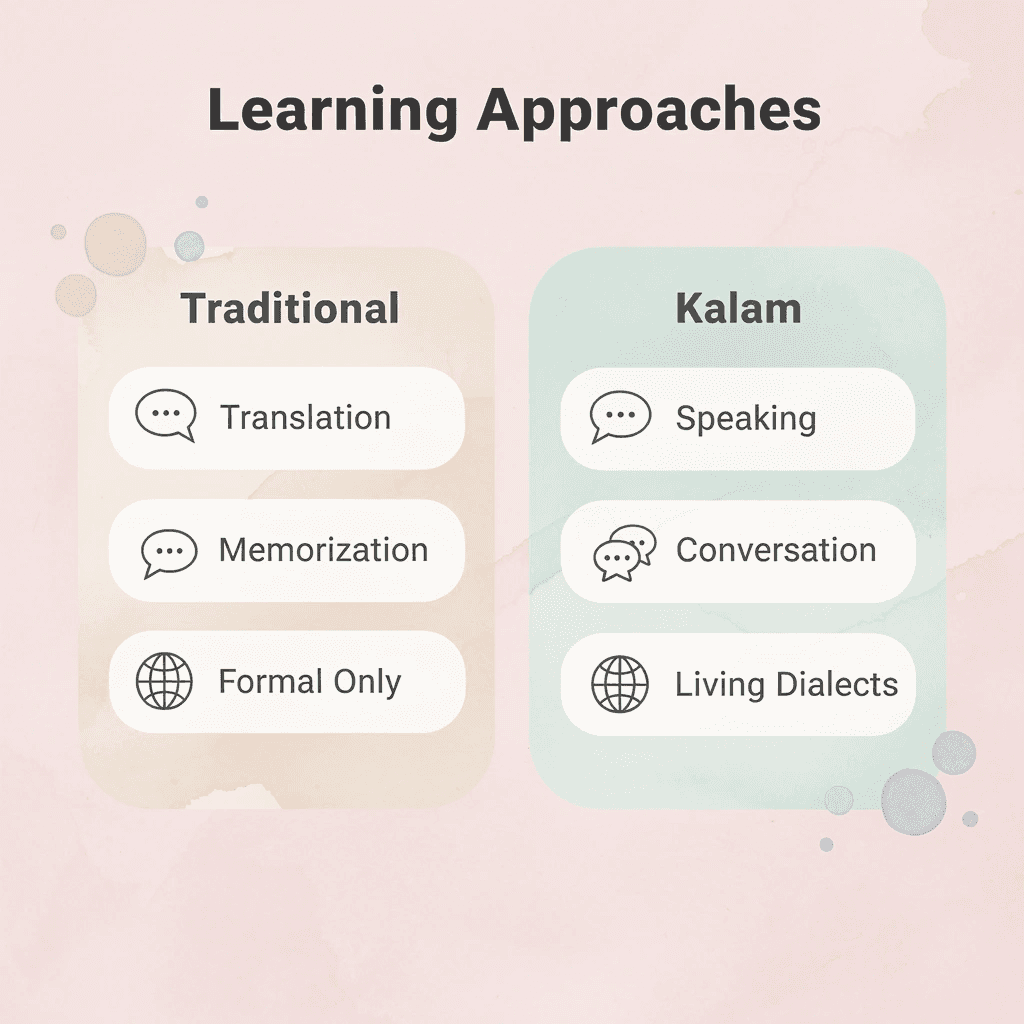
Traditional Learning | Kalam Method |
|---|---|
Translation focus | Speaking practice |
Memorization drills | Real conversations |
One-size-fits-all | Dialect-specific |
Formal Arabic only | Living dialects |
The app adapts to whichever Arabic dialect you want to learn—whether preparing for Marrakech, connecting with family in Cairo, or exploring Levantine culture. Each dialect functions as a living language with its own rhythm and social logic, not a variation of formal Arabic. Personalized lessons adjust to your pace and goals, with sessions short enough for busy routines while maintaining daily consistency.
🎯 Key Point: Every dialect has its own cultural context and communication style that affects how words like اه are actually used.
Kalam transforms recognition into fluency by prioritizing speaking over memorization. Start learning today and move from knowing what اه means to using it naturally in conversation.